Vol 10, No 2 (2026)
https://doi.org/10.7577/njcie.6393
Article
Investigating Transferable Skills in Early Childhood Education and Care PhD Programs in Norway and Greece
Zacharias Andreadakis
Western Norway University of Applied Sciences
Email: Zacharias.Andreadakis@hvl.no
Glykeria Fragkiadaki
Aristotle University of Thessaloniki
Email: fragkiadaki@nured.auth.gr
Athanasios Gregoriadis
Aristotle University of Thessaloniki
Email: asis@nured.auth.gr
Elin Eriksen Ødegaard
Western Norway University of Applied Sciences
Email: Elin.Eriksen.Odegaard@hvl.no
Abstract
The article investigates how transferable skills are defined, supported, and evidenced in Early Childhood Education and Care (ECEC) doctoral training in Norway and Greece. Addressing a documented gap—fragmented definitions and weak operationalisation across Europe—it combines semi-structured interviews with doctoral researchers (n=20) and a document scan of institutional websites and course catalogues (n=70). The review assessed visibility, framing, and assessment of transferable-skills provision; interviews traced candidates’ reported development through supervision, collaboration, and day-to-day research practice. Results show shared formal recognition but divergent implementation. In Norway—via research-school infrastructures, competency frameworks, and structured ties to employment—transferable skills are purposefully integrated and periodically monitored. In Greece, references appear largely rhetorical: limited coursework, few institutional mechanisms, and minimal cross-sector engagement. Across both settings, candidates depict skill acquisition as tacit and emergent rather than explicitly taught. The analysis identifies a persistent policy–practice delta. Governance capacity and institutional culture condition what becomes visible as “skill” and where responsibility for its development is located. The study contributes comparative, evidence-based guidance on aligning doctoral curricula and supervisory practice with labour-market expectations, clarifying where targeted coursework, assessment, and partnership structures are most likely to close the implementation gap.
Keywords: Transferable Skills in Doctoral Education, Early Childhood Education and Care (ECEC), PhD Training, PhD Employability and Knowledge Economy, Transversal Skills
Introduction
Transferable skills—often construed under disparate but exactly synonymous labels such as transversal skills, generic competencies, or core capacities—form a large and loosely connected family of ideas within education and labour policy (Clarke, 2018; Eurodoc Doctoral Training Working Group, 2018; European Commission, 2020; European Science Foundation, 2009; Hillage & Pollard, 1998; Knight & Yorke, 2002; Pool & Sewell, 2007; Roy et al., 2025; Rychen & Salganik, 2003; Römgens et al., 2020). What unites these frameworks is the assumption that certain abilities travel well. They can move between disciplines and occupations, helping people combine knowledge, communicate with clarity, work productively with others, and exercise ethical and critical judgment in situations that rarely stay stable (Dāvidsone et al., 2021; Heckman & Kautz, 2012). Unlike domain-specific expertise, such capacities reach across the cognitive, interpersonal, and intrapersonal. They sustain adaptability, reflective learning, and creative thought throughout a career. In higher education—and most clearly in doctoral formation—these skills are less a syllabus item than a by-product of lived academic practice. They grow through supervision, teaching, collaboration, and the everyday uncertainties of research itself. In this way, transferable skills serve as the link between disciplinary mastery and social contribution, defining the figure of the versatile, future-ready researcher.
Within this conceptual frame, transferable skills in education—and particularly in Early Childhood Education and Care (ECEC)—extend beyond individual competence to the capacity of systems to remain resilient and socially responsive. In ECEC, where pedagogy and professional learning bear directly on collective welfare and long-term sustainability, deliberate cultivation of these skills is essential (Agrawal et al., 2022; Hancock, 2023; Leon, 2023; Muurlink et al., 2023; OECD, 2023; Rasmussen & Andreasen, 2023; Teelken et al., 2023). Amid the green transition, Industry 5.0, and AI-driven change, such capacities anchor decision-making under uncertainty and connect ethical judgment with technological and social innovation. They are not merely instruments of employability but foundations for adaptive, reflective, and responsible professional life. The idea also runs through research on graduate attributes and employability, which identifies adaptability, critical judgement, and collaboration as core outcomes of higher learning (Barrie, 2007; Clarke, 2018; Knight & Yorke, 2002; Pool & Sewell, 2007). Competence models present these as abilities that travel—skills linking what one knows to effective action under changing conditions (European Commission, 2020; Rychen & Salganik, 2003). Synthesis studies extend the point, showing how such capacities sustain learning and mobility as technologies and labour markets evolve (Heckman & Kautz, 2012; OECD, 2023; Römgens et al., 2020). Together, these strands indicate that transferable skills underpin the adaptability and shared problem-solving modern education demands.
In ECEC doctoral education, transferable competencies link theory to public life, enabling movement across classrooms, communities, and policy arenas (Eurodoc, 2018; European Commission, 2011a; 2011b; Roy et al., 2025). Yet the evidence base is thin. Doctoral education has broadened in response to shifting career trajectories (Haug & Tauch, 2002; Nerad & Evans, 2014), but ECEC programmes seldom make these skills explicit or examine how they are formed. Most available studies are national policy reviews (Kehm, 2020; Minea, 2023; Santos, 2021) or sector-wide analyses (OECD, 2023; UNICEF, 2019). Comparative analyses that test competencies against shared reference points—such as the Eurodoc taxonomy (2018)—seem entirely absent in ECEC.
This study tackles that research gap through close analysis of two real-world higher education settings. Using the Eurodoc framework, it examines how transferable skills are framed, taught, and understood in ECEC doctoral programmes in Norway and Greece. The evidence integrates programme documentation, candidate perspectives, and international directives cited above. In doing so, it connects national policy with lived academic experience, identifying where intention meets practice. Its contribution lies in tracing how these systems cultivate the competencies that increasingly define doctoral education’s purpose and value (Clarke, 2018; Knight & Yorke, 2002; Pool & Sewell, 2007; Roy et al., 2025).
Conceptual Framework
This study positions transferable skills as a foundational construct for doctoral education. Transferable skills, used as exact synonymous as the kin concepts of transversal skills or generic skills, describe competencies learned in one context and usefully applied in another, serving as a bridge between research training and diverse professional futures (European Commission, 2020; European Science Foundation, 2009; Roy et al., 2025). These are understood as behaviours that can be enacted across a wide range of functions and activities (Dāvidsone et al., 2021), not tied to a particular job, discipline, or task, but applicable in varied situations and work settings. As Roy and colleagues (2025) clarify, transversal skills are skills for doctorates which have multiple domains of application—and thus multiple domains of value. Historically, transferable skills are variously labeled: basic skills (Rosenberg et al., 2012), generic skills or competencies (Nägele & Stalder, 2017), generic attributes (Jones, 2013), cross-cutting capabilities (Lansing-Stoeffler & Daley, 2022), core competencies (Suciu et al., 2023), employability skills (Holmes, 2013; Tight, 2023; Tuononen et al., 2023), key competencies (Rychen & Salganik, 2003), transversal skills (European Commission, 2011a; 2011b; Sá & Serpa, 2018), or life skills (Cidlinska et al., 2023). These labels encompass a range of core proficiencies applicable across contexts and occupations (Nägele & Stalder, 2017), with such skills being widely recognised as enabling adaptability, employability, and lifelong learning in dynamic societal conditions (European Commission, 2020; Heckman & Kautz, 2012; Römgens et al., 2020).
The need to conceptualise transferable skills emerged gradually. Earlier apprenticeship models presumed broader competence would arise naturally through scholarly inquiry (Kehm, 2020). However, as doctoral graduates increasingly pursued employment outside academia (Nerad & Evans, 2014), concerns surfaced: PhD holders often exhibited deep expertise but also overspecialisation and limited readiness for interdisciplinary settings (Cui & Harshman, 2020; Cusack et al., 2021). Doctoral education has thus evolved to position researchers for broader roles within knowledge economies and public life (Bologna Process, 2005; European Commission, 2020; Haug & Tauch, 2002). This expansion elevated discourse on transferable skills, though the concept remains theoretically fragmented (Roy et al., 2025). Different perspectives generate persistent tensions: the human capital view instrumentalises skills as drivers of labour-market competitiveness (Clarke, 2018); a generic-attributes perspective treats them as foundations of citizenship and lifelong learning (Nägele & Stalder, 2017; Rychen & Salganik, 2003), and a capabilities orientation highlights how individuals mobilise competencies in context, shaping agency and identity (Knight & Yorke, 2002; Pool & Sewell, 2007). These lenses produce ongoing debates around standardised versus contextual development, individual versus institutional responsibility, and doctoral identity anchored in academia versus broader societal engagement (Acker & Haque, 2017; Römgens et al., 2020). To ensure analytic focus, this study adopts the Eurodoc transferable skills taxonomy (Eurodoc, 2018), consolidating nine domains essential for researchers: career development, cognitive skills, communication, digital literacy, enterprise/innovation, interpersonal and collaborative capability, mobility, research practice, and teaching/supervision. The taxonomy supports cross-national comparison, aligns with the ESCO competence architecture (European Commission, 2020), and reflects doctoral-reform priorities on collaboration, innovation, and societal value (Minea, 2023; Santos, 2021). This framework holds particular resonance for ECEC, a discipline inherently intersectoral and relational, operating at the convergence of education, social welfare, and policy. Unlike laboratory-based sciences, ECEC inquiry is embedded in the 'quintuple helix' of families, practitioners, policymakers, researchers, and civil society (Galvao et al., 2019). Consequently, domains such as 'Interpersonal and Collaborative Capability' constitute core operational mechanics of ECEC praxis rather than supplementary soft skills. Yet programmes differ in how explicitly they support such development (Gregoriadis et al., 2016)—a mismatch providing the study's empirical motivation.
This approach structures analysis around four dimensions: what is studied (nine Eurodoc domains, excluding discipline-specific expertise); how skills are understood (relational, practice-based—formed through doctoral work rather than existing as fixed traits); where they develop (supervision, teamwork, communication, teaching, intersectoral mobility); and why they matter (helping ECEC doctoral graduates navigate complex careers and contribute to innovation). This framework enables consistent coding, linking clear definitions to observable structures.
Figure 1. The Eurodoc Framework (adapted from the Eurodoc Skill Report 2018)
![A circular diagram showing nine transferable skill domains for doctoral researchers arranged around a central hub. These domains are: Career Development & Management, Cognitive Abilities, Communication & Dissemination Skills, Digital & Data Management Capacities, Enterprise & Innovation Skills, Interpersonal & Collaborative Capabilities, Mobility (International & Intersectoral), Research Ethics & Integrity, and Teaching & Supervision Skills.]Et bilde som inneholder tekst, skjermbilde, dokument, design](https://journals.oslomet.no/nordiccie/article/download/6393/version/6506/5411/37300/image001.png)
Rationale for This Study: National Contexts and Frameworks for Skills
Norway and Greece were purposefully selected because they represent markedly different educational ecosystems for the translation of transferable-skills agendas into doctoral education—especially within ECEC.
Norway's ECEC system is unified under the Ministry of Education and Research, ensuring a holistic approach through the Framework Plan for Kindergartens (Norwegian Directorate for Education and Training, 2017; Størksen et al., 2025). Transversal competences such as collaboration, empathy, and analytical reflection are built into cross-sectoral strategies for education, innovation, and sustainability (Meld. St. 14 (2022-2023); OECD, 2019; 2023). This reflects a Nordic tradition treating learning as a collective societal commitment, manifesting through strong professional cultures, transparent governance, and pedagogical continuity linking practice, research, and policy.
Greece presents a different configuration. Its ECEC system is split between kindergartens and childcare centres, governed by different ministries and lacking a cohesive national curriculum for children under four (European Commission, 2023; Gregoriadis et al., 2016; Vasilopoulos & Giotakou 2022). While Greece has formally adopted the NQF and HQF, implementation remains uneven due to institutional fragmentation (European Commission, 2023). Policy ambition often exceeds institutional bandwidth, constrained by chronic underinvestment and overlapping administrative layers. Innovative practices emerge locally rather than through unified governance, and reform becomes a slow negotiation between inherited academic traditions and external pressures for European alignment. Together, the two cases reveal how coherence and constraint shape doctoral ecosystems in opposite ways. Norway demonstrates a setting where governance capacity, resourcing, and pedagogical vision reinforce one another. Greece exposes how reform, mediated by institutional fragility, requires improvisation and context-specific adaptation. Embedding transferable skills depends less on policy instruments and more on the epistemic cultures that determine how such policies are lived. Doctoral education becomes a mirror of national priorities—balancing social-pedagogical values against the imperatives of employability, innovation, and sustainability (Römgens et al., 2020).
This analysis is guided by one key research question and a related sub-question:
Q1: What is the level of awareness and support for transferable skills in the doctoral training of ECEC PhD programs in Norway and Greece?
SQ1: What are the current needs, challenges, and prospects of PhD candidates regarding the development of transferable skills in ECEC?
Literature Review: The State of Transferable Skills in Doctoral Education
Transferable skills have shifted from a minor policy tag to a core idea shaping the purpose of doctoral education. Initially, the term covered broad, cross-context abilities that let graduates move across sectors and adapt to changing work (Rychen & Salganik, 2003). Early frameworks—Employability: Developing a Framework for Policy Analysis (Hillage & Pollard, 1998) and the Bologna/Salzburg declarations (Bologna Process, 2005; Haug & Tauch, 2002)—recast the PhD as preparation for varied careers, not only academia. Subsequent guidance—Research Careers in Europe (European Science Foundation, 2009) and the European Commission’s Principles for Innovative Doctoral Training (2011a)—made this operational, embedding communication, project management, leadership, ethics, and entrepreneurship in doctoral training. The shift tracked the rise of the “knowledge economy,” emphasising competencies that connect scientific inquiry with societal application (European Commission, 2020; Heckman & Kautz, 2012).
The debate then matured. Barrie (2007) and Jones (2013) argued these abilities express disciplinary learning rather than sit outside it. Clarke (2018) and Pool and Sewell (2007) linked them to employability and career self-management—reflection, adaptability, judgement. Yet an implementation gap persists: universities endorse transferable skills but struggle to define, teach, and assess them consistently (Green et al., 2009). Attempts to stabilise the language—ESCO (European Commission, 2020) and OECD’s Skills Outlook 2023—define “transversal knowledge, skills, and competences” as capacities for operating in complex, evolving environments (OECD, 2023). Across doctoral education, the Eurodoc (2018) taxonomy discussed above offers the most systematic framework (see Figure 1). Its nine categories underpin a European consensus that transferable skills are fundamental to modern research careers. Ashonibare (2022) explored how this framework is applied across European universities, finding uneven implementation and a tendency to treat skills training as secondary to disciplinary work. Building on this, Roy and colleagues (2025) proposed the HIRES-PhD model, linking transversal-skill development directly to doctoral employability and to policies promoting open science and innovation.
Empirical findings reveal a consistent gap between what doctoral programmes teach and what employers expect. PhD candidates rank research and analytical abilities highest, while employers prioritise teamwork, communication, leadership, and project management (Rodrigues et al., 2018). Doctoral training often fails to align with regional labour-market needs (Germain-Alamartine & Moghadam-Saman, 2020), and professional networks, rather than formal curricula, shape how graduates translate research into employment (Germain-Alamartine et al., 2021). Calls for staged doctoral models combining structured coursework, personalised assessment, and modular learning persist (Ashonibare, 2022; Cusack et al., 2021), yet transferable skills remain unevenly embedded, influenced more by disciplinary norms and supervisory practices than by institutional frameworks (Kehm, 2020). Within education—and particularly ECEC—the evidence base is thinner but conceptually aligned. ECEC research consistently highlights communication, collaboration, reflection, and leadership as markers of professional competence (Nutbrown, 2021; Urban et al., 2012). Workforce studies show that these relational and cognitive capacities are essential for quality improvement and organisational learning (Gregoriadis et al., 2016). Mikuska and colleagues (2023) describe such skills as foundational to “graduate-practitioner competences” for ECEC practitioners, while Lumsden and Musgrave (2023) emphasise reflective and interpersonal attributes as defining early-years professionalism. Yet doctoral-level research on transferable skills in ECEC is virtually absent. Existing ECEC doctoral studies and graduate students (Macy & Steed, 2023) focus on professional identity and praxis through close mentorship, not transferable skills integration.
Thus, the transferable skills literature in higher education presents a clear paradox: decades of policy consensus and conceptual refinement coexist with limited empirical evidence—especially outside STEM disciplines—on how these skills are taught, institutionalised, and perceived by doctoral candidates. Ashonibare (2022) calls this a “fragmented implementation ecology,” where frameworks abound but evaluation mechanisms remain weak. Roy and colleagues (2025) similarly note that doctoral employability depends less on possessing skills than on how institutions translate them into visible, valued competencies. In education and ECEC, where doctoral graduates often move between academia, policy, and professional practice, this translation gap is particularly stark.
Research Design
Method
To map the formal presence (or absence) of transferable-skills components across national ECEC-related higher education programmes, a structured review of official institutional websites was conducted. In total, 29 Norwegian and 41 Greek programme or course pages were systematically screened, covering Bachelor, Master, and PhD levels. Each page was reviewed for explicit learning outcomes, competence statements, and course descriptions referring to transversal or transferable skills. Relevant items were logged with institution, study level, URL, and date of access. Norwegian websites were accessed on 11 December 2023, and Greek websites on 22–23 November 2023. The specific programmes and catalogues examined for each national context are detailed in Figure 2 below.
Figure 2. Overview of Institutional Data Sources Reviewed in Norway and Greece
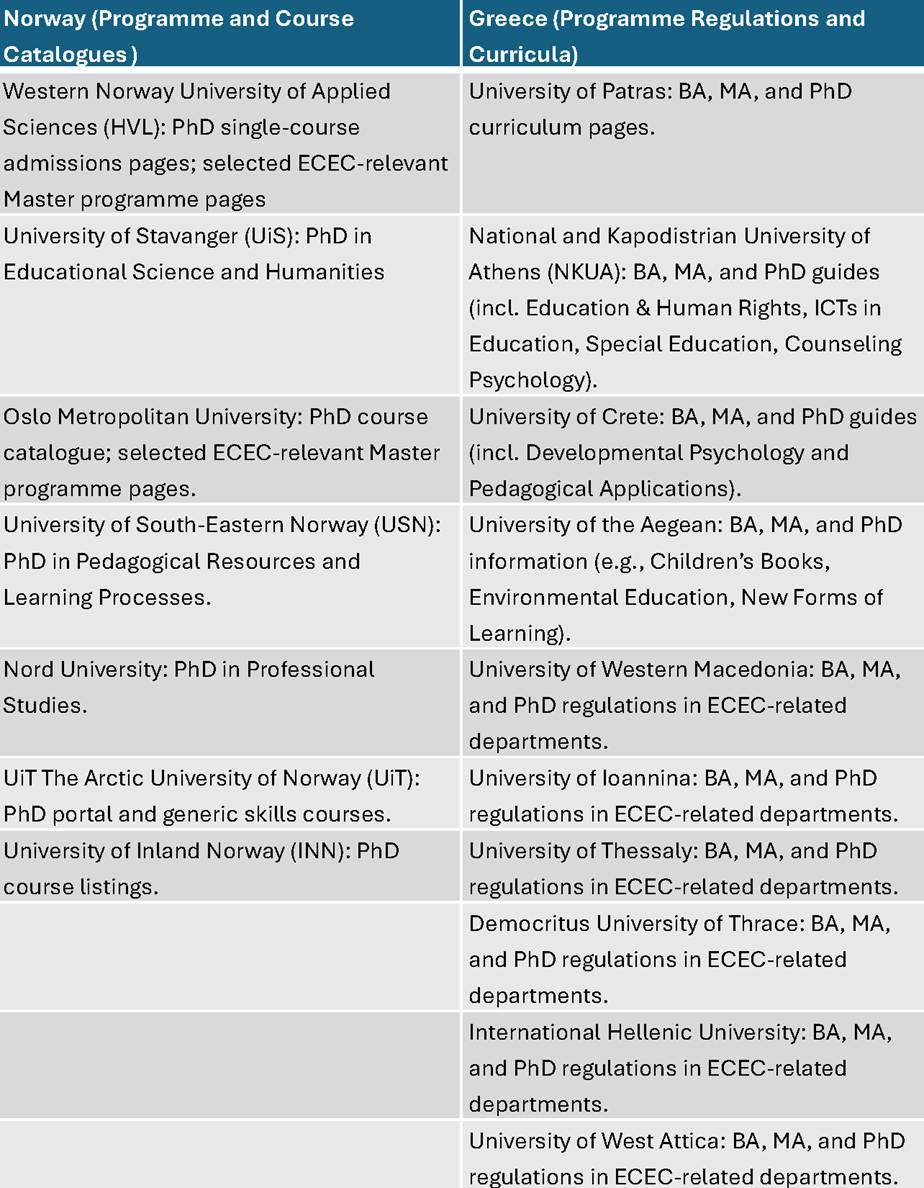
Search logic and extraction. A controlled vocabulary guided the search within each site and programme document (transferable skills, transversal skills, key competences, generic competences, employability skills, cross-cutting capabilities). Extracted data included: (a) explicit mentions of transferable/transversal competences, (b) course-level learning outcomes aligned with these competences, and (c) programme-level statements relating to research, communication, ethics, leadership, collaboration, or innovation. Absence of any such reference was recorded as no result to ensure traceability.
Participants
The study involved 20 doctoral researchers—10 from Norway and 10 from Greece—representing individuals either in the final stage of their PhD trajectory or who had completed their degree within the previous two years. This inclusion criterion was deliberate. The study examined how transferable skills are developed, recognised, and applied both during the doctoral process and immediately after its completion. Recent graduates were therefore included to provide retrospective insights into how such competences translate into early post-doctoral and professional experiences. This combination of near-completion candidates and early graduates allowed the analysis to capture both lived and reflected perspectives on skill formation and use.
Participants were drawn from six Norwegian institutions and from two National and Kapodistrian University of Athens and Aristotle University of Thessaloniki, both offering ECEC-related doctoral programs. Recruitment followed a purposeful sampling strategy (Patton, 2015), selected for institutional relevance, disciplinary alignment, and proximity within existing research networks, which facilitated access and trust in cross-national settings. Purposeful sampling was considered appropriate given the exploratory nature of the inquiry and the emphasis on information-rich cases rather than representativeness.
The sample size of twenty participants was sufficient to ensure data saturation and analytical depth. Consistent with the principle of information power (Malterud et al., 2016), sample adequacy was determined by the study's narrow focus, participants' expertise specificity, and high-quality interview data. Saturation was achieved when no new conceptual categories emerged during iterative coding. This participant diversity, across institutional contexts and national systems, was judged methodologically robust for qualitative comparative analysis.
Data Collection and Ethics
Semi-structured interviews were conducted via MS Teams (Norway) or Zoom (Greece), lasting 30–60 minutes each. This format balanced consistency with openness, allowing participants to expand on individual experiences while maintaining a shared thematic structure across cases (Kallio et al., 2016). The interview guide focused on how transferable skills were cultivated, recognised, and applied during and after the doctoral trajectory, covering initial exposure, institutional emphasis, personal learning journeys, and long-term application. Questions captured nuanced reflections on how institutional environments shaped learning, the impact of training methods, and strategies for skill retention post-PhD. Follow-up prompts—including 'Memorable Moments' and 'Success Stories'—elicited concrete examples and institutional reflections, supporting analytical depth and cross-national comparability.
Ethical approval was obtained from the Norwegian Agency for Shared Services in Education and Research (SIKT; reference 384379) and the Faculty of Education and Pedagogy, Aristotle University of Thessaloniki. Participants' anonymity was protected throughout. In the absence of a formal pilot study, the interview protocol underwent rigorous expert review by senior researchers, with primary questions condensed for clarity and follow-up probes expanded for analytical depth (Kallio et al., 2016).
Data Analysis Plan
Interview data were professionally transcribed and verified for accuracy. Using Braun and Clarke’s (2019; 2020) thematic analysis, the research team developed codes and grouped them into broader themes and analyzed the findings manually. The inductive thematic analysis crystallised four primary themes: (1) Limited Initial Exposure, which highlights the pervasive lack of formal introduction or conceptual clarity regarding these skills at the onset of doctoral training; (2) Personal and Professional Impact, which captures candidates’ retrospective valuation of these competencies in both academic and non-academic spheres; (3) Challenges in Teaching and Retention, identifying specific pedagogical gaps and the difficulty of maintaining skills without applied reinforcement; and (4) The Collaborative Nature of Skill Development, which reframes skill acquisition as a socially situated process driven by teamwork and networking rather than solitary study. This inductive approach allowed themes to emerge naturally from the data, highlighting key experiences in skills awareness, integration, and retention. Recurring patterns and specific insights were systematically categorised to identify areas of significance, such as challenges in skill cultivation and the collaborative nature of skill development.
Survey Findings
Using web scraping techniques, this section outlines key findings from an online survey of doctoral-level courses offered by Norway’s major universities in ECEC-related fields. A total of 87 PhD courses across eight institutions were examined to assess their alignment with transferable skills development. Many of these explicitly mentioned competencies such as collaboration, innovation, problem-solving, and interdisciplinary engagement. The reviewed institutions—see Figure 2 above - a coordinated national effort to strengthen ECEC doctoral education.
From this dataset, seven courses clearly met the criteria for interdisciplinary, targeted promotion of transferable skills. At Nord University, the course PRO9019 Professional Development and Innovation emphasises professional development and innovation, while PRO9017 Secondary Analysis provides training in systematic and scoping review methodologies. At UiT, GEN-8001 Take Control of Your PhD Journey focuses on academic norms, open-access publishing, and research data management; BED-8004 Academic Entrepreneurship encourages entrepreneurial thinking and innovation. INN’s BUK4009 Practice-Based Research and Development Work combines interdisciplinary theoretical frameworks with practice-based research focused on children’s development and participation. OsloMet’s Presenting Arts-Based Research integrates arts-based and multidisciplinary approaches to educational sciences, illustrating their relevance for teacher education and broader educational inquiry.
In Greece, the review encompassed twelve doctoral programmes in Early Childhood Education and Care (ECEC)—nine focused on Early Childhood Education (ages 4–6, kindergarten) and three on Early Childhood Care (ages 2–4, childcare settings)—across eleven universities: the National and Kapodistrian University of Athens, University of Patras, Aristotle University of Thessaloniki, University of Crete, University of the Aegean, University of Ioannina, University of Thessaly, University of Western Macedonia, Democritus University of Thrace, University of West Attica, and the International Hellenic University. Using a defined set of keywords—transferable skills, transversal skills, generic competences, key competences, and employability skills—the analysis systematically reviewed publicly available study regulations, programme descriptions, and course outlines to identify explicit provisions for transferable-skill development.
The conclusion that most Greek doctoral programmes are unstructured and lack formal coursework was based on consistent empirical evidence from this document analysis. Across all twelve programmes, study regulations specify an individualised research-based structure centred on dissertation work and supervision, with little or no mention of mandatory taught modules, credit-bearing training, or doctoral seminars focused on skill development. In several cases, the official programme documents explicitly state that the doctoral degree is awarded solely based on the dissertation and its defence, aligning with broader analyses of Greek doctoral education, which describe its limited formalisation compared with Northern European models (European Commission, 2023).
In Norway, the same keyword strategy was applied to doctoral and master’s programmes across the seven included institutions. Searches were performed in both English and Norwegian, using equivalent terms such as ‘tverrfaglige ferdigheter’, ‘generiske ferdigheter’, ‘nøkkelkompetanser’, and ‘overførbare ferdigheter’. Course catalogues, programme frameworks, and study plans were examined to identify whether transferable skills were explicitly embedded in learning outcomes or doctoral training components, by probing with and identifying the aforementioned defined set of keyword searches and analysing their thematic context.
Interview Findings
Limited Initial Exposure to Transferable Skills
• Sub-themes: a) Skills Awareness, and b) Institutional Emphasis
A common theme across interviews was the limited or non-existent initial exposure to transferable skills, especially when it came to building skills awareness. In several cases, participants appeared to have a vague or limited understanding of the term “transferable skills.” For example, one participant (GR6) noted:
I was not aware of the term transferable skills. At first my thought went to skills that we learn as PhD students and then we transmit them in our academic work. For example, I teach as an assistant professor now in my university and I can transfer my academic skills to my students. But I am not sure if the term includes the soft skills as well. Or perhaps it does and it also includes the hard skills as well.
Participants consistently reported that the term “transferable skills” was rarely used explicitly in their programs and that related learning was largely implicit. As one participant noted, “Well, I don’t specifically hear the term transferable skill. But there are some skills courses that are offered by the university… there’s not much on like, oh, these are the transferable skills that you’re going to learn” (Participant NOR1). This view was echoed: “It was a lot about relationships and building very good relationships, but there wasn’t really a course on transferable skills” (Participant NOR2). Others described development as primarily self-directed: “I never hear about it as a concept. Transferable skills, no. I just think… the skills have been there but not visible” (Participant NOR3). Several indicated that the concept was first encountered through cross-institutional activities: “The first time I met this concept was at the first NORBARN seminar… I don’t remember anywhere else where it’s been the focus like this” (Participant NOR4); similarly, “There’s… discussion about how we are supposed to write… but it was first in NORBARN that the concept of transferable skills was mentioned” (Participant NOR5). Overall, participants perceived that awareness of such skills emerged informally through relationships, collaboration, and writing practices rather than through designated coursework, with explicit terminology appearing mainly in national or networked research-school contexts.
In some cases, participants reported a complete lack of institutional support. For example, GR1 stated:
I don’t think my university provided any support related to transferable skills… We had an annual colloquium where we presented our progress in our PhD, but it offered little to us since it was just a typical presentation. No workshops, no courses were available for PhD students. Overall, I don’t think I got any support from my university.
Another participant (NOR3) highlighted the implications of this gap:
For the PhD programs, at least the one that I’ve been to, it wasn’t so much an academic topic… I’ve told this to my supervisor many times, that I think maybe each PhD candidate should take management courses.
This statement emphasises the need for foundational awareness and structured programs in transferable skills as part of PhD training.
The Personal and Professional Impact of Transferable Skills
• Sub-themes: a) Skill Relevance, and b) Application
Participants reflected on how transferable skills, once acquired, became critical to their professional and personal development. However, the process often required significant personal initiative. One participant (NOR4) explained: “The things that I see as working are to create fruitful discussions and knowledge building… the leadership of these arenas and networks is something that I try to learn from.” This illustrates how informal mentorship and collaborative settings facilitated learning beyond formal training. Continuity between diverse settings was also highlighted by the participants. For example, GR3 noted:
Because both in the master's degree and in the PhD, I had to work with all the people. The same applies to my workplace with colleagues, and the same applies to my children in kindergarten. And this [collaboration] is the first skill that I try to strengthen in kindergarten, through play… I think we need to know how to work together.
The need for transferability is critical here and is reflected in many of the participants’ responses.
Another insight came from NOR5, who mentioned the subtle yet essential nature of certain skills: “Active listening is not as evident when it is happening, but it is very important in teamwork and working with diverse groups.” This highlights the importance of recognising the value of less visible skills. Similarly, another participant (NO3) stated: “It’s so easy to give a lecture, but when you’re actually really engaged in applying those skills… the applied part of the transferable skills, if you will, that’s more valuable.” These statements underline the significant impact of applied learning, personal reflection, and self-investment on the internalisation of transferable skills. Equally important is that participants appeared to recognise transferable skills as a system of complementary skills connected with real problems and everyday life. For example, GR7 noted:
Apart from academic writing, all the rest—being able to speak politely, knowing how to speak in different situations, going out, working with someone for the simplest thing, asking for help, accepting help, deciding, for example, in family settings… All these are, I think, skills that exist in everyday life. We use almost all of them.
This statement reflects a holistic perspective on developing and utilising transferable skills.
Challenges in Teaching and Retaining Transferable Skills
• Sub-themes: a) Learning Methods, and b) Retention Barriers
The effectiveness of teaching and retaining transferable skills varied greatly according to the interviewees. One participant (NOR3) noted:
The applied part of the transferable skills, if you will, that’s more valuable… First of all, it would be very nice to actually have training and the ability to recognise what the transferable skill is.
This points to a need for more structured approaches to not just practice but also an awareness of the terminology and frameworks underpinning these skills. Additionally, participants highlighted the critical role of personal involvement and initiative in learning about transferable skills. For example, GR4 stated:
I don’t recall being specifically taught a transferable skill… Even the seminars that the doctoral program of my university organises, do not describe any seminar as focusing on transferable skills, but I am the one who concludes that this topic is a transferable skill.
Regarding retention, one participant (GR6) mentioned that intentionally applying these skills in diverse settings may help retain the acquired skills:
After I finished my PhD, a lot of opportunities opened up for me. The fact that my daily work is at the university with undergraduate students helps me to keep my skills in shape via teaching, supervising students, participating in research projects, and cooperating with colleagues. At the same time, the challenges in my personal life— having a spouse and a newborn child—make me apply the time management and self-discipline skills I learned in my PhD studies in my family as well.
Another participant (NOR4) shared an experience that highlighted the challenges of retention: “Maybe even more awareness about what it is and when we are doing it… maybe giving examples of how this can be transferred would help me understand better.” This insight reflects the struggle many candidates face when trying to identify and internalise skills taught in less structured or fragmented formats. The lack of reinforcement in real-world settings was identified as a barrier to long-term retention and planned development of these skillsets, especially in alternative career pathways.
The Collaborative and Adaptive Nature of Skill Development
• Sub-themes: a) Teamwork, and b) Networking
Contrary to the frequently imposed academic identity of solitary PhD students, the collaborative dimension of learning emerged as a core component of developing transferable skills. One participant (NOR10) stated: “What we do should always become accessible to the field and should always have an impact… we want to contribute to children’s everyday lives.” In line with this, another participant said:
Having the failed experience from my first PhD attempt… I realised that mentoring plays a very big role. Who will be the supervisor, and how will your cooperation with the supervisor begin, that is critical. When the supervisor doesn't just want a porter but wants someone to collaborate, he communicates this immediately and immediately puts you in his collaboration networks already to get into the atmosphere and generally helps you collaborate with other people… So, I think the mentor is the most important thing.
These points emphasise connection between collaborative learning, the practical application of skills, and the need for connectedness.
Another participant (ΝΟR1) highlighted the importance of teamwork, saying: “Collaboration is one of the most genuine ways of gaining knowledge… being open to different perspectives and building on the strength of individuals together.” This statement illustrates the role of collective learning and adaptability in enhancing the skillset of PhD candidates. Moreover, the social aspect of collaboration was seen as integral to fostering innovation and sustaining professional growth, with another participant (NO3) stating: “The courage to share and co-create… I’m better with others, with the co-creation and sharing and creating knowledge with others, and that’s the way I’ve always learned.”
Networking was also highlighted as crucial, with one participant (NOR2) stating: “My supervisor said that the most important job as a PhD student is networking… I’ve focused on this extensively, meeting relevant scientists and figuring it out. It works.” Similarly, another participant (GR2) pointed to the importance of connections, saying:
I will put more emphasis on communication with the community, that is to say, that some meetings should be held—at the start of the PhD program, a small meeting that all the candidates will attend. Mostly to get to know each other, not necessarily to present something about our work, but about our interests. To create a connection.
This emphasises the role of networking not just as a skill but as a survival mechanism in academia, enabling candidates to leverage resources, opportunities, and shared knowledge—a trend broadly aligned with current European research (cf. Minea, 2023).
Overall, the findings present a complex picture of transferable skill development in PhD programs for ECEC. Although their value is widely recognised, initial exposure is often unstructured and relies heavily on self-directed learning. Meaningful development is best supported through applied experiences and collaborative contexts, which enhance both relevance and retention. To improve PhD training, institutions should embed transferable skills more explicitly into the curriculum—using concrete examples, applied tasks, and team-based projects to reinforce their importance.
Discussion
This study has addressed a central question: What is the level of awareness and support for transferable skills in ECEC PhD programs in Norway and Greece? It has also examined the related sub-question: What are the current needs, challenges, and prospects facing PhD candidates in developing these skills?
Several insights emerged. Conceptually, transferable skills are not peripheral additions to doctoral education but its connective fabric—linking research excellence with the capacity to engage, adapt, and contribute across professional and societal domains. European frameworks such as the Principles for Innovative Doctoral Training (European Commission, 2011a), the Eurodoc taxonomy (Eurodoc, 2018), and recent models like HIRES-PhD (Roy et al., 2025) and DocTalent4EU (Minea, 2023) have reframed doctoral education as relational capability-building, emphasising both the need for transferable skills and their paucity in existing programmes. As Ashonibare (2022) notes, these skills embody intellectual maturity—the capacity to translate disciplinary insight into shared, actionable knowledge. Empirically, institutional data reveal structural contrasts: Norway’s integrated doctoral system operationalises transferable skills as a public good, embedding them in national strategies for innovation, sustainability, and professional learning. Greece’s fragmented model, though aligned with European frameworks, demonstrates the difficulty of implementation in the absence of coordinated governance and resources. The interviews added human texture to this comparison. Participants across both countries described how the development of transferable competences depended less on formal curricula than on lived relational contexts—mentorship, collegial exchange, and experiential learning. Several spoke of “learning to collaborate through practice,” underscoring that doctoral formation is as much about becoming a certain kind of thinker and collaborator as about mastering research methods.
Taken together, these findings affirm what the literature suggests: transferable skills mark the ethical and epistemic horizon of doctoral education. They are not merely employability instruments but expressions of what it means to conduct research in and for a shared world. Embedding them more systematically within ECEC doctoral training requires moving beyond technical skill lists toward cultures that value reflection, co-creation, and interdependence. From this perspective, the contrast between Norway and Greece becomes instructive—not as a binary of success and failure, but as evidence that the depth of transferable-skill integration mirrors the degree to which doctoral systems conceive of knowledge as a collective, socially situated endeavour.
These findings highlight the need to embed transferable skills more systematically in PhD training—balancing disciplinary knowledge with applied and collaborative competencies. Drawing from both contexts, the study outlines possible strategies for aligning doctoral education with the evolving demands of ECEC and the knowledge economy. Despite increasing recognition, transferable skills remain insufficiently integrated into ECEC doctoral training. Prior research (Hancock, 2023; Teelken et al., 2023) confirms they are often treated as peripheral to academic specialisation. This was echoed in our data, where PhD candidates reported limited exposure and few formal opportunities to engage with these skills. Many must navigate this terrain alone, with little institutional guidance or common vocabulary (Teelken et al., 2023).
Aligned with debates on specialisation versus range (Tuononen et al., 2023), transferable-skill development in both systems remains weak and ad hoc. Graduates often show strong disciplinary records but limited readiness for interdisciplinary or applied work (Cidlinska et al., 2023; Hancock, 2023), a mismatch that contributes to stress and attrition (Cidlinska et al., 2023). Social capacities—networking, collaboration, co-creation—are undervalued within doctoral cultures that reward individual expertise over collective competence (Watermeyer & Tomlinson, 2022). Despite their clear salience for employability (Cronin et al., 2021), gaps persist in communication and leadership training (Minea, 2023). Structural inertia sustains this pattern (Hashim et al., 2024; Leon, 2023), leaving many PhD graduates underprepared to mobilise knowledge beyond academia (Minea, 2023; World Economic Forum, 2023). The consequences are tangible. Graduates struggle to integrate technical skills with leadership and communication, limiting career mobility and diminishing higher education's societal impact (Leon, 2023). Universities risk failing their mission to support innovation and sustainable development without addressing this rigidity (Alderson et al., 2022), particularly acute in underfunded fields like ECEC, where doctoral pathways remain marginalised (Murphy, 2023; Urban et al., 2012). As the future of work and technology evolve under Industry 5.0 (Agrawal et al., 2022; Leon, 2023; World Economic Forum, 2023), the need for structural reform in doctoral education has become pressing. Transferable skills must be integrated into daily academic practice as fundamental, not peripheral, elements of training (Alderson et al., 2022). Adopting applied and collaborative learning formats can strengthen doctoral graduates’ capacity to move across sectors and professions. Such an approach would also enable universities to engage more effectively with the broader quintuple helix of education, economy, environment, civil society, and governance (Galvao et al., 2019). This is a sine qua non for the future of education.
Final Remarks
The evidence is clear: transferable skills must become a core element of PhD training, not a peripheral concern. Conceptually, they should be made explicit in programme outcomes and assessed through authentic evidence, becoming part of a programme's epistemic culture rather than a checklist (Barrie, 2007; Pool & Sewell, 2007). Empirically, studies demonstrate that employability and mobility increase when programmes connect candidates to real problems, diverse audiences, and multi-party collaborations (Clarke, 2018; Germain-Alamartine et al., 2021). Within ECEC specifically, research links quality and professionalisation to situated development across teaching, leadership, and communication—precisely the spaces where transferable skills are enacted (Gregoriadis et al., 2016; Lazzari et al., 2013; Mikuska et al., 2023). Complementing this, Roy and colleagues (2025) argue for skills architectures that make graduate capacities legible beyond academia.
Translating these insights into practice requires concrete mechanisms. Programmes should map coursework and supervision to clearly named skill domains, evidencing achievement through criterion-referenced tasks—policy briefs, stakeholder workshops, data narratives—curated in assessed portfolios that support stackable micro-credentials (DocTalent4EU, 2024; Roy et al., 2025). Equally important are network-building mechanisms: co-supervision with external partners, cross-sector placements, and mentored team projects consistently predict stronger transition outcomes and broader career capital (Clarke, 2018; Germain-Alamartine et al., 2021). For ECEC doctorates in particular, credit-bearing teaching portfolios and co-designed projects with municipalities provide robust evidence of collaboration and problem-solving while aligning with the field's relational demands (Lazzari et al., 2013; Mikuska et al., 2023). European initiatives such as DocTalent4EU (2024) and NORCHILD (2025) exemplify this broader shift toward embedded, cross-sectoral doctoral pathways.
Nevertheless, this study has limitations that warrant acknowledgement. Its focus on Norway and Greece constrains broader applicability, while reliance on institutional websites may omit informal training opportunities. The small sample (n=20) and absence of longitudinal tracking limit generalisability, and the Eurodoc taxonomy may not fully capture evolving demands around digital skills or sustainability. Despite these constraints, the study contributes empirical insight into the status of transferable skills in ECEC doctoral training. Moving forward, the field requires broader research with diverse samples and longitudinal designs, alongside greater methodological precision in measuring transferable skills. In light of Industry 5.0 and evolving innovation ecosystems, ECEC PhD programmes must prioritise resilience, adaptability, and lifelong learning to meet the demands of a dynamic knowledge economy.
References
Acker, S., & Haque, E. (2017). Left out in the academic field: Doctoral graduates deal with a decade of disappearing jobs. Canadian Journal of Higher Education, 47(3), 101–119. https://doi.org/10.47678/cjhe.v47i3.187951
Agrawal, A., Gans, J., & Goldfarb, A. (2022). Power and Prediction: The Disruptive Economics of Artificial Intelligence. Harvard Business Review Press.
Alderson, D., Clarke, L., Schillereff, D., & Shuttleworth, E. (2022). Navigating the academic ladder as an early career researcher in earth and environmental sciences. Earth Surface Processes and Landforms, 48(2), 475–486. https://doi.org/10.1002/esp.5497
Ashonibare, A. A. (2022). Doctoral education in Europe: Models and propositions for transversal skills training. Studies in Graduate and Postdoctoral Education, 13(3), 262–278. https://doi.org/10.1108/SGPE-03-2022-0028
Barrie, S. (2007). A Conceptual Framework for the Teaching and Learning of Generic Graduate Attributes. Studies in Higher Education, 32(4), 439–458. https://doi.org/10.1080/03075070701476100
Bologna Process. (2005). Doctoral programmes for the European knowledge society. European University Association.
Braun, V., & Clarke, V. (2019). Reflecting on Reflexive Thematic Analysis. Qualitative Research in Sport, Exercise and Health, 11(4), 589–597. https://doi.org/10.1080/2159676X.2019.1628806
Braun, V., & Clarke, V. (2020). One Size Fits All? What Counts as Quality Practice in (Reflexive) Thematic Analysis? Qualitative Research in Psychology, 18(3), 328–352. https://doi.org/10.1080/14780887.2020.1769238
Cidlinska, K., Nyklova, B., Machovcova, K., Mudrak, J., & Zabrodska, K. (2023). “Why I Don’t Want to be an Academic Anymore?” When Academic Identity Contributes to Academic Career Attrition. Higher Education, 85, 141–156. https://doi.org/10.1007/s10734-022-00826-8
Clarke, M. (2018). Rethinking graduate employability: The role of capital, individual attributes and context. Studies in Higher Education, 43(11), 1923–1937. https://doi.org/10.1080/03075079.2017.1294152
Cronin, L., Allen, J., Ellison, P., Marchant, D., Levy, D., & Harwood, C. (2021). Development and Initial Validation of the Life Skills Ability Scale for Higher Education Students. Studies in Higher Education, 46(6), 1011–1024. https://doi.org/10.1080/03075079.2019.1672641
Cui, Q., & Harshman, J. (2020). Qualitative investigation to identify the knowledge and skills that U.S.-trained doctoral chemists require in typical chemistry positions. Journal of Chemical Education, 97(5), 1247–1255. https://doi.org/10.1021/acs.jchemed.9b01027
Cusack, T., Correia, L., & McCarthy, J. (2021). Interdisciplinary and intersectoral doctoral education designed to improve graduate employability. In Education and New Developments 2021 (pp. 643–645). inScience Press. https://doi.org/10.36315/2021end136
Dāvidsone, A., Seppel, K., Telyčėnaitė, A., Matkevičienė, R., Uibu, M., Silkāne, V., Jurāne-Brēmane, A., & Allaje, Õ. (2021). Exploring students’ perceptions on acquisition of transversal skills during an online social simulation. Human, Technologies and Quality of Education, 727–738. https://doi.org/10.22364/htqe.2021.57
DocTalent4EU. (2024). Project Webpage. Accessed November 1, 2024. https://doctalent4eu.eu/
Eurodoc Doctoral Training Working Group (Eurodoc). (2018). Identifying Transferable Skills and Competences to Enhance Early Career Researchers’ Employability and Competitiveness. The European Council of Doctoral Candidates and Junior Researchers.
European Commission. (2011a). Principles for Innovative Doctoral Training. European Commission. Principles for innovative doctoral training. https://euraxess.ec.europa.eu/sites/default/files/policy_library/doctoral_principles.pdf
European Commission. (2011b). Transferability of Skills across Economic Sectors. https://doi.org/10.2767/40404
European Commission. (2020). ESCO portal. https://esco.ec.europa.eu/en/classification/skill_main
European Commission. (2023). National qualifications framework Greece. Accessed November 16, 2023. https://eurydice.eacea.ec.europa.eu/national-education-systems/greece/national-qualifications-framework
European Science Foundation. (2009). Research Careers in Europe: Landscape and Horizons. European Science Foundation.
Galvao, A., Mascarenhas, C., Marques, C., Ferreira, J., & Ratten, V. (2019). Triple helix and its evolution: a systematic literature review. Journal of Science and Technology Policy Management, 10(3), 812–833. https://doi.org/10.1108/jstpm-10-2018-0103
Germain-Alamartine, E., Ahoba-Sam, R., Moghadam-Saman, S., & Evers, G. (2021). Doctoral graduates’ transition to industry: Networks as a mechanism? Studies in Higher Education, 46(12), 2680–2695. https://doi.org/10.1080/03075079.2020.1754783
Germain-Alamartine, E., & Moghadam-Saman, S. (2020). Aligning doctoral education with local industrial employers’ needs: A comparative case study. European Planning Studies, 28(2), 234–254. https://doi.org/10.1080/09654313.2019.1637401
Gregoriadis, A., Tsigilis, N., Grammatikopoulos, V., & Kouli, O. (2016). Comparing quality of childcare and kindergarten centres: the need for a strong and equal partnership in the Greek early childhood education system. Early Child Development and Care, 186(7), 1142–1151. https://doi.org/10.1080/03004430.2015.1077820
Hashim, M. A., Tlemsani, I., Mason-Jones, R., Matthews, R., & Ndrecaj, V. (2024). Higher education via the lens of industry 5.0: Strategy and perspective. Social Sciences & Humanities Open, 9. https://doi.org/10.1016/j.ssaho.2024.100828
Haug, G., & Tauch, C. (2002). Trends II: Towards the European Higher Education Area. European University Association. https://www.eua.eu/publications/reports/trends-ii-towards-the-european-higher-education-area-survey-of-main-reforms-from-bologna-to-prague.html
Heckman, J. J., & Kautz, T. (2012). Hard evidence on soft skills. Labour Economics, 19(4), 451–464. https://doi.org/10.1016/j.labeco.2012.05.014
Hillage, J., & Pollard, E. (1998). Employability: Developing a framework for policy analysis (Research Report RR85). Department for Education and Employment.
Holmes, L. (2013). Competing Perspectives on Graduate Employability: Possession, Position or Process? Studies in Higher Education, 38(4), 538–554.
Jones, A. (2013). There is Nothing Generic about Graduate Attributes: Unpacking the Scope of Context. Journal of Further and Higher Education, 37(5), 591–605. https://doi.org/10.1080/0309877x.2011.645466
Kallio, H., Pietilä, A.-M., Johnson, M., & Kangasniemi, M. (2016). Systematic methodological review: Developing a framework for a qualitative semi-structured interview guide. Journal of Advanced Nursing, 72(12), 2954–2965. https://doi.org/10.1111/jan.13031
Kehm, B. M. (2020). The past, present and future of doctoral education in Germany. In M. Yudkevich, P. G. Altbach, & H. de Wit (Eds.), Trends and issues in doctoral education: A global perspective (pp. 79–102). SAGE.
Knight, P. T., & Yorke, M. (2002). Employability through the curriculum. Tertiary Education and Management, 8(4), 261–276. https://doi.org/10.1023/A:1021222629067
Lansing-Stoeffler, K., & Daley, N. (2022). Cross-Cutting Capabilities: Transferable Skills for the 21st Century. ACT Research Report, 7. http://files.eric.ed.gov/fulltext/ED625874.pdf
Lazzari, A., Picchio, M., & Musatti, T. (2013). Sustaining ECEC quality through continuing professional development. Early Years, 33(2), 124–133. https://doi.org/10.1080/09575146.2012.758087
Leon, R. D. (2023). Employees’ reskilling and upskilling for industry 5.0: Selecting the best professional development programmes. Technology in Society, 75. https://doi.org/10.1016/j.techsoc.2023.102393
Lumsden, E., & Musgrave, J. (2023). “Early Childhood Studies is More than a Degree; It is an Experience”: Undergraduate Students’ Motivations, Professional Aspirations and Attributes. International Journal of Early Years Education, 31(4), 1086-1104. https://doi.org/10.1080/09669760.2023.2240836
Macy, M., & Steed, E. A. (2023). Mentoring graduate students in early childhood education. In A. Wilkerson & S. Samuels (Eds.), Best Practices and Programmatic Approaches for Mentoring Educational Leaders (pp. 102–119). IGI Global. https://doi.org/10.4018/978-1-6684-6049-8.ch008
Malterud, K., Siersma, V. D., & Guassora, A. D. (2016). Sample size in qualitative interview studies: Guided by information power. Qualitative Health Research, 26(13), 1753–1760. https://doi.org/10.1177/1049732315617444
Meld. St. 14 (2022-2023). Outlook on the skills needs in Norway. Ministry of Education and Research. https://www.regjeringen.no/en/documents/meld.-st.-14-20222023/id2967608/
Mikuska, E., Fairchild, N., Sabine, A., & Barton, S. (2023). Quality Early Childhood Education and Care Practices: The Importance of Skills, Knowledge and the Early Childhood Graduate Practitioner Competences. International Journal of Early Years Education, 33(2), 411-425. https://doi.org/10.1080/09669760.2023.2254819
Minea, A. A. (2023). Report on current and future needs for transferable skills. DocTalent4EU Consortium. https://doi.org/10.5281/zenodo.10692834
Murphy, D. (2023). Caring about early Childhood Education. In M. Ampartzaki & M. Kalogiannakis (Eds.), Early Childhood Education - Innovative Pedagogical Approaches in the Post-modern Era. IntechOpen. https://doi.org/10.5772/intechopen.104674
Muurlink, O., Chen, L., Boorman, R., Pearson, D., & Cohen, G. (2023). Stakeholder Perceptions of What Industry Wants from Doctoral Students: A Systematic Literature Review. Higher Education Research & Development, 43(4), 952-965. https://doi.org/10.1080/07294360.2023.2269871
Nerad, M., & Evans, B. (Eds.). (2014). Globalization and its impacts on the quality of PhD education: Forces and forms in doctoral education worldwide. Sense/Brill. https://doi.org/10.1007/978-94-6209-569-4
NORCHILD Research School. (2025). Retrieved November 3, 2025, from https://www.hvl.no/en/norchild/
Norwegian Directorate for Education and Training. (2017). Framework Plan for Kindergartens: Contents and Tasks. Established as regulations. https://www.udir.no/contentassets/5d0f4d947b244cfe90be8e6d475ba1b4/framework-plan-for-kindergartens--rammeplan-engelsk-pdf.pdf
Nägele, C., & Stalder, B. E. (2017). Competence and the Need for Transferable Skills. In M. Mulder (Ed.), Competence-based Vocational and Professional Education (pp. 739–753). https://doi.org/10.1007/978-3-319-41713-4_34
Nutbrown, C. (2021). Early Childhood Educators’ Qualifications: A Framework for Change. International Journal of Early Years Education, 29(3), 236–249. https://doi.org/10.1080/09669760.2021.1892601
OECD. (2019). OECD Skills Strategy 2019: Skills to Shape a Better Future. OECD Publishing. https://doi.org/10.1787/9789264313835-en
OECD. (2023). OECD Skills Outlook 2023: Skills for a Resilient Green and Digital Transition. OECD Publishing. https://doi.org/10.1787/27452f29-en
Pool, L. D., & Sewell, P. (2007). The key to employability: Developing a practical model of graduate employability. Education + Training, 49(4), 277–289. https://doi.org/10.1108/00400910710754435
Rasmussen, A., & Andreasen, K. E. (2023). To and from the University: Employability Discourses and Narratives of PhD Graduates from the Social Sciences and Humanities in Denmark. Studies in Higher Education, 48(10), 1551-1562. https://doi.org/10.1080/03075079.2023.2253439
Rodrigues, J. C., Freitas, A., Garcia, P., Maia, C., & Pierre-Favre, M. (2018, 27-29 June). Transversal and Transferable Skills Training for Engineering PhD/doctoral Candidates [Conference presentation]. 3rd International Conference of the Portuguese Society for Engineering Education (CISPEE), Aveiro, Portugal. IEEE. https://doi.org/10.1109/cispee.2018.8593472
Rosenberg, S., Heimler, R., & Morote, E.-S. (2012). Basic Employability Skills: A Triangular Design Approach. Education & Training, 54(1), 7–20. https://doi.org/10.1108/00400911211198869
Roy, A., Meriläinen, M., & Singh, D. (2025). HIRES-PhD: A transversal skills framework for diversifying PhD employability. Humanities and Social Sciences Communications, 12. https://doi.org/10.1057/s41599-024-04257-x
Rychen, D. S., & Salganik, L. H. (Eds.) (2003). Key competencies for a successful life and a well-functioning society. Hogrefe & Huber.
Römgens, I., Scoupe, R., & Beausaert, S. (2020). Unraveling the concept of employability: Bringing together research on employability in higher education and the workplace. Studies in Higher Education, 45(12), 2588–2603. https://doi.org/10.1080/03075079.2019.1623770
Sá, M. J., & Serpa, S. (2018). Transversal Competences: Their Importance and Learning Processes by Higher Education Students. Education Sciences, 8(3). https://doi.org/10.3390/educsci8030126
Santos, P. (2021). Public policies for university–business collaboration in Portugal: An analysis centred on doctoral education. Portuguese Journal of Social Science, 20(1), 65–86. https://doi.org/10.1386/pjss_00034_1
Størksen, I., Lenes, R., ten Braak, D., McClelland, M., & Golinkoff, R. M. (2025). Quality in Norwegian Early Childhood Education and Care: Progress, Persistent Challenges, and Recommendations. Early Childhood Education Journal, 53, 2631–2640. https://doi.org/10.1007/s10643-024-01770-1
Suciu, M. C., Plesea, D. A., Petre, A., Simion, A., Mituca, M. O., Dumitrescu, D., Bocaneala, A. M., Moroianu, R. M., & Nasulea, D. F. (2023). Core Competence—As a Key Factor for a Sustainable, Innovative and Resilient Development Model Based on Industry 5.0. Sustainability, 15(9). https://doi.org/10.3390/su15097472
Teelken, C., Andreasen, K. E., Galimberti, A., & Rasmussen, A. (2023). An international exploration of post-PhD careers. Discussing the issues of employability and intersectorial mobility. Studies in Higher Education, 48(10), 1519–1522. https://doi.org/10.1080/03075079.2023.2253031
Tight, M. (2023). Employability: A Core Role of Higher Education? Research in Post-Compulsory Education, 28(4), 551–571. https://doi.org/10.1080/13596748.2023.2253649
Tuononen, T., Hyytinen, H., Kleemola, K., Hailikari, T., & Toom, A. (2023). Generic Skills in Higher Education – Teachers’ Conceptions, Pedagogical Practices and Pedagogical Training. Teaching in Higher Education, 30(1), 207-224. https://doi.org/10.1080/13562517.2023.2248003
UNICEF. (2019). A world ready to learn: Prioritizing early childhood education. https://www.unicef.org/media/57926/file/A-world-ready-to-learn-2019.pdf
Urban, M., Vandenbroeck, M., Van Laere, K., Lazzari, A., & Peeters, J. (2012). Towards Competent Systems in Early Childhood Education and Care. Implications for Policy and Practice. European Journal of Education, 47(4), 508–526. https://doi.org/10.1111/ejed.12010
Vasilopoulos, A., & Giotakou, A. (2022). Doctoral studies in the context of the Bologna Process: Industrial doctorates in Greece. European Journal of Education and Pedagogy, 3(3), 52–58. https://doi.org/10.24018/ejedu.2022.3.3.292
Watermeyer, R., & Tomlinson, M. 2022. Competitive Accountability and the Dispossession of Academic Identity: Haunted by an Impact Phantom. Educational Philosophy and Theory, 51(1), 92–103. https://doi.org/10.1080/00131857.2021.1880388
World Economic Forum. (2023). The Future of Jobs Report 2023. https://www.weforum.org/publications/the-future-of-jobs-report-2023/
 ©2026
Zacharias Andreadakis, Glykeria Fragkiadaki, Athanasios Gregoriadis, Elin
Eriksen Ødegaard. This is an Open Access article distributed under the terms of
the Creative Commons Attribution 4.0 International License
(http://creativecommons.org/licenses/by/4.0/), allowing third parties to copy
and redistribute the material in any medium or format and to remix, transform,
and build upon the material for any purpose, even commercially, provided the
original work is properly cited and states its license.
©2026
Zacharias Andreadakis, Glykeria Fragkiadaki, Athanasios Gregoriadis, Elin
Eriksen Ødegaard. This is an Open Access article distributed under the terms of
the Creative Commons Attribution 4.0 International License
(http://creativecommons.org/licenses/by/4.0/), allowing third parties to copy
and redistribute the material in any medium or format and to remix, transform,
and build upon the material for any purpose, even commercially, provided the
original work is properly cited and states its license.