Vol 10, No 1 (2026)
https://doi.org/10.7577/njcie.6399
Article
Indigenous students learning experiences using their mother tongue when studying: A focus group study with Northern-Sámi Nursing Students
Linda Alise Okstad
UiT The Arctic University of Norway
Email: linda.a.okstad@uit.no
June Brita Eira
Kvenangen Municipality
Email: junebrita@gmail.com
Grete Mehus
UiT The Arctic University of Norway
Email: grete.mehus@uit.no
Abstract
This study explores the significance of using the Sámi mother tongue in the learning process for Sámi-speaking nursing students in Finnmark, Norway. Established in the context of a unique nursing education program that incorporates Sámi culture and language. The research employs a hermeneutic-phenomenological approach, utilizing focus group interviews with seven students. Findings indicate that students experience enhanced learning outcomes when instruction occurs in Northern Sámi, leading to increased participation, confidence, and engagement in academic discussions. Participants reported that using their mother tongue facilitated effortless communication, reduced anxiety, and allowed for a deeper understanding of the subject matter. Conversely, when instruction was conducted in Norwegian, students felt silenced and less inclined to participate, highlighting the challenges posed by linguistic barriers in a predominantly Norwegian-speaking healthcare system. The study suggests the need for further formalization of Sámi nursing terminology used orally to support students learning and enhance professional communication. Ultimately, the research advocates recognizing Sámi as a legitimate language in nursing education, positing that such recognition not only enriches the educational experience but also serves as a form of decolonization. This asserts that linguistic capital plays an important role in promoting the independence and autonomy of Indigenous Peoples. The study contributes to Indigenous education research by demonstrating how mother-tongue instruction supports culturally responsive pedagogy and challenges colonial language hierarchies in higher education.
Keywords: Sámi, Indigenous, mother tongue, nursing education, decolonization
Introduction
This study originated from the Sámi nursing program in Kautokeino. The program has Sámi as language of instruction according to requirements set by Sámi Allaskuvla (Sámi University of Applied Sciences) (SA)[1]. SA is a member of the Indigenous Peoples' organization World Indigenous Higher Education Consortium (WINHEC), which works for the recognition of the right to education for the world's Indigenous Peoples. Through WINHEC, SA has received its Indigenous accreditation as an educational institution (WINHEC accreditation authority, 2018). The Indigenous accreditation involves, among other things, a commitment to restore and preserve Indigenous culture, language, and social structure through higher education, as well as to uphold the general right to self-determination of Indigenous Peoples (WINHEC accreditation authority, 2018). Recruiting and retaining nursing lecturers with Sámi language skills has been a challenge for the program. The aspiration to uphold Sámi language as a medium for instruction has therefore proven to be challenging.
A nursing program with Sámi as language of instruction has not been previously conducted in Norway. To investigate how students in the Sámi nursing program themselves experienced being taught in their native language, we conducted a qualitative interview study. The study examines the importance of learning in one's mother tongue in nursing education and involves understanding both theoretical and clinical nursing concepts in Sámi. In our perspective, the study is positioned academically at the intersection of educational research, healthcare personnel research, and research on healthcare services.
The purpose of this study is to contribute to the recognition of Sámi as a legitimate language in nursing education and contribute to a decolonization process for Indigenous Peoples in general and for Sámi peoples in particular (Magga & Skutnabb-Kangas, 2002; Sannhets- og forsoningskommisjonen, 2023). The study posits that such recognition not only enriches the educational outcome but also serves as a form of colonial devolution, affirming the cultural identity and rights of Sámi peoples. In addition, this research highlights the urgent need for both uncovering, recognition, exploration and development of Sámi nursing terminology to empower the Indigenous students. Establishing a formalized Sámi nursing terminology promotes both student learning outcome and later professional communication between healthcare personnel and patients. Furthermore, this enhances the dialogue on Indigenous education and the significance of mother tongue instruction in professional training, positing that linguistic capital is essential for the empowerment and self-determination of Indigenous populations.
There has been nursing education in Finnmark since 1960. Finnmark is a trilingual area where Northern Sámi, Finnish/Kven, and Norwegian are the daily languages in different regions. Many people living in Finnmark are bilingual and proficient in their native language and Norwegian. Finnmark is part of the area known as Sápmi, which extends from the northern part of Fennoscandia and includes four countries: Finland, Norway, Sweden, and Russia. During the time that nursing education has existed in Finnmark, several decentralized study models have been tested to meet the districts' need to recruit nurses (Blix & Eriksen, 2015; Eriksen & Huemer, 2019). In 1995 and 1998, two cohorts of Sámi-speaking nurses were trained in Kautokeino, the first of its kind in Norway (Bratland, 2013). In 2008, a nursing education program was conducted in Lakselv (Eriksen & Okstad, 2008) with a Sámi perspective, along with the offer of Sámi language courses parallel to the nursing education (Mehus et al., 2023).
Background and literature
Research conducted in Northern Sámi[2] areas shows that the established healthcare system in structure and content is built on the organization of Western medicine, where Norwegian is the majority language. This presents challenges for the Sámi population due to differences in language and culture (Dagsvold et al., 2015; Engnes et al., 2022; Mehus et al., 2018; Mehus et al., 2019). Studies show that linguistic and cultural barriers between nurses and patients still occur and can have both impacts on the relationships between healthcare personnel and patients (Dagsvold et al., 2015; Mehus et al., 2019). The barriers are perceived as more challenging for the Sámi patients than for the Norwegian nurses (Engnes et al., 2022; Mehus et al., 2018), which may be due to the patients' language and culture not being given attention or being neglected by nurses who represent the majority perspective in the healthcare services.
The importance of mother tongue in learning
Magga and Skutnabb-Kangas (2002) emphasize that instruction in mother tongue promotes individual student learning. They made another important point concerning the use of mother tongue in learning situations is to both preserve and develop the language. Angelo et al. (2022) and Nishanthi (2020) corroborates that studying in one's native language fosters greater engagement and confidence in educational contexts. Angelo et al. (2022) and Nishanthi (2020) asserts that mother tongue-based education models enhance the training process and elevate completion rates. Furthermore, both assert that there is a significant demand for educators with native language ability, as well as instructional materials that facilitate teaching. Utilizing language in education is essential for fostering linguistic development in a professional context.
Studies conducted in Africa and Asia also emphasize the importance of mother tongue in learning new knowledge and skills (Brock-Utne, 2012; Engelbrecht & Wildsmith, 2010; Sultana, 2014). Most of these studies focus on the learning of children and young people in primary school. The findings in the studies are transferable according to how all learning occurs, regardless of the level of education. Angelo et al. (2022) also argues that learning should take place in students' native language throughout their entire educational journey. Engelbrecht and Wildsmith (2010) confirm that the mother tongue promotes learning based on findings from research in nursing education. They point out that Indigenous Peoples' mother tongues may lack technical terminology and teaching materials in their language, which poses academic and pedagogical challenges for those who teach. This aligns with the situation of the Sámi language where only a few glossaries and teaching booklets in health sciences have been written in Sámi (Balto, 2019; Grønmo & Grønmo; 2019; Utsi 1986; 2006).
Both Angelo et al. (2022) and Brock-Utne (2012) point out that learning in one's mother tongue in general leads to participation at a higher level of taxonomy in all learning. Teaching in the mother tongue contributes to preserving the language, strengthening cultural identity, and developing a specialized vocabulary. Students feel less alienated, more confident in themselves and others, and increase their engagement in learning (Angelo et al., 2022; Brock-Utne & Alidou, 2012). Brock-Utne is supported by Angelo et al. (2022) and Sultana (2014), who argue that learning in a language other than the mother tongue creates distance from the subject matter, conceptual understanding, learning activities. The use of nursing terms in the native language ensures the quality of professional and academic communication as well as communicating with the patient on their own terms (Austgard, 2007; Engelbrecht et al., 2010).
Mother tongue as capital and empowerment
While the previous section focused on the pedagogical and practical importance of mother tongue, this section addresses its role as symbolic capital and power within social structures.
Bourdieu (1977) presents in "The Economics of Linguistic Exchanges" a framework for how understanding language and the practice of linguistic expression in society is a form of capital that is applied in social contexts. He argues that language is not only a tool for communication but also a means of power as part of the construction of society. Bourdieu (1977) highlights language as a form of symbolic power. Those who hold linguistic power, or capital, can also effectively exercise authority over others. In Norway, we can say that the majority society holds this power and capital, as the Norwegian language is the majority language and is therefore presented as the language of greatest value. The value of language as capital, in addition to the power that language and language comprehension are embedded within the social structures of society, depends on the recognition the language receives from others (Bourdieu, 1977). The conscious language policy implemented at SA, where Northern Sámi is the medium of instruction, can, considering Bourdieu, be seen as a decolonization and a counterforce against the colonization and assimilation processes that the Sámi have experienced during the Norwegianization processes in Norway (Sannhets- og forsoningskommisjonen, 2023).
Magga and Skutnabb-Kangas (2002) supports our understanding of the Sámi language perceived as a form of capital, a factor of power and a tool for decolonization. They also assert that the value of a language is attributed by external entities, including authorities and society at large. Sámi language is frequently linked to limited capital and influence due to their infrequent recognition in relation to education, work, or other facets of social existence (Magga & Skutnabb-Kangas, 2002).
Establishment of Sámi nursing education
The Sámi nursing program has been developed with specific learning outcomes related to interactions with the Sámi population in the healthcare service, both through the curriculum (Mehus et al., 2020) and in the accreditation of the study program (Mehus & Okstad, 2020). As a result of the National Curriculum Regulations for Norwegian Health and Welfare Education (RETHOS) (Kunnskapsdepartmentet, 2024), the new regulations initiated explicit learning outcomes related to knowledge about the Sámi as an Indigenous People. The RETHOS-revisions were implemented for all health and social care education programs in Norway. Based on the revisions, the nursing programs are expected to strengthen the learning objectives related to Sámi health, care, and nursing. When the Sámi nursing program was established, work began on developing an independent Regulation on the National Guidelines for Sámi nursing education (Nasjonal retningslinje for samisk sykepleierutdanning, 2021). The Sámi guidelines were developed as part of the national RETHOS revision and involve broad collaboration between educational institutions, practice fields and students (Mehus et al., 2023).
In 2020, UiT and SA entered a close collaboration to accredit an education program in nursing for Sámi-speaking students based on the existing nursing program in Finnmark[3]. The establishment of the program was an initiative by educational institutions, with support and funding from the Ministry of Education and Research. The purpose was to improve the educational offerings, increase the availability of Sámi nurses, and enhance the healthcare services for the Sámi population (Mehus et al., 2023).
The study program was developed with enhanced learning outcomes focused on Sámi culture, language, traditions, and Sámi health challenges. Examining the perspectives on SA’s priorities and decisions was natural when organizing the new nursing program. Based on this, it became a goal for UiT to work towards providing Sámi nursing lecturers for instruction and guidance to the students, as well as conducting exams in Sámi.
To guarantee that instruction would take place in Sámi, Sámi-speaking educators were recruited and employed. Additionally, external Sámi-speaking teaching staff were recruited through Sámi health services (Okstad et al., 2021). The design and Sámi language of governance documents, learning tools, and the admission requirements of the study program is therefore unique in the history of UiT (Mehus et al., 2023; Mehus et al., 2020). The purpose was that students would have the opportunity to learn, reflect, and discuss the nursing profession in their mother tongue to strengthen the learning processes and as a possibility for language revitalization within the nursing field as well. The establishment of the Sámi nursing program can also be seen as a decolonial act due to the recognition of both Sámi culture and language (Lane, 2023).
Method
This is a study involving Sámi nursing students as follow-up research on the implementation of Sámi nursing education in Finnmark county, Norway. It is based on two focus group interviews with one student group and the research question for this study is: How do Northern-Sámi-speaking students experience learning when mother tongue is utilized in lessons?
The study is exploratory, focusing on students' descriptions of their experiences with encountering subject matter in mother tongue (Creswell, 2013). The goal is to develop new understanding in the development of Sámi nursing programs at universities and colleges in Sápmi. Based on experiences from collaboration with SA, we became aware that the use of Sámi in teaching had advantages for students' learning processes. The analysis is conducted with this preunderstanding as a backdrop with the intention of finding out whether this also applies to the education of Sámi-speaking nurses. In this regard, our methodological approach in the study is also hermeneutic-phenomenological (Creswell, 2013).
Indigenous methodological considerations
The importance of having researchers who are familiar with the culture and language and who can contribute an insider perspective in the analyses is emphasized (Olsen, 2017). Conducting the sessions exclusively in the Sámi language enabled participants to communicate freely and genuinely, without of the limitations or power imbalances that may emerge when translation is involved in discourse (Tuhiwai Smith, 2022). We interviewed students in their mother tongue to create a culturally- and linguistically safe environment as described in Arieli et al. (2012) and Creswell (2013). Use of mother tongue in interviews is consistent with an Indigenous approach (Denzin et al., 2008, Tuhiwai Smith, 2022).
Our research team consists of one Sámi researcher and two researchers with Sámi/Norwegian ethnicity. The Sámi speaking researcher conducted interviews in Sámi and transcribed the interviews into Norwegian so that the other two could contribute to the analyses. The original transcripts were not checked for accuracy by a second Sámi speaker. According to important aspects of Indigenous Methodology (IM) recommendations, it is important to anchor the research in the community where the research is conducted and to carry out the study in the Indigenous language for reciprocity, transparency and in respect for the Sámi community (Tuhiwai Smith, 2022). The study findings will be shared in the community through oral presentations in Sami- language and by posters.
Sampling and Data Collection
All seven Sámi nursing program first-year students are sampled. Both men and women aged 20-45 are present. The entire student cohort was informed of the study's goal, and all seven welcomed focus group interviews. Participants had completed one semester of theoretical teaching and were preparing to begin practical training in Sámi communities when the first data was collected. The second data collection phase followed the practical studies. Some participants practiced with a Sámi-speaking supervisor (Mehus et al., 2020).
The selection was made in a rural location with few qualified study participants. The selection seems modest compared to Norwegian institutions and colleges. Few students are admitted however the cohort is indicative of most SA’s degree programs. Ford and Reutter (1990) contend that sample size does not limit the investigation of a significant subject. These findings are applicable to SA’s professional education programs across disciplines.
The interview language follows methodological guidelines as described by Tuhiwai Smith (2022) as well as what educational research suggests for gaining in-depth insight into the explored themes (Angelo et al., 2022; Brock-Utne, 2012; Sultana, 2014). The semi structured focus group interviews lasted 50–70 minutes. Due to participant shortages, the study was not piloted. The students discussed both theoretical and practical experiences. Our research question was answered despite low participation. We asked the participants for example about how they experienced situations in which Sámi functions as the majority or primary language, particularly in cases where they might be required to speak Norwegian. We also asked about the significance of the language of instruction for them as students, and whether instruction in Sámi influenced their confidence in asking questions and participating in classroom discussions.
Analysis
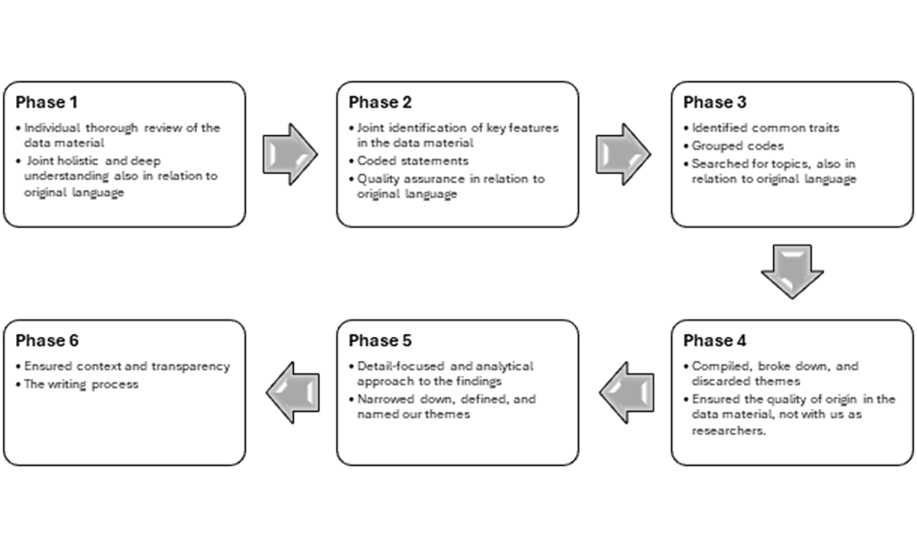
We follow Nowell et al. (2017) six-phase model for thematic analysis (Figure 1). All authors contributed to the analysis of transcriptions. Identification and interpretation of phenomena related to students’ experiences of being taught in a Sámi nursing education using both the mother tongue and the second language were conducted. In addition to our experiences from collaboration with SA, our preunderstanding consists of our work with the Sámi nursing education and the linguistic choices made in the planning of the program.
The Sámi speaking second author translated the transcribed interviews into Norwegian. If researchers lack language abilities, Squires (2008) suggests this quality assurance and data collection technique. All authors analyzed translated material, met and discussed their independent in-depth reading of both transcripts and our understanding of the text. The discussions were conducted jointly with the Sámi-speaking author's understanding of the original Sámi-language transcription. In this way, the original material in Sámi was included in the analysis and not discarded after translation. Furthermore, we discussed and organized three main themes guided by the research question, and then as quotes in subthemes (Nowell et al., 2017) which were carefully considered in relation to the original material and context (Figure 1).
Figure 1. Illustration and application of Nowell’s (2017) six phases for analysis
Ethical considerations
Norwegian Agency for Shared Services in Education and Research (SIKT) has approved the processing of sensitive data, and all participants received written information about the study and provided written consent to participate (SIKT Ref. No. 120959). They were also informed about the possibility of withdrawing along the way. To avoid the identification of students in the quotes, we have not referred to gender or other recognizable signs (Ford & Reutter, 1990; Lerdal & Karlsson, 2009).
Results and discussion
The participants share their various experiences with the achieved learning outcomes both individually and somewhat collectively. This is related to reading study plan documents, lectures, practice, and academic discussions that they expressed were preferred in their native language rather than in their second language. Overall, the participants describe an experience of stronger presence in learning situations and increased quality in their own learning when the learning activities take place in Sámi.
Table 1. Descriptions of main- and subtopics-based analysis of transcriptions from interviews
|
Research Question: How do Northern-Sámi-speaking students experience learning when mother tongue is utilized in lessons? |
||
|
Main themes |
Sub themes |
Quotes |
|
Effortless communication through mother tongue |
One rests in the mother tongue
|
It's easier to participate actively in the classes
that are in Sámi. We don't have to think about how to ask something in
Norwegian.
|
|
Everything is much more uncomplicated when using the mother tongue |
Question: Have you prepared to be able to use Sámi as
a working language?
|
|
|
The strength of mother tongue |
The majority language (Norwegian) always prevails |
We were four people in the break room. All Sámi
speakers. Someone who speaks Sámi with their own children and understands a
lot. But since this person prefers to speak Norwegian, everyone else also
spoke Norwegian, both with her and among themselves. I tried to speak only
Sámi, but it was difficult since everyone continued in Norwegian.
|
|
Empowerment through the mother tongue
|
In a Norwegian-speaking area, it is of course natural
to start in Norwegian. But if we are here in [Sámi municipality], I speak
Sámi first.
|
|
|
The experience of being silenced
|
The utilization of a second language results in insecurity and silence. |
In the classroom, language plays a significant role. We have had a couple of teaching days in Norwegian this week, and we were very quiet then. We didn't ask about much. But when there were [Sámi-speaking lecturers], then we told, commented, and spoke very actively.
|
|
The inner process of translation requires time and leads to silence |
We spend a lot of time thinking, translating questions into Norwegian, and afterwards we can start asking. Then it might be that the lecturer is done with that topic, and I didn't manage to translate it when I was about to ask. Then I just let it go and stay quiet.
|
|
Effortless communication through mother tongue
One key finding relates to the sense of ease associated with communication in one’s mother tongue. Participants emphasized that they “rest” in their mother tongue and experience interaction as more uncomplicated when it is used.
Sámi nursing students are given priority in the allocation of practice placements in Sámi-speaking areas, where Sámi patients are the majority group in healthcare services. Upon inquiry regarding the students' reflections on the application of Sámi in a nursing context, several participants indicated that they had not perceived the use of their mother tongue as a challenge. Findings indicated that they communicate naturally in Sámi also within professional settings and reveals that students’ experiences in learning processes are significantly simplified when utilizing the mother tongue (Table 1). Their native language is employed in all conversations with minimal cognitive effort for expression. Participants reported that discussions in a professional environment occurred more effortlessly, spontaneously, and freely in mother tongue. The descriptions result in the discovery of “resting in their native language” (Table 1). They did not need to search for words or translate in their minds prior to speaking; they were in harmony and did not remain silent. One of the participants explained:
You can discuss it in Sámi. Because one is not always completely confident in the Norwegian language. For example, earlier, when we were answering the questions, there was one I didn't quite understand.
This reflects how the mother tongue is deeply integrated within the students’ linguistic repertoire, which is both entirely understandable and natural. When teaching is conducted by a Sámi-speaking lecturer, students do not need to focus on preparing to use Norwegian in the classroom (Table 1).
The findings are consistent with the descriptions provided by Angelo et al. (2022) and Nishanthi (2020). The incorporation of the mother tongue in educational contexts enhances the accessibility of the subject matter and facilitates safer and more effective learning environments. It is also consistent with the results reported by Engelbrecht and Wildsmith (2010) and Sultana (2014). These studies indicate that the use of the mother tongue enhances student participation and improves learning outcomes from instruction.
The participants characterized their use of their native language as an automatic process that enabled them to express themselves confidently and accurately convey their intended communication. They also described language conversion in learning activities as processes that induced distraction and potential anxiety in students regarding the possibility of making errors (Table 1). The situation generated uncertainty among students regarding the potential for misinterpretation by the lecturer when a second language was employed. In the interviews, it is described as follows:
It is also much easier, I feel, to ask something in my own language. I can present my question much more easily in Sámi than in Norwegian. Others [fellow students] also understand the question much better.
This finding is in line with how Raatiniemi and Mehus (2012) also found that minority language-speaking nurses in hospital departments experienced that "they rested in their language" (Table 1). The nurses were able to discuss professional issues and quality assurance processes with colleagues who spoke their mother tongue.
These experiences may also be interpreted considering Pierre Bourdieu’s perspective on linguistic exchanges. Bourdieu (1977) argues that language use is embedded in social relations and that speakers possess varying degrees of linguistic capital, which influence their confidence and legitimacy in communication. When individuals communicate in their mother tongue, they operate within a linguistic field where their competence is fully recognized and where expression requires less symbolic and cognitive effort. In contrast, using a second language may reduce the speaker’s perceived linguistic capital and create uncertainty regarding the adequacy of expression. In this perspective, the students’ descriptions of “resting in their native language” can be understood as a situation where their linguistic competence is fully mobilized, enabling more spontaneous participation and confident engagement in professional discussions.
Participants noted that the course literature associated with the study is available only in a second language, not in their native language. The role of a lecturer in facilitating comprehension of the curriculum in the native language is essential and was articulated as follows from a participant:
Our literature is in Norwegian. And if there's something we read and don't understand for sure, then we have a Sámi-speaking lecturer to ask. Then I think it's easier to understand if you're doubtful.
Findings show that participants find themselves using extra time and capacity to validate their own academic understanding when reading in a second language. Reading Norwegian textbooks and literature is described as an additional academic challenge compared to the other learning activities in the program, which are tailored to Sámi. The Sámi-speaking lecturers’ availability in the validation of understanding textbooks and literature in the second language was described of great importance (Table 1).
According to Engelbrecht and Wildsmith (2010) and Angelo et al. (2022), it is not an unknown challenge that Indigenous languages may lack both conceptual content to describe professional terms and that there is also no professional literature in one's own language. The use of the mother tongue in educational settings improves attention to the subject matter. This will mitigate concerns associated with inaccurate or imprecise expressions that may occur when a non-native language is utilized (Engelbrecht & Wildsmith, 2010; Magga & Skutnabb-Kangas, 2002; NOU 2016: 18).
One of the students describes:
I think, at least as I have experienced it, that I understand some things better when they are explained in Sámi, and other things better in Norwegian.
This indicates blending of clinical, oral Sámi nursing terminology and Norwegian theoretical nursing terminology acquired through the curriculum. The integration of terminology from various languages may be regarded as a coping mechanism. In these instances, certain participants indicate a preference for the Norwegian term over the Sámi term, which they consider to be less comprehensive compared to the content presented in Norwegian textbooks (Table 1). Collaborating with experienced Sámi nurses may facilitate the introduction of nursing terminology in Sámi that has evolved over time. This variation in language strategy choices referred to as integrated, as it is observed that identical strategies utilized in everyday life when Sámi terms for a phenomenon described in Norwegian are absent. The findings demonstrate that participants have experience in language integration and are actively pursuing coherence and comprehension in communication by utilizing resources from both languages (Table 1).
This phenomenon is common in an Indigenous context, as noted by Engelbrecht et al. (2010), but it is not only positive regarding preservation of their mother tongue. The lack of Sámi nursing literature underscores the need for the formal creation of professional terms within the nursing field, facilitating a common professional language for Sámi nurses, educators, and nursing students to communicate effectively in learning and practice (Engelbrecht et al., 2010; Engelbrecht & Wildsmith, 2010).
The strength of mother tongue
Further findings highlight the complex dynamics between languages. While participants noted that the majority language (Norwegian) often dominates, they also described the empowering effect of being able to use their mother tongue.
The participants reported that they perceive an unspoken demand to speak Norwegian among colleagues, even when they are in Sámi-majority areas. They described situations where they experienced that "the Norwegian always prevails." One of the participants recounted an example of a situation where Norwegian prevails: In a student-patient context, the Sámi nursing supervisor requested a transition from Sámi to Norwegian to facilitate comprehension of the communication (Table 1). This indicates that Sámi being suppressed by the dominant language, even in contexts where communication in Sámi would be appropriate. A participant recounted an incident involving a group in which all members engaged in a professional guidance conversation were Sámi-speaking. Nevertheless, the Sámi nursing supervisor preferred that the discussion occur in Norwegian. The participant expressed it this way:
I actually tried to speak only Sámi, but it was difficult when the others continued in Norwegian, even though we all know Sámi. I thought it became strange and unnatural. That's why I tried to speak Sámi.
The situation described in the quote, can be understood in context of the absence of clinical nursing terminology in Sámi (Table 1). The nursing supervisor trained in a nursing framework that utilizes professional terminology in Norwegian, lacking Sámi terminology pertinent to nursing education. Similar findings can also be seen in Nishanthi (2020), Brock-Utne (2012), and Engelbrecht and Wildsmith (2010), where neglect of the mother tongue arises from the absence of appropriate terminology to sustain academic discourse. This also points towards the necessity of developing professional nursing terminology in Sámi to enhance the quality of professional dialogue among peers and facilitate learning and guidance for students who speak Sámi.
Participants additionally reported feelings of resignation due to the challenges of continuing in Sámi while others communicated in Norwegian. Challenges in transitioning from a Sámi linguistic- and cultural framework to a context dominated by the Norwegian language was reported as well (Table 1). In this context, verbal and non-verbal expressions do not consistently align as effectively as they do in one's native language. A study conducted by Boge (2020) in nursing homes located in Sámi regions, determines that the Sámi language has an inferior position to Norwegian. In addition, the findings indicated that healthcare staff felt empowered using the Sámi language in patient interactions. Participants in this study also reported a sense of powerlessness in Norwegian-speaking contexts, perceiving that Norwegian language predominates and suppresses their mother tongue. This also impacts their linguistic sense of safety (Boge, 2020).
A finding in our study is that the students felt empowerment through their mother tongue. The experience of the mother tongue being displaced by the majority language can be understood as being led to a kind of powerlessness (Table 1). A participant sarcastically says:
Where I live [referring to a Norwegian-speaking majority area] there is not much risk of being criticized for the language. No one asks us to stop speaking Norwegian.
Even with a
common proficiency in the Sámi language, discussions in Sámi-speaking regions
may still transition into Norwegian. The participants indicated a preference
for communicating in the language of the curriculum to mitigate
misunderstandings and errors, as also noted by Engelbrecht and Wildsmith (2010).
This situation may also be understood through the perspective of Pierre Bourdieu and his concept of linguistic exchanges. Bourdieu (1977) argues that certain languages hold greater symbolic value and legitimacy within specific social fields. In institutional contexts such as healthcare and education, the dominant language often carries greater linguistic capital and is therefore perceived as the appropriate language for professional communication. In this perspective, the tendency for Norwegian to prevail, even among Sámi speakers in Sámi-majority areas, reflects how institutionalized linguistic hierarchies shape communicative practices. The students’ experiences illustrate how Sámi may be marginalized in professional contexts despite being the shared language of the participants.
Structuring a professional terminology in Sámi represents a language acknowledgment that enhances the linguistic resources for individuals pursuing nursing education (Convention No. 169, 1989). Consequently, the Sámi can exert control over the development of healthcare services and utilize their shared working language (Bourdieu, 1977; Engelbrecht & Wildsmith 2010). Nonetheless, it is evident that the Sámi language lacks adequate recognition and is not consistently utilized as the preferred language, even within the Sámi language area in Finnmark [4] (Magga & Skutnabb-Kangas, 2002).
The experience of "being silenced"
The experience of “being silenced” emerged as an important theme. Participants explained that using a second language often generates insecurity and hesitation, and that the internal process of translating thoughts into another language requires time, frequently resulting in silence.
The participants say that conducting learning activities in Norwegian resulted in a quieter classroom environment, characterized by fewer questions and reduced participation in academic discussions (Table 1). One participant stated:
In the classroom, language matters a lot. This week, we conducted several teaching sessions in Norwegian, and we maintained silence during that time. We didn't ask about much. When there were Sámi-speaking lecturers, we commented and spoke very actively.
In the absence of qualified North Sámi available lecturers, students have experienced that Norwegian-speaking nurses have been hired for certain lectures. This has resulted in unintentional suppression and “silencing” of the student group. They struggle to consistently translate the Norwegian language into Sámi. The participants noted that by the time they had processed and mentally translated the information, the lecturer had typically progressed, leaving them to follow along as best as possible (Table 1). This indicates an internal disruption in learning processes, limiting students' opportunities for reflection and inquiry. Such conditions are suboptimal and misaligned with the intended study plan (Mehus et al., 2020). Our analysis (Table 1) is consistent with Lane (2023), that the use of second language contributes to “silencing” of students, representing a significant disturbance within the linguistic and pedagogical framework for learning (Hiim, 1998). In addition, this confirms the claims in Angelo et al. (2022) and Nishanthi (2020) statements that utilizing one's mother tongue makes learning safer and more active.
Bourdieu (1977) identifies the commonly acknowledged language as a fundamental element of societal power structures. The dominant language is associated with the highest recognition, and the language of the capital confers authority, power, and value upon the population. Consequently, Sámi nurses and nursing students may perceive an absence of agency in the professional development of Sámi healthcare services due to the inadequate recognition of Sámi language as the preferred natural language
According to the ideas of Bourdieu (1977) the opportunity to learn and practice a profession in one's mother tongue can be interpreted as a transfer of power. The empowerment and recognition of Indigenous Peoples' rights to social life, education, and healthcare, grounded in their own culture and language, are essential (Constitution, 1814; Convention No. 169, 1989; United Nations - General Assembly, 2007). The Sámi language in education and professional practice represents an enhancement of linguistic and cultural capital, facilitating Sámi community development, recognition, and autonomy. This perspective can be viewed as a form of decolonization and an advancement in the societal perception of Indigenous Peoples, including the Sámi (Bourdieu, 1977; Lane, 2023; Magga & Skutnabb-Kangas, 2002;). Such an approach is also consistent with recommendations found in the plan of action from the Truth and Reconciliation Commission (Sannhets- og forsoningskommisjonen, chapter 26, pp. 653-654).
Study's limitations
According to our understanding of Bourdieu (1977), the translation process into the majority language might be perceived as a means of diminishing the linguistic capital and therefore also the symbolic power of the Sámi language. Nevertheless, this was the sole method by which we could disseminate the data with the guidance of our Sámi co-author, ensuring that this crucial knowledge could be conveyed.
The authors have extensive clinical and academic experience as nurses in Finnmark, as lecturers in Sámi communities, and meeting Sámi students in previous nursing programs. These experiences provide a fundamental pre-understanding that helps enrich the study. The employment of the Sámi language in interviews enhances the study's validity, although cultural and semantic nuances may be diminished in translation (Denzin et al., 2008; Tuhiwai Smith, 2012). If all researchers had possessed knowledge of the Sámi language, it might have impacted both the direction and content of the interviews, potentially resulting in a different analysis. The authors possess diverse expertise in culture and clinical practice within Sámi regions, which will impact the study discursively, hence improving quality assurance and reinforcing the credibility of the analysis (Ford & Reutter, 1990; Squires, 2008).
Summary
This study indicates that nursing students from a Sámi language and cultural background derive significant learning benefits from utilizing their native language in their education. The use of Sámi language by lecturers enhances participation and engagement in academic discussions, potentially fostering a sense of empowerment among the students. This facilitates greater academic accessibility to the nursing profession for students compared to instruction solely in Norwegian. Educational institutions encounter challenges due to the lack of Sámi-language teaching materials and professional literature, hindering the development of nursing-related Sámi terminology. Our analysis of the findings of this study leads us to conclude that the development of a structured Sámi professional terminology is essential.
This study emphasizes the imperative need for educating more Sámi nurses and educators committed to advancing the development of Sámi professional terminology in nursing and healthcare. They will serve as essential foundations in tackling the challenges encountered by the study program. Maintaining and enhancing the initiative of Sámi nursing education in Sámi language, will therefore be essential as a decolonial act. The initiative encompasses political goals and economic incentives for education and for nursing students. While universities also should provide master's programs in Sámi for healthcare professionals as the next step to recruit and retain Sámi lecturers into higher education.
References
Angelo, D., Disbray, S., Singer, R., O'Shannessy, C., Simpson, J., Tuhiwai Smith, H., Meek, B., & Wigglesworth, G. (2022). Learning (in) indigenous languages: Common ground, diverse pathways. OECD Education Working Papers, No. 278, OECD Publishing. https://doi.org/10.1787/e80ad1d4-en
Arieli, D., Friedman, V. J., & Hirschfeld, M. J. (2012). Challenges on the path to cultural safety in nursing education. International Nursing Review, 59(2), 187-193. https://doi.org/10.1111/j.1466-7657.2012.00982.x
Austgard, K. (2007). Language and the experience of patients' values in nursing care: a theoretical exploration. Nurse education today, 27(2), 139–144. https://doi.org/10.1016/j.nedt.2006.04.005
Balto, A. (2019). Kulturveileder-for arbeid med Sámiske pasienter og deres pårørende/Kulturofelaš-sámi dearvvašvuođasuorgái [Cultural guide for working with Sámi patients and their relatives]. Utviklingssenter for sykehjem og hjemmetjenester (USHT).
Blix, S., & Eriksen, L. (2015). ”ET GODT LOKALT LÆRINGSMILJØ?” Erfaringer med desentralisert bachelor i sykepleie, i tre kommunale studentgrupper 2001 -2004 ["A GOOD LOCAL LEARNING ENVIRONMENT?" Experiences with a decentralized bachelor's degree in nursing, in three municipal student groups 2001 - 2004]. Septentrio Reports, (1). https://doi.org/10.7557/7.3339
Boge, J. (2020). The inferior position of the Sámi language in a bilingual nursing home in Norway. Journal of Multilingual and Multicultural Development, 41(3), 195-205. https://doi.org/10.1080/01434632.2019.1597875
Bourdieu, P. (1977). The economics of linguistic exchanges. Social Science Information, 16(6), 648-668. https://doi.org/10.1177/053901847701600601
Bratland, R. (2013). Sámiske tilbud innenfor sykepleierutdanningen i Finnmark [Sámi nursing education in Finnmark]. In E. Boine, S. B. Johansen, S. Lund, & S. Rasmussen (Eds.), Sámisk skolehistorie (Vol. 6). Davvi Girji. http://skuvla.info/skolehist/bratland-n.htm
Brock-Utne, B. (2012). Language and inequality: global challenges to education. Compare: A Journal of Comparative and International Education, 42(5), 773-793. https://doi.org/10.1080/03057925.2012.706453
Brock-Utne, B., & Alidou, H. (2011). Active students – learning through a language they master. In A. Ouane & C. Glanz (Eds.), Optimising Learning, Education and Publishing in Africa: The Language Factor A Review and Analysis of Theory and Practice in Mother-Tongue and Bilingual Education in sub–Saharan Africa (pp. 187-216). UIL/ADEA.
Constitution. (1814). The Constitution of the Kingdom of Norway (LOV-1814-05-17). Lovdata. https://lovdata.no/NLE/lov/1814-05-17
Convention No. 169. (1989). Concerning Indigenous and tribal peoples in independent countries/ILO-konvensjon nr. 169 om urfolk og stammefolk i selvstendige stater (27-06-1989 nr. 2 Mulitlateral). Lovdata. https://lovdata.no/dokument/TRAKTAT/traktat/1989-06-27-2
Creswell, J. W. (2013). Qualitative Inquiry and Research Design: Choosing Among Five Approaches (3rd ed.). SAGE
Dagsvold, I., Mollersen, S., & Stordahl, V. (2015). What can we talk about, in which language, in what way and with whom? Sámi patients' experiences of language choice and cultural norms in mental health treatment. International Journal of Circumpolar Health, 74, 26952. https://doi.org/10.3402/ijch.v74.26952
Denzin, N. K., Lincoln, Y. S., & Tuhiwai Smith, L. T. (2008). Handbook of Critical and Indigenous Methodologies. SAGE Publications Inc.
Engelbrecht, C., Shangase, N. C., Majeke, S. J., Mthembu, S. Z., & Zond, Z. M. (2010). IsiZulu Terminology Development in Nursing and Midwifery. Alternation, 17(1), 249-272.
Engelbrecht, C., & Wildsmith, R. (2010). Exploring Multilingualism in a Problem-based Learning Setting: Implications for Classroom and Clinical Practice in the Nursing Discipline. Alternation, 17(1), 108-137.
Engnes, J. I., Sivertsen, N., Bongo, B. A., & Mehus, G. (2022). Sámi language in Norwegian health care: 'He speaks good enough Norwegian, I don't see why he needs an interpreter'. Scandinavian Journal of Caring Science, 36(1), 275-284. https://doi.org/10.1111/scs.12986
Eriksen, L., & Okstad, L. (2008). Rapport om deltid BA Sykepleie 2008. [Report on part-time nursing education 2008]. Høgskolen i Finnmark, Hammerfest. Unpublished work
Eriksen, L. T., & Huemer, J. E. (2019). The contribution of decentralised nursing education to social responsibility in rural Arctic Norway. International Journal of Circumpolar Health, 78(1). https://doi.org/10.1080/22423982.2019.1691706
Ford, J. S., & Reutter, L. I. (1990). Ethical dilemmas associated with small samples. Journal of advanced Nursing, 15(2). https://doi.org/10.1111/j.1365-2648.1990.tb01800.x
Grønmo, K., & Grønmo, L. P. (2019). Mátkkeloahpa ovddasmoraš-vuoiŋŋalaš veahkki [Care at the end of life - spiritual care] (2. utg.). Utviklingssenter for sykehjem og hjemmetjenester i Finnmark.
Hiim, H. (1998). Undervisningsplanlegging for yrkeslærere [Teaching planning for vocational lecturers] (2. utg.). Universitetsforlaget.
Kunnskapsdepartementet. (2024). Nasjonale retningslinjer for helse- og sosialfagutdanningene (RETHOS) [Information about National Curricula for Norwegian Health and Welfare Educations (RETHOS)]. https://www.regjeringen.no/no/tema/utdanning/hoyere-utdanning/innsikt/nasjonale-retningslinjer-for-helse-ogsosialfagutdanningene-rethos/id3054017/
Lane, P. (2023). From Silence to Silencing? Contradictions and Tensions in Language Revitalization. Applied Linguistics, 44(5), 833-847. https://doi.org/10.1093/applin/amac075
Lerdal, A., & Karlsson, B. (2009). Bruk av fokusgruppeintervju [Employing focus group interviews]. Sykepleien Forskning, 3(3), 172-175. https://doi.org/10.4220/sykepleienf.2008.0036
Magga, O. H., & Skutnabb-Kangas, T. (2002). Life or death for languages and human beings – experiences from Saamiland. In A. Camilleri, L. Huss, & K. King (Eds.), Transcending Monolingualism: Linguistic Revitalization in Education (pp. 35-53). CRC Press LLC.
Mehus, G., Bongo, B. A., Engnes, J. I., & Moffitt, P. M. (2019). Exploring why and how encounters with the Norwegian health-care system can be considered culturally unsafe by North Sami-speaking patients and relatives: A qualitative study based on 11 interviews. International Journal of Circumpolar Health, 78(1). https://doi.org/10.1080/22423982.2019.1612703
Mehus, G., Bongo, B. A., & Moffitt, P. (2018). Important factors when communicating with Sami patients about health, illness and care issues. Nordisk sygeplejeforskning, 8(4), 288-301. https://doi.org/10.18261/issn1892-2686-2018-04-04
Mehus, G., Hætta, A. B. K., Emaus, N., & Okstad, L. (2023). The history of Sámi nursing education and the path towards regulations on a national guideline for Sámi nursing education in Norway. AlterNative: An International Journal of Indigenous Peoples, 19(2). https://doi.org/https://doi.org/10.1177/11771801231168762
Mehus, G., & Okstad, L. (2020). Akkreditering Samisk sykepleierutdanning [Accreditation of Sámi Nursing Education]. Universitetsstyret, UiT Norges arktiske universitet.
Mehus, G., Somby, A., & Okstad, L. (2020). Studieplan bachelor i Samisk sykepleierutdanning [Study plan for a Bachelor's in Sámi Nursing Education]. UiT Norges arktiske universitet.
Nasjonal retningslinje for samisk sykepleierutdanning. (2021). Forskrift om nasjonal retningslinje for samisk sykepleierutdanning (FOR-2021-10-26-3096) [Regulation on the national guideline for Sámi nursing education]. Lovdata. https://lovdata.no/forskrift/2021-10-26-3096
Nishanthi, R. (2020). Understanding of the Importance of Mother Tongue Learning. International Journal of Trend in Scientific Research and Development (IJTSRD), 5(1), 77-80.
NOU 2016:18. (2016). Hjertespråket: Forslag til lovverk, tiltak og ordninger for Sámiske språk [The Heart’s Language, Proposal for legislation, measures, and arrangements for Sámi languages]. Kommunal- og distriktsdepartementet. https://www.regjeringen.no/no/dokumenter/nou-2016-18/id2515222/
Nowell, L. S., Norris, J. M., White, D. E., & Nancy, M. (2017). Thematic Analysis: Striving to Meet the Trustworthiness Criteria. International Journal of Qualitative Methods, 16(1). https://doi.org/10.1177/1609406917733847
Okstad, L., Emaus, N., Hætta, A. B. K., & Mehus, G. (2021). Samisk sykepleierutdanning: Målet er å utdanne kulturelt trygge sykepleiere [Sámi nursing education: The goal is to educate culturally safe nurses]. Sykepleien, 109. https://doi.org/10.4220/Sykepleiens.2021.82754
Olsen, T. A. (2017). Privilege, Decentring and the Challenge of Being (Non-) Indigenous in the Study of Indigenous Issues. The Australian Journal of Indigenous Education, 47(2), 206-215. https://doi.org/10.1017/jie.2017.16
Raatiniemi, J., & Mehus, G. (2012). Språkvansker skaper stress på jobb [Language difficulties create stress at work]. Sykepleien, 100(13), 68-70. https://doi.org/10.4220/sykepleiens.2012.0137
Sannhets- og forsoningskommisjonen. (2023). Sannhet og forsoning – grunnlag for et oppgjør med fornorskingspolitikk og urett mot samer, kvener/norskfinner og skogfinner [Truth and reconciliation – the foundation for addressing the Norwegianization policy and injustices against Sámi, Kven/Norwegian Finns, and Forest Finns]. https://www.stortinget.no/globalassets/pdf/sannhets--og-forsoningskommisjonen/rapport-til-stortinget-fra-sannhets--og-forsoningskommisjonen.pdf
Squires, A. (2008). Language barriers and qualitative nursing research: methodological considerations. International Nursing Review, 55(3), 265-273. https://doi.org/10.1111/j.1466-7657.2008.00652.x
Sultana, S. (2014). English as a medium of instruction in Bangladesh's higher education: Empowering or disadvantaging students? Asian EFL Journal, 16(1), 11-52.
Tuhiwai Smith, L. T. (2022). Decolonizing Methodologies: Research and Indigenous Peoples (3rd ed.). Bloomsbury Academic.
United Nations - General Assembly. (2007). United Nations Declaration on the Rights of Indigenous People. A/RES/61/295. https://documents.un.org/doc/undoc/gen/n06/512/07/pdf/n0651207.pdf
Utsi, E. (1986). Anatomiia [Anatomy]. Inari, Saamelaiskäräjät; Sámi Giellagáldu . https://www.samediggi.fi/wp-content/uploads/2022/03/Anatomia_sanasto_koltansaame_16.3.2022.pdf
Utsi, E., & Jenssen, H. (2006). Apotekordliste: reseptparlør på norsk, Sámisk og finsk = Apotehkasátnelistu : reseaptagihppagaš dáro-, sáme- ja suomagillii = Apteekkisanasto : reseptisanoja norjaksi, saameksi ja suomeksi [Pharmacy glossary: prescription phrasebook in Norwegian, Sámi, and Finnish]. Davvi girji
WINHEC accreditation authority. (2018). WINHEC accreditation handbook. World Indigenous Nations Higher Education Consortium. https://winhec.org/AccreditationInfo
 ©2026
Linda Alise Okstad, June Brita Eira, Grete Mehus. This is an Open Access article
distributed under the terms of the Creative Commons Attribution 4.0
International License (http://creativecommons.org/licenses/by/4.0/), allowing
third parties to copy and redistribute the material in any medium or format and
to remix, transform, and build upon the material for any purpose, even
commercially, provided the original work is properly cited and states its
license.
©2026
Linda Alise Okstad, June Brita Eira, Grete Mehus. This is an Open Access article
distributed under the terms of the Creative Commons Attribution 4.0
International License (http://creativecommons.org/licenses/by/4.0/), allowing
third parties to copy and redistribute the material in any medium or format and
to remix, transform, and build upon the material for any purpose, even
commercially, provided the original work is properly cited and states its
license.