Vol 10, No 2 (2026)
https://doi.org/10.7577/njcie.6414
Article
Constructing imagined communities in the digital space of schools: A view from northeastern Estonia
Kara Diane Brown
University of South Carolina
Email: kara.diane.brown@ut.ee
Kadri Koreinik
University of Tartu
Email: kadri.koreinik@ut.ee
Abstract
This article investigates the construction of imagined school communities in the digital space of schools. Drawing on Benedict Anderson’s theory of imagined communities, the study examines how two schools in northeastern Estonia, amidst significant systemic educational reforms and demographic shifts, use social media as a space to establish values and cultivate a sense of belonging. Using qualitative content analysis of over 200 Facebook posts from two newly opened state gymnasia in Narva, a predominantly Russian-speaking city, we found that social media served as a curated digital space for community construction, a compass for community direction, and a channel for articulating community commitments. The analysis demonstrates that social media functioned not only as an informational, but also as a cultural forum for generating new educational imaginaries. This study contributes to the spatial turn in comparative education by highlighting the value of researching social media to understand school community development and the role of digital space, especially during periods of systemic reform.
Keywords: Imagined school communities, digital space, Estonia, Russian-speaking minority
Introduction
Although the spatial turn – a reorientation in social theory and humanities in which space became an equally fundamental category of analysis alongside time – in Comparative and International Education (CIE) has expanded in dynamic ways (Beech et al., 2025; Paulston, 2000), digital space remains underexplored and merits investigation. Digital space refers to socially produced, digitally mediated environments and interactions. We examine the use of social media as a digital tool and platform for producing and cultivating educational community. As a space with explicit and implicit messages about school values, goals, and community, social media offers a rich site for comparative research. In this article, we consider the ways school social media create an imagined educational community. The following question guided our research: which values and identity markers shape new educational communities on the social media platforms of two schools and how do these presentations compare?
The concept of imagined communities offers exciting possibilities for understanding how school communities take shape in digital spaces. Informed by Benedict Anderson’s theory (1991), we investigated efforts to create two new school communities within a growing state gymnasia network in Estonia. While our focus is on novel educational settings resulting from advances in digital technology, governance, language-policy, and demographic changes, such spaces also emerge through school consolidation, closure, redistricting, or (de)centralization; all developments facing educational communities in the Nordic countries and elsewhere (Autti & Hyry-Beuhammer, 2014; Beach et al., 2018; Šūpule & Søholt, 2019).
Benedict Anderson’s (1991) theorizing serves as our starting point; we consider schools as imagined educational communities. Anderson’s insights into how nations take shape and spread helps explain how school communities emerge and circulate today. Schools, like nations, are a dynamic socio-cultural concept as much as an organization and bureaucratic institution. Schools are imagined since, as with nations, most of the fellow members will “never know most of their fellow-members, meet them, or even hear of them, yet in the minds of each lives the image of their communion” (Anderson, 1991, p. 6). Schools are also communities since, as with Anderson’s nations, their bodies (e.g., teachers, students, staff) are “always conceived as a deep, horizontal comradeship” (Anderson, 1991, p. 7). While school-based belonging might be shot through with vertical power and social structures, the notion of collective comradeship is inclusive of all members. Finally, Anderson’s attention to the crucial role of print media in imagining communities pairs well with contemporary social media platforms such as Facebook. Anderson’s understanding of media as the infrastructure through which imagined communities come into being aligns closely with media scholars who argue that media no longer occupy a separate social domain but instead organize social life itself. Schools, like families, function as “communicative figurations” sustained through mediated interactions via phone calls, text messages, or common screen time (Hasebrink & Hepp, 2017; Hepp, 2013).
Previous Research
Education-focused scholars (Brezicha, 2018; He et al., 2017; Kanno & Norton, 2003; Li, 2019; Norton, 2001 Stables, 2003) take up the concept of “imagined communities” to examine the ways students and schools play central roles in producing communities. One research strand focuses on social-identity construction. Kanno and Norton (2003) conceptualize imagined communities as “groups of people, not immediately tangible and accessible with whom we connect through the power of imagination” (p. 241). In their research, they posit that language learners, interacting with both local and global imagined communities, find their social identities extending beyond the immediate geographic or institutional boundaries. Norton (2001), based on her research of two ESL students in Canada, found that their learning communities “transcended time and space…to the imagined world outside their classroom – their imagined community” (p. 164). She notes the ways classrooms serve as key sites of identity construction where students, through language practices, and sometimes non-participation, link themselves to larger existing social, cultural, and political communities beyond the classroom as well as to future worlds.
Another strand of “imagined communities” and education scholarship centers schools as primary institutions shaping spatial and social imaginaries and understandings of community and belonging. Scholars find that classrooms, schools (Brezicha, 2018), and curricula (Li, 2019) contribute to the construction of social spaces where students engage in imagined communities. Stables (2003) draws attention, however, to the lack of clarity around the “boundaries” of school:
Where do we find a school? In and among its buildings, perhaps, yet these buildings cannot of themselves constitute the school. A school only exists in relation to its being imagined: if it is the sum total of anything, it is the sum total of perceptions and experiences of it. Such perceptions and experiences are certainly refined through the school’s social networks, but these are themselves indefinite and elusive, linking those who work in the institution, those who have personal connections with it and those who know it only at second or third hand (p. 896).
Brezicha (2018) identifies schools as key sites of political socialization giving students some of their earliest encounters with an imagined community; the students’ sense of inclusion or exclusion, based on these school-based experiences, deeply influences how they understand their larger imagined community (p. 30).
Importantly, concepts of imagined educational communities have spatial and temporal aspects. As Kanno and Norton (2003) argue, “…we can invest our time and energy to strive for the realization of alternative visions of the future. Our identities then must be understood not only in terms of our investment in the ‘real’ world but also in terms of our investment in possible worlds” (p. 248). The future work embedded in educational communities is reflected in Norton’s scholarship. She defines an education community as foundationally one of the imagination and linked closely with future (2010, p. 355). He, Bettez, and Levin (2017) also take up these temporal ideas in their work on asset-based approaches to refugee and immigrant education, to highlight the need both for looking back and forward, “…it is critical to engage all community members in both positive retrospective reconstructions of past educational experiences to uncover assets and resources and prospective imagination for a co-constructed educational community to create a shared vision” (p. 979).
Social media, by enabling individuals to connect, share, and engage across political and geographic distances and boundaries, has enabled communities to form beyond those in the immediate physical school. Social media platforms, like Facebook and Instagram, help to constitute new communities, cultivate micro-identities, and strengthen existing ones within this digital space. Selwyn and Stirling (2016) highlight the community’s role in generating social media dependent on “user generated’ content that masses “authored, curated, critiqued and reconfigure” (p. 3). In this way, online identity works as some degree of collective creation and curating, and, also as an opportunity to negotiate. While social media has the potential to generate a sense of belonging and identity among users, it can also contribute to fragmentation, lead to attenuated interactions, and potentially result in societal disintegration (Kossowska et al., 2023). In Estonia, school webpages have mainly been studied from perspectives of communication management and public relations (Tikerperi, 2018). Building on (corporate) reputation research, Tikerperi (2020) identifies relational, normative, temporal, context-sensitive, and actional dimensions through which schools communicate values. Her research suggests that new schools, having limited possibilities to communicate traditions, continuity, and alumni (success) stories, must instead rely on alternative resources such as physical appearance, teacher qualifications, and media coverage to establish credibility.
Context
Estonia and its public school system, internationally known as a global reference for its top PISA scores (Mazurek et al., 2021; Volante & Klinger, 2023), is undergoing a significant systemic reform layered on a previously unrealized language-in-education policy. The systemic reform involves the state aiming to enhance access to high quality schooling at the upper secondary level. In 2010, the Estonian national government initiated a policy to fund and develop at least one state upper secondary school (riigigümnaasium; grades 10-12) in every county of Estonia. Converging with ongoing demographic shifts (discussed below), financial strains, and a national system of choice, among other dynamics, the municipal governments, the long-standing owners of upper secondary schools in Estonia, have agreed to this reform. As part of these agreements, many existing municipal schools (grades 1-12) have transformed into Basic Schools (grades 1-9) or closed; the Estonian Ministry of Education and Research owns and manages these new upper secondary schools (grades 10-12). By academic year 2023-2024, at least one state upper secondary school operated in every county center, with more than one in four counties as well as in the national capital of Tallinn. Foundationally, the state’s plan attempts to advance opportunities through constructing (or renovating) a new school building, hiring the school directors, and ensuring innovative curricula.
An unrealized, language-in-education policy in Estonia also plays a role in this systemic reform. As with other former Soviet Republics (Brown, 2022; Silova, 2006), Estonia contends with the legacy, and continuity, of a divided public-school system by language of instruction. Though the Estonian government had a policy already in 1993 to shift the medium of instruction from Russian to Estonian by 2000 (Pettai, 2024, p. 316), the transition never made its way throughout the system particularly in Estonia’s more heavily Russian-speaking areas, like the northeast. Ida-Viru municipalities, in particular urban ones, are places of limited access to high quality schooling in Estonian, the sole state language. Despite over three decades of varying local and EU-level, state, and non-governmental organizational attempts to enhance education and acquisition in Estonian through law enactment and experimenting with Russian-medium-school programming, proficiency levels in the state language remain low and depend on the immediate language environment (i.e., peers, school, and community) (for regional and age differences in patterns of multilingualism see Ehala & Koreinik, 2021). The northeastern city of Narva, Estonia’s third largest, has compounding features that diminish educational opportunity – it has a particularly weak Estonian-language environment (95% primarily Russian-speaking) and is located far (2.5 hours of drive) from the stronger academic schools in Tallinn, the country’s capital, and Tartu (2 hours 15-minute drive). Located directly on the Russian border, Narva is a place where multiple forms of belonging — Narvan, Estonian, Russian, and European — are continually negotiated and reshaped (Kaiser & Nikiforova, 2008, p. 545).
With its overwhelmingly Russian-medium schools, Narva’s municipal education system serves as a backbone of public infrastructure facilitating the constant reproduction of socioeconomic inequality blocking opportunities for effective Estonian-language learning and subsequent higher education and employment opportunities (Tammaru et al., 2021). From the state perspective, this situation constrains both Russian-speaking students’ opportunities to learn Estonian, which impacts their sense of belonging in Estonia as well as their future educational and professional opportunities. A renewed effort to make the transition in all schools to Estonian-medium education began in September 2024, with pre-primary, first, and fourth grades, and aims for the shift to Estonian to be complete, systemwide, in 2030/31 (Act Amending the Basic and Upper Secondary Schools Act and Other Acts 2022 § 21).
These major policy shifts closely interact with Narva’s demographic trends, which have swung dramatically over the 20th century to (re)shape education. According to the first and only Russian imperial census in 1897, the population of Narva was 16,577 with roughly 7,300 Estonians and 7,300 Russians, 1,000 Germans and 1,000 others (incl. Ivangorod, but excl. Kreenholm with ca 8,500); the city grew to 82,200 by 1989. Soviet-era population growth was accelerated by labor migration from Russia and other Soviet republics. After the dissolution of the Soviet Union in 1991, the city population has dramatically decreased and aged. In 2026, there were 51,020 residents in Narva, ca 60% of its peak population, with the forecast for the population to continue to decrease. According to the most optimistic, post-1991 scenario, northeastern Estonia, including Narva, might have profited enormously from a possible growth in trade between Russia and the EU (Smith, 2002, p. 106). However, Russia’s decade long war in Ukraine, and especially its 2022 full-scale military invasion of the country, along with the resulting EU trade sanctions and import and export bans, has dissolved that hope for economic opportunity and demographic stability.
These collective policy and demographic shifts have radically changed the educational landscape in Narva especially in terms of governance, medium of instruction, and upper secondary level offerings. School closures and consolidations, often backed by efficiency arguments, aiming to optimize resources and improve the quality of education in the city, have transformed educational communities. In 2023, three formerly grade 1-12 Russian-medium municipal schools – Narva Pähklimäe School (est. 1973), Narva Kreenholmi School (est. 1946), and Narva Kesklinna School (est. 1926) – lost their upper secondary levels (grades 10-12) and were converted into basic schools (grades 1-9). Another school, known most recently as Narva Soldino School, constructed in the mid-1980s for 1,360 students, grew into a secondary school by 1989, but was closed in 2024 and demolished by 2026. Narva Language Lyceum (a 1-12 grade school) currently houses the only municipal upper-secondary level in Narva. The city’s sole, post WWII Estonian-medium language school, offering grade 1-12 education, Narva Estonian Gymnasium, shifted from municipal to state governance in September 2021 and then to a basic school in 2023. Narva Vanalinna School, long Narva’s only official (Estonian-Russian) immersion school, similarly became a state school in 2000, expanded to a state gymnasium in 2009, and was downgraded to a state basic school in 2023. All but two of the city’s school buildings (Kesklinna and Vanalinna Basic Schools) are examples of Soviet standardized designs from the intensive in-migration and school-building period of the 1970s and 1980s (see Mänd, 2018).
While the school governance system has dramatically changed in Narva, the physical school landscape remained caught in the Soviet era. Narva – once called the Swedish Baroque pearl – suffered greatly from the 1944 Red Army bombings and the subsequent post‑war, Soviet urban reconstruction. Into this changed mix of educational arrangements, shifted municipal-state governance, and medium of instruction, the two new, strikingly modern state upper secondary schools in Narva opened in 2023. These schools are central to the research shared in this article. One (Gymnasium A) primarily serves the graduates of four city Russian-medium Basic Schools. The other school (Gymnasium B) largely enrolls students from the city’s Estonian-immersion (grades 1-9) and Estonian-medium Basic School (grades 1-9)[1].
Methods & Data
This research is part of our ongoing (2023-2026) longitudinal, comparative project focused on spatial understandings within these new upper secondary schools. For the slice of the project presented in this article, we focused on a crucial period of the educational-policy process – the initial “building” phase of the schools’ development to identify and make sense of the values and identity markers shaping the new educational communities on school social media platforms. This phase (spring 2022 through 31 August 2023) began with the state’s selection of School Directors and spanned the final stages of school construction,[2] the hiring of the schools’ teaching corps, and recruitment of students. Our data collection period ended with the last day that the schools existed only as a “conceived community” (Lefebvre, 1991/1974); that is the day before September 1st, when the entire school body, came together for the first time physically for the celebratory and historic opening of two new upper secondary schools.
Online ethnography represents a significant extension of our longitudinal ethnographic fieldwork, introducing a new site for inquiry. We concur with Hallett and Barber’s (2014) argument that digital spaces are now integral rather than optional in ethnographic research (p. 307). It enables us to trace data and examine social media content in-depth – phenomenon that is inherently unpredictable and difficult to theorize prior to data collection and analysis (Hampton, 2017; Postill & Pink, 2012). As a significant public-oriented source of information and value declaration, these social media contents reflect individual school-leadership priorities. Authored during this period by the state-selected school leadership, the Facebook posts created during our collection period capture explicit (and implicit) messaging about community. Social media served as one of the central public platforms for communicating, announcing, updating developments, plans, and possibilities related to the schools. To carry out this research, our team collected the social media (i.e., Facebook which contents are also reposted to Instagram) posts from both schools’ Facebook pages. We created a database of all school Facebook posts and reactions. For the purposes of this article, we focus on the descriptive text, including hashtags and emojis, and visuals (i.e., photos and videos) of the posts. We consider these data as the central school-constructed public-facing for expressing the aims and values of state-envisioned spatial equity.
One of the key questions in online research, as in offline research, concerns ethics. Ethical decision-making is complicated by the absence of a universal set of rules or guidelines that can be applied across all projects (Sloan & Quan-Haase, 2016). To address ethical issues, we considered three types of precautions: legal, privacy, and publication (Townsend & Wallace, 2017). Content on public Facebook pages is openly accessible, allowing anyone – followers, non-followers, and even non-users – to view it without privacy expectations. Moreover, data posted by schools is expected to reach as wide an audience as possible. Given our focus on the school-generated posts rather than engagement, which could potentially include minors, we maintain ethical relationship with content creators. We use aliases instead of school names, though, as organizations, gymnasia are easily locatable and recognizable. The research project was granted ethical clearance by the University of Tartu Research Ethics Committee on April 17, 2023, under approval number 376/T-20.
Figure 1. Number of Facebook posts by gymnasia (April 2022-August 2023)
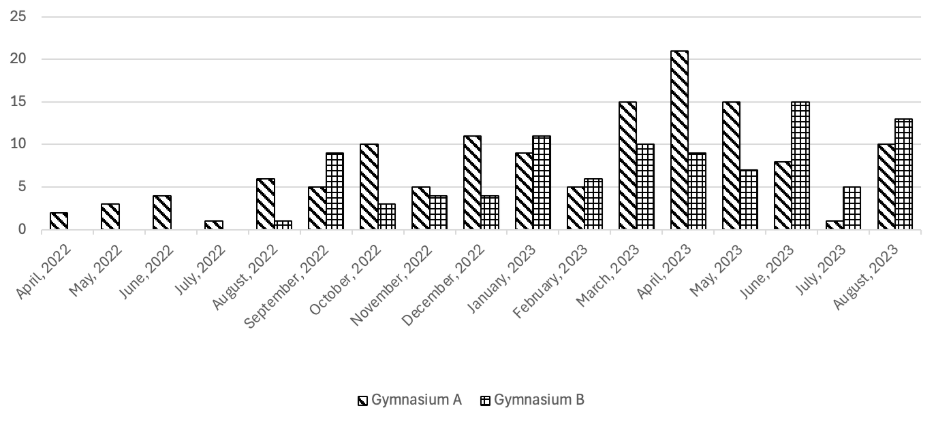
To pull all available Facebook posts prior to the schools’ physical openings in September 2023, we used the public Facebook application of programming interface to collect both page-level (e.g., the number of followers, 851 and 1,100, respectively in July 2023) and post-level data (including the post creation date, post text, description, media type). In addition, data for the number of tags, number of hashtags, and all comment attributes (incl. content and language) were collected, but were not used in these analyses.[3] The content was primarily in Estonian with select instances of Russian. We created a database of (n=218) of these texts, photos, videos, reels, and media reposts. While engagement data (reactions such as likes and cares, comment attributes, shares) were also collected, our analysis is limited to curated content only.
For the analysis of content formats, we engaged in individual and team-based open, axial, and selective coding of our data to construct meaning (Strauss & Corbin, 1990). In axial coding, both inductive and deductive techniques are combined. The multilingual research team reviewed the data in the original languages and then coded in both Estonian and English. Our unit of analysis was a post, i.e., a status update, a photo, a video, and a repost or a combination of those. Initial codes were developed (e.g., attention to state holidays/commemoration), which were later combined into sub-themes, (e.g., identifying with the state) and finally recurring sub-themes formed broader ones (e.g., community construction, compass, and commitments). With national and local scales of analysis, our research is spatially and temporally comparative. We compared data and codes between schools and across the years as we developed themes. We selected illustrative examples of main themes to include in this article keeping the original language of the text as well as creating an English translation. We include the school aliases and the date of the post following quotes in day, month, year format (e.g., Gymnasium B, 13/9/22). The original quotations can be provided upon request.
Our epistemological and methodological choices support our researcher's positionality. One member was born and raised in Estonia and is a multilingual dominant Estonian-speaker. The other is from the United States, who is a home English speaker who knows Estonian and Russian. Neither researcher is from northeastern Estonia, but both have lived or visited frequently there (from 2023-2026) for fieldwork. Our multilingual backgrounds allowed us to conduct fieldwork in multilingual settings, such as schools without a single dominant language. At the same time, our partial outsider status requires ongoing reflexivity regarding access, interpretation, and power relations in the field.
Findings
In the following section, we share the ways the two schools’ social media functioned as a site for shaping their educational community. Community, in these cases, refers to the connected school body – the school administration, teachers, staff, students, and parents. In addition to social media’s practical function as an information disseminator, it served to generate community, as we detail below, in three distinct ways. First, posts updating the progress with school building and collaborative planning activities contributed to community construction, inviting followers to imagine the physical learning environments and participate in shaping the school culture. The schools also articulated a community compass by situating themselves directly within Narva’s cultural, geographic, and national significance, highlighting the city’s role in Estonia’s historical memory along with future opportunities and priorities. Finally, the two schools used digital space to outline their community commitments, emphasizing Estonian-language education, shared values, and the recruitment of teachers and partners aligned with their vision for modern, new ways of schooling. Through these intertwined narratives, as we explain in this section, the gymnasia use digital space to present themselves as institutions being built for, and with, an emerging community, grounded in place, and presenting local (and national) aspirations.
Before turning to the community themes, we note that the schools’ social media plays a role in disseminating practical information; it was a space to share teacher job advertisements, registration/application links with potential students, vote on a student art competition, and enlist school band members. Figure 1 captures, for example, the spike in both schools’ posts during the call for student enrollment in the spring of 2023. The social media also bridges the digital and in-person space in, for example, their November 2022 invitations for public, community discussions to share ideas in the “Have your say” series about the future shape and direction of the gymnasia. The schools solicited community feedback via forms and shared details about where to meet in person for these discussions.
Community Construction
Community construction, or attentiveness to the physical learning environments and efforts to shape the emergent school culture, emerged as one of the defining themes of the schools’ imagined communities. School buildings played a significant role in the digital space of both schools. The new physical learning spaces, which were in the process of being built when the schools launched their social media, feature prominently across the year of postings. The design of the completed school buildings, shared via architectural renderings and photos of the school construction in progress, provided opportunities to imagine the future schools and track the progress of their construction. Gymnasium B site’s first post establishes one of the social media functions for the school as a chronicle of developments: “Follow us on this journey through our FB and Instagram pages” (22/9/22). Digital space likewise Both the schools’ first Facebook posts showed images and various visualizations of the completed schools (Gymnasium B, 31/8/22; Gymnasium A, 30/4/22), school building pictures also served as the Facebook cover photos and reappeared when linked with key dates like Independence Day (Gymnasium B, 23/2/23) and school information sessions (Gymnasium B; 22/3/23). Milestone events, like the placement of the schools’ cornerstones (Gymnasium B, 28/10/22; Gymnasium A 5/22/22) and wreath-raising/highest-point reaching were celebrated with photos of the buildings in progress. Commentary that accompanied the chronicle of the schools’ construction was future-directed and joyously projected the anticipated life within these completed buildings: “After 364 days we will have our own school building and a school full of activity and curious students and teachers” (Gymnasium B, 9/22/22).
The schools used social media to celebrate specific aspects of the buildings and to capture the life of the educational community. Gymnasium A, whose building was on track to open by September 1st, highlighted the school’s interiors (3/10/22; with photos) and featured the atrium with a photo and architectural image. They anticipated that the atrium would be “the central meeting place for the whole school family” (22/6/22). Gymnasium B, in contrast, did not share school-interior images, in large part since the school was still under significant construction. The mention of school-related construction also provided an opportunity to share the ways certain additions, like the percent for art[4] selected for each school, carried important values. Gymnasium B, for example, highlighted:
Our schoolyard will be adorned with Ihan Toomik's sculpture "Developmental Leaps"...and a message about the developmental leap that our school wants to set a strong starting point for through a supportive and caring learning environment, valuing knowledge and learning experiences. Bit by bit, it is born... this whole... this school! (14/2/23)
Gymnasium A linked the school’s public art installation to the ways they support student growth:
…the artwork "On Fertile Ground", by Art Allmägi, was officially handed over to us. The installation consists of 17 acorns, which are arranged around an oak tree growing in the school yard. Together they form a constantly changing combination, because as the seasons change, the oak tree changes, as well as its reflection on the surface of the acorns. The acorns are like our own students, each of whom has their own wishes and dreams, and [Gymnasium A] is a fertile environment in which to develop and discover the world (5/6/23).
Along with the images of the completed schools and construction updates, Gymnasium A’s social media contents described its future building as being “modern” and “new”. Their hashtags – #newschoolbuilding and #creationofnewschools – emphasize their brand-new building. As Gymnasium A approached its completion, social media shared, indirectly referring to a well-known poem (1982) for the generations of ABC book readers by Olivia Saar: “The school building is also brand new, which means that on September 1st you can say, ‘Everything (is) new in September!’” (Gymnasium A, 3/4/23). Gymnasium A included a post about the school being “our dream learning nest” that motivates the school team and provides for current learning needs and our community’s expectations “gives the team strong motivation to rethink modern teaching and school organization and thereby meet the expectations, needs, and dreams of our community 💖” (12/12/22). Social media exclaimed that the school building should be “modern and awesome and responsive to our youth’s expectations” (Gymnasium A, 7/2/23) and that is what they are providing. In a post referring to the building that served as Gymnasium B’s unexpected, temporary home – an early twentieth century architectural monument and example of a historicist-style management residence – Gymnasium B highlighted the way the contemporary mixes with the past in the building, “where history meets modernity” (Gymnasium B, 20/4/23).
Social media stressed the value of collaboratively creating the schools’ learning environments. The schools used social media to depict their learning spaces (e.g., curricular, mentoring, etc.) as developing in cooperation with other state gymnasia, the broader city community, partners, city schools, and gymnasia teachers and students rather than according to some pre-determined plan. In the first half of the year, both gymnasia especially emphasized cooperation with each other. Gymnasium A, for example, early in their Facebook postings, mentions “Together with Gymnasium B, we are creating schools where students have plenty of learning options and everyone has the opportunity to build their own individual learning path” (13/9/22). Posts emphasize that these are “new” schools and ones that would be formed through listening to the priorities and dreams of those involved in “idea collection” or brainstorm sessions during autumn 2022: “It’s so nice to dream together! Before lunch on Saturday, students, teachers, parents, partners and others who were interested gathered to think together about what kind of new schools we want in Narva” (Gymnasium B, 4/12/22). Responsiveness to the community emerged as a defining aspect of the schools’ development; these institutions will serve as “...the ones that are most needed for Narva and Estonia” (Gymnasium B, 13/9/22). Social media shared that local and national partnerships also were to play a role in creating learning and employment opportunities for students. These partners, as Gymnasium B noted, “are openly ready to contribute to the name of our joint goals, our youth, our Narva, our Estonia” (Gymnasium B, 10/7/23).
Community Compass
The schools also used digital media to develop their community compass, or their place-based link to Narva and commitment to Estonia. Geography defined the imagined community in multiple ways. Descriptions of the location of schools – in Narva – emphasize the city’s geopolitical and state importance. In the 2022 co-created video introducing both state gymnasia, the directors point to Narva as a place of European beginnings: “Narva is a border city. Estonia and the European Union begin here at the Narva River.” Narva plays a significant role for Estonia as well both in national spirit – “We were the first [in Estonia] to hoist the blue, black and white [Estonian] flag in the northern courtyard of Narva Castle” (Gymnasium A, 24/2/23) – and in policy development. The city is highlighted as a “key region” (Gymnasium A, 28/7/22), according to the then Minister of Education and Research, for the transition to Estonian-language education. Schools also made space for student descriptions of Narva, “Narva is a good energy city where different peoples and cultures are braided together. Narva is a city where history and modernity are valued”[5] (Gymnasium A, 10/4/23). Social media underscored that the Estonian-medium schools will also ideally serve the students in Estonia who live beyond Narva: “…a school where not only local but also youth who live far from Narva will want to come to study…” (Gymnasium B, 3/11/22). Facebook posts suggested that both schools will be involved in transforming Narva. This sentiment was reflected in an introduction of one of the teachers-administrators, where they noted “…Narva needs good changes…” (Gymnasium A, 17/8/22).
While the community compass of both schools settled regularly on Narva as a key geographic point, the Facebook posts engaged with the place in geographic rather than linguistic ways. Though the city is Russian-language dominant since the end of WWII (~95% home Russian speaking), this profile was not reflected in the language used in both schools’ digital space. Gymnasium B exclusively and Gymnasium A, except for two initial parallel Estonian-Russian posts (22/5/22 & 6/9/22), used Estonian in their Facebook posts. Russian did appear on the Facebook pages through reposts of two Russian-media articles about the school (Gymnasium A, 3/12/22 & Gymnasium B, 7/6/23) and of a bilingual Narva City Government post (Gymnasium A, 26/10/22). The local community compass appeared in Gymnasium A’s note emphasizing their response to local media (i.e., Narva, Russian-language): “We shared our thoughts on the process of creating a new school in the local media outlet (Narvskaya) Gazeta” (3/12/22).As the only official language of Estonia, the schools’ use of Estonian pointed more to the city’s Estonian minority and the broader state than to the Narva majority.
School social media also featured the importance of the state through their acknowledgment of key holidays and key state-level visitors. Both schools used their digital space as a platform to celebrate the Tartu Peace Treaty (February 2), Estonian Independence Day (February 24), Victory Day (June 23), and Estonian Re-Independence Day (August 20) among other holidays. Estonian-language celebratory wishes, and periodic poetry, accompanied these state-holiday postings. Photos of the school leaders and others from the school family showed their participation in local commemorations of these state holidays in Narva’s Garrison Cemetery, the burial site of the victims of the War of Independence (1918-1920), and the 700-year-old Narva Castle. These images record the schools’ physical participation and presence at these key community events underscores their valuing of historic commemoration.
Community Commitments
The third way the schools used digital space was to introduce their community commitments to Estonian-language education and recruiting teachers and partners aligned with their vision for modern, new ways of schooling. The gymnasia shared that Estonian-language education is paramount. The schools periodically communicated the priority of Estonian-language use and study through their reports on meetings with politicians. For example, in one meeting with politicians and top regional officials, Gymnasium B articulated the priority of Estonian-medium instruction: “The school is not only a place to study but also for developing values and broadening the world view – this what we spoke today with good Ida-Viru friends including four female mayors and prefect – we are after common thing – the very good Estonian-medium education in Narva has to be more natural than naturalness!” (4/1/23). Both schools also capitalized on visits by the Minister of Education and Research to highlight the importance of Estonian-language education. For Gymnasium B, the Minister’s visit on Estonian Literature Day (30/1) provided an opportunity to underscore the central place of the school’s Estonian-language education:
…on that same day we sat down with teachers of Estonian and discuss how and what extent we will teach Estonian and literature in our school...the discussion was joined by the Minister of Education and Research Tõnis Lukas, whom the promoting Estonian-language education means a lot. We were happily able to assure Estonian literature will have an important place in our school and we will be able to celebrate this day with students next year. (Gymnasium B, 31/1/23)
Gymnasium B, exclusively, includes “eestimeelsus” (“Estonian-mindedness” or pro-Estonian-ness) as a defining school value:
One of the values of Gymnasium B is Estonian-mindedness – a stance created precisely from memory and understanding – to recalling and commemorating it forever we place a wreath to those fallen in the war of independence! Let's remember, commemorate and build the future Narva! (24/6/23)
The schools used digital space to promote community identity and to introduce new hires. These efforts also served as institutional branding vis-à-vis other local schools. Both schools communicated their valuing of teachers and developing a culture of teacher support. A full year before Gymnasium A opened its doors to students they announced: “Ensuring the succession of teachers is the biggest challenges of Estonian education and society today. Also, in the newly established Gymnasium A we consider the knowledgeable and systematic support of beginning teachers important” (3/8/22). Gymnasium A further emphasized the importance of teachers with the hashtag #teacherscreateestoniaoftomorrow” (3/8/22). Teacher introductions and the profile of the students targeted for application dominate the school posts in the second half of the year. The schools used social media space to introduce faculty sometimes with an individual video profile and in other cases by a photograph highlighting their wishes for the future school or a description of their subject. Both schools constructed community through individual faculty introductions highlighting their teacher-hire connections with Narva whether they be “lifelong Narva natives” or those with decades with the city “connected to Narva with tail and horns already since 2001” (Gymnasium B, 3/11/22). Faculty introductions additionally highlighted the role of teachers in nurturing student qualities. The educators will “help students to make sense of the world and what is surrounding us, consider important to provide students with tools for building their cultural identity” (Gymnasium B, 10/1/23). The schools also used social media to describe their work to cultivate the identities of their future graduates. Gymnasium B, for example, mentions its goal to prepare students as active citizens for local and national levels: “We believe that our students will become active members of society whose voice can be heard both in Narva and in all of Estonia” (22/2/23).
Discussion
Beech, Larsen, and Wei (2025) argue that major “technological shifts” have reorganized “space and time in society” and these “transformations are significant because they have occurred almost everywhere in the world crossing political, economic, and cultural boundaries” (p. 184). This spatial-temporal “reorganization” impacts all facets of schooling – its governing, organizing, constituting, operating, and presenting. Our research responds to these shifts by embracing, along with other CIE scholars’ spatial theories. Specifically, we help to elucidate how this technological shift shapes the ways schools use digital space for building educational communities. In this sense, digital space functions culturally as a “window into” (McKenna et al., p. 87) building and maintaining an educational imagined community through the setting and defining of values, norms, and identities.
The interplay of global, regional, and local developments in the Nordic countries and beyond generates a range of new school groupings with concomitant needs to develop educational communities. The cross-European trend of significant demographic decline, for example, continues to result in school consolidation and closure (in the Nordic region, specifically, see the case of Finland, for example, Lehtonen, 2021) with the subsequent formation of changed educational groups. Immigration trends and refugee-resettlement policies, similarly, reshape communities and their schools (Helakorpi et al., 2023). Likewise, school desegregation initiatives in countries like Sweden (Svensson & Flesner, 2025) serve as a further prompt to explore the ways newly constituted school communities are imagined both in person and in digital spaces. Finally, digital schools, resulting from the increased digitalization of education systems in countries like Norway (Høydal & Haldar, 2022), present new opportunities to examine community defining.
In northeastern Estonia, community building in schools’ digital spaces emerged through three themes: construction, compass, and commitments. Significantly, we found that digital space has a spatio-temporality dimension linking it to concrete places and times – past, present, and future. Our findings align with the existing literature on educational imagined communities that points to the role of future thinking in these communities, or the idea of belonging to “possible worlds” (Kanno & Norton 2003, p. 248). In our comparative case data, we discovered that these future worlds were both defined by the guiding commitments and values of the schools (e.g., as opening opportunities), but also by being open to community-generated ideas. In this way, these schools’ future trajectories are dynamic, rather than set, and community responsive. Our research contributes to existing scholarship by pointing to the role of the past in imagined communities of education just as in Anderson’s conception of “imagined communities.” We found that Gymnasium B, in contrast to Gymnasium A, utilized their digital space to “look back” and highlight their historic appreciation of Narva when introducing their temporary school building.
Turning to the spatial aspect of this spatio-temporality theme, we found the state, city, and school spaces working in multiple and intersecting ways to advance community identity. The geographer David Harvey (2005) recognizes the role of “geographical imagination” (p. 212) of a nation. In his work, he argues that nation states create geographical understandings as a foundation for national identity. Likewise, we find these geographic-informed notions playing a role in developing these imagined identities with the prominent roles of the local and the state in social media posting. In sharing images and reflections on state holidays and government visitors in posts, the schools communicate a pro-Estonian state and Estonian culture stance. The decision by both schools to largely use Estonian in their posts, conveys the value placed on the use of the state language and these educational communities’ emphasis on Estonian. While we found a great deal of overlap in the two schools’ national and city references and use of Estonian over Russian, we noted that Gymnasium B more heavily leaned into mentioning the importance of Estonian-medium instruction and the emphasis of “Estonian-mindedness” as a school value. We understand this as Gymnasium B’s commitment to the continuity of Estonian-language education in Narva, as well as to their articulated efforts to develop an Estonian values space for the school community.
“Spatial consciousness” (Harvey, 2005, p. 212) in these comparative cases is, in part, cultivated centrally around the new school buildings. Both new educational communities were attentive in their digital space to the physical school buildings. Sharing construction updates, spotlighting distinct school spaces, and posting real-time or projected images of the schoolhouses all point to the ways the buildings themselves serve as one defining aspect of the educational imagined community. The tethering of digital and physical space not only defines the future educational setting, but also projects these communities as new, modern school designs. This focus on design also sets the schools apart from the standardized, industrial aesthetics of city’s Soviet-era school architecture (see Riaubiene & Nekrošius, 2021).
While the curated social media posts were the central focus in our project, the audience – intended and actual – also plays a significant background role within this broader imagined community. Audiences for digital content can span the global to the local. The schools in our study with their posts in Estonian, “speak to” an audience as Estonian-speaking or bilingual. The regional linguistic profile reveals a potential disjunction between those imagined audiences and local readers and potentially limit the audience’s participation – both the reading of posts and commenting on them. With this tension in mind, Marwick and Boyd (2011) raise important conceptual questions about the audience for those engaged in digital-space research:
Our understanding of the social media audience is limited. While anyone can potentially read or view a digital artifact, we need a more specific conception of audience than ‘anyone’ to choose the language, cultural referents, style, and so on that comprise online identity presentation….This, the imagined audience, might be entirely different from the actual readers of a profile, blog post, or tweet (p. 115).
These points help to generate a series of key questions for researchers: Who is the “imagined audience” for educational posts? What is their role in the educational imagined community? And, how do we research the imagined audience in these educational cases?
We conclude this section with the limitations to this study. In this analysis, we analyze Facebook content only. Instagram, in contrast, allows users to share visuals. YouTube channels also require multimodal, semiotically informed approach. We did not include other features such as Facebook Live and Facebook Stories into our analysis due to their temporary nature. Finally, we included Facebook content only up to, and including, August 31, 2023; we did not return to these posts after September 1, 2023 to note any post-analysis administering of content (i.e., editing, deletion) and/or user engagement.
Conclusions
This study offers valuable insights into the role of social media in the development of new educational spaces. Social media analysis works to capture the efforts to introduce public identities and form their imagined communities. This analysis highlights how digital spaces merit investigation by comparative education scholars. These spaces act as more than a record of archival traces, they also serve as a cultural forum presenting imagined possibilities for schooling, identity, and opportunity. As sites of civic, cultural, and linguistic shift, the new gymnasia in Estonia represent a symbolic and physical break from the Soviet past, located in their modern buildings and defined by their efforts to provide high-quality education in Estonian. The digital space also documents efforts at a horizontal, co-constructed process of school-making involving multiple spatial layers – the local and the state especially – each shaping the meaning of education in Narva (and Ida-Viru County) and the contours of the imagined communities.
Our research also points to directions for future projects. A comparative temporal analysis of past and present imagined communities within digitally mediated space, or of digital and physical spaces, could explore the ways the “perceived” and “lived” spaces of these new state gymnasia compare to the “conceived” spaces (Lefebvre, 1991/1974) created on Facebook (and other social media) of community construction, compass and commitments. Another future study could analyze and compare other types of media and platforms schools use in digital space for messaging and setting value and culture (e.g., Wilma, Stuudium, Itslearning, Skooler, Meldingsbok, etc.). Plantin et al. (2016, p. 295) have suggested that the cross-articulation of converging theoretical approaches – namely infrastructure studies and platform studies – opens new analytical horizons for understanding contemporary digital media objects. A related comparative project could focus on the use of digital space by various community members and at diverse levels (e.g., teacher-to-students, student-to-student, within one class, grade, etc.). Finally, researchers could explore the creation of these imagined communities in this development, through interviews with the content creators. As educational spaces continue to develop and change in the Nordic region, research on community imagining can help to elucidate the cultural work located and developed within digital spaces.
Acknowledgements
This work was supported by the Estonian Research Council grant (PRG1719). We would like to express our deepest gratitude to both participating schools for their long‑term collaboration in our research.
References
Act amending the Basic and Upper Secondary Schools Act and other acts (transition to Estonian-language education) (2022). https://www.riigiteataja.ee/akt/128122022008
Anderson, B. (1991). Imagined communities: Reflections on the origin and spread of nationalism (Revised and extended ed.). Verso.
Autti, O., & Hyry-Beihammer, E. K. (2014). School closures in rural Finnish communities. Journal of Research in Rural Education, 29(1), 1-17.
Beach, D., From, T., Johansson, M., & Öhrn, E. (2018). Educational and spatial justice in rural and urban areas in three Nordic countries: a meta-ethnographic analysis. Education Inquiry, 9(1), 4–21. https://doi.org/10.1080/20004508.2018.1430423
Beech, J., Larsen, M. A., & Wei, W. (2025). Stretching spatial theories in comparative education: new approaches for challenging times. Comparative Education, 61(2), 183-201. https://doi.org/10.1080/03050068.2024.2366760
Brezicha, K. F. (2018). Reimagining education’s role in the imagined community: toward a more comprehensive theory of political socialization. The Good Society, 27(1-2), 29-60. https://doi.org/10.5325/goodsociety.27.1-2.0029
Brown, K. D. (2022). Spatial perspectives on adopting and developing the two-way immersion program in Estonia’s kindergartens: Resources & risks. Eesti Haridusteaduste Ajakiri/Estonian Journal of Education, 10(2), 178–202. https://doi.org/10.12697/eha.2022.10.2.07b
Commissioning of Artworks Act (2010). https://www.riigiteataja.ee/en/eli/ee/506072017005/consolide/current
Ehala, M. & Koreinik, K. (2021). Patterns of individual multilingualism in Estonia. Journal of Baltic Studies, 52(1), 85−102. https://doi.org/10.1080/01629778.2020.1858125
Gulson, K. (2015). Relational space and education policy analysis. In K. Gulson, M. Clarke, & E. Bendix Petersen (Eds.), Education policy and contemporary theory: Implications for research (pp. 219–229). Routledge.
Hallett, R. E., & Barber, K. (2014). Ethnographic research in a cyber era. Journal of Contemporary Ethnography, 43(3), 306–330.
Hampton, K. N. (2017). Studying the digital: Directions and challenges for digital methods. Annual Review of Sociology, 43, 167-188. https://doi.org/10.1146/annurev-soc-060116-053505
Harvey, D. (2005). The sociological and geographical imaginations. International Journal of Politics, Culture, and Society, 18, 211-255. https://doi.org/10.1007/s10767-006-9009-6
Hasebrink, U., & Hepp, A. (2017). How to research cross-media practices? Investigating media repertoires and media ensembles. Convergence, 23(4), 362-377. https://doi.org/10.1177/1354856517700384
He, Y., Bettez, S. C., & Levin, B. B. (2017). Imagined community of education: voices from refugees and immigrants. Urban Education, 52(8), 957-985. https://doi.org/10.1177/0042085915575579
Helakorpi, J., Dovemark, M., Rasmussen, A., & Holm, G. (2023). Positions of newly arrived students in Nordic education policies and practices. Nordic Studies in Education, 43(2), 111–127. https://doi.org/10.23865/nse.v43.3986
Hepp, A. (2013). The communicative figurations of mediatized worlds: Mediatization research in times of the ‘mediation of everything’. European Journal of Communication, 28(6), 615–629. https://doi.org/10.1177/0267323113501148
Høydal, Ø. S., & Haldar, M. (2022). A tale of the digital future: analyzing the digitalization of the Norwegian education system. Critical Policy Studies, 16(4), 460–477. https://doi.org/10.1080/19460171.2021.1982397
Kaiser, R., & Nikiforova, E. (2008). The performativity of scale: The social construction of scale effects in Narva, Estonia. Environment and Planning D: Society and Space, 26(3), 537-562. https://doi.org/10.1068/d3307
Kanno, Y., & Norton, B. (2003). Imagined communities and educational possibilities: Introduction. Journal of Language, Identity, and Education, 2(4), 241-249.
Kossowska, M., Kłodkowski, P., Siewierska-Chmaj, A., Guinote, A., Kessels, U., Moyano, M., & Strömbäck, J. (2023). Internet-based micro-identities as a driver of societal disintegration. Humanities and Social Sciences Communications, 10. https://doi.org/10.1057/s41599-023-02441-z
Lefebvre, H. (1991/1974). The production of space [Donald Nicholson-Smith trans.] Basil Blackwell.
Lehtonen, O. (2021). Primary school closures and population development: Is school vitality an investment in the attractiveness of the (rural) communities or not? Journal of Rural Studies, 82, 138-147. https://doi.org/10.1016/j.jrurstud.2021.01.011
Li, Y-C. (2019). Negotiating imagined community in national curriculum: The Taiwanese case. The International Education Journal: Comparative Perspectives, 18(1), 80-92. http://orcid.org/0000-0002-5887-4224
Marwick, A. E., & Boyd, D. (2011). I tweet honestly, I tweet passionately: Twitter users, context collapse, and the imagined. New Media & Society 13(1), 114-133. https://doi.org/10.1177/1461444810365313
Mazurek, J., Fernández García C., & Pérez Rico, C. (2021). Inequality and Students’ PISA 2018 Performance: a Cross-Country Study. Comparative Economic Research, 24(3), 163–83. https://doi.org/10.18778/1508-2008.24.27
McKenna, B., Myers, M. D., & Newman, M. (2017). Social media in qualitative research: Challenges and recommendations. Information and Organization, 27, 87-99. https://doi.org/10.1016/j.infoandorg.2017.03.001
Mänd, A. (2018). The many faces of the state upper secondary school programme. Maja. Eesti Arhitektuuriajakiri. Retrieved (December 12, 2025) from https://ajakirimaja.ee/en/andro-mand-the-many-faces-of-the-state-upper-secondary-school-programme/
Norton, B. N. (2001). Non-participation, imagined communities and the language classroom. In M. Breen (Ed.), Learner contributions to language learning: New directions in research (pp. 159-71). Routledge.
Paulston, R. G. (2000). A spatial turn in comparative education? Constructing a social cartography of difference. In J. Schriewer (Ed.), Discourse formation in comparative education (pp. 297-357). Peter Lang.
Pettai, V. (2024). Educational reform in Estonia and Latvia: An end to Russian-language schools? In European Centre for Minority Issues, The European Academy Bozen/Bolzano, Abo Akademi University, Babeş-Bolyai University, Hungarian Academy of Science, & University of Glasgow (Eds.), European Yearbook of Minority Issues Online, 21(1), 313-332. https://doi.org/10.1163/22116117_02101014
Plantin, J.-C., Lagoze, C., Edwards, P. N., & Sandvig, C. (2016). Infrastructure studies meet platform studies in the age of Google and Facebook. New Media & Society, 20(1), 293-310. https://doi.org/10.1177/1461444816661553
Postill, J., & S. Pink, S. (2012). Social media ethnography: The digital researcher in a messy web. Media International Australia, 145, 123-134. https://doi.org/10.1177/1329878x1214500114
Riaubiene, E., & Nekrošius, L. (2021). Standardisation and architectural ideas for school buildings in Soviet Lithuania. Oxford Review of Education, 47, 638-658. https://doi.org/10.1080/03054985.2021.1953974
Selwyn, N., & Stirling, E. (2016). Social media and education…now the dust has settled. Learning, Media and Technology, 41(1), 1–5. https://doi.org/10.1080/17439884.2015.1115769
Silova, I. (2006). From sites of occupation to symbols of multiculturalism. Reconceptualizing minority education in post-Soviet Latvia. Information Age Publishing.
Sloan, L., & Quan-Haase, A. (2016). A Retrospective on State of the Art Social Media Research Methods: Ethical Decisions, Big-small Data Rivalries and the Spectre of the 6Vs. In The SAGE Handbook of Social Media Research Methods (pp. 663-672). SAGE Publications Ltd. https://doi.org/10.4135/9781473983847.n39
Smith, D. J. (2002). Narva region within the Estonian Republic. From autonomism to accommodation? Regional & Federal Studies, 12(2), 89–110. https://doi.org/10.1080/714004740
Stables, A. (2003). School as imagined community in discursive space: a perspective on the school effectiveness debate. British Educational Research Journal, 29(6), 895-902. https://doi.org/10.1080/0141192032000137367
Strauss, A. L., & Corbin, J. M. (1990). Basics of qualitative research: Grounded theory procedures and techniques. Sage Publications.
Šūpule, I., & Søholt, S. (2019). Rural Municipalities and Change in Local School Structure: Comparing Room for Manoeuvre among Rural Municipalities in Latvia and Norway. Scandinavian Journal of Educational Research, 63(7), 1070–1085. https://doi.org/10.1080/00313831.2018.1476916
Svensson, Y., & Flensner, K. (2025) The construction and negotiation of social identities Following a school desegregation initiative in Sweden. Identity, 25(1), 115-133. https://doi.org/10.1080/15283488.2024.2383760
Tammaru, T., Knapp, D., Silm, S., van Ham, M., & Witlox, F. (2021). Spatial underpinnings of social inequalities: A vicious circles of segregation approach. Social Inclusion, 9(2), 65-76. https://doi.org/10.17645/si.v9i2.4345
Tikerperi, M.-L. (2018). Public schools' websites in Estonia: required communication channel but no shared knowledge. Studies of Transition States and Societies, 10(2), 66-81.
Tikerperi, M.-L. (2020). Otsides “müstilist miskit”: millest koosneb kooli maine? [Looking for the “inexplicable something”: which aspects form a school’s reputation?] Eesti Haridusteaduste Ajakiri = Estonian Journal of Education, 8(2), 219−244. https://doi.org/10.12697/eha.2020.8.2.09
Townsend, L., & Wallace, C. (2017). The ethics of using social media data in research: A new framework. In K. Woodfield (Ed.), The ethics of online research (Advances in Research Ethics and Integrity, Vol. 2) (pp. 189-207). Emerald Publishing Ltd.
Volante, L., & Klinger, D. A. (2023). PISA, global reference societies, and policy borrowing: The promises and pitfalls of ‘academic resilience’. Policy Futures in Education, 21(7), 755-764. https://doi.org/10.1177/14782103211069002
 ©2026
Kara Diane Brown, Kadri Koreinik. This is an Open Access article distributed
under the terms of the Creative Commons Attribution 4.0 International License
(http://creativecommons.org/licenses/by/4.0/), allowing third parties to copy
and redistribute the material in any medium or format and to remix, transform,
and build upon the material for any purpose, even commercially, provided the
original work is properly cited and states its license.
©2026
Kara Diane Brown, Kadri Koreinik. This is an Open Access article distributed
under the terms of the Creative Commons Attribution 4.0 International License
(http://creativecommons.org/licenses/by/4.0/), allowing third parties to copy
and redistribute the material in any medium or format and to remix, transform,
and build upon the material for any purpose, even commercially, provided the
original work is properly cited and states its license.