Vol 10, No 2 (2026)
https://doi.org/10.7577/njcie.6467
Article
Shared Leadership and Governance in Swedish and Norwegian Schools: Implications for Leadership Autonomy in Quality Work
Rikke A. Sundberg
University of South-Eastern Norway
Email: rikke.a.sundberg@usn.no
Elisabeth Hovdhaugen
University of South-Eastern Norway
Email: elisabeth.hovdhaugen@nifu.no
Abstract
Shared leadership has gained impact in educational research and policy, and is often portrayed as key to quality enhancement in schools. However, intricate soft governance strategies, increased focus on school leaders’ responsibility for results and external quality assessment can all cause dilemmas due to differences in professional cultures, traditions and expectations of involvement in decision-making processes. In the Nordic countries, school leadership is often characterised as shared; however, these countries use different governance strategies to ensure quality, and research on shared leadership practices within quality work is limited. This comparative, mixed-method study aims to investigate and compare conditions for school leader autonomy in Sweden and Norway through exploring characteristics of shared leadership and school leaders’ experiences of governance in quality work. The two countries share a social-democratic background but have developed different approaches to education governance. Results show that governance and shared leadership in quality work in Sweden is characterised by comparatively clearer task division and roles. Governance strategies in Norway are more diverse, with more actors involved in sharing leadership, highlighting how different governance strategies can contribute to creating different conditions for school leader autonomy in the two countries.
Keywords: shared leadership, governance, quality work, school leader autonomy
Introduction
Since the turn of the millennium, various perspectives on shared leadership have gained foothold in educational research and policy, countering or supplementing the understanding of school leadership as an individual endeavour tied to formal positions or roles (e.g. Pont et al., 2008; Tian et al., 2016). Shared leadership is often used as an umbrella term for collective forms of leadership, including distributed leadership, collaborative leadership, co-leadership and democratic leadership. While these conceptualisations are numerous and divergent, leadership is often understood as influence, emphasising interactions across actors or stakeholders (e.g. Connolly et al., 2019). In transnational policy, school leadership and autonomy is presented as key to achieving educational quality and equity (Cheng et al., 2016; OECD, 2012), and, in research, shared leadership such as distributed leadership patterns have been found to positively impact schools and student outcomes (Leithwood et al., 2020). As such, it is possible to talk of a trend in both research and policy connecting shared leadership practices and school leader autonomy to quality enhancement in schools. However, school leadership is also characterised by high complexity as school leaders[1] must grapple with a multitude of expectations, norms and responsibilities (Norqvist & Ärlestig, 2021). For example, expectations of shared decision-making have been found to cause dilemmas related to individual accountability, autonomy and efficiency for school leaders (Wildy et al., 2004). Leadership is also context dependent (Connolly et al., 2019), making shared leadership sensitive to diverse cultures and governing contexts. Moos (2009, p. 379) argued that an increased use of soft governance has shifted attention away from school leaders’ decision-making towards influence exerted in processes preceding decisions and the subsequent handling of decisions made, illuminating the complexities surrounding school leaders’ decision-making and autonomy.
Nordic countries offer valuable examples of such complexities. The current study builds on literature portraying school leadership in Sweden and Norway as shared (Gunnulfsen & Leo, 2023; Møller & Eggen, 2005). Both Sweden and Norway have traditionally placed trust in local professionals (Nordholm et al., 2022a), although policy initiatives are currently in place that give more control to the state through soft forms of governance such as guidelines and support-systems as well as increased inspection (Prøitz & Nordin, 2020). Previous research from these two countries has provided some insight into the value of shared leadership approaches for school development and improvement (e.g. Hauge et al., 2014; Nehez et al., 2023), teachers’ sensemaking and instructional leadership and practice (e.g. Abrahamsen et al., 2015; Larsson & Löwstedt, 2023). However, little research has been conducted on shared leadership in quality work in these contexts, despite policy expectations linking shared leadership to quality enhancement (e.g. Abrahamsen & Aas, 2016). A tendency to generalise findings on leadership practices across the Nordic or Scandinavian countries is also evident (e.g. Salo et al., 2015). Consequently, educational scholars and professionals are at risk of overlooking important contextual differences that might further our understanding of shared leadership in different governing contexts and provide nuanced understandings of implications these contexts might have on school leader autonomy. To address this issue, the current study aims to investigate and compare conditions for school leader autonomy in Sweden and Norway through exploring characteristics of shared leadership and school leaders’ experiences of governance in quality work.
The study is guided by the following research questions:
1. What characterises shared leadership and school leaders’ experiences of governance in quality work in Sweden and Norway?
2. What implications might these experiences and practices have for leadership autonomy?
Both Sweden and Norway have undergone educational reforms with an increased focus on quality in education since the turn of the millennium, introducing a variety of structures and systems to support quality development combined with an enhanced focus on data-use from various assessments and surveys for quality improvement (Bergh, 2015; Prøitz et al., 2017). Several of these policy initiatives have, however, met strong resistance from school leaders in both countries, indicating that quality and assessment is an area prone to tensions (Sundberg, 2025a). Quality work therefore serves as context for studying conditions for school leader autonomy through shared leadership and school leaders’ experiences of governance. In the study, assessment is considered an indicator of quality work.
Shared Leadership and School Leader Autonomy
Previous Research
The concept of shared leadership emerged in the 1990s as an alternative to a leader-centric understanding of leadership, resulting in a rapidly growing body of research (Ulhøi & Müller, 2014; Zhu et al., 2018). In education, distributed leadership (DL) has gained traction as a way of understanding leadership influence from both formal and informal leaders, emphasising leadership practices as constructed through interdependent interactions between leaders, followers and their context (Harris, 2009; Spillane, 2005). Through this practice-oriented approach, the how of leadership in interactions is emphasised rather than leadership roles or positions (Diamond & Spillane, 2016; Spillane, 2005). More recently, Charteris et al. (2024) use the metaphor of mosaics to describe how collaborative leadership practices are distributed in different patterns and sites. DL has, however, also been challenged. Gronn (2008, p. 152) for example, argued that DL do not fully acknowledge the ‘mix of the work of solo, dyad and team leadership’ in schools, calling for a hybrid and more holistic understanding of leadership in education. Others have focussed more on formally shared leadership roles, such as Döös et al. (2018) who describe shared leadership as responsibility that is shared and shouldered by at least two formal leaders.
Findings from empirical research point to numerous positive outcomes of shared leadership, such as enhancing student achievement and a learning-centred school culture, developing inclusive schools and countering inequality (Billingsley et al., 2018; Carpenter, 2015; Leithwood & Mascall, 2008; Poom-Valickis et al., 2022). The focus in empirical studies centre primarily on processes of sharing leadership across three actor groups: principals, teachers and students (Sundberg, 2025b), for example in the context of teacher leadership (e.g. Webber et al., 2024). Leadership practice and influence from formal leaders other than principals, or from other actors, such as local education authorities (LEA) or parents, have been given less attention. This is particularly evident in the DL literature, possibly due to the emphasis on the interactions between school leaders and teachers in the conceptual groundwork (e.g. Diamond & Spillane, 2016). As recently pointed out by Harris et al. (2022, p. 452), needed are more empirical studies of DL that ‘integrate multiple sources of robust evidence from different sources of data (qualitative and quantitative)’. There are few studies exploring intersections between shared leadership and school leader autonomy. Through a mixed-methods study investigating the effect of shared leadership for learning in Denver, USA, Torres et al. (2020) found that high accountability pressure impacted school leaders’ willingness to share decision-making negatively, despite being granted autonomy from the district level. Similar findings are also evident in studies from England and Australia, where school leaders were found to experience a focus on outcomes and accountability as undermining trust and professionalism, challenging shared leadership and autonomy enactment (MacBeath, 2009; Starr, 2014). According to Torres et al. (2020), however, supporting school leaders through relieving them from decision-making responsibilities in some areas, for example HR or budget, could positively influence shared leadership.
Conceptual Framework
For this study, we employ an understanding of leadership in education as a hybrid phenomenon (Gronn, 2008) that occur in both hierarchical and heterarchical structures, and that can simultaneously be exercised by solo-leaders (such as principals) and shared across a variety of actors, formal or informal. This perspective makes it necessary to examine both who are involved and how they are involved in practices of leading quality work. According to Gronn (2008), DL is conceptually related to distribution of power and collective decision-making, confined to conjoint agency. For analytic purposes, distinctions are made between formal sharing of leadership roles and responsibility (e.g. Döös et al., 2018), and the practice of sharing decision-making and leadership responsibility in interactions between people (e.g. Spillane, 2005). Shared leadership further exhibit patterns that can be found in different sites regardless of roles (Charteris et al., 2024). Decision-making is also a central construct of school leader autonomy (Nordholm et al., 2025), related to school leaders’ capacity to influence or control their own work and local practice. School leader autonomy can comprise both individual and collective dimensions, for example when school leaders act in pairs or teams (Kim & Weiner, 2022; Sundberg, 2025a). From the systems-perspective of Schulte (2023), professional autonomy is considered a dynamic and multidimensional phenomenon, nested within layers of normative systems such as political, professional, emotional or socio-cultural. This entails that school leader autonomy is negotiated and enacted through interactions between policy and practice; processes which can include many different actors and relations. Taking this perspective, school leader autonomy is here understood as school leaders’ navigation of possibilities and restrictions, bound by individual or professional norms or rules (Schulte, 2023), for example when sharing leadership responsibilities or in interaction with governance.
Contexts of the Study
Sweden and Norway are relevant countries to compare because they have a similar ideological tradition but have deployed different educational governance strategies during the last 30 years (Aasen et al., 2014). In Sweden, extensive marketisation of the school system such as school choice, competition and individualization has raised concerns about increasing segregation and declining equality; nevertheless, social democratic principles and values such as free access to education remain central in policy discourse (Lundahl et al., 2013). The traditional framing of school leaders in the Scandinavian countries as primus inter pares gradually changed around the turn of the millennium (Møller, 2009), and in both countries, school leadership is now increasingly seen as a profession on its own (Abrahamsen & Aas, 2016; Jarl et al., 2012). There has also been a rise in mid-level leaders and task differentiation, and teachers are now more involved in areas such as instructional leadership, improvement and development work (Liljenberg, 2022; Lorentzen, 2022). However, while more leaders and new leadership structures have challenged traditional leadership practices, roles and relationships (Abrahamsen et al., 2015), the Nordic tradition of democracy, egalitarianism and codetermination in schools still seems to persist (Ärlestig & Leo, 2023). In the Swedish context, the market-oriented school system, the Swedish Education Act, and a strong belief in the single leader within a hierarchic organisation have all served to challenge shared leadership (Ärlestig & Leo, 2023; Döös & Wilhelmson, 2021). Research from Norway has shown that school leaders have experienced more administrative work in spite of the growing number of leaders being appointed to shoulder the work (Prøitz & Mausethagen, 2022), and school leaders in both countries manoeuvre increasingly complex work tasks as well as higher expectations from many different stakeholders (Gunnulfsen et al., 2023; Møller, 2009). In line with international literature, Nordic studies have shown that shared approaches to leadership and a collective culture have led to school improvement and sustainable educational change (Ahlström & Aas, 2024; Hauge et al., 2014), as well as a reduced risk of stagnation in development processes (Postholm, 2019). Studies from Sweden also indicate that shared leadership can mitigate school leaders’ sense of loneliness (Döös et al., 2018; Liljenberg & Andersson, 2020).
In both Sweden and Norway, quality of educational provision is ensured through a combination of governance instruments and strategies (NOU 2023:1). Quality work and responsibility for quality development is, however, described somewhat differently in the education acts and curricula of the two countries. The Swedish Education Act uses the terms systematic quality work and quality work interchangeably (Skollag, 2010/2025), stating that the local education authorities (LEA)[2] must analyse results and, “based on the analysis, carry out efforts with the aim of developing education” (§ 3) (authors’ translation). Quality work should also be conducted at each school unit level, with teachers, other members of staff and students, and parents/guardians being given the opportunity to participate (§ 4). As the national curriculum (Lgr22) states, the principal is “responsible for monitoring and evaluating the school’s performance in relation to the national objectives” (Skolverket, 2024, p. 19). The Norwegian Education Act uses the term quality development (Opplæringslova, 2023, kap. 17), and the description is shorter and less detailed than that found in the Swedish education act. The former states that LEA is responsible for maintaining and increasing the quality of education and ensuring that schools regularly assess their education and training. The LEA is to receive information about the school environment and results at least once a year (§ 17-12) (e.g. Hall & Karseth, 2025). While school leaders, teachers, other staff, students and parents are not mentioned explicitly in the section describing quality development, it is stated in § 17-2 that the principal shall work on development of the school. Another difference between the two countries is found in their curricula. While the responsibility of the principal is explicitly stated in the Swedish curriculum, this is not case in the Norwegian curriculum (LK20) where the terms “leadership” and “school leaders” are used instead of “principal” (Ministry of Education and Research, 2017). In the Norwegian curriculum, “good school leadership” is specifically described as prioritising “collaboration and relationships to build trust in the organisation” (Ministry of Education and Research, 2017, p. 24-25), indicating that school leadership is expected to be shared and relational in contrast to the more individual type of leadership presupposed by the Swedish curriculum.
Methods
This study is designed as a comparative, mixed-method study (Bartlett & Vavrus, 2017; Creswell & Plano Clark, 2018) tracing the phenomenon of shared leadership along different axes and sites, including individuals and groups of school leaders in different schools, municipalities and countries. To achieve both depth and breadth of comparison, the topic is explored through qualitatively driven mixed method, meaning that the overall method is qualitative, while quantitative method is used as a supplementary strategy (Morse et al., 2018). Through providing examples of shared leadership in Swedish and Norwegian schools that draw on school leaders’ descriptions of structures, experiences and practices, the study thus aims for analytical rather than statistical generalisation. The study utilises data collected through the CLASS-project[3], consisting of a survey sent out to school leaders in Norway and Sweden combined with semi-structured interviews with school leaders in a total of ten municipalities in both countries. The interview-guide and survey were piloted by a reference group to ensure conceptual equivalence across the countries.
The survey data was collected through a partnership with school leader unions in Norway and Sweden, and the survey was sent via email to their members: 6500 members in Sweden and 2900 members in Norway. The respective response rates in the surveys were 21% for Norway and 17% for Sweden and corresponds to a total of 1143 responses. Even if these are relatively modest response rates, comparisons of the samples to the population indicate that the spread across different types of public compulsory schools as well as types of school leaders mirror reality quite well. Additionally, as our intention is primarily to map and discuss how school leaders rate who are involved in decision-making, the data provides useful insights. Although the questionnaire was directed to all types of school leaders, our analysis was based on data from school leaders who work at a public compulsory school. In total, we used data from 387 school leaders in Norway and 756 school leaders in Sweden. The survey covered a range of themes on leadership autonomy in various contexts of decision making. In this study, we used data from the following question, which relates to responsibility for leading quality work: “At the school, who has significant responsibility for the following type of decision-making: leading systematic quality work.” Respondents were instructed to select all relevant actors they thought had significant responsibility. The actors they could choose among were ‘principal’, ‘other members of school leadership team’, ‘teachers (not part of school leadership team)’, ‘local authority (municipality)’, and ‘national authority’.
For the interviews, municipalities were selected through purposive sampling aiming for variation in geographic location and population (Rapley, 2014). As Sweden and Norway are countries with large geographical variations, this sampling strategy enabled us to gain a broader understanding than would be possible by sampling only one region or urban or rural areas. A description of the participants in the interviews can be found in Table 1.
Table 1. Interviews in Sweden and Norway
|
|
Sweden |
Norway |
||
|
Municipality |
Number of participants |
Number of interviews |
Number of participants |
Number of interviews |
|
A |
2 |
2 |
4 |
4 |
|
B |
2 |
2 |
1 |
1 |
|
C |
8 |
4* |
2 |
2 |
|
D |
2 |
1* |
4 |
4 |
|
E |
2 |
2 |
4 |
4 |
|
Total |
16 |
11 |
15 |
15 |
|
|
*In these interviews, there were two participants. |
|||
Interviews were conducted between spring 2023 and spring 2024 with participants recruited through their LEA through e-mail from members of the research team, who provided information about the project and a form for written consent. In the Swedish municipality A (Table 1), one participant was recruited as a result of snowballing (Parker et al., 2019). The school leaders interviewed were either principals or had other formal leadership roles in public compulsory schools. All interviews lasted approximately 60 minutes, and two researchers were present in each interview allowing for immediate reflections and initial discussions following the interviews (Monforte & Úbeda-Colomer, 2021). The interviews followed an interview guide covering questions about the school leaders’ daily work and experiences as leaders and the organisation of staff and school leaders’ work.
For this study, we drew on the thematic section of the interviews focusing on the school leaders’ understanding of assessment in their own work, their opinion as to what constitutes the most important forms of assessment, their decision-making practices, experiences of regulation/governance and perceived changes over time to their autonomy regarding assessment. For practical reasons, most of the interviews with Swedish school leaders were conducted online through Teams or Zoom, while all interviews in the Swedish municipality C (Table 1) were held in person with two participants in each interview. The two participants from the Swedish municipality D (Table 1) were interviewed together via Zoom, upon their request. All the Norwegian interviews were individual and in-person except one interview, which was conducted via Zoom due to the informant’s request. The interviews were audio-recorded and transcribed verbatim by members of the research team, partly aided by the AI-tool Autotekst.
The survey data was analysed both descriptively, through frequencies, and by summarising the number of actors the respondents indicated. This number was calculated first as a proportion who ticked a certain number of boxes and then as the mean number of boxes ticked. Interview-material was analysed through an iterative and dynamic abductive process that involved testing and developing analytical ideas starting during the data collection (Hesse-Biber, 2018). The first phase involved familiarisation with the data through sharing immediate thoughts and interpretations with researcher-colleagues immediately after the interviews and continuing in this vein during transcription and analysis (Brinkmann & Kvale, 2018). The second analytical phase consisted of coding the interview extracts containing questions and answers about assessment in NVivo, looking for both semantic and latent meaning (Braun & Clarke, 2022) concerning participants’ experiences with practices of leading quality work. Through analytic memoing following the initial coding, we were able to identify broad patterns of shared practices of leading quality work (Saldana, 2011). A second coding done by hand focused only on identifying actors involved in quality work. In the third analytical phase, participants’ semantic, explicit responses when asked specifically who or what governs their work with assessment were coded and categorised. Lastly, the interview extracts were re-read with a focus on sites of leading, patterns of interactions and influence in quality work (Charteris et al., 2024; Moos, 2009).
The idea behind using results from analysis of the quantitative and qualitative data together in the paper is to see the issue from two different angles at the same time. The analyses thus aim at integrating the findings, looking at how the findings in the quantitative survey is supported by findings in the interviews.
The study’s limitations
Like all research studies, this one also has limitations. The comparatively low response rate is a general limitation, but as the paper does not have the intention to make statements about all school leaders, but rather document perceptions of who at the school are involved in various decisions, and particularly who are involved in leading systematic quality work at the school. Additionally, the distribution of school leaders across different types of schools (by size or if they are only primary, only lower secondary or both) mirrors the population of schools quite well. Hence, regardless of the limited response rate the data can be used in a descriptive manner: to map and discuss how school leaders rate who at the school are involved in decision-making.
The interviews are based on purposive sampling, where schools in different parts of Sweden and Norway were recruited to the study. Since neither the qualitative interview material, nor the data from the survey can be said to be fully representative of all compulsory schools in the two countries, we do not aim to make any generalizations based on the data. Rather, the point of using the two data sets in combination is to get a fuller picture of decision-making in schools.
Results
The comparative analysis displays both similarities and differences in how Swedish and Norwegian school leaders portray experiences of governance and practices of shared leadership in quality work. In the following, results are presented in three sections. First, we present findings on responsibility for leading quality work at schools in Sweden and Norway. Second, school leaders’ experiences of governance in quality work are presented, based on an analysis of the interview data. We then expand on findings concerning shared leadership responsibility through a mixed analysis of qualitative and quantitative data.
Responsibility for Leading Quality Work
Analysis of the survey results display that, in both countries, most respondents considered leading quality work a responsibility shared amongst several actors (Figure 1). Almost all respondents viewed principals as responsible, reflecting national legislation in these countries. Very few in either country, however, considered leading quality work at the school a responsibility of national authorities.
Figure 1. Proportion of School Leaders Indicating Who Has Responsibility for Leading Systematic Quality Work at the School, by Country
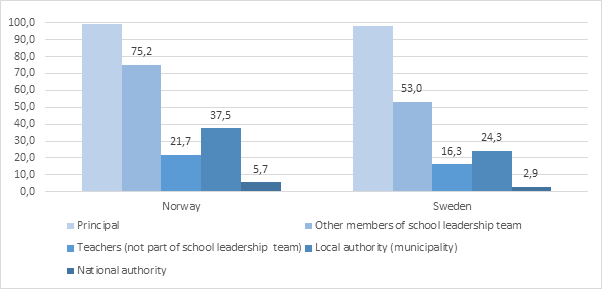
For actors other than principals, significant differences in the responses from Norway and Sweden emerged. The proportion indicating that other actors, including members of school leadership teams, teachers, local authorities and national authorities, are important in leading quality work was higher in Norway than in Sweden. For example, three out of four respondents in Norway stated that other members of the school leadership team also have responsibility for leading quality work, while only a little over half of the respondents in Sweden gave this response. Interesting differences between the two countries also emerged with respect to the proportion who indicated that only one actor is responsible for leading quality work. In Sweden, over a third of respondents, 37 percent, gave this response, while the corresponding share in Norway was one in six respondents. Apparently, Swedish school leaders are more inclined to view principals as individually responsible, indicating a more hierarchical leadership model than that in Norway. While the share who indicated that two actors are involved is similar across the two countries, a significantly higher proportion of respondents in Norway stated that three actors are involved. This country difference is also visible in the mean number of actors involved, which is just below 2 for Sweden and 2.39 for Norway (Table 2), again pointing towards more shared experiences of leading quality work in Norway.
Table 2. Number of actors involved in leading quality work at the school, by country
|
Number of actors involved |
Sweden |
Norway |
|
1 |
37,4 |
17,6 |
|
2 |
37,6 |
39,0 |
|
3 |
18,8 |
32,0 |
|
4 |
5,3 |
9,6 |
|
5 |
0,9 |
1,8 |
|
Total |
100,0 (756) |
100,0 (387) |
|
Mean |
1,95 |
2,39 |
|
Std. deviation |
0,93 |
0,94 |
|
Median |
2,0 |
2,0 |
Experiences of Governance
School leaders’ experiences of what or who governs or regulates their work related to assessment, seen as an indicator of quality work, was a central question in the interviews. The answers illustrate how leadership is shared while also pointing to differences between the two countries. Answers from the Swedish school leaders were consistent across municipalities, indicating similar experiences and shared understandings of governing structures. Figure 2 groups the answers into four main categories – national governing documents, local politics, local administration and principal/s – with only three answers categorised as ‘other’.
Figure 2. School Leaders’ Experiences of What or Who Governs Their Assessment Work – Sweden
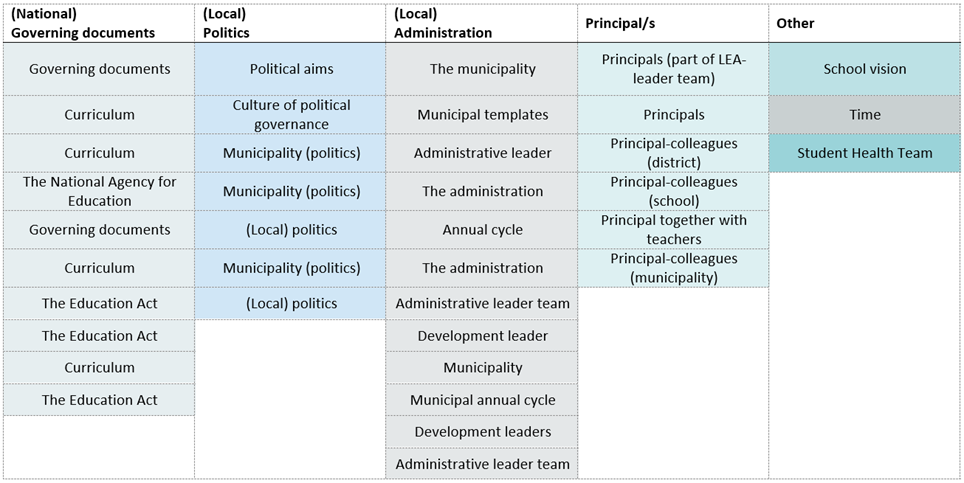
Here the LEA (local politics and local administration combined) is perceived as regulating school leaders’ quality work to a large degree, both through political objectives and control of results, but also by structuring school leaders’ work via standardised templates, matrices and annual cycles. Referring to the LEA, one Swedish school leader stated that:
[A]dministrative leaders and politicians are interested in our results. If we do not reach a certain level of results, we are called to a meeting to evaluate ways to improve. . . . It is presented to politicians. So, there is a very clear chain of command between these parts.[4]
The Swedish informants described the work of both LEA and school leaders as governed by national governing documents, specifically the Education Act and the Curriculum, while national politics was not specifically mentioned. Where school leaders were mentioned, it was as part of the municipal administration or as working in collaboration with teachers or with other leader-colleagues, as described below:
[W]e have a principal district [where we] are a total of eight principals. We meet once a week . . . and discuss common issues such as assessment. We also have check-ins with the municipal leader who is the head of us principals in our district. It is very, very nice to be able to discuss these issues with a colleague who is in the same situation.
In contrast to the above, answers from Norwegian school leaders painted a much more varied picture of how governance of assessment work is experienced (Figure 3).
Figure 3. School Leaders’ Experiences of What or Who Governs Their Assessment Work – Norway
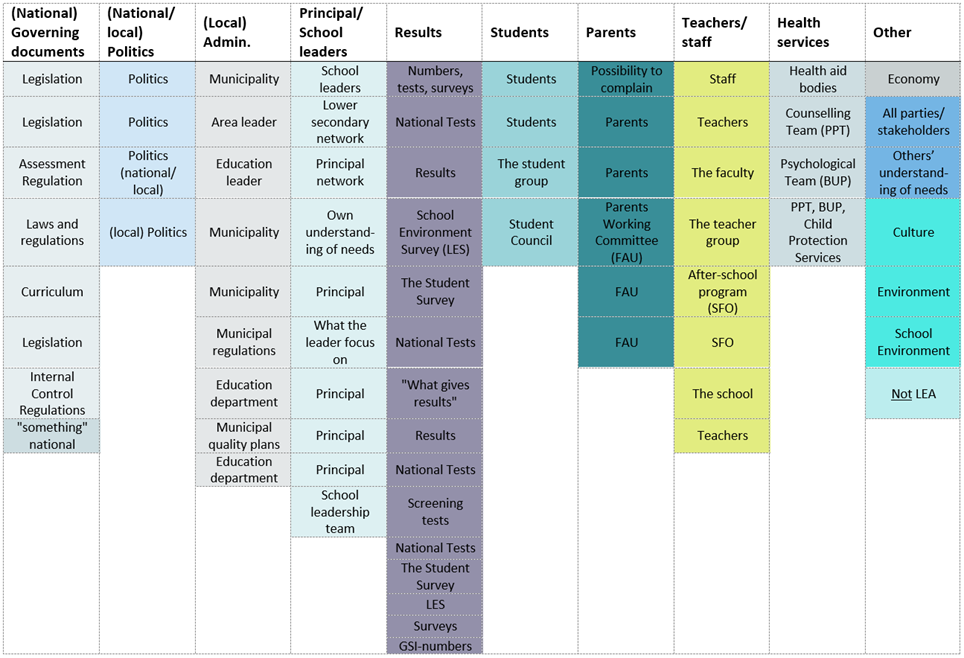
While the four main categories in Figure 2 (Sweden) are also present in Figure 3 (Norway), the latter contains five additional categories: results, students, parents, teachers/staff and student health services. Most noticeable is the ‘results’ category. While results, tests and surveys were also mentioned in the Swedish interviews, they were not given as answers to the question of what governs school leaders’ work with assessment. The Norwegian school leaders also expressed a stronger sense of being continuously assessed. As one Norwegian school leader explained, they are “evaluated by the municipality, and to some extent by the parents, every single day”. In the Swedish interviews, results were referred to as data sources for analysis and information that guides quality work, indicating more of an emotional distance towards external assessments. In sum, the school leaders’ experiences indicate diverging governing contexts where a few actors in the Swedish context contrasts with many actors in the Norwegian context. They also suggest that more actors are involved in practices of shared leadership in Norway than in Sweden.
Sharing Leadership Responsibility
It was evident from our analysis that both Sweden and Norway contain a plurality of sites for dialogue and involvement in quality work. The two countries have similar structures and sites for dialogue, although within each country some variety exists between municipalities and schools. Formal, one-to-one performance appraisal dialogue between employer (school leader) and employee (teacher) are regularly carried out in both countries, as are quality meetings focussing on results, school performance and/or quality development between LEA and schools. Additionally, permanent teams of teachers organised around subjects or levels where dialogue related to teaching and learning takes place, as well as ad hoc teams where school leaders invite teachers or other professionals to discuss issues concerning students’ needs, were identified in both country contexts through the analysis. These sites for dialogue, interactions and collaborations indicate broad involvement and shared responsibility across many different actors and suggest a democratic mindset or attitude amongst school leaders. Accordingly, many of the school leaders hesitated to pinpoint decisions they make alone, despite the authority their formal leadership position gives them. Where examples of individual decision-making were given, Norwegian school leaders highlighted staffing and budgeting, while Swedish school leaders emphasised accommodating students’ needs. One Norwegian school leader stated that decisions related to hiring or allocation of resources, including staff, might involve “moving people” (i.e. a teacher from one class to another) during the school year; however, such decisions “will always be [made] after discussion and listening”. A Swedish school leader similarly explained that actions taken regarding students’ needs are made after discussions with other professional groups: “I, of course, will listen to, for example, the teacher’s assessment and the student health team’s assessment. . . . But ultimately, it’s I who make that decision.”
While respondents from both countries described dialogue and listening as highly valuable in quality work, acting upon the results of dialogue through decision-making seems to a larger degree to be shared in Norwegian schools:
I think the most important thing we have is actually the voices we bring in. We have a quality follow-up meeting once a year, where a student representative, a teacher representative, a parent representative, the leadership team, and a counsellor from the PPT[5] are present. We then look at the surveys and discuss “what do we see here”. . . . And from that, we develop plans for moving forward. (school leader, Norway)
Many of the Norwegian school leaders interviewed indicated that relation-building is an important part of their quality work. They were referring to the relation not only between leader/s and teacher/s but also between teacher/s and student/s, a relation based on day-to-day dialogue as well as organised teacher-student conversations and the work of the student councils. The involvement of both students and parents – the latter through the parents’ working committees (FAU), which were frequently mentioned in the Norwegian interviews – point to a difference between the two countries that the survey did not capture. Norwegian school leaders expressed high regard for student involvement with words such as “it’s wonderful to have student participation”. They found parental involvement more challenging, however, largely because parents were preoccupied with other issues then the students’ learning. Others also indicated that the response rate on surveys to parents is generally low. Nevertheless, they valued the FAU, stating that it provides them with regular parental feedback. In the Swedish context, students’ and (to some extent) parents’ voices are heard through surveys, but the respondents gave less emphasis to dialogue or other involvement of these actors in quality work. One Swedish school leader explained that they used to have a parent council, but it was discontinued during the COVID-19 pandemic and has not been replaced; consequently, parental involvement is often reduced to cases where individual students need extra follow-up or where there are conflicts.
While shared leadership thus appeared more prevalent in the Norwegian context, we found two examples of shared leadership in Sweden that were less prevalent in Norway. They relate to the way school leadership is organised by the LEA. First, several of the Swedish school leaders participating in the interviews were co-principals, meaning principals in school units where the position is occupied by two or more persons. While responsibility for staff and students was formally divided between these co-principals, their shared principalship allowed for shared decision-making in areas such as instructional development and teacher collaboration in student assessment. As one school leader commented, “we share an office, [the co-principal] and me. A lot of questions are landed in the office, I think, when we discuss things together”. The principals indicated that working with other leaders on the same leadership level was an asset as it enabled them to assist each other in difficult situations requiring tough decision-making. The other example from Sweden was found within a municipality where one principal oversees several school units. This way of organising leadership resulted in a practice of involving assistant principals and teacher leaders more in leading quality work:
Together with my assistant [principals], we are trying to find out where we are now . . . together with our teacher leaders. Once we have done that, we will set a goal to work towards. We have both a long-term goal, which is a large umbrella for the entire area, and smaller goals for different units or activities. (school leader, Sweden)
This finding is notable, given that results from the survey show that responsibility for leading quality work is shared with teachers and school leader teams in Norway more so than in Sweden. It might indicate more variation in the organisation of leadership in different municipalities than that present in Norway. However, it might also point towards emerging practices that challenge the more traditional understanding of leadership responsibility as individual and hierarchical.
Discussion and Concluding Remarks
Underpinned by the comparative logic of this mixed method study (Bartlett & Vavrus, 2017), overall findings largely support previous research from Sweden and Norway portraying school leadership in these countries as shared (e.g. Salo et al., 2015). The many sites for dialogue about issues related to quality are indicative of broad involvement and distributed practices (Charteris et al., 2024; Spillane, 2005), giving different actors a possibility to voice their opinions, make professional assessments or raise personal concerns. In both countries, several actors are positioned to influence leadership through day-to-day interactions and formal sites for dialogue, regulated through national legislation, agreements between employee- and employer organisations or embedded in the culture through social-democratic tradition (Aasen et al., 2014). Seen through the lens of Gronn (2008), leadership is shared through both hierarchical and heterarchical relations. The democratic mindset of the school leaders partaking in this study is further illustrative of a similar culture across the two countries where collectivity and inclusion is highly valued, indicating similar conditions for school leaders’ negotiations of professional autonomy in interaction with socio-cultural normative systems. From a comparative point of view, however, shared leadership in the Swedish context seems limited to the various professions working in and around the schools and municipality, resulting in clearer boundaries drawn around those who share leadership than is evident in the Norwegian context. We also find indications that Norwegian school leaders involve more actors in decision-making than Swedish school leaders. A possible explanation for this might be that expectations of collaboration and joint responsibility between local actors are clearly stated in the Norwegian curriculum. From an autonomy perspective, policy expectations, cultural norms and structures for involvement thus appear to impact school leaders’ work slightly differently in the two countries. With more people and actors involved in leadership and governance of quality work in the Norwegian context of this study, conditions might be better suited for collective negotiations of leadership autonomy there.
In the Swedish context, clear divisions of tasks and roles reflect national policy expectations of systematic quality work (Bergh, 2015). Even though several formal and informal (teacher) leaders are involved in shared leadership practices, Swedish principals shoulder the responsibility of leading quality work in schools in a hierarchical and individual leadership culture that to some extent limit the possibilities for shared leadership (Döös & Wilhelmson, 2021). It can also be argued that the increased quality control from the municipal level found in this, and previous studies (e.g. Nordholm et al., 2022b) brings out dilemmas for leaders who might wish to involve more actors in leadership practices through distributed approaches (e.g. Spillane, 2005). Our findings indicate that some stakeholders are left out of sites where dialogue and influence regarding educational quality take place even though their participation in systematic quality work is regulated through the Swedish Education Act. Their omission might be explained by the dilemma principals face when weighing the benefits and risks of normative ideals of involvement in situations where individual responsibility prevails (Mausethagen et al., 2021). On the other hand, since the Swedish school leaders do not report results as governing their quality work and thus communicate a soft individual accountability, it might also be explained by the sheer complexity of fulfilling quality goals in all areas of education (Lundström, 2015). Variation in municipal organisation of leadership in Sweden indicate some movement towards mitigating this dilemma. However, where leadership is formally shared through co-principalship, it appears mostly as an aid to ease individual responsibility (Liljenberg & Andersson, 2020). This variation in organisation of leadership also indicates differences in structural conditions for school leader autonomy between the Swedish municipalities in this study; a difference not found to the same extent in the Norwegian context. In Swedish municipalities where one principal oversees several school units and no longer involved in the day-to-day leadership practices in schools, we also find a tendency towards displacement of influence and control from school-level to the LEA as the principal’s scope of responsibilities has moved closer to the municipal administrative level. This model of leadership seems to stimulate shared practices of leading in leadership teams across schools, elucidating how shared leadership in one site can change practices of leading in other sites. This might challenge traditional perceptions of leadership autonomy as school leaders must navigate possibilities and restrictions within new leadership contexts that emphasise other relations.
Compared to Sweden, regulation and organisation of leadership in quality work seem more complex and less transparent in Norway due to its emphasis on shared and relational leadership. The school leaders’ varied experiences of governance in Norway illustrate a landscape that is comparatively more intricate to navigate for leaders, and highlights how different governance strategies can contribute to creating different conditions for school leader autonomy in the two countries. Quality control through follow-up of results by the LEA appears to garner more attention from school leaders than in Sweden and illustrates what Moos (2009) has identified as a consequence of soft forms of governance. As displayed in the data, some leaders have difficulties separating issues at stake from the feeling of being personally assessed, creating an emotional tension resembling the accountability/democracy dilemma previously discussed (Mausethagen et al., 2021; Wildy et al., 2004). These emotions surfacing can possibly be attributed to a relational, shared and heterarchical culture of leadership with less attention given to the formal solo-leadership (Charteris et al., 2024; Gronn, 2008), combined with professional leadership norms resisting governance by results (Sundberg, 2025a). Broad involvement in practices of leading quality work clearly aligns with national policy expectations of good school leadership. However, tensions arise when LEAs take responsibility for quality by emphasising results in local governance, exposing Norwegian school leaders to a situation where seemingly everyone and everything is leading all at once, challenging collective leadership autonomy by shaking professional norms.
In this study, we have compared conditions for school leader autonomy through exploring characteristics of shared leadership and school leaders’ experiences of governance in quality work in two Nordic countries and shown how they diverge in several respects. National and local governance contexts are found to have implications for leadership autonomy as they create possibilities and constraints, exemplified by varying municipal leadership structures in Sweden and a focus on results in Norway. It follows that contextual policy literacy is important to the professional development of school leaders as it enables them to critically navigate autonomy in diverging contexts and thus ensure educational quality that aligns with policy expectations and professional and individual norms. Policy makers, on their hand, must be aware of the implications harder or softer governance strategies have on school leaders' autonomy, and in turn on educational quality. However, additional empirical research drawing on quantitative and qualitative data is needed to enhance our understanding of relationships between governance, different practices of shared or solo leadership, and leadership autonomy in quality work.
Funding
This work was supported by the Norwegian Research Council as part of the project CLASS - Comparisons of Leadership Autonomy in School Districts and Schools, under Grant 315147.
References
Abrahamsen, H., & Aas, M. (2016). School leadership for the future: Heroic or distributed? Translating international discourses in Norwegian policy documents. Journal of Educational Administration and History, 48(1), 68–88. https://doi.org/10.1080/00220620.2016.1092426
Abrahamsen, H., Aas, M., & Hellekjær, G. O. (2015). How do principals make sense of school leadership in Norwegian reorganised leadership teams? School Leadership & Management, 35(1), 62–78. https://doi.org/10.1080/13632434.2014.992775
Ahlström, B., & Aas, M. (2024). Leadership in low- and underperforming schools—two contrasting Scandinavian cases. International Journal of Leadership in Education, 27(1), 157–178. https://doi.org/10.1080/13603124.2020.1849810
Bartlett, L., & Vavrus, F. (2017). Comparative case studies: An innovative approach. Nordic Journal of Comparative and International Education, 1(1). https://doi.org/10.7577/njcie.1929
Bergh, A. (2015). Local quality work in an age of accountability – between autonomy and control. Journal of Education Policy, 30(4), 590–607. https://doi.org/10.1080/02680939.2015.1017612
Billingsley, B., DeMatthews, D., Connally, K., & McLeskey, J. (2018). Leadership for effective inclusive schools: considerations for preparation and reform. Australasian Journal of Special and Inclusive Education, 42(1), 65–81. https://doi.org/10.1017/jsi.2018.6
Braun, V., & Clarke, V. (2022). Thematic analysis: A practical guide. SAGE.
Brinkmann, S., & Kvale, S. (2018). Doing interviews (2nd ed.). SAGE Publications Ltd. https://doi.org/10.4135/9781529716665
Carpenter, D. (2015). School culture and leadership of professional learning communities. International Journal of Educational Management, 29(5), 682–694. https://doi.org/10.1108/IJEM-04-2014-0046
Charteris, J., Smardon, D., & Kemmis, S. (2024). Collaborating and distributing leading: Mosaics of leading practices. The Australian Educational Researcher. https://doi.org/10.1007/s13384-024-00690-8
Cheng, Y. C., Ko, J., & Lee, T. T. H. (2016). School autonomy, leadership and learning: A reconceptualisation. International Journal of Educational Management, 30(2), 177–196. https://doi.org/10.1108/IJEM-08-2015-0108
Creswell, J. W., & Plano Clark, V. L. (2018). Designing and conducting mixed methods research (Third edition.; International student edition). Sage.
Connolly, M., James, C., & Fertig, M. (2019). The difference between educational management and educational leadership and the importance of educational responsibility. Educational Management Administration & Leadership, 47(4), 504–519. https://doi.org/10.1177/1741143217745880
Diamond, J. B., & Spillane, J. P. (2016). School leadership and management from a distributed erspective: A 2016 retrospective and prospective. Management in Education, 30(4), 147–154. https://doi.org/10.1177/0892020616665938
Döös, M., & Wilhelmson, L. (2021). Changing organizational conditions: Experiences of introducing and putting function-shared leadership (FSL) into practice in schools and pre-schools. Leadership and Policy in Schools, 20(4), 672–689. https://doi.org/10.1080/15700763.2020.1734628
Döös, M., Wilhelmson, L., Madestam, J., & Örnberg, Å. (2018). The shared principalship: Invitation at the top. International Journal of Leadership in Education, 21(3), 344–362. https://doi.org/10.1080/13603124.2017.1321785
Gronn, P. (2008). The future of distributed leadership. Journal of Educational Administration, 46(2), 141–158. https://doi.org/10.1108/09578230810863235
Gunnulfsen, A. E., & Leo, U. (2023). Principals’ roles in a Nordic education context: Shared responsibility and pedagogical engagement. In A. E. Gunnulfsen, H. Ärlestig, & M. Storgaard (Eds.), Education and democracy in the Nordic countries: Making sense of school leadership, policy, and practice (pp. 115–132). Springer International Publishing. https://doi.org/10.1007/978-3-031-33195-4_8
Gunnulfsen, A. E., Ärlestig, H., & Storgaard, M. (2023). Making sense of Nordic school leadership – four perspectives on similarities and variations. In Gunnulfsen, A. E., Ärlestig, H., & Storgaard, M. (Eds.) Education and democracy in the Nordic countries: Making sense of school leadership, policy, and practice (pp. 173–182). Springer International Publishing. https://doi.org/10.1007/978-3-031-33195-4_11
Hall, J. B., & Karseth, B. (2025). Juridification of Norwegian education: students’ rights to a safe and good school environment. Journal of Education Policy, 40(6), 1000–1021. https://doi.org/10.1080/02680939.2025.2537179
Harris, A. (Ed.). (2009). Distributed leadership: Different perspectives. Springer. https://doi.org/10.1007/978-1-4020-9737-9
Harris, A., Jones, M., & Ismail, N. (2022). Distributed leadership: Taking a retrospective and contemporary view of the evidence base. School Leadership & Management, 42(5), 438–456. https://doi.org/10.1080/13632434.2022.2109620
Hauge, T. E., Norenes, S. O., & Vedøy, G. (2014). School leadership and educational change: Tools and practices in shared school leadership development. Journal of Educational Change, 15(4), 357–376. https://doi.org/10.1007/s10833-014-9228-y
Hesse-Biber, S. (2018). Toward an understanding of a qualitatively driven mixed methods data collection and analysis: Moving toward a theoretically centered mixed methods praxis. In U. Flick (Ed.), The SAGE handbook of qualitative data collection (pp. 545-563). SAGE Publications Ltd. https://doi.org/10.4135/9781526416070
Jarl, M., Fredriksson, A., & Persson, S. (2012). New public management in public education: A catalyst for the professionalization of Swedish school principals. Public Administration (London), 90(2), 429–444. https://doi.org/10.1111/j.1467-9299.2011.01995.x
Kim, T., & Weiner, J. (2022). Negotiating incomplete autonomy: Portraits from three school principals. Educational Administration Quarterly, 58(3), 487–521. https://doi.org/10.1177/0013161X221080374
Larsson, P., & Löwstedt, J. (2023). Distributed school leadership: Making sense of the educational infrastructure. Educational Management Administration & Leadership, 51(1), 138-156. https://doi.org/10.1177/1741143220973668
Leithwood, K., Harris, A., & Hopkins, D. (2020). Seven strong claims about successful school leadership revisited. School Leadership & Management, 40(1), 5–22. https://doi.org/10.1080/13632434.2019.1596077
Leithwood, K., & Mascall, B. (2008). Collective leadership effects on student achievement. Educational Administration Quarterly, 44(4), 529–561. https://doi.org/10.1177/0013161x08321221
Liljenberg, M. (2022). Drivers of improvement at local level – tension and support from coexisting logics. Scandinavian Journal of Educational Research, 66(2), 225–237. https://doi.org/10.1080/00313831.2020.1788157
Liljenberg, M., & Andersson, K. (2020). Novice principals’ attitudes toward support in their leadership. International Journal of Leadership in Education, 23(5), 567–584. https://doi.org/10.1080/13603124.2018.1543807
Lorentzen, M. (2022). Principals’ positioning of teacher specialists: Between sensitivity, coaching, and dedication. International Journal of Leadership in Education, 25(4), 615–633. https://doi.org/10.1080/13603124.2020.1737240
Lundahl, L., Arreman, I. E., Holm, A. S., & Lundström, U. (2013). Educational marketization the Swedish way. Education Inquiry, 4(3). https://doi.org/10.3402/edui.v4i3.22620
Lundström, U. (2015). Systematic quality work in Swedish schools: Intentions and dilemmas. Scandinavian Journal of Public Addministration, 19(1), 23–43. https://doi.org/10.58235/sjpa.v19i1.15628
MacBeath, J. (2009). Distributed leadership: Paradigms, policy, and paradox. In K. Leithwood, B. Mascall, & T. Strauss (Eds.), Distributed Leadership According to the Evidence (pp. 41–57). Routledge. https://doi.org/10.4324/9780203868539
Mausethagen, S., Prøitz, T. S., & Skedsmo, G. (2021). Redefining public values: Data use and value dilemmas in education. Education Inquiry, 12(1), 1–16. https://doi.org/10.1080/20004508.2020.1733744
Ministry of Education and Research. (2017). Core curriculum – values and principles for primary and secondary education. Laid down by Royal decree. The National curriculum for the Knowledge Promotion 2020. https://www.regjeringen.no/contentassets/53d21ea2bc3a4202b86b83cfe82da93e/core-curriculum.pdf
Monforte, J., & Úbeda-Colomer, J. (2021). Tinkering with the two-to-one interview: Reflections on the use of two interviewers in qualitative constructionist inquiry. Methods in Psychology, 5. https://doi.org/10.1016/j.metip.2021.100082
Moos, L. (2009). Hard and soft governance: The journey from transnational agencies to school leadership. European Educational Research Journal, 8(3), 397–406. https://doi.org/10.2304/eerj.2009.8.3.397
Morse, J. M., Cheek, J., & Clark, L. (2018). Data-related issues in qualitatively driven mixed-method designs: Sampling, pacing, and reflexivity. In U. Flick (Ed.), The SAGE handbook of qualitative data collection (pp. 564–583). SAGE Publications Ltd. https://doi.org/10.4135/9781526416070
Møller, J. (2009). Approaches to school leadership in Scandinavia. Journal of Educational Administration and History, 41(2), 165–177. https://doi.org/10.1080/00220620902808244
Møller, J., & Eggen, A. B. (2005). Team leadership in upper secondary education. School Leadership & Management, 25(4), 331–347. https://doi.org/10.1080/13634230500197132
Nehez, J., Sülau, V., & Olin, A. (2023). A web of leading for professional learning – leadership from a decentring perspective. Journal of Educational Administration and History, 55(1), 23–38. https://doi.org/10.1080/00220620.2022.2114433
Nordholm, D., Wermke, W., Andersson, A., & Kotavuopio Olsson, R. (2022a). State, municipality and local community. Exploring principal’s autonomy and control in the rural north of Scandinavia. Education Inquiry, 15(4), 548-565. https://doi.org/10.1080/20004508.2022.2149059
Nordholm, D., Wermke, W., & Jarl, M. (2022b). In the eye of the storm? Mapping out a story of principals’ decision-making in an era of decentralisation and re-centralisation. Journal of Educational Administration and History, 55(4), 420-440. https://doi.org/10.1080/00220620.2022.2104823
Nordholm, D., Jarl, M., & Wermke, W. (2025). School leader autonomy – A systematic review. Educational Administration Quarterly, 0(0), 0013161X251349562. https://doi.org/10.1177/0013161x251349562
Norqvist, L. & Ärlestig, H. (2021). Systems thinking in school organizations – perspectives from various leadership levels. Journal of Educational Administration, 59(1), 77-93. https://doi.org/10.1108/JEA-02-2020-0031
NOU 2023:1. (2023). Kvalitetsvurdering og kvalitetsutvikling i skolen. Et kunnskapsgrunnlag. Kunnskapsdepartementet. https://www.regjeringen.no/contentassets/8758c1a973ae4f94ab67e3830c96b9c9/no/pdfs/nou202320230001000dddpdfs.pdf
OECD. (2012). Equity and quality in education. OECD Publishing. https://doi.org/10.1787/9789264130852-en
Opplæringslova. (2023). Lov om grunnskoleopplæringa og den vidaregåande opplæringa (LOV-2023-06-09-30). Lovdata. https://lovdata.no/dokument/NL/lov/2023-06-09-30
Parker, C., Scott, S., & Geddes, A., (2019). Snowball Sampling. In P. Atkinson, S. Delamont, A. Cernat, J. W. Sakshaug, & R. A. Williams (Eds.), SAGE Research Methods Foundations. https://doi.org/10.4135/9781526421036831710
Pont, B., Nusche, D., & Moorman, H. (2008). Improving School Leadership, Volume 1: Policy and Practice. OECD Publishing. https://doi.org/10.1787/9789264044715-en
Poom-Valickis, K., Eve, E., & Leppiman, A. (2022). Creating and developing a collaborative and learning-centred school culture: Views of Estonian school leaders. Center for Educational Policy Studies Journal, 12(2), 217–237. https://doi.org/10.26529/cepsj.1029
Postholm, M. B. (2019). The school leader’s role in school-based development. Educational Research, 61(4), 437–450. https://doi.org/10.1080/00131881.2019.1677171
Prøitz, T. S., & Mausethagen, S. (2022). Mellom administrasjon og faglig-pedagogisk arbeid - rektorrollen i reformtid i Norge. Paideia, 23, 7–20.
Prøitz, T. S., Mausethagen, S., & Skedsmo, G. (2017). Data use in education: Alluring attributes and productive processes. Nordic Journal of Studies in Educational Policy, 3(1), 1–5. https://doi.org/10.1080/20020317.2017.1328873
Prøitz, T. S., & Nordin, A. (2020). Learning outcomes in Scandinavian education through the lens of Elliot Eisner. Scandinavian Journal of Educational Research, 64(5), 645–660. https://doi.org/10.1080/00313831.2019.1595717
Rapley, T. (2014). Sampling strategies in qualitative research. In U. Flick (Ed.), The SAGE handbook of qualitative data analysis (pp. 49-63). SAGE Publications Ltd. https://doi.org/10.4135/9781446282243.n4
Saldana, J. (2011). Fundamentals of qualitative research. Oxford University Press.
Salo, P., Nylund, J., & Stjernstrøm, E. (2015). On the practice architectures of instructional leadership. Educational Management Administration & Leadership, 43(4), 490–506. https://doi.org/10.1177/1741143214523010
Schulte, B. (2023). The policy-practice nexus as ‘politics of use’: Professional autonomy and the teacher agency in the classroom. In T. Prøitz, P. Aasen, & W. Wermke (Eds.), From Education Policy to Education Practice: Unpacking the Nexus (pp. 39–57). Springer.
Skollag. (2010/2025). Skollag (2010:800). Sveriges Riksdag. https://www.riksdagen.se/sv/dokument-och-lagar/dokument/svensk-forfattningssamling/skollag-2010800_sfs-2010-800/
Skolverket. (2024). Curriculum for compulsory school, preschool class and school-age educare – Lgr22. https://www.skolverket.se/publikationer?id=13128
Spillane, J. P. (2005). Distributed leadership. The Educational Forum, 69(2), 143–150. https://doi.org/10.1080/00131720508984678
Starr, K. E. (2014). Interrogating conceptions of leadership: School principals, policy and paradox. School Leadership & Management, 34(3), 224–236. https://doi.org/10.1080/13632434.2014.905466
Sundberg, R. A. (2025a). Collective autonomy through school leader unions (2006–2021): Comparative case study from Sweden and Norway. European Educational Research Journal, 24(3), 372-393. https://doi.org/10.1177/14749041241277921
Sundberg, R. A.(2025b). School leader autonomy in quality work: A comparative study from Norway and Sweden [Doctoral dissertation]. University of South-Eastern Norway, submitted for evaluation.
Tian, M., Risku, M., & Collin, K. (2016). A meta-analysis of distributed leadership from 2002 to 2013: Theory development, empirical evidence and future research focus. Educational Management Administration & Leadership, 44(1), 146–164. https://doi.org/10.1177/1741143214558576
Torres, A. C., Bulkley, K., & Kim, T. (2020). Shared leadership for learning in Denver's portfolio management model. Educational Administration Quarterly, 56(5), 819–855. https://doi.org/10.1177/0013161X20906546
Ulhøi, J. P., & Müller, S. (2014). Mapping the landscape of shared leadership: A review and synthesis. International Journal of Leadership Studies, 8(2), 66–87.
Webber, C. F., Nickel, J., Hamilton, S., & Braunberger, D. (2024). Contextualised shared leadership: A Canadian case study. School Leadership & Management, 44(3), 318–337. https://doi.org/10.1080/13632434.2024.2303636
Wildy, H., Forster, P., Louden, W., & Wallace, J. (2004). The international study of leadership in education: Monitoring decision making by school leaders. Journal of Educational Administration, 42(4), 416–430. https://doi.org/10.1108/09578230410544044
Zhu, J., Liao, Z., Yam, K. C., & Johnson, R. E. (2018). Shared leadership: A state-of-the-art review and future research agenda. Journal of Organizational Behavior, 39(7), 834–852. https://doi.org/10.1002/job.2296
Ärlestig, H., & Leo, U. (2023). Sweden – Good will on all governance levels is not enough to create sustainable improvement. In A. E. Gunnulfsen, H. Ärlestig, & S. Merete (Eds.), Education and Democracy in the Nordic Countries: Making Sense of School Leadership, Policy, and Practice (pp. 75-87). Springer. https://doi.org/10.1007/978-3-031-33195-4_6
Aasen, P., Prøitz, T. S., & Sandberg, N. (2014). Knowledge regimes and contradictions in education reforms. Educational Policy, 28(5), 718–738. https://doi.org/10.1177/0895904813475710
 ©2026 Rikke A. Sundberg, Elisabeth Hovdhaugen. This is an Open
Access article distributed under the terms of the Creative Commons Attribution
4.0 International License (http://creativecommons.org/licenses/by/4.0/),
allowing third parties to copy and redistribute the material in any medium or
format and to remix, transform, and build upon the material for any purpose,
even commercially, provided the original work is properly cited and states its
license.
©2026 Rikke A. Sundberg, Elisabeth Hovdhaugen. This is an Open
Access article distributed under the terms of the Creative Commons Attribution
4.0 International License (http://creativecommons.org/licenses/by/4.0/),
allowing third parties to copy and redistribute the material in any medium or
format and to remix, transform, and build upon the material for any purpose,
even commercially, provided the original work is properly cited and states its
license.