Vol 10, No 2 (2026)
https://doi.org/10.7577/njcie.6494
Article
Research-based teaching and learning: Proposals to engage university students with science and their transfer to the Nordic context
Narcís Bassols i Gardella
Uppsala University
Email: narcis.bassols@angstrom.uu.se
Beatriz Helena Díaz Solano
Universidad Autónoma del Caribe
Email: beatriz.diaz@uac.edu.co
Sandra Osorio Bastos
Universidad Autónoma del Caribe
Email: sandra.osorio@uac.edu.co
Abstract
Research-Based Teaching and Learning strategies have come to the fore in recent years to better engage students from all levels with research. As in any novel area in teaching, practices and experiences are needed for the teaching community to eventually implement this approach. Hence, this article presents and appraises several activities with the potential of engaging university students with research. Three extracurricular proposals are analyzed within the framework of Research-Based Teaching and Learning. These are: the scheme ‘Young Researcher Seedbeds’ in Colombia, the student activities at the CONPEHT Tourism Conference in Latin America and the thoughts and experiences of one of the authors about publishing with students in Sweden and in Colombia. The authors use case study techniques to report the first and second initiatives, whereas the third initiative is presented under an auto-ethnographical point of view. In the final section, some thoughts about transferring these ideas to the Nordic context are put forth. The studied extracurricular activities and schemes are found to have potential in promoting ‘hands-on’, active learning, as they bring students in contact with research early in their education. These activities bring about not only an interest in science but also a range of related soft skills, such as collaboration, communication, and presentation competencies. Students get to experience the ‘social’ side of science by producing or disseminating it. A thorough evaluation of these activities and their transfer, however, remains a pending issue. Practitioners interested in expanding their portfolio towards research-based activities may find in this paper inspiration from international, innovative sources to eventually transfer to their contexts.
Keywords: Active Learning, Research-Based Learning, Inquiry-Based Teaching, Extracurricular activities
Introduction and goals
Within the broad streams of ‘active learning’ (Latorre Beltrán, 2009), in recent years there has been a push for ‘Research-Based Teaching and Learning’, RBTL henceforth (Healey, 2005), also called ‘Research-Based Teaching’ or ‘Inquiry-Based Learning’ (Mieg, 2019). This framework posits the usefulness of having students working in real-world research contexts from their first learning stages. This is not just to instill in them a liking for science, but also to provide them with more ‘hands-on’ curricula and the opportunity to learn some soft skills related to science, such as collaboration with peers, presentations at conferences, the writing of papers, etc.
Advancing curricula with RBTL contents or activities may be challenging, especially in humanities and social science courses because RBTL seems to be anchored more in ‘hard sciences’; in this respect, Jansen-Schulz and Tantau (2018, p. 14) remark on the ‘growing popularity’ of RBTL in science and technology curricula, and Hammer and Podleschny (2019) implement research-based curricula at a technical university. However, RBTL proposals in the social sciences, arts and humanities are also emerging, see contributions to Mieg (2019). This article analyses three proposals for extracurricular activities within the RBTL framework.
Research-related activities at universities (and even at primary and secondary schools) come with a series of benefits, which will be critically presented and analyzed here via the three reported initiatives. These initiatives are: the Young Researchers’ Seedbeds in Colombia, a scheme which has students participating in real projects at their universities (and even schools); the CONPEHT Hospitality and Tourism Latin American conference, as an international meeting offering students the possibility to present their research results and do networking; and finally, the experience of publishing with students, i.e., having fresh university graduates turning their final research works into publications. These three practices have been selected as they offer an insight into three of the main areas in RBTL: producing, presenting and publishing science (Elmgren & Henriksson, 2021).
These proposals come largely from Latin American contexts (except the third one which comes with fieldwork from both Sweden and Colombia). This region has brought up some interesting (but still not researched nor disseminated) proposals for RBTL. Moreover, initiatives related to RBTL are growing in numbers across several countries in the continent, which makes it interesting to study them and to reflect on their transfer to other contexts (here the Nordic context is chosen for reasons of geographical convenience). Furthermore, the reported initiatives here mainly refer to the domain of Hospitality and Tourism, an under-researched area in RBTL, to the authors’ knowledge. While presenting the activities, we will also try to understand to what extent they conform to the multiple definitions of RBTL to bring some clarification to the literature as well.
Frameworks and methods
As for our theoretical frameworks, the first two initiatives presented are seen as case studies or best practices (Stake, 1995). This approach posits that reality may be comprehended by examining concrete and tangible phenomena and therefore allows for detailed, rich descriptions. The section on publishing with students, however, uses autoethnography as a method (Adams, 2014; Ellis et al., 2011) since it allows for introspective, subjective explorations of facts and people.
The fieldwork consisted of compiling statistical data from authoritative sources related to the presented initiatives, which also includes data about participants and outreach. Also, attending conferences and presentations was part of the fieldwork. Several authors of this paper have been engaged in the reported schemes for years; therefore, self-reporting also forms part of the data collection for this paper. Finally, exchanges with colleagues involved in these initiatives, as well as students, complete the data collection for this article.
RBTL: A concise literature review
Huber (2014, p. 37) puts forth a definition for RBTL, though distinguishing between the teaching and learning sides:
· Research-oriented teaching implies introducing students to the academic culture of their discipline and to the theory and practice of science. Students and instructors jointly design learning events in which competency-oriented preparation for highly complex activities both within and outside of academia takes place.
· Research-based learning is defined as: ‘the independent – albeit carefully guided – development and definition of research questions by the learners; the independent design of processing activities aimed at the independent practice of scientific practices and methods; and the critical discussion, plausible evaluation, and clear documentation of research experiences and results.’
Hence, this double-sided definition operates on two levels; at one level, research teaching is characterized by the co-design of activities between instructors and students, whereas on the other level, research-based learning refers to students working independently on the designed goals and activities. The examples presented in this article are connected to the second definition, ‘research-based learning’.
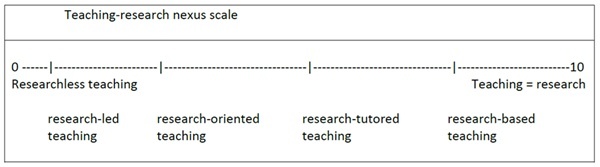
Healey’s (2005) seminal paper on RBTL remains a central contribution to the literature. He conceptualized this learning and teaching stream mostly in terms of the extent to which research is emphasized in activity or curriculum. Specifically, Healey posited three dichotomous dimensions describing RBTL: emphasis on research content vs. research processes; treating students as audience vs. participants; and the teaching being teacher-focused vs. student-focused. Subsequent theoretical discussions have refined these distinctions, proposing different levels of RBTL and shifting the focus toward either results or processes (Willcoxson et al., 2011). Figure 1 reproduces the model by Dekker & Wolff (2016), which presents a continuum ranging from teaching without research integration to teaching fully based on research:
Figure 1. The ‘teaching-research nexus scale’.
Source: Dekker & Wolff (2016, p. 3)
Griffiths (2004) also adopts a four-level scale of RBTL to further develop its application in the field of building science teaching. He underscores that RBTL teaching leads to greater diversity in teaching practices and encourages reflection on the different ways in which scientific knowledge is produced in a specific discipline.
Elmgren & Henriksson (2021, p. 240-243) acknowledge the different uses of RBTL ranging from discussions on current scientific issues and their social impact, to introducing students to research, showing them how to understand the implications of research and supporting them in disseminating research results. For their part, Park et al. (2023) apply RBTL to support student understanding of research papers. Hence, the literature soon identified different levels of RBTL engagement, an issue that has been discussed continually in these terms up to the present day.
The efficacy and benefits of RBTL in active teaching and learning have been highlighted in recent research in terms of building communication and collaboration skills and encouraging early contact with research during student studies. (Arifin et al., 2022; Farag, 2023; Wessels et al., 2021). Also, the broader usefulness of RBTL has been discussed by different authors. Saunders (2017) examines the application of this framework in teacher education, and Aguilar (2020) highlights its usefulness in resource evaluation. Fiskum et al. (2025) reflect on the value of research-based learning in teacher education in a Nordic context. However, the authors of this paper could not find any proposals on RBTL as extracurricular support or dealing with tourism-related topics. Hence, this paper proposes such activities within an RBTL framework.
Training in research: the Young Researchers Seedbeds scheme in Colombia, South America
Context and outreach of the program
Researchers’ seedbeds are defined by Avolio et al. (2023) as “communities of extracurricular learning and voluntary participation, wherein students, through a guided and progressive exercise, develop competencies for research through training activities, extracurricular workshops and research projects.” This section presents the main contributions and current situation of the scheme ‘Young Researchers Seedbeds’ (Semilleros de investigación is the original Spanish term), an RBTL initiative, as is has been implemented in Colombia. The interesting aspect of this initiative is the close interaction among researchers and students, who volunteer their time in this extracurricular activity, which may benefit both groups.
The background to this program can be traced back to the higher education policies introduced in Colombia in the 1980s, when new generations of researchers emerged requiring specific legal frameworks to support their development. Thus, a new national law was passed (Government of Colombia, 1980) which put forth the following research-based strategies for post-secondary education:
• Including a research component in all curricula
• The requirement of final research works (Bachelor/Master thesis or equivalent research project)
• Including specific research courses in the curricula
• Promoting a new model for primary and secondary schools focused on community-based projects and active pedagogical tools
It is from this specific framework and context that the Young Researchers Seedbeds (YRS henceforth) gradually emerged in the country (Quintero-Corzo et al., 2008). Additional curricular modifications and policies for scientific development, which were implemented in the country around the turn of the millennium, further promoted active student participation as research assistants, thesis’ authors, (co-) proponents of innovation projects, members or coordinators of research seedbeds or research mentors to younger cohorts. All these activities started to revolve around the YRSs, as they supported the students’ ability ‘to produce knowledge processes which were key to the construction of the new knowledge the nation needed’ (Maury et al., 2017).
As the number of YRSs grew across the country, the need arose for an institution to take on the overall coordination of the initiative at a national level, which led to the Redcolsi network. This is a non-profit foundation that has been leading and overseeing the YRSs across the country since 1998 (Redcolsi, 2017; 2021). Moreover, the YRS initiative has extended throughout the Colombian education system, with primary and secondary sectors also adopting an RBTL-orientated approach, in some instances with interesting results: see for instance Bassols i Gardella (2020) reporting on the ‘Friends of Tourism’ scheme for primary and secondary education, an initiative pushed by the national tourism authorities in collaboration with the national hotel association. As a multi-level, nation-wide initiative, the YRS task is to foster a national research culture (Redcolsi, 2022a; 2022b) and increase the visibility of their members’ research results. The extent of Redcolsi’s activity after 25 years is reflected in the fact that, by 2023, approximately 204,000 students had been part of the YRS scheme (one third of them at primary or secondary schools, two thirds at universities).
The network has grown over time, and today it comprises 21 regional nodes. As of 2023, it had 50,731 registered ongoing projects and 11,745 finished projects, of which 2,852 had been labelled ‘innovation projects’ and 3,234 ‘entrepreneurship projects’ (Redcolsi, 2024). Virtually every university department in Colombia has YRS-related activities.
Students may carry out activities supporting their teacher’s research or laboratory-based research. Science communicating is another possible activity within the YRS scheme, as some groups have their own pages on social media to network and disseminate their findings.
In some instances, scientific publishing is also part of the work carried out within a YRS. The publications may appear in journals that are specifically intended to receive YRS papers. On other occasions, depending on the quality and novelty of the research, papers appear in national or even international journals.
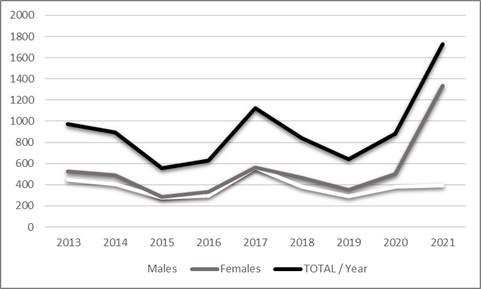
The YRS initiative also provides an opportunity for student mobility: universities welcome students (both undergraduates and postgraduates) who are funded as a part of the student support initiative at a national level. To be part of this funding scheme, students must be up to 28 years of age and be endorsed by a senior researcher at the host university, as they become involved in projects led by senior staff (MinCIT, 2020 and Figure 2).
Figure 2. Young researchers directly funded by the National Ministry of Science, 2013-2021.
Source: OCyT (2021).
Students participating in a project in any given year may participate at the annual YRS national conference, where they can network with their peers, share knowledge and present their results in front of an audience. A special distinction is given to the projects that are judged to be the best. This national conference has been held annually for the last 20 years.
Finally, it is to notice the scheme’s recent expansion into other Latin American countries such as Mexico, Peru and Ecuador, which also have started to develop their own YRS programs.
Managing the YRS day-to-day at a university: the experience of the Universidad Autónoma del Caribe (UAC) in Barranquilla, Colombia
Research-based activities need to be well-planned and evaluated to be effective (George & Clevenger, 2019). In the specific case of the YRSs, Villalba Cuéllar & González Serrano (2017) underscore that these initiatives need strong support from schools and universities. To illustrate the everyday management of the YRS processes, we report here on the ones from the Universidad Autónoma del Caribe (UAC) in the city of Barranquilla, on the Colombian Caribbean coast.
At the UAC, the YRS scheme operates under the guidance of the university’s research director, together with a certain number of designated researchers in each faculty. These researchers welcome and mentor students in their research labs, after having established their needs for young researchers over a certain term.
Every term, a call for young researchers is issued. All the teachers at the university help in disseminating the call on their courses. Every student may join the initial step to become part of the initiative, which is a three-month course about research practices. To be accepted on the course, an undergrad student must be at least in the 3rd semester of their BA/BEng and to have demonstrated good academic performance. This course is taught by the university’s main researchers.
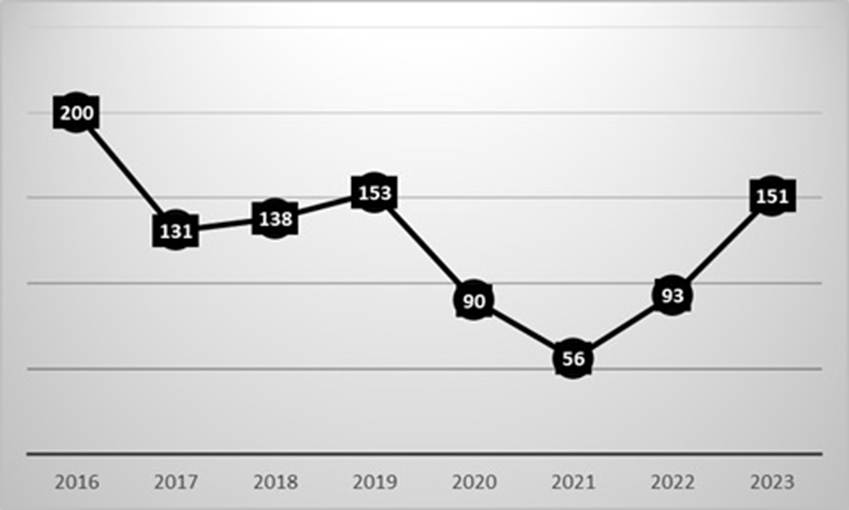
The training ends with the students presenting their own research proposals. Figure 3 shows the numbers of students who have passed the course at the UAC in the last decade. The average participation is approximately 140 students per year, out of an overall average student population of 9200 (years 2013 to 2023). The after-COVID recovery is notable.
Figure 3. Number of trained young researchers per year at the UAC, Barranquilla.
Source: UAC (2024)
After finishing their training course, the fresh young researchers are invited to join various ongoing projects. The number of weekly hours devoted to research is negotiated individually, usually between 4 and 10 hours. This figure may be re-negotiated at the beginning of any semester, depending on project requirements and student availability. As stated above, students joining a group may support different research activities such as gathering of data or dissemination tasks.
Crucially, as is also the case with sports or social activities, the university highly encourages YRS, but according to the national university curriculum, the time spent on research (or sports or social activities) is considered ‘complementary education’, so students cannot earn any academic credits from them. It is therefore extracurricular education. The main tangible benefits for young researchers at the UAC and other universities are the discounts on the registration fees, which can range from 10% to 50%, depending on the number of hours worked in the previous semester. In some externally funded projects, there is also the possibility of receiving a salary. The UAC also provides management and mentorship to undergraduates who are part of the national scheme, by funding up to 12 months of their participation in different projects. A certain level of seniority is required for specific projects, as well as having passed 60% of one’s degree credits.
Summing up: a preliminary evaluation of the YRS scheme
The bottom-line motivation of the YRS initiative is that progress in science, technology and knowledge is essential for addressing the various problems emerging today (Silva Arias et al., 2008; Saavedra-Cantor, et al. 2015). YRSs are seen as a tool to generate improvement and social change, by helping to train the future researchers the country needs, according to Castro-Rodríguez (2022). They have also instilled research skills in students, together with the soft skills required for research such as collaboration with peers, presentation skills, communication skills in disseminating scientific ideas or networking with peers (UAC, 2023).
As the YRS scheme has been running for decades, it has expanded to almost all the universities in the country, including more than 200,000 students. It has also expanded internationally and fostered cooperation between universities and industry, growing in numbers and outreach.
Students at research conferences: the example of the Pan-American Association of Hospitality, Gastronomy and Tourism Schools Conference, CONPEHT
Another worthy RBTL experience is that offered by CONPEHT, the association of tourism universities and hospitality vocational schools in Latin America and the Caribbean, with a few members in Europe and North America as well. To give some context and scale to this initiative, it is reported that it was founded in 1991, at a time tourism started to increase in the region and currently consists of 132 institutions from across 20 countries, with a community of 68,000 students and 3,800 teachers. Since its inception, CONPEHT has aimed to elevate tourism education standards throughout the region by fostering co-operation among its members, knowledge exchanges and the dissemination of good practices. It also has helped in developing quality standards in the education of future hospitality professionals (see www.conpeht.com; Giraldo Velásquez & Rivera Herrera, 2017). Students also find possibilities for exchanges, internships and other forms of mobility within the association.
The CONPEHT’s conference, held annually in a different country across the region, is the association’s most important annual highlight, an exchange experience between senior researchers from universities or vocational schools, similar to any scientific conference. However, what makes this conference unique is that it also offers students ample possibilities for active participation. In fact, the program includes activities targeted specifically at them by promoting learning, exchanges and socializing. Among these activities, there is the Student Research Contest, the Food Service Contest or the social event called Pan-American Night. Furthermore, CONPEHT’s annual conferences have consistently maintained a strong student focus, through these activities. The powerful presence of students, representing the majority of participants (mostly local and national due to budgetary restraints), is a distinctive feature of the conference, in many ways making it a ‘student conference’.
In the early editions, international experts were invited to bring the latest ideas about tourism to the Latin American and Caribbean region. However, over time, knowledge and experience emerged from their own ranks. This is when the Students’ Coordination was created, with its main emphasis on research. They introduced the Student Research Contest, one of the most prominent events at the annual conferences. The entrants may be individual students or small groups, who are always mentored by a teacher from their institution. The contributions submitted to the contest must be original and are evaluated confidentially by a committee of researchers from different member institutions. Out of the research works received, around 20 to 25 are selected for presentations at the conference. The presentations are held in front of a mixed international audience including peers, researchers and local tourism stakeholders. The three winning research teams, as well as their home institutions, are recognized with a reward.
There are no restrictions on the themes to be submitted, so every group can pursue their interests. Taking part in this contest helps students develop research skills and address practical industry challenges. Both analytical and problem-solving skills are promoted, together with the honing of presentation skills before large academic and professional audiences (Giraldo Velásquez & Rivera Herrera, 2017). In recent years, there has been an increasing number of submissions from a growing range of universities and technical schools across the region.
Having reached its 28th edition in 2025, the Student Research Contest is a well-established feature in the CONPEHT conferences. We list here below the three winning presentations of the contest held at the 2024 CONPEHT conference in Guatemala, Central America (see www.conpehtguatemala2024.com) as examples:
• The usage of coca leaves in the traditional Colombian gastronomy
• Culinary Culture at the Royal Palace, Ecuador
• Communitarian rural tourism and economic development in the Huaral province, Peru
Furthermore, the contest has recently undergone restructuring as other forms of active student participation have been introduced, for example, the Food Service Contest and the Bartender Contest, aimed at fostering innovations in the food service value chain and the management of food-related start-ups. Also, at the 2024 conference in Guatemala, a new type of research contest for students was launched: the first Student Poster Contest, a session allowing for more informal, artistic and personal presentations. This first poster contest was quite successful, and it is to be continued in coming years.
While there are benefits in participating in such a conference (having one’s research disseminated, interacting with peers to build networks…), it must still be pointed out that this is an extracurricular activity, and although students are adding an ‘extra’ item to their curricula, the long-term professional benefits may not be immediately apparent.
When supervisors and supervised students become co-authors: challenges and opportunities in publishing with students
This section illustrates another way to involve students in RBTL: co-authoring peer-reviewed publications with their supervisors. The focus here is on Bachelor and Master students in Sweden and Colombia. For most of these students, turning their first substantive piece of research (i.e., their final Bachelor or Master research works) into an article is also their first publication opportunity. This process creates both challenges and benefits, for the student and the supervisor, which we analyze here.
As statistics on successful, unsuccessful or non-achieved associations between supervisors and students are difficult to obtain due to confidentiality, we have opted for an auto-ethnographical account by one of the co-authors of this article (see Methods section). This account covers five experiences in this domain: 3 successes and 2 non-events. As stated in the Methods section, auto-ethnography allows for a detailed, in-depth account of facts together with self-reflections addressing a question. Recounts 1, 2, and 3 detail the successful experiences, whereas Recount 4 summarizes the two ‘non-events’. The recounts are narrated from the supervisor’s point of view in the first person, and some conclusions are presented at the end of the section. To guarantee privacy, student identities, the articles, times, places and thematic interests remain anonymous. Moreover, it should be noticed that 2 of these recounts report on facts that happened in Latin America, whereas the other 2 recounts happened in Scandinavia.
Recount 1. In this instance, I served as the second supervisor to an undergraduate thesis. After our first conversation, the students appeared highly motivated to further explore the findings, and their main supervisor was an open-minded colleague. Neither students nor supervisor expressed concerns about the interdisciplinary nature of the project, and so the thesis was written at a Department in a Faculty outside my own. Over a couple of months, I co-supervised the students from my area of expertise. Although the thesis contributed to new knowledge, it required further structure and format. In due course, the students defended it and, thanks to a revised and upgraded final work, they achieved a high mark. I maintained a fluent and transparent relationship with the students, though our rapport was strictly academic. Following their defense, I had no further face-to-face contact with them.
However, from the beginning, this thesis engaged my interest as it applied highly technical solutions to my domain, which is anchored in the social sciences. Therefore, early in the process, I suggested that the students, the main supervisor and I adapt the thesis for publication.
A few weeks after the defense, I enthusiastically sent out mails to every party to initiate the combined writing process; however, for more than one year, no progress was made. I started thinking that everyone had lost interest. Nevertheless, I continued to emphasize to the students the career benefits of having a publication, and I eventually restored their interest and so the writing process began. Several months of iterations followed between them and me (as the main supervisor had decided to withdraw from the process). During this time, I assumed the role of the leading author - or continued as a supervisor in the students’ minds. In those months, while the students dutifully, and with significant enthusiasm condensed a long final thesis into a publishable article by reducing word counts and summarizing key sections, a disparity became progressively evident to me: the work required qualitative improvement, which meant upgrading the literature reviewed, restructuring the results and discussion sections, and refining the format. These tasks were primarily my responsibility. Upon completion of the final paper, I realized I had invested considerably effort than anticipated: elevating the final research to publication standards had required a substantial amount of my time and energy.
When it came to the peer review and editorial process, I assumed the bulk of the workload due to the students’ inexperience in this area, although they did read the reviewers’ comments and discuss them with me. Upon publication, we celebrated together; however, the experience served a significant lesson: publishing with supervised students is not a straightforward task. Motivation was not the problem, as the students remained engaged despite being novices in the academic publishing trade. Rather the challenge was that the required workload was more than we anticipated. One of the issues contributing to the students’ limited understanding of the process was their unawareness of the post-publication efforts needed to promote the article. They did not contribute to this, assuming that their work was finished once the article was published. As for the students themselves, I think they gained initial experience in the art of writing papers and some meaningful insights into review processes.
Recount 2. Again, a small group of students were doing their final research work together, and I was invited from a university in another city for remote supervision. The work progressed at a steady pace, though we repeatedly encountered objections from the examiners, which delayed the process considerably. The examiners stated several times that the text needed to be reworked substantially, and this made me skeptical about a possible common article. I kept listening to the examiners’ suggestions, following their indications and motivating the students accordingly. When the students finally graduated, I proposed writing an article based on their BA thesis. The proposal was received with significant enthusiasm, and we immediately set to work, contrary to the previous case where the students took more time to commit to the project.
We started working on the article with the usual iterations, but this time family issues brought things to a momentary halt: a close relative of mine died and a student’s mother developed a terminal illness, which proved fatal a few months later. While I resumed my responsibilities after a few weeks of bereavement, the student who lost the mother ceased to participate in the project as, understandably, the student did not have the capacity to continue; and gave the rest of us a consent to complete the work.
At some point, I felt a tendency to manage all aspects of the project, similar to the situation described in the previous recount, and so ultimately, I finalized the paper’s form and content. Together with the remaining students, we conducted a final review of the manuscript, and I sent it to the publisher. In this instance, the students took a more active part in the peer review process, although I assumed full responsibility for the formatting (possibly exerting significant pressure). In retrospect, I think that I should have instructed them on the formatting and then checked their work; however, that would have been more time-consuming than completing the task myself. That was a pedagogical trade-off between student learning and operational efficiency. As in Recount 1 above, the primary benefit for the students was gaining knowledge and experience in the basics of article publishing and the peer review process, and of course, experiencing the sense of accomplishment in having published an article. Finally, I should note that the rapport with this group of students was stronger and more personal than in the previous case, probably due to the shared personal hardships along the way.
Recount 3. This case involved the supervision of one student’s final research work. From the outset, this postgrad thesis seemed highly promising and with clear publishing potential. The research and writing were conducted with more academic maturity, as this student was more experienced than the students in the two previous recounts. During the supervision, we developed a productive, professional relationship, which has lasted to the present day. The student defended the thesis brilliantly, so I proposed writing an article, which the student readily accepted. As this was a more mature student, and I had learned from the two previous experiences reported above, I let the student take the initiative.
The student helped with formatting the article and making it fit for several different journals to which we submitted. Since this article was of better academic quality than the previous ones, I targeted high-impact journals. We were rejected twice based on perceived lack of depth. This highlights a common pitfall for research stemming from Bachelor and Master students: while their fieldwork, and especially their literature reviews, are of sufficient quality for their degrees, they do not fully meet the standards as publishable academic articles.
While we were reviewing different sections of the draft after the rejections, my main concern became the ultimate publication of the paper: I felt responsibility to the student to ensure we reached a middle-ranked journal. This pressure contributed to professional stress for me; however, I did not perceive similar concerns from the student.
The student deferred to my selection of journals, although we discussed them collaboratively. Once we identified the journal that finally accepted our article, we worked closely to revise formats and wording. It was more of a joint effort rather than me taking on the full burden. This instance was a much more equitable experience, and this is the kind of ‘supervision for articles’ I intend to use in the future. The successful publication was significant in this case, particularly as this paper may prove to be pivotal for the student who will probably follow a career in academia.
Recount 4. There are also students who have withdrawn from the proposal of writing an article, which is perfectly acceptable. Both cases reported refer to two individuals who were highly engaged as students, wrote high quality final research works and passed their defenses with honors and on time. I became familiar with their final research work, while acting as the main supervisor on one case, and the examiner in the other, establishing a productive, professional relationship in the first case, and mutual professional respect in the latter, probably due to fewer meetings.
The above circumstances would appear to provide the ideal situation for article writing. However, in both cases, the students declined the invitation to publish. Some tentative explanations emerge. First, both students were more interested in the ‘practical’ aspects and wrote their theses with practical applications, which perhaps indicated they were distancing themselves from the formal business of academic publishing. Furthermore, they had both expressed no interest in pursuing an academic career – another disincentive for the publication process. In addition, after graduating, both quickly secured their first serious professional positions. Consequently, they both explained that they were more interested in focusing on their new responsibilities than dedicating the time and energy to writing an article. So, both their professional trajectories moved them away from academia and publishing.
Summing up: from the four recounts above, several lessons can be derived for future co-authorships with students, although summarizing and interpreting evidence is not the primary goal of an autoethnography. The following points underscore the most salient facts of the four cases combined with my personal reflections and practical recommendations:
• A good final research work is the basis to initiate the process. Also, the student must be engaged, demonstrating a high level of commitment (Recounts 1, 2, and 3).
• The relationship during the supervision/examination period must have been transparent, fluent and professional (Recounts 1, 2, and 3). On the personal level, a lower or higher level of rapport between supervisor and supervised student(s) does not seem to have influence the willingness to publish, or on the publication process (see Recount 1 versus Recount 2).
• Some extra inspiration to start the process may be needed sometimes, and this may be provided by the supervisor, but only up to a certain point, as the final decision rests on the student (Recounts 1 and 2)
• Throughout the whole process, students need firm, close support, as they do not know the academic conventions. Eventually, the supervisor will assume the primary responsibility in upgrading the quality of the work to make it publishable (Recounts 1, 2).
• Depending on outside circumstances, there may be significant changes in the levels of motivation or engagement during the process, from the side of the students, for better or for worse (Recount 2)
• It is not clear whether a prospective academic career is sufficient motivation, as Recounts 1 and 2 have had no academic career as a result. However, for all Recounts 1, 2, and 3 one common factor is keen student curiosity: continued motivation (eventually supported by the supervisor) is a crucial factor here. Also, motivation seems to go beyond the students’ degree of seniority (Recount 1 versus Recount 3).
• As expected, it seems that the more senior students striving for senior degrees are better prepared for the academic publishing trade (Recount 3). Unavoidably, the more junior the students, the more work required from the supervisor in bringing the paper up to journal standards. This also includes promoting the papers after publication (compare Recounts 1 and 2 to Recount 3).
• The choice of the journal must be judicious and critical. Lower-ranked journals are more suitable as outlets for a thesis turned into an article, though occasionally one can successfully secure publication in a medium-ranked journal (Recount 3), whereas the other two published papers were tier-three journals (Recounts 1 and 2).
Discussion, reflections and conclusions
The three proposals above for students (participating in their department’s research projects, presenting research at international conferences and turning their final research works into publishable articles) offer possibilities for them to engage with science in an extracurricular framework. The proposals are independent of each other, but can be part of a logical, three-way scheme of (1) conducting research, (2) presenting it and (3) publishing it. This, intuitively, results in a comprehensive research component in education, i.e., ‘research-based learning’ per se, or the most robust form of RBTL, see Figure 1 and discussed literature there. We use the term ‘intuitively’ because the conceptual models in the literature (see literature section) are all qualitative, leaving it at the researcher’s discretion to decide where a certain teaching activity is ranked in the RBTL scales. This is a first criticism to be made of the research models on RBTL we have come across: they do not offer measurable frameworks.
For the first two reported initiatives, evaluations are required to assess their validity as learning tools: both Redcolsi and CONPEHT have not yet produced any evaluations displaying their real impact. In the case of the YRSs, certain universities might just see them as superficial compliance exercises and not as in-depth strategies, and this will impede their full deployment and deter some students from joining. All this must be considered before transferring these initiatives to another context, for example to Scandinavia.
Further research and reflection are needed if these initiatives are to be transferred to other social and cultural contexts. Some related questions here refer to their general nature: would every university around the world allow students to receive financial remuneration for their ‘work’? Would young researchers be allowed to collaborate on projects requiring some degree of confidentiality? In a Nordic context (and maybe in other contexts as well), the demands posed in Latin America regarding the need for good academic performance to join an YRS program may be seen as non-inclusive. In Colombia, this rule ensures that students first concentrate on their studies, and join an YRS as an additional activity, not a burden for them (once again we note that this is an extracurricular activity). However, in the Nordic context, this reasoning may not be accepted. A related question for further inquiry is how to integrate RBTL extracurricular activities with the regular, curricular RBTL teaching. In fact, in Nordic universities, extracurricular settings are characterized by different institutional dynamics from those in Latin America and the Caribbean.
Further research is also necessary to ascertain the weight and importance of the different points put forth at the conclusion of the previous subsection. While these open some initial insights of interest, they must nonetheless be followed up and investigated. A general criticism which may be made in the case of publishing with students is that it requires considerable effort and there is the risk of limited professional success: if students are not planning on pursuing a research career, this raises the question of how interesting it is for them to acquire skills they will not use in the rest of their careers. While some policy makers link academic publishing with students to higher outcomes, this is not a straightforward process as this paper has shown. This manuscript provides a preliminary framework by presenting some initiatives, but clearly more research is needed to ascertain this issue.
Despite all these critical points and research gaps for the future, it is important not to lose sight of the potential of extracurricular RBTL activities, as these are expanding across Latin America and the Caribbean. There, and potentially also in Scandinavia, they are a valuable supplement to natural and physical sciences curricula and the social sciences curricula, by adding a strong hands-on component. Furthermore, in certain cases, RBTL activities may be particularly engaging or interesting for students because they provide young people with a bridge between the practical application of science and its ‘social’ aspect through presenting and communicating research results.
References
Adams, T. E. (2014). Autoethnography. Oxford University Press.
Aguilar, S. J. (2020). A research-based approach for evaluating resources for transitioning to teaching online. Information and Learning Sciences, 121(5/6), 301-310. https://doi.org/10.1108/ILS-04-2020-0072
Arifin, Z., Sukristyanto, A., Widodo, J., & Rahman, M. R. (2023). Effectiveness, Implementation, Outcomes, and Effectiveness of Research-Based Learning: A Systematic Literature Review. International Journal of Education & Literacy Studies, 10(4), 153-163. https://doi.org/10.7575/aiac.ijels.v.10n.4p
Avolio, B., Paucar-Menacho, L. M., & Pretell, C. (2023) Formation and Consolidation of Research Seedbeds: A Systematic Literature Review. International Journal of Learning, Teaching and Educational Research, 22(4), 286-309. https://doi.org/10.26803/ijlter.22.4.17
Bassols i Gardella, N. (2020). Promoting tourism education in elementary and secondary schools: An experience from Colombia. Journal of Hospitality, Leisure, Sport & Tourism Education, 26. https://doi.org/10.1016/j.jhlste.2020.100244
Castro-Rodríguez, Y. (2022). Revisión sistemática sobre los semilleros de investigación universitarios como intervención formativa. Propósitos y Representaciones, 10(2). https://doi.org/10.20511/pyr2022.v10n2.873
Dekker, H., & Wolff, S. W. (2016, December 5). Re-inventing Research-Based Teaching and Learning [Conference presentation]. European Forum for Enhanced Collaboration in Teaching of the European University Association, Brussels.
Ellis, C., Adams, T. E., & Bochner, A. P. (2011). Autoethnography: An Overview. Forum Qualitative Sozialforschung, 12(1), https://doi.org/10.17169/fqs-12.1.1589
Elmgren, M., & Henriksson, A. S. (2021). Universitetspedagogik [Academic Teaching] (2nd ed.). Studentlitteratur.
Farag, M. (2023). From Research-Based Learning to Research Output: Lessons from an Undergraduate Course in Germany. Political Science and Politics, 56(4), 487 – 492.
Fiskum, T. A., Jegstad, K. M., Aspfors, J., & Eklund, G. (2025). The goal of research-based learning in teacher education: Norwegian and Finnish teacher educators’ perspectives. Cogent Education, 12(1). https://doi.org/10.1080/2331186X.2025.2465918
George, K., & Clevenger, A. (2019). Preventing a boondoggle: assuring short-term research abroad activity is an educative experience. Journal of Research in Innovative Teaching and Learning, 14(2), 133-149. https://doi.org/10.1108/jrit-05-2019-0056
Giraldo Velásquez, C. M., & Rivera Herrera, L. G. (2017). La magia que atrapa a Iberoamérica. Pasado, presente y prospectiva de la CONPEHT. Colegio Mayor de Antioquia.
Government of Colombia. (1980). Decree no. 80 from 1980, On the organization of post-secondary education. Retrieved October 22, 2025, from https://www.funcionpublica.gov.co/eva/gestornormativo/norma.php?i=67073
Griffiths, R. (2004). Knowledge production and the research–teaching nexus: the case of the built environment disciplines. Studies in Higher Education, 29(6), 709-726. https://doi.org/10.1080/0307507042000287212
Hammer, M., & Podleschny, N. (2019). Schub erzeugen MINT-Studiengänge zukunftsorientiert weiterentwickeln. Technical University of Hamburg. https://doi.org/10.15480/882.2172
Healey, M. (2005). Linking Research and Teaching to Benefit Student Learning. Journal of Geography in Higher Education, 29(2), 183–201. https://doi.org/10.1080/03098260500130387
Huber, L. (2014). Forschungsbasiertes, Forschungsorientiertes, Forschendes Lernen: Alles dasselbe? Ein Plädoyer für eine Verständigung über Begriffe und Unterscheidungen im Feld forschungsnahen Lehrens und Lernens. Das Hochschulwesen, 62(1 & 2), 32–39.
Jansen-Schulz, B., & Tantau, T. (Eds) (2018). Excellent Teaching: Principles, Structures and Requirements. wbv Publikation. https://doi.org/10.3278/6004662w
Latorre Beltrán, A. (2009). La investigación acción. In: R. Bisquerra (Ed.), Metodología de la investigación educative (pp. 370-394). La Muralla.
Maury, A. L., Cassetta Córdoba, J. P., & Mora Caicedo, J. L. (2017). Los semilleros de investigación como estrategia pedagógica transformadora en el desarrollo de habilidades y competencias investigativas. Revista Fedumar Pedagogía y Educación, 4(1), 145-181.
Mieg, H. A. (2019). Inquiry-Based Learning – Undergraduate Research. The German Multidisciplinary Experience. Springer.
MinCIT - Ministerio de Ciencia Tecnología e Innovación de Colombia [The Colombian Ministry of Science, Technology, and Education] (2020). Vinculación de jóvenes investigadores e innovadores de pregrado y profesionales en proyectos de I+D+i. Colombian Government.
OCyT – Observatorio Colombiano de Ciencia y Tecnología [The Colombian Watching Institute of Science and Teachnology] (2021). Indicadores de Ciencia y Tecnología e Innovación Colombia 2020. Colombian Government.
Park, J., Yoon, H.-G., & Lee, I. (2023). Research-based Teaching: Analyzing Teachers’ Process of Understanding and Using Academic Papers to Teach Scientific Activity. Journal of Baltic Science Education, 22(1), 57-72. https://doi.org/10.33225/jbse/23.22.57
Quintero-Corzo, J., Ancizar Munévar-Molina, R., & Munévar-Quintero, F. I. (2008). Semilleros de investigación: una estrategia para la formación de investigadores. Educación y Educadores, 11(1), 31-42. https://www.redalyc.org/pdf/834/83411103.pdf
Redcolsi - Red Colombiana De Semilleros de Investigación (2017). Estado Semilleros de Investigación en Colombia. Editorial Redcolsi.
Redcolsi - Red Colombiana De Semilleros de Investigación (2021). Estado Semilleros de Investigación en Colombia. Editorial Redcolsi.
Redcolsi - Red Colombiana De Semilleros de Investigación (2022a). Quienes somos. Retrieved November 26, 2025, from https://web.redcolsi.org/inicio/quienes-somos
Redcolsi - Red Colombiana De Semilleros de Investigación (2022b). Inicio. Retrieved November 26, 2025, from https://web.redcolsi.org/inicio
Redcolsi - Red Colombiana De Semilleros de Investigación (2024) INFORME ACADÉMICO y ADMINISTRATIVO 2024, PLAN DE TRABAJO 2025. Retreived May 17, 2026 from https://drive.google.com/file/d/18wk7vVlzbN1Aa6hMty4gfiC_KR-yafgj/view
Saavedra-Cantor, C. J., Muñoz-Sánchez, A. I., Antolínez-Figueroa, C. Rubiano-Mesa, Y. L., & Puerto-Guerrero, A. H. (2015). Semilleros de investigación: desarrollos y desafíos para la formación en pregrado. Educación y Educadores, 18(3), 391-407. https://www.redalyc.org/pdf/834/83443150002.pdf
Saunders, C. (2017). Research-Based Learning in Teacher Education at Humboldt-Universität zu Berlin, Oldenburg Universität.
Silva Arias, A. C., Torres Rodríguez, M., González Román, P., & Sarmiento Espinel, J. A. (2008). Dinámicas de los Semilleros de Investigación en la Universidad Militar de la Nueva Granada. Revista Facultad de Ciencias Económicas, 16(1), 131-149. https://revistas.umng.edu.co/index.php/rfce/article/view/4488
Stake, R. E. (1995) The art of case study research: Perspective in practice. Sage Publications.
UAC – Universidad Autónoma del Caribe (2023). Vinculación al programa institucional de semilleros de investigación. Coordinador de Investigación y Transferencia.
UAC – Universidad Autónoma del Caribe (2024). Semilleros de investigación. Retrieved December 2, 2024 from https://investigaciones.uac.edu.co/semilleros-de-investigacion
Villalba Cuéllar, J. C., & González Serrano, A. (2017). La importancia de los semilleros de investigación. Revista Prolegómenos. Derechos y Valores, 20(39), 9-10.
Wessels, I., Rueß, J., Gess, C., Deicke, W., & Ziegler, M. (2021). Is research-based learning effective? Evidence from a pre–post analysis in the social sciences. Studies in Higher Education, 46(12), 2595-2609. https://doi.org/10.1080/03075079.2020.1739014
Willcoxson, L., Manning, M. L., Johnston, N. & Gething, K. (2011). Enhancing the Research-Teaching Nexus: Building Teaching-Based Research from Research-Based Teaching. International Journal of Teaching and Learning in Higher Education, 23(1) 1-10.
 ©2026 Narcís Bassols Gardella,
Beatriz H. Díaz Solano and Sandra Osorio Bastos. This is an Open Access article
distributed under the terms of the Creative Commons Attribution 4.0
International License (http://creativecommons.org/licenses/by/4.0/), allowing
third parties to copy and redistribute the material in any medium or format and
to remix, transform, and build upon the material for any purpose, even
commercially, provided the original work is properly cited and states its
license.
©2026 Narcís Bassols Gardella,
Beatriz H. Díaz Solano and Sandra Osorio Bastos. This is an Open Access article
distributed under the terms of the Creative Commons Attribution 4.0
International License (http://creativecommons.org/licenses/by/4.0/), allowing
third parties to copy and redistribute the material in any medium or format and
to remix, transform, and build upon the material for any purpose, even
commercially, provided the original work is properly cited and states its
license.