Vol 10, No 4 (2026)
https://doi.org/10.7577/njcie.6549
Article
Student- and system-level assessment in Nordic countries and in Estonia
Najat Ouakrim-Soivio
University of Jyväskylä
Email: najat.n.ouakrimsoivio@jyu.fi
Nestori Kilpi
University of Tampere
Email: nestori.kilpi@tuni.fi
Abstract
Although the Nordic countries and Estonia share many similarities in their basic education system, student assessment and evaluation of educational systems in these countries are implemented in many ways. Even though international assessments such as the OECD's PISA and their results have influenced the development of the educational systems of these countries, in this review article, we analyze and compare how national student-level assessments and system-level evaluations are implemented in the Nordic countries and Estonia. This study is based on a critical analysis of 40 documents. The document analysis has been used in an abductive-driven manner. Our results show that, in both student- and system‑level assessments, there are significant differences among all the Nordic countries and Estonia in terms of how many assessments are conducted, in which grades they take place during compulsory education, and for what purposes the results are used. The results show how system-and student-level assessments are implemented differently in the Nordic countries and in Estonia. However, our results also show that mother tongue and mathematics are almost invariably assessed at the system- and student-level. The research themes and results discussed in this paper are essentially related to the special issue of this journal from the perspective of how learning outcomes and students’ performance are assessed.
Keywords: system-level assessment, student assessment, Nordic countries, compulsory education
Introduction
Assessment of learning outcomes has always been an essential part of formal education (Korkeakoski, 2005). The results of these assessments matter not only for students, teachers, and parents, but also for stakeholders who need reliable information about the functioning of the education system. Although student assessment and large-scale assessments (LSA) both focus on students’ performance, they serve different purposes and operate at different levels. Nevertheless, the distinction between these two forms of assessment has become increasingly blurred, particularly as LSA results are, in some countries, partially or fully incorporated into students’ course grades for purposes of promotion or graduation (Simon et al., 2012). This can lead to confusion: although individual students’ knowledge and competences are assessed, the conclusions drawn often concern schools or even entire education systems. As Kuusela and Hautamäki (2005) emphasize, it is crucial to understand both the similarities and the differences between student-based assessment and system-level assessment. A good example is Sweden, where the introduction of target management aimed to use student-level results to describe quality at the school, municipal, and national levels (Adolfsson, 2024).
Despite the above example from Sweden, assessing individual students’ learning differs fundamentally from assessing education systems in terms of objectives, purposes, and methods. Student assessment is designed to determine prior knowledge (diagnostic assessment), support ongoing learning (formative assessment), and summative assessment describes the extent to which the objectives have been achieved (Taras, 2009).
System-level evaluation, by contrast, aims to generate information about the quality, equity, effectiveness, and developmental needs of education. Chelimsky (1997) characterizes this as evaluation for accountability, development, and knowledge. Unlike student assessment, system evaluation focuses on the functioning of curricula, educational structures, and institutional arrangements rather than individuals. Schools and systems are therefore assessed using group-level indicators that describe populations, with conclusions intended to reflect average trends across large groups (Olson, 2003). Consequently, educational evaluation relies on large samples and focuses on aggregated analyses of students’ performance and attitudes (Simon et al., 2012). International LSA studies such as the Programme for International Student Assessment (PISA), conducted by the Organisation for Economic Co-operation and Development (OECD), illustrate this approach: the assessment measures the ability of 15-year-olds to apply knowledge and skills in reading, mathematics, and science to real-world tasks (OECD, 2023b). Importantly, PISA results cannot be used to assess individual students, as not all participants complete the same test items and because proficiency is estimated using statistical techniques such as plausible values (OECD, 2023b; 2024).
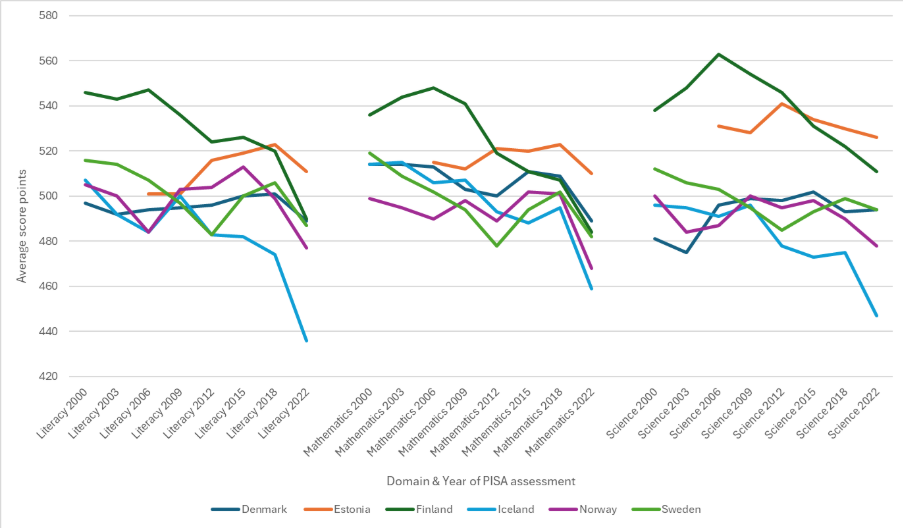
The role of PISA in evaluating education systems became especially visible after the early assessments in 2000 and 2003. In several countries, most notably Germany, unexpectedly weak results triggered intense public debate and political responses, a phenomenon widely known as the “PISA shock” (Breakspear, 2014; Tire & Värä, 2022). As illustrated in Figure 1, declining PISA performance has occurred at different times across the Nordic countries. In Iceland, Norway, and Sweden, decreases appeared earlier, while in Finland the decline became evident later. Estonia is an exception among the selected comparison countries, which are discussed in this article. As it can be seen also from figure 1, Estonia has not experienced a so-called PISA shock, rather the opposite, as its results have remained at a high level or even increased, apart from science results in 2022. In the 2022 PISA cycle, results reached their lowest recorded levels in all these countries and in all domains, except for science in Denmark, reading literacy in Estonia, and all areas assessed in Sweden.
Figure 1. Average performance in PISA reading literacy, mathematics, and science domains in Nordic countries and Estonia between 2000–2022.
.
Note: Adapted with permission from Kilpi et al. (2025).
The downward trend in learning outcomes has prompted extensive discussion in Nordic education policy about the purposes and practices of student assessment in basic education. Growing demands for accountability and several national assessment reforms have made this debate particularly visible in Sweden and Denmark, where international assessment results have revealed a shift in student assessment towards school-level evaluation and external accountability (Wallenius et al., 2018). A clear example is Sweden’s response to declining PISA and TIMSS results in the early 2010s, which led to substantial changes in student assessment practices, including revisions to the grading scale, the introduction of assessment criteria for grades 6 and 7, and the expansion of national tests across subjects and grade levels (Skolverket, 2015a).
Although this article focuses on system-level evaluation from a national perspective, it is important to note that international comparative assessments consistently complement national assessments in all Nordic countries and Estonia. In some cases, they even form an integral part of the national learning outcomes assessment system. These international evaluations have also highlighted challenges that may not have been equally visible in national assessments.
The Nordic countries were chosen for this study because their compulsory education systems (i.e., primary and lower secondary education, excluding any compulsory pre-primary classes and upper secondary education) are founded on shared values, most importantly, equal access to education and equal opportunities for all, and because their systems have influenced one another over time (Telhaug et al., 2006). Although the aim of this study is not to compare Estonia with the Nordic countries, but rather all the reference countries with each other, Estonia serves as an interesting reference point for the Nordic countries, as its national curricula in the late 1990s and early 2000s were largely shaped by the principles of the Finnish National Core Curriculum (Volmari, 2019). The Estonian education system is also of current interest because its learning outcomes, especially in PISA, have developed in a different direction during the 2010s than those of Nordic countries. Despite these similarities, the countries differ substantially in how system‑level assessment and end compulsory education assessment are organized. For example, in Finland, as part of the comprehensive school reform of the 1970s, it was decided that the final assessment would be based solely on teachers’ final grades, with no national exit examinations (Wallenius, 2020). On the other hand, in Sweden, national examinations (nationella prov) were introduced in grades 3, 6, and 9 in 1998 (Skolverket, 2015b), and in Estonia, a system of three mandatory exit examinations was implemented in 2004 (Oja, 2024). In addition, in Denmark, exit examinations became mandatory for all 9th grade students in 2006 (Lov om ændring av lov om folkeskolen, 2006, § 14).
Surprisingly, little comparative research exists on the educational evaluation systems of the Nordic countries and Estonia (Hudson, 2011; Wallenius, 2020), or on their assessment guidelines and grading practices (Lundahl et al., 2016; 2017; Lysne, 2006). For this reason, the purpose of this review article is to examine how and at which stages of compulsory education national or exit examinations are organized in the Nordic countries and Estonia, and how the results of these assessments are used during the 2025–2026 academic year. The article concludes with a discussion on how learning outcome information is utilized to support system functioning and how national learning outcomes have been considered in educational policy decision making.
Key Concepts and Related Definitions
The key concepts used in this article include diagnostic, formative, and summative assessments; low-stakes and high-stakes test; national test and exit examination, and student-, school-, and system-level assessments. The concepts of educational equality and equity are defined in the following chapter. Since several of these terms are sometimes used interchangeably, we aim to clarify their meanings and interrelationships.
Regarding the purpose of information use, assessment systems can be described as diagnostic, formative, or summative (Jakku-Sihvonen, 2013). Since Scriven (1967) introduced the concepts of formative and summative assessment, these terms have been widely used to describe assessment tasks at both student and system levels. Huhta (2010) points out that diagnostic assessment shares many characteristics with formative assessment, and the two are often treated as nearly synonymous in the literature. Summative assessment, by contrast, aims to determine the extent to which goals have been achieved and may provide the basis for grading or feedback to improve goal attainment. Importantly, formative and summative assessment are not dichotomous; rather, summative assessment is an integral component of formative processes (Taras, 2009; Wiliam, 2011).
The distinction between high- and low-stakes tests serves to clarify when test consequences are significant for students, teachers, or institutions, and when more robust quality assurance is therefore required (Nunnally, 1975). Low-stakes tests typically have minor consequences and are primarily formative, whereas high-stakes tests carry important implications such as eligibility for graduation or decisions about school funding. These high-stakes assessments are typically summative in nature (Tannenbaum & Kane, 2019).
Confusion also arises between national tests and exit examinations that are sometimes mistakenly used as synonyms. Both can serve student-level and system-level assessment purposes, but their core functions differ. Exit examinations are taken at the end of an educational stage and passing them is required to complete the education program and obtain a certificate (Jakku-Sihvonen; 2013; Ouakrim-Soivio, 2024). National tests, on the other hand, may be used to support grading, monitor curriculum implementation, or inform system-level evaluation, depending on the country.
The purposes for which evaluation information is used also depend on whether the system is organized around complete age cohorts or sample-based assessments (Mills, 2021). In Finland, for example, both national and international assessments of learning outcomes in compulsory education are sample based (Kauko et al., 2022). Such systems primarily aim to support the data-informed development of educational quality and equality. Monitoring educational equality includes not only providing feedback for improvement but also following changes over time (Verger et al., 2019).
Table 1 outlines how assessments of learning outcomes function at student, school, national, and international levels, and how their purposes differ. For instance, while an exit exam provides an individual student with information about their attainment of graded learning goals, it also contributes to system-level evaluation by informing curriculum development and broader educational reforms. This dual role is reflected in Table 1, which is adapted from Jakku-Sihvonen (2013). National tests and exit examinations may cover either full age cohorts or representative samples, whereas international comparative assessments are almost always sample-based.
Table 1. Examples of student assessments, national- and international-level evaluations, and their tasks.
|
The purpose of assessment |
Diagnostic |
Formative |
Summative |
|
Students’ assessment |
A test that maps the student's starting level or learning difficulties. |
Task, set of tasks, or tests that describe progress and current learning. Can be prepared by a teacher, a subject of pedagogic organization, or a provider of learning materials. |
At the end of the academic year, an overall assessment of the student's current knowledge, skills, and competences. May also include an exit exam for the entire age group at the end of the syllabus. |
|
National-level assessment |
A national exam or other test that maps the previous knowledge or starting level of the students in the age group or sample. |
A national exam, other evidence, or demonstration of competence that describes the current knowledge and progress of the students in the age group or sample. |
A national exam aimed at the entire age group or based on a sample at any time during the syllabus, or an exit exam aimed at the entire age group at the end of the syllabus. |
|
International comparative evaluations |
It can be used to develop the educational system, for example in the realization of equality in education. |
For example, the OECD's PISA or the IEA's TIMSS that provide opportunity to obtain reliable trend information. IEA favors a decentralized, cooperative management model of decision making and implementation, whereas OECD members form an official coalition of participants that planned long-term objectives for cyclical testing. |
Learning outcomes as an indicator of educational equality
The Swedish educational psychologist Torsten Husén had a profound influence on the interpretation of educational equality in the 1970s, particularly in Northern Europe. Husén (1972) defined educational opportunity as the idea that education is universal and publicly funded and accessible to everyone regardless of background. Viewing equal learning opportunities as the core ideal of educational equity implies that no statistically significant differences should exist between groups such as genders, linguistic groups, socio‑economic backgrounds, or regions (Jakku‑Sihvonen, 2013). These background factors often play a central role when monitoring national or international learning outcomes (see Table 1) and functionality of the educational system.
The concept of equal opportunity can be understood broadly or narrowly. A broad interpretation emphasizes the removal of structural barriers, such as unequal access to resources or institutional arrangements that may restrict participation in education (Masschelein & Simons, 2010; Pelletier, 2009). A narrow interpretation focuses on the equality of learning outcomes. Within this perspective, individual differences in achievement are expected, but systematic performance gaps between groups, such as those based on gender or parental education, signal that the education system is failing to uphold the principle of equality (Jakku‑Sihvonen & Kuusela, 2002; Ouakrim-Soivio et al., 2018).
From the 1970s onward, the narrow definition became dominant: equal opportunity was understood to mean that pupils should be able to acquire knowledge and skills as equally as possible (Ouakrim-Soivio et al., 2018). This interpretation rested on a pedagogically optimistic ethos, assuming that all pupils can reach the same learning goals, albeit at different paces (Ahonen, 2003). Yet, as Lynch and Baker (2005) point out, no plausible egalitarian theory claims that the outcomes of all social processes should be identical for everyone. In other words, pursuing educational equality does not imply that all students should achieve the same results, but rather that systemic or group‑based disparities should not be reproduced or reinforced through schooling.
Research questions
Educational equality is a central value in both the Nordic and Estonian education systems. Because of its importance, it is essential to examine how student assessment during compulsory education also contributes to understanding and developing these education systems. In this review article, we therefore analyze the national assessment practices in the Nordic countries and Estonia through the following research questions:
1. When are students assessed nationally during compulsory education?
2. For what purposes are students assessed nationally?
Data and methods
This study is based on a critical analysis of existing studies and documents. The data for this study were selected from primary sources, namely documents that determine decisions, guidelines, and instructions for student- and system-level assessment. In practice, the data consist of laws, decrees, regulations, national curriculum texts, and various guidance documents from the Nordic countries and Estonia. All 40 documents analysed in this study are listed in Annex Table 1. The data include documents in Finnish and Swedish, as well as English translations of documents originally in Estonian, Norwegian, Icelandic, and Danish. As official translations were not consistently available, these documents were translated using machine translation tools (e.g. Microsoft Copilot). The resulting translations were reviewed by the authors to ensure a sufficient level of accuracy for analysis, particularly for the Nordic languages, based on their proficiency in English and Swedish. In addition, the content was verified against multiple sources (see Table 1 in the Appendix, Supplementary documents concerning assessment).
In this study we are concentrating on only the subject-specific or basic skill-based cognitive learning outcome tests, excluding screening tests for reading difficulties, screening for high ability pupils etc. In this study we focus exclusively on the national tests, and therefore we do not address other parts of the countries' assessment systems (e.g., Iceland’s Matsferill system; Miðstöð menntunar og skólaþjónustu, n.d.).
For analyzing the data collected, document analysis has been used. In this method, which is a form of content analysis, the object of analysis is previously published material for other purposes, often in text form (Corbetta, 2003). After systematically delimiting the data, i.e. documents mentioned above, the analysis was conducted in an abductive or theory driven manner (van Hulst & Visser, 2025). The abductive analysis was used to analyse the data, and it included multiple iterations between data and theory (van Maanen et al., 2007). The abductive analysis proceeded in iterative loops, which Yanow (1999) describes as reiterative.
In this study, the explanations or confirmations from theory were sought to support the interpretations of the findings made in the documents. We had three main iteration rounds. At the beginning of each round, the documents were read several times, after which the facts that emerged from them were classified according to which subject was assessed in which grade and whether they were student-level or system-level assessments. In the next step, we recorded which subject was tested in which grade in each country. Subsequently, the findings were refined during the second iteration, where the document contents were classified according to the specific assessment task (diagnostic, formative, or summative). During the third round, national assessments addressing student- and system-level factors were further analyzed and categorized by whether they functioned as exit exams. At the same time, information was also sought from the documents about whether the tests were low- or high-stakes in their nature. The result of the abductive (theory-driven) classification of the data can be seen in Table 2, which describes the national assessments at the student- and system-level in the Nordic countries and Estonia.
Results
In line with the first research question, the initial phase of the analysis focused on when students are nationally assessed in compulsory education in the Nordic countries and Estonia. Because some of the countries have recently reformed their assessment systems or the reforms are currently in the process, the analysis focused on the situation during the academic year 2025–2026. As shown in Table 2, Finland differs from the other comparison countries in that it does not have any national examinations or standardized tests covering the entire age cohort during compulsory education. Instead, the Finnish education system is monitored through sample-based studies. Thus, from this point onward in the results section, references to comparison countries exclude Finland unless otherwise noted. In other Nordic countries and in Estonia, students are assessed with national-level tests multiple times during comprehensive school. In Denmark, students are assessed at seven different grade levels, which is more frequent than in the other countries. Moreover, the first assessment in Denmark occurs earlier than elsewhere - already in the second grade. The latest start of national student assessment is in Iceland, where students participate in national tests for the first time in fourth grade. Together with students in Sweden, students in Iceland are also assessed less frequently than in the other comparison countries - three times.
Table 2. Student- and system-level assessments in Nordic countries and Estonia in 2025–2026.
|
Country/ Grade |
2 |
3 |
4 |
5 |
6 |
7 |
8 |
9 |
10 |
|
Denmark |
12AB: |
12AB: |
12AB: |
|
12AB: |
12AB: |
12AB: |
12C: |
|
|
Estonia |
12BC: |
12BC: ES/ES2, RU, MA, NS |
12BC: |
12BC: ES/ES2, RU, MA, NS |
12BC: |
12C:
|
|||
|
Finland |
|||||||||
|
Iceland |
12BC: |
12BC: |
12BC: |
||||||
|
Norway |
12BC: |
12BC: |
12BC: |
12C*: |
|||||
|
Sweden |
12BC: |
12BC: |
12BC: |
Note.
Italic text = Test is held in autumn, Bold text = Test is held in spring
¹ Student assessment.
² National level assessment.
A Diagnostic assessment. B
Formative assessment. C Summative assessment.
* Exit
examination.
AC = Arts and
crafts, BI = Biology, CD = Crafts and design, CH = Chemistry, CS = Christian
studies, DA = Danish, EN = English, ES = Estonian, ES2 = Estonian as a second
language, ESL = Estonian language and literature, FR = French, GE = Geography,
GER = German, HE = Home economics, HI = History, IC = Icelandic, MA =
Mathematics, MU = Music, NO = Norwegian, NS = Natural science, NU = Numeracy,
PE = Physical Education and sports, PH = Physics, RE = Reading, RS = Religious
studies, RU = Russian, SA = Sami, SS = Social studies, SW = Swedish, SW2 =
Swedish as a second language, VA = Visual Arts.
In all the comparison countries, these tests include assessments of mathematics or numeracy and mother tongue (or official language as a second language) or reading. In addition to these subjects, in grades two to eight, only English is assessed in Norway and Sweden, and in Estonia, natural science, social studies, and one of the A2-level languages (English, German or Russian) are assessed. Additionally, in Denmark, students are assessed in one of the four artistic and practical subjects in grade eight. In all the countries, students’ skills in mathematics and mother tongue are also assessed in grades nine and ten, but these grade levels differ in that also a broader set of school subjects are assessed in every country except in Iceland. In most comparison countries, the number of tests increases as students’ progress toward the end of compulsory education. Most of the tests assess students’ skills in written format, but in Denmark (grades 8–9), Estonia (grades 4 and 7–9), Norway (grade 10), and Sweden (grades 6 and 9), some tests are conducted either entirely or partially in oral and/or practical formats.
In line with the second research question, the next phase of the analysis examined to what purpose students are tested nationally in Nordic countries and Estonia in compulsory education. In all comparison countries, there are assessments that can be classified as summative. However, in all the countries except in Denmark, most of these tests are both summative and formative at the same time. Tests whose results are used only summatively, are held at the end of compulsory education: Summative national exit examinations are held in Estonia in grade nine, in Denmark in grade nine, and in Norway in grade ten to assess students’ level of knowledge and skills after compulsory education. In addition, one of the four artistic and practical subjects is assessed in a summative way in grade eight in Denmark, and passing it is required to complete the education program and obtain a certificate.
Tests used for diagnostic or formative purposes are typical in grades two to eight in all the comparison countries, although there are tests which are used formatively also in ninth grade in Iceland, Norway and Sweden. Most of these tests are both formative and summative at the same time. Denmark differs from the other comparison countries with its stronger emphasis on diagnostic and formative assessment in grades two to eight: all the tests are both diagnostic and formative except the assessment of an artistic and practical subject.
In most countries, all assessments that are used formatively or diagnostically are held in the autumn term (first term of the school year) where they serve primarily as tools for teachers to evaluate progress and adapt their teaching to the students' needs during the school year. Only in Estonia (in grades three and six) and in Iceland are formative tests held in the spring semester (second term of the school year). In Sweden, national tests, which are both formative and summative, are typically held in the spring term but in sixth and ninth grade the oral parts of Swedish, Swedish as a second language, English, and mathematics (only in ninth grade) examinations are held during the autumn term.
In all the comparison countries, most tests are both student- and national-level assessments, so they give information about the skills of an individual student but also information about the skills of the entire age cohort. In some Nordic countries, such as Sweden, Norway and Denmark, it is possible to examine national learning outcome results even at the level of individual schools by using Skolverket’s (in Sweden) portal and Utdannigsdirektoratets’ Skoleporten (in Norway) made for this purpose. In Denmark various indicators of school performance are collected in an official web portal Skoletal under the Danish Ministry of Children and Education. Its main function is to provide information on the schools and their performance. Finland, on the other hand, is an example of the other extreme, where school-specific learning outcomes are only shared with the sample schools themselves.
Discussion
As the results in table 2 show, there is variation between all the Nordic countries and Estonia in terms of how often assessments are organized during compulsory education and what their results are used for at the student level and school system level. According to the assessment plan between the Ministry of Education and the Finnish Education Evaluation Center (2024), it seems that in Finland the learning outcome assessments at the system level are carried out using the sample-based assessments which are implemented on a three- to five-year cycle in subject-specific assessments. In terms of system-level assessment, Iceland is probably the closest to Finland, as its recent assessment reform has reduced the number of national tests, currently limiting them to three tests in Icelandic and mathematics during compulsory education. At the same time, the nature of these national tests has become more formative, according to the steering documents, which have been the sources of our document analysis (see Appendix 1).
Although national tests are administered several times during compulsory education in Sweden, Norway, and Denmark, their purpose is not solely summative but also formative and diagnostic. Low-stakes national tests are intended to inform teachers, students, and their parents, typically at the beginning of the school year, about what a student or group of students knows. This enables teachers to plan and target instruction to better meet students’ needs. At the student level, diagnostic tests provide students and their parents with concrete information about the student’s knowledge at the beginning of the school year. This, in turn, facilitates the monitoring of students’ progress in specific subjects or basic skills over time.
In Denmark and Estonia, low-stakes tests are also used to determine whether learning goals have been achieved at both the student and system levels. In addition, Denmark, Estonia, and Norway administer exit examinations at the end of compulsory education to assess students’ competence nationwide and to ensure eligibility and equal access to upper secondary education.
In Denmark, a key concern has been that examinations may lead teachers to “teach to the test” or may demotivate students (Beuchert & Nandrup, 2018). Similarly, in Estonia, the Ministry of Education proposed in 2019 a draft amendment to abolish exit examinations at the end of compulsory education, citing student stress related to exams (Eisenschmidt et al., 2023). The amendment was ultimately not approved due to strong opposition from various stakeholders, and public debate on the issue continues.
A broader challenge with assessments of learning outcomes, such as those described above, is that they often treat outcomes as attributable to students or systems in abstraction. This perspective risks overlooking how institutional arrangements, such as school governance, resource allocation, tracking, and accountability regimes, shape what becomes measurable in the first place.
However, the situation is the opposite in Finland and Sweden. The subject-specific low-stakes national tests conducted at the end of compulsory education have shown that there are multiple grade discrepancies in the grades given by teachers and the competence demonstrated by students (Klapp Lekholm, 2011; Ouakrim-Soivio, 2013; Ouakrim-Soivio et al., 2018; Skolverket, 2020). The phenomenon has been identified in the Swedish and Finnish education systems for a decade, and efforts have been made to solve it in Finland with subject-specific criteria for final grades (Opetushallitus, 2026) and in Sweden with new regulations introduced in 2025 (Lag om ändring i skollagen, 2025). The problem described above is an indication of a flaw in the education system, which creates an inequality problem when students apply for further studies with grades they received from school that are not actually comparable nationally. These inconsistencies between grades and demonstrated competence at the system level can influence students’ access to further education, encourage risk-averse choices, and reinforce segregated educational paths (Klapp, 2015; Klapp Lekholm & Cliffordson, 2009).
There are also major differences between countries in how public or confidential the learning results of national tests are (Wallenius, 2020). For example, in Sweden, Norway and Denmark, a decision in principle was made years ago that school-specific results are public and can be followed by anyone, for example through portals created for them. Finland is an exception in this regard: schools have access to their own sample-based results, which they can publish if they wish, but neither the Finnish Educational Evaluation Centre, nor any other body publish school-specific results. The idea behind the decision is to follow the principle of the neighborhood school and prevent school shopping, for example in large cities in Finland, where the phenomenon has already reared its head (Seppänen et al., 2018).
For the development of the education system, it is important to obtain reliable trend data on, for example, the impact of parents' socio-economic background on student learning outcomes and thereby to know how well education can balance out differences due to student backgrounds. As shown in Table 1, national tests are suitable for this, but not student-level assessments, whose task is to report on the student's learning at an individual level. In Denmark, the use of national test results diagnostically throughout almost the entire period of compulsory education from grade 2 to grade 8 clearly differs from the use of learning outcomes in other Nordic countries. The Danish example also works well in how national test results are also used in class and student-level assessment, when the aim is to know the level of students' competence, their progress during the academic year's studies and to help teachers target their teaching correctly and, if necessary, with the most suitable teaching methods.
Recent national reforms in assessment in Sweden, Iceland, Denmark, and Estonia have sought to strengthen the formative dimension of learning‑outcome assessment by ensuring that results can be used not only for summative accountability but also to support instruction. It is therefore important to recall Taras’ (2009) argument that formative and summative functions should not be viewed as mutually exclusive; rather, they represent complementary tasks within a coherent assessment design. This shift toward integrating formative purposes raises broader questions about the overall functioning and evidence base of Nordic assessment systems. In the Nordic countries and Estonia, education systems have long been shaped by both national and international assessments (Buli-Holmberg et al., 2022; Corral-Granados et al., 2023). Yet despite the centrality of assessment to educational governance, there remains surprisingly little empirical research on how effectively these systems operate. The main exception is exit examinations, which have generated substantial scholarly work examining their potential benefits and drawbacks (Hovdhaugen et al., 2025; Lysne, 2006).
The study involves some data-related limitations. First, we used so-called primary sources, which were available in Finnish and Swedish. For documents from other Nordic countries and Estonia, we had to rely on English translations. However, the translated content was verified against multiple supplementary documents to prevent errors or misinterpretations. Second, the research data consists of regulations (acts and decrees) as well as steering and policy documents concerning student-level and system-level assessment in Nordic countries and Estonia. The analysis is limited to these 40 documents (see Appendix 1), with the understanding that they are mainly used to describe how student-level and system-level assessment is thought to work. Therefore, the documents and their analysis describe what is, rather than how they work or what challenges are associated with their application.
The same challenge is also related to learning outcomes at the system level. At best, the results can only describe how things are, and not – what education policymakers would like to know - why this is so. Except for international and national longitudinal evaluation studies, such as TIMSS longitudinal (von Davier et al., 2025) or FINEEC assessment in mathematics and in mother tongue and literature (Ukkola et al., 2025), learning outcome data does not provide much information about cause-and-effect relationships, and they do not allow for causal inference. This would require wider use of various other data, such as register data, and their combination with learning outcome assessment data. It seems to be possible that in the future, evaluation research that combines learning outcome data with, for example, register data will become more common, simply because combining data provides better opportunities to answer complex education policy questions.
As stated in the call for abstracts for this special issue, the paradigm of quantification is highlighted as having significantly shaped both public and political discourse surrounding international large-scale assessments (Klieme et al., 2010; Krejsler & Moos, 2023). International assessments have influenced education systems in the Nordic countries and Estonia, sharpening attention to performance and accountability, and prompting renewed scrutiny of what equality of educational opportunity entails in practice. This is particularly evident in Finland, where education providers are responsible for assessing the quality of their own teaching and where access to assessment data is largely limited to national reporting and providers’ own publications. Questions have arisen regarding the ethical sustainability of a system in which assessment data are not publicly available beyond these channels, a model that contrasts sharply with practices in, for example, Sweden, Denmark, and Norway, where learning outcomes are openly published (Wallenius, 2020).
In many Nordic countries and Estonia, international assessments such as PISA have also become integrated into the evaluation of education systems (Kilpi et al., 2025). Although these assessments do not establish cause-and-effect relationships, they can provide reliable trend data on the functioning of education systems and issues of equity. This is particularly the case when results are analysed in relation to factors such as gender and socio-economic background (OECD, 2023a), the geographical location of schools, and differences between schools across various assessment domains (OECD, 2023b). However, this reliance on measurable indicators also raises questions about their capacity to capture intersectional inequalities. While large-scale assessments can disaggregate results by individual variables such as gender or socio-economic status, they may overlook how these dimensions intersect, thereby risking the reproduction of inequalities through simplified representations (Bauer et al., 2026).
As highlighted in this special issue of Nordic Journal of Comparative and International Education, current learning‑outcomes frameworks tend to privilege a limited range of measurable competencies like we have been shown in our results, where basic skills like mathematics and literacy are assessed in almost every educational system studied in this article. From the perspective of educational policy decision‑making, this underscores the importance of understanding what different assessments measure, what they were originally intended to inform, and how valid the inferences drawn from them are. Validity encompasses not only the appropriateness, meaningfulness, and usefulness of assessment results (Messick, 1994), but also the interpretive practices through which these results are employed (Ouakrim-Soivio, 2024). Also, the latter perspective on the validity of assessment of learning outcomes links directly to this special issue and the themes emphasizing more holistic and context‑sensitive approaches in shaping the use of learning outcomes.
Across the Nordic countries and Estonia, the configuration of student‑level assessments, national‑level evaluations, and exit exams provide multiple lenses for understanding the functioning of compulsory education. Yet these mechanisms are most effective when their results are used in a manner consistent with their purposes: diagnostic information to identify needs, formative feedback to support learning, and summative or exit exam data to ensure fairness and transparency. Purpose‑aligned use of assessment information will remain central to safeguarding high‑quality and equitable education systems. For these reasons, it remains essential to clearly distinguish between student‑level and system‑level assessments, and to consider carefully what their respective results can, and cannot tell us.
References
Adolfsson, C. H. (2024). The local governance of Swedish schools in light of a new educational policy landscape empirical exploration and theoretical elaboration. Nordic Journal of Studies in Educational Policy, 10(2), 85–97. https://doi.org/10.1080/20020317.2024.2348298
Ahonen, S. (2003). Yhteinen koulu. Tasa-arvoa vai tasapäisyyttä? [A common school: Equality or uniformity?]. Vastapaino.
Bauer, T., Zviagintsev, R., & Kampa, N. (2026). Credibility of intersectionality frameworks in question: evidence from a large-scale study in Austria.European Journal of Psychology of Education, 41, 63.
Beuchert, L. V., & Nandrup, A. B. (2018). The Danish national tests at a glance. Nationaløkonomisk tidsskrift, 2018(1), 1–37. https://doi.org/10.2139/ssrn.2996431
Breakspear, S. (2014). How does PISA shape education policy making? Why how we measure learning determines what counts in education (Seminar Series Paper No. 240). Centre for Strategic Education. https://simonbreakspear.com/wp-content/uploads/2021/06/Breakspear-PISA-Paper.pdf
Buli-Holmberg, J., Sigstad, H. M. H., Morken, I., & Hjörne, E. (2022). From the idea of inclusion into practice in the Nordic countries: a qualitative literature review. European Journal of Special Needs Education, 38(1), 79–94. https://doi.org/10.1080/08856257.2022.2031095
Chelimsky, E. (1997). Thoughts for a new evaluation society. Evaluation, 3(1), 97-109.
Corbetta, P. (2003). Social research: Theory, methods and techniques. SAGE Publications, Ltd. https://doi.org/10.4135/9781849209922
Corral-Granados, A., Rapp, A. C., & Smeplass, E. (2023). Nordic challenges related to exclusion and local responses in Swedish, Finnish, and Norwegian urban compulsory education. Education Inquiry, 16(1), 37–68. https://doi.org/10.1080/20004508.2022.2163002
Eisenschmidt, E., Heidmets, M., Kitsing, M., Kasesalk, M., & Vanari, K. (2023). Aim high and work hard: Building a world-class learning system in Estonia. National Center on Education and the Economy.
Finnish Education Evaluation Center. (2024). National education evaluation plan 2024–2027. https://www.karvi.fi/sites/default/files/sites/default/files/documents/National%20Education%20Plan%202024-2027.pdf
Hovdhaugen, E., Flobakk-Sitter, F. & Fossum, L.W. (2025). Nordic research on organisation and implementation of exams and final assessments – a systematic scoping review. Educational Assessment Evaluation and Accountability, 37, 443–464. https://doi.org/10.1007/s11092-025-09469-6
Hudson, C. (2011). Evaluation – the (not so) softly approach to governance and its consequences for compulsory education in the Nordic countries. Education Inquiry, 2(4), 671–687. https://doi.org/10.3402/edui.v2i4.22006
Huhta, A. (2010). Innovations in diagnostic assessment and feedback: An analysis of the usefulness of the DIALANG language assessment system [Doctoral dissertation]. University of Jyväskylä. https://urn.fi/URN:ISBN:978-952-86-0718-2
Husén, T. (1972). Social background and educational career: Research perspectives on equality of educational opportunity. OECD/CERI.
Jakku-Sihvonen, R. (2013). Oppimistulosten arviointijärjestelmistä ja niiden kehittämishaasteista [Learning-outcome assessment systems and their development challenges]. In A. Räisänen (Ed.), Oppimisen arvioinnin kontekstit ja käytännöt (pp. 13–36). Opetushallitus. https://www.oph.fi/sites/default/files/documents/Oppimisen%20arvioinnin%20kontekstit%20ja%20k%C3%A4yt%C3%A4nn%C3%B6t%202.pdf
Jakku-Sihvonen, R. & Kuusela, J. (2002). Mahdollisuuksien koulutuspolitiikan tasa-arvo [Equity in an education policy of opportunities] (Arviointi 7/2002). Opetushallitus.
Kauko, J., Pitkänen, H., & Varjo, J. (2022). Quality in Finnish comprehensive schools: Entrenching enhancement-led evaluation. In C. de la Porte, G. B. Eydal, J. Kauko, D. Nohrstedt, P. Hart, & B. S. Tranøy (Eds.), Successful public policy in the Nordic countries: Cases, lessons, challenges (pp. 432–455). Oxford University Press. https://doi.org/10.1093/oso/9780192856296.003.0021
Kilpi, N., Ouakrim-Soivio, N., Minkkinen, L., & Söyrinki, S. (2025). Oppimistuloskehitys ja koulutuspoliittiset toimet Pohjoismaissa ja Virossa 2010-luvulta 2020-luvun alkuun [Trends in learning outcomes and education policy measures in the Nordic countries and Estonia from the 2010s to the early 2020s] (Koulutuksen tutkimuslaitos, Raportteja ja työpapereita 13). Jyväskylän yliopisto, Koulutuksen tutkimuslaitos. https://doi.org/10.17011/ktl-rt/13
Klapp, A. (2015). Does grading affect educational attainment? A longitudinal study. Assessment in Education: Principles, Policy & Practice, 22(3), 302-323. https://doi.org/10.1080/0969594X.2014.988121
Klapp Lekholm, A. (2011). Effects of school characteristics on grades in compulsory school. Scandinavian Journal of Educational Research, 55(6), 587–608. https://doi.org/10.1080/00313831.2011.555923
Klapp Lekholm, A., & Cliffordson, C. (2009). Effects of student characteristics on grades in compulsory school. Educational Research and Evaluation, 15(1), 1–23. https://doi.org/10.1080/13803610802470425
Korkeakoski, E. (2005). Perusopetuksen oppimistulokset ohjausjärjestelmän osaksi [Integrating learning outcomes in compulsory education into the steering system]. In H. K. Lyytinen & A. Räisänen (Eds.), Kehittämissuuntaa arvioinnista (pp. 175–192). Koulutuksen arviointineuvosto. https://urn.fi/URN:ISBN:978-951-39-3242-8
Krejsler, J. B., & Moos, L. (Eds.) (2023). School policy reform in Europe. Exploring Transnational Alignments, National Particularities and Contestations. Springer. https://doi.org/10.1007/978-3-031-35434-2
Kuusela, J., & Hautamäki, J. (2005). Mitataan oppilaita, mutta päätellään koulusta [Pupils are assessed, but conclusions are drawn about schools]. In H. K. Lyytinen & A. Räisänen (Eds.), Kehittämissuuntaa arvioinnista (pp. 229–241). Koulutuksen arviointineuvosto. https://urn.fi/URN:ISBN:978-951-39-3242-8
Lag om ändring i skollagen. (2025). Lag om ändring i skollagen (2010:800) (SFS 2025:729) [Act amending the Education Act (2010:800)]. Svensk författningssamling. https://svenskforfattningssamling.se/sites/default/files/sfs/2025-06/SFS2025-729.pdf
Lov om ændring af lov om folkeskolen. (2006). Lov om ændring af lov om folkeskolen (Styrket evaluering og anvendelse af nationale test som pædagogisk redskab samt obligatoriske prøver m.v.) (LOV nr. 313 af 19/04/2006) [Act amending the Folkeskole Act (strengthened evaluation and use of national tests as a pedagogical tool and compulsory examinations, etc.)]. Retsinformation. https://www.retsinformation.dk/eli/lta/2006/313
Lundahl, C., Hultén, M., & Tveit, S. (2016). Betygssystem i internationell belysning [Grading systems in an international perspective]. Skolverket. https://www.skolverket.se/sok-publikationer/publikationsserier/ovrigt-material/2017/betygssystem-i-internationell-belysning
Lundahl, C., Hultén, M., & Tveit, S. (2017). The power of teacher-assigned grades in outcome-based education. Nordic Journal of Studies in Educational Policy, 3(1), 56–66. https://doi.org/10.1080/20020317.2017.1317229
Lynch, K., & Baker, J. (2005). Equality in education: An equality of condition perspective. Theory and Research in Education, 3(2), 131–164. https://doi.org/10.1177/1477878505053298
Lysne, A. (2006). Assessment theory and practice of students' outcomes in the Nordic countries. Scandinavian Journal of Educational Research, 50(3), 327–359. https://doi.org/10.1080/00313830600743365
Masschelein, J., & Simons, M. (2010). The hatred of public schooling: School as the mark of democracy. Educational Philosophy and Theory, 42(5–6), 666–682. https://doi.org/10.1111/j.1469-5812.2010.00692.x
Messick, S. (1994). The interplay of evidence and consequences in the validation of performance assessments. Educational Researcher, 23(2), 13–23. https://doi.org/10.3102/0013189X023002013
Mills, B. (2021). Education research and evaluation in leading education nations. How nations organize, focus and fund their research and policy making. Education Policy Institute.
Nunnally, J. C. (1975). Psychometric theory – 25 years ago and now. Educational Researcher, 4(10), 7–21. https://doi.org/10.3102/0013189X004010007
OECD. (2023a). PISA 2022 Results (Volume I): The State of Learning and Equity in Education. OECD Publishing. https://doi.org/10.1787/53f23881-en.
OECD. (2023b). PISA 2022 Results (Volume II): Learning During – and From – Disruption. OECD Publishing. https://doi.org/10.1787/a97db61c-en.
OECD. (2024). PISA 2022 Technical Report. OECD Publishing. https://doi.org/10.1787/01820d6d-en
Oja, M. (2024). External evaluation as an influencer of history teaching: Analyzing the final exam in Estonia’s basic schools. In J. Wojdon, E. van Eeden, A. John, M. Oja, A. Palikidis, R. Weintraub, & B. Vajda (Eds.), International Journal of History Education & Culture: Yearbook of the International Society for History Didactics (Vol. 45, pp. 111–138). Wochenschau Verlag. https://jhec.wochenschau-verlag.de/wp-content/uploads/sites/23/2025/05/issue_2024.pdf
Olson, D. R. (2003). Psychological theory and educational reform: How school remakes mind and society. Cambridge University Press.
Opetushallitus. (2026). Perusopetuksen opetussuunnitelman perusteet 2014 [National Core Curriculum for Basic Education 2014]. https://eperusteet.opintopolku.fi/#/fi/perusopetus/419550/tiedot
Ouakrim-Soivio, N. (2013). Toimivatko päättöarvioinnin kriteerit? Oppilaiden saamat arvosanat ja Opetushallituksen oppimistulosten seuranta-arviointi koulujen välisten osaamiserojen mittareina [Do the final assessment criteria work? Grades awarded to pupils and the Finnish National Board of Education’s follow-up assessment of learning outcomes as measures of differences in competence between schools] [Doctoral dissertation, University of Helsinki]. Helda. http://hdl.handle.net/10138/41026
Ouakrim-Soivio, N. (2024). Assessment of and for learning. Otava.
Ouakrim-Soivio, N., Rautopuro, J., & Hildén, R. (2018). Shadows under the North Star: The inequality developing in Finnish school education. Nordidactica. Journal of Humanities and Social Science Education, 8(3), 65–86. https://journals.lub.lu.se/nordidactica/article/view/19073
Pelletier, C. (2009). Emancipation, equality and education: Rancière's critique of Bourdieu and the question of performativity. Discourse: Studies in the Cultural Politics of Education, 30(2), 137–150. https://doi.org/10.1080/01596300902809054
Scriven, M. (1967). The methodology of evaluation. In R. W. Tyler, R. M. Gagné, & M. Scriven (Eds.), Perspectives of curriculum evaluation (pp. 39–83). Rand McNally.
Seppänen, P., Kosunen, S., & Rinne, R. (2018). Lohkoutuuko koulutuspolku, katoaako tasa-arvo? In R. Rinne, N. Haltia, S. Lempinen, & T. Kaunisto (Eds.), Eriarvoistuva maailma – tasa-arvoistava koulu? (pp. 65–91). Suomen kasvatustieteellinen seura. https://urn.fi/URN:ISBN:978-952-5401-84-4
Simon, M., Ercikan, K., & Rousseau, M. (2012). Introduction. In M. Simon, K. Ercikan, & M. Rousseau (Eds.), Improving large-scale assessment in education: Theories, issues and practice (pp. 1–8). Taylor & Francis. https://doi.org/10.4324/9780203154519
Skolverket. (2015a). Skolreformer i praktiken: Hur reformerna landade i grundskolans vardag 2011–2014 [School reforms in practice: How the reforms were realised in everyday compulsory school practice 2011–2014] (Rapport 418). https://www.skolverket.se/publikationer?id=3553
Skolverket. (2015b). Resultat på nationella prov i årskurs 3, 6 och 9, läsåret 2014/15 [Results of national tests in grades 3, 6, and 9 in the 2014/15 academic year]. https://www.skolverket.se/download/18.6bfaca41169863e6a65bbf7/1553966415233/pdf3556.pdf
Skolverket. (2020). Likvärdiga betyg och meritvärden: Ett kunskapsunderlag om modeller för att främja betygens och meritvärdenas likvärdighet [Equivalent grades and merit values: A knowledge base on models for promoting the equivalence of grades and merit values] (Rapport 2020:7). https://www.skolverket.se/publikationer?id=7582
Tannenbaum, R. J., & Kane, M. T. (2019). Stakes in testing: Not a simple dichotomy but a profile of consequences that guides needed evidence of measurement quality. ETS Research Report Series, 2019(1), 1–16. https://doi.org/10.1002/ets2.12255
Taras, M. (2009). Summative assessment: the missing link for formative assessment. Journal of Further and Higher Education, 33(1), 57–69. https://doi.org/10.1080/03098770802638671
Telhaug, A. O., Asbjørn Mediås, O., & Aasen, P. (2006). The Nordic Model in Education: Education as part of the political system in the last 50 years. Scandinavian Journal of Educational Research, 50(3), 245–283. https://doi.org/10.1080/00313830600743274
Tire, G., & Värä, E. (2022). Cross-national achievement surveys and educational monitoring in Estonia. In L. Volante, S. V. Schnepf, & D. A. Klinger (Eds.), Cross-National Achievement Surveys for Monitoring Educational Outcomes: Policies, Practices and Political Reforms within the European Union (pp. 192–207). Publications Office of the European Union. https://doi.org/10.2760/406165
Ukkola, A., Suomilammi, M., Silverström, C., Metsämuuronen, J., & Marjanen, J. (2025). Matematiikan ja äidinkielen taidot kuudennen luokan lopussa – Perusopetuksen oppimistulosten pitkittäisarviointi 2018–2024 [Competence in mathematics and mother tongue and literature at the end of sixth grade – A longitudinal assessment of learning outcomes in basic education 2018–2024] (Julkaisut 1:2025). Kansallinen koulutuksen arviointikeskus. https://www.karvi.fi/sites/default/files/sites/default/files/documents/KARVI_0125.pdf
van Hulst, M., & Visser, E. L. (2025). Abductive analysis in qualitative research. Public Administration Review, 85(2), 567–580. https://doi.org/10.1111/puar.13856
van Maanen, J., Sørensen, J. B., & Mitchell, T. R. (2007). Introduction to special topic forum: The interplay between theory and method. Academy of Management Review, 32(4), 1145–1154. https://doi.org/10.5465/amr.2007.26586080
Verger, A., Parcerisa, L., & Fontdevila, C. (2019). The growth and spread of large-scale assessments and test-based accountabilities: A political sociology of global education reforms. Educational Review, 71(1), 5-30. https://doi.org/10.1080/00131911.2019.1522045
Volmari, K. (Ed.). (2019). Basic education in the Nordic region: Similar values, different policies. Finnish National Agency for Education.
von Davier, M., Kennedy, A. M., Reynolds, K. A., Gonzalez, E., & Khorramdel, L. (2025). TIMSS 2023 Longitudinal International Results in Mathematics and Science. Boston College, TIMSS & PIRLS International Study Center. https://doi.org/10.6017/lse.tpisc.timss.dn2487
Wallenius, T. (2020). Schools, performance and publicity: Contrasting the policy on publicising school performance indicators in Finland with the other Nordic countries [Doctoral dissertation, University of Helsinki]. Helda. http://hdl.handle.net/10138/318298
Wallenius, T., Juvonen, S., Hansen, P., & Varjo, J. (2018). Schools, accountability and transparency – Approaching the Nordic school evaluation practices through discursive institutionalism. Nordic Journal of Studies in Educational Policy, 4(3), 133–143. https://doi.org/10.1080/20020317.2018.1537432
Wiliam, D. (2011). What is assessment for learning? Studies in Educational Evaluation, 37(1), 3–14. https://doi.org/10.1016/j.stueduc.2011.03.001
Yanow, D. (1999). Conducting interpretive policy analysis. SAGE Publications.
 ©2026 Najat Ouakrim-Soivio, Nestori Kilpi. This is an Open
Access article distributed under the terms of the Creative Commons Attribution
4.0 International License (http://creativecommons.org/licenses/by/4.0/),
allowing third parties to copy and redistribute the material in any medium or
format and to remix, transform, and build upon the material for any purpose,
even commercially, provided the original work is properly cited and states its
license.
©2026 Najat Ouakrim-Soivio, Nestori Kilpi. This is an Open
Access article distributed under the terms of the Creative Commons Attribution
4.0 International License (http://creativecommons.org/licenses/by/4.0/),
allowing third parties to copy and redistribute the material in any medium or
format and to remix, transform, and build upon the material for any purpose,
even commercially, provided the original work is properly cited and states its
license.
Appendix
Table A1. The documents included in the analysis
|
Type of document |
Document |
|
Legislation of compulsory education |
Education Act. (2023). Act relating to primary and secondary education and training (LOV-2023-06-09-30). Lovdata. https://lovdata.no/dokument/NLE/lov/2023-06-09-30 Folkeskoleloven. (2020). Bekendtgørelse af lov om folkeskolen (LBK nr. 1396 af 28/09/2020) [Compulsory education act - Denmark]. Retsinformation. https://www.retsinformation.dk/eli/lta/2020/1396/pdf Lög um grunnskóla. (2008). Lög um grunnskóla, nr. 91/2008 [Compulsory Education Act]. Alþingi/Government of Iceland. https://www.government.is/media/menntamalaraduneyti-media/media/frettatengt2016/91_2008-Compulsory-School-Act-ENGLISH-Uppfaert-Jan-2017.pdf Perusopetusasetus. (1998). Perusopetusasetus (852/1998) [Decree on primary and lower secondary education]. Finlex. https://finlex.fi/fi/lainsaadanto/1998/852 Perusopetuslaki. (1998). Perusopetuslaki (628/1998) [Act on Primary and Lower Secondary Education]. Finlex. https://www.finlex.fi/fi/lainsaadanto/saadoskokoelma/1998/628 Põhikooli- ja gümnaasiumiseadus. (2025). Põhikooli- ja gümnaasiumiseadus (RT I, 09.01.2025, 24) [Basic Schools and Upper Secondary Schools Act]. Riigi Teataja. https://www.riigiteataja.ee/akt/109012025024 Riigieksamite vormid ja ajad, ühtsete põhikooli lõpueksamite ning tasemetööde õppeained, vormid ja ajad 2025/2026. õppeaastal. (2025). Riigieksamite vormid ja ajad, ühtsete põhikooli lõpueksamite ning tasemetööde õppeained, vormid ja ajad 2025/2026. õppeaastal (määrus nr. 14) [Forms and dates of state examinations and the subjects, forms, and dates of unified basic school final examinations and level tests in the 2025/2026 academic year]. Riigi Teataja. https://www.riigiteataja.ee/akt/110042025008 Skollagen. (2010). Skollag (2010:800) [Education act, Sweden]. Sveriges riksdag. https://www.riksdagen.se/sv/dokument-och-lagar/dokument/svensk-forfattningssamling/skollag-2010800_sfs-2010-800 Valtioneuvoston asetus perusopetuslaissa tarkoitetun opetuksen valtakunnallisista tavoitteista ja perusopetuksen tuntijaosta. (2012). Valtioneuvoston asetus perusopetuslaissa tarkoitetun opetuksen valtakunnallisista tavoitteista ja perusopetuksen tuntijaosta (422/2012) [Government decree on the national objectives for education referred to in the Act on Primary and Lower Secondary Education and on the distribution of lesson hours in primary and lower secondary education]. Finlex. https://www.finlex.fi/fi/lainsaadanto/2012/422 |
|
National (core) curriculum |
Miðstöð menntunar og skólaþjónustu. (2011). Chapter 9: Assessment in elementary school. Aðalnámskrá. https://www.adalnamskra.is/en/primary-school/chapter-9-assessment-in-elementary-school Ministry of Children and Education. (n.d.). Subjects & curriculum. Retrieved February 11, 2026, from https://eng.uvm.dk/primary-and-lower-secondary-education/the-folkeskole/subjects-and-curriculum Ministry of Education and Research. (2017). Core curriculum – values and principles for primary and secondary education. Laid down by the Royal degree. The National curriculum for Knowledge Promotion 2020. https://www.regjeringen.no/contentassets/53d21ea2bc3a4202b86b83cfe82da93e/core-curriculum.pdf Ministry of Education and Research. (2024, April 30). Pre-school, basic and secondary education. https://www.hm.ee/en/education-research-and-youth-affairs/general-education/general-education-estonia Opetushallitus. (2025). Perusopetuksen opetussuunnitelman perusteiden 2014 muuttaminen (OPH-531-2025) [Amendment to the national core curriculum for basic education 2014]. ePerusteet. https://eperusteet.opintopolku.fi/eperusteet-service/api/maaraykset/liite/62e8ae12-9f28-4600-b263-c2b42c3f8236 Skolverket. (2024). Läroplan för grundskolan, förskoleklassen och fritidshemmet 2022 [Curriculum for compulsory school, preschool class and school-age educare 2022] (2nd ed.). https://www.skolverket.se/download/18.11f7c7851925054d8c642/1727947566208/pdf13074.pdf |
|
Supplementary documents concerning assessment |
Finnish Education Evaluation Center. (2024). National education evaluation plan 2024–2027. https://www.karvi.fi/sites/default/files/sites/default/files/documents/National%20Education%20Plan%202024-2027.pdf Haridus- ja Noorteamet. (2025, September 4). Tasemetööd. https://harno.ee/tasemetood Haridus- ja Noorteamet. (2026, February 3). Põhikooli lõpueksamid. https://harno.ee/eksamid-testid-ja-uuringud/eksamid-testid-ja-lopudokumendid/pohikooli-lopueksamid Miðstöð menntunar og skólaþjónustu. (n.d.-a). Assessment. Aðalnámskrá. Retrieved February 8, 2026, from https://www.adalnamskra.is/en/supporting-materials/assessment Miðstöð menntunar og skólaþjónustu. (n.d.-b). Matsferill [The Icelandic student assessment profile]. Ísland.is. Retrieved February 8, 2026, from https://island.is/s/midstod-menntunar-og-skolathjonustu/namsmat-matsferill Ministry of Education. (n.d.). The Folkeskole. Retrieved February 8, 2026, from https://eng.uvm.dk/primary-and-lower-secondary-education/the-folkeskole/ Ministry of Education and Research. (2014). The Estonian lifelong learning strategy 2020. Education Estonia. https://www.educationestonia.org/wp-content/uploads/2022/12/estonian_lifelong_strategy.pdf Skolverket. (n.d.). Nationella prov [National tests]. Retrieved February 3, 2026, from https://www.skolverket.se/prov-och-bedomning/nationella-prov Skolverket. (2015). Skolreformer i praktiken: Hur reformerna landade i grundskolans vardag 2011–2014 [School reforms in practice: How the reforms were realised in everyday compulsory school practice 2011–2014] (Rapport 418). https://www.skolverket.se/publikationer?id=3553 Undervisningsministeriet. (n.d.). Folkeskolens prøver [The Folkeskole's tests]. Retrieved February 8, 2026, from https://uvm.dk/grundskole/folkeskolen/folkeskolens-proever/ Utdanningsdirektoratet. (n.d.). Eksamen og prøver [Examinations and tests]. Retrieved February 9, 2026, from https://www.udir.no/eksamen-og-prover/ Utdanningsdirektoratet. (2023). The education system in Norway from early childhood to young adults: Information for newly arrived parents and guardians. https://www.udir.no/contentassets/b54ac3a95899409e8629a9f3606d4408/engelsk---informasjon-om-barnehage-og-opplaring-i-norge.pdf |
|
Reports and reviews of European Commission's Eurydice portal |
European Education and Culture Executive Agency. (2023a, October 18). Norway: Digital learning analytics in a Norwegian context. Eurydice. https://eurydice.eacea.ec.europa.eu/news/norway-digital-learning-analytics-norwegian-context European Education and Culture Executive Agency. (2023b, November 27). Estonia: Assessment in single-structure education. Eurydice. https://eurydice.eacea.ec.europa.eu/eurypedia/estonia/assessment-single-structure-education European Education and Culture Executive Agency. (2023c, November 27). Estonia: Quality assurance in early childhood and school education. Eurydice. https://eurydice.eacea.ec.europa.eu/national-education-systems/estonia/quality-assurance-early-childhood-and-school-education European Education and Culture Executive Agency. (2023d, November 27). Sweden: Assessment in single-structure education. Eurydice. https://eurydice.eacea.ec.europa.eu/national-education-systems/sweden/assessment-single-structure-education European Education and Culture Executive Agency. (2024, June 20). Estonia: Extension of the compulsory education. Eurydice. https://eurydice.eacea.ec.europa.eu/news/estonia-extension-compulsory-education European Education and Culture Executive Agency. (2025a, March 18). Finland: Quality assurance in early childhood and school education. Eurydice. https://eurydice.eacea.ec.europa.eu/eurypedia/finland/quality-assurance-early-childhood-and-school-education European Education and Culture Executive Agency. (2025b, March 18). Norway: Assessment in single-structure education. Eurydice. https://eurydice.eacea.ec.europa.eu/eurypedia/norway/assessment-single-structure-education European Education and Culture Executive Agency. (2025c, September 23). Iceland: Ongoing reforms and policy developments. Eurydice. https://eurydice.eacea.ec.europa.eu/national-education-systems/iceland/ongoing-reforms-and-policy-developments European Education and Culture Executive Agency. (2025d, October 6). Finland: Single-structure primary and lower secondary education. Eurydice. https://eurydice.eacea.ec.europa.eu/eurypedia/finland/single-structure-primary-and-lower-secondary-education European Education and Culture Executive Agency. (2025e, November 24). Estonia: National reforms in general school education. Eurydice. https://eurydice.eacea.ec.europa.eu/eurypedia/estonia/national-reforms-general-school-education European Education and Culture Executive Agency. (2026a, January 5). Denmark: Assessment in single-structure education. Eurydice. https://eurydice.eacea.ec.europa.eu/eurypedia/denmark/assessment-single-structure-education European Education and Culture Executive Agency. (2026b, January 5). Denmark: Quality assurance in early childhood and school education. Eurydice. https://eurydice.eacea.ec.europa.eu/eurypedia/denmark/quality-assurance-early-childhood-and-school-education European Education and Culture Executive Agency. (2026c, January 5). Iceland: Quality assurance. Eurydice. https://eurydice.eacea.ec.europa.eu/national-education-systems/iceland/quality-assurance |