Vol 10, No 2 (2026)
https://doi.org/10.7577/njcie.6560
Article
The Science of Play, the Play of Science: A scoping review of play-based pedagogies for learning sciences in early childhood education and care
Martina Tesikova*
University of South-Eastern Norway
Email: martina.tesikova@usn.no
Anne-Line Bjerknes*
University of South-Eastern Norway
Email: anne-line.bjerknes@usn.no
Therese Wilhelmsen
University of South-Eastern Norway
Email: terese.wilhelmsen@usn.no
Ingunn Skalstad
University of South-Eastern Norway
Email: ingunn.skalstad@usn.no
Anne Lene Kristiansen
University of South-Eastern Norway
Email: kanne_lene@hotmail.com
*These authors contributed equally to this work
Abstract
Approaches to play and learning in early childhood education and care (ECEC) range from child-centered to academically focused pedagogies. These different perspectives shape how ECEC teachers support children’s learning in play-based contexts, reflecting a continuum in how child-initiated learning during play is encouraged. At one end is free play, initiated and directed by children, while the opposite end represents teacher-guided activities, often designed with specific learning objectives in mind.
In this scoping review, we explore existing research on play-based pedagogies in science education within ECEC. It includes 48 peer-reviewed qualitative and quantitative studies published in English between 2010 and 2024, focusing on children aged 0-6 years in ECEC institutions. The analysis combines descriptive and content methods.
We found that most studies focused on play activities planned and/or structured by teachers that were closely linked to specific learning objectives. In contrast, only a few studies (10) explored children’s free play and how children learn science in such settings. Notably, toddlers were largely absent from the research, with very few studies including this age group. These findings provide insight into how play and learning science are framed in research, revealing limited attention to how ECEC teachers support children’s learning during free play. Finally, we highlight both the importance of play in early science education and the critical role of ECEC teachers in fostering children’s engagement with science through play.
Keywords: kindergarten, learning, play, science education, teachers’ guidance
Introduction
The experiences and education children receive in early childhood education and care (ECEC) can significantly influence their future quality of life (Chetty et al., 2011; Gray-Lobe et al., 2023). ECEC practices often involve both play and learning, sometimes separately but often intertwined, with play forming a central and important part of children’s daily lives. Through play, children develop important cognitive and social skills (e.g., Hansel, 2015; Nicolopoulou, 1993; Pyle & Danniels, 2017; Tal et al., 2008), which lay an early foundation for academic learning (e.g., Bustamante et al., 2017; Kotsopoulos et al., 2015; Pyle & Danniels, 2017). Play also brings joy and promotes social interactions, making it valuable for children both in the present moment and for their social development (Vickerius & Sandberg, 2006).
However, defining "play" in ECEC presents conceptual challenges. As indicated by Cheng and Johnson (2010), definitions of play in research are often adapted to fit specific study purposes, such as focusing on free play, exploratory play, and guided play, or are left undefined, assuming that readers share a common understanding of the concept. Moreover, cultural and pedagogical contexts shape how play is understood and valued by both researchers and ECEC practitioners, particularly in relation to its role in academic learning (e.g., Kotsopoulos et al., 2015). These differences are often reflected in two main pedagogical approaches (Broström, 2017): 1) The Nordic and German model, which is child-centered and holistic, emphasizing care, play, relationships, activity, and developmental learning (Fung & Cheng, 2012; Ghafouri & Wien, 2005; Karila, 2012). In this model, play is viewed as a natural part of childhood and should be expressed on the child’s terms, with minimal teacher interference. 2) The academically oriented model, which emphasizes teaching, learning, and curriculum with clearly defined learning objectives and methodologies. Often referred to as ECE (excluding the C for “care”), this approach positions play primarily as a strategy for helping children acquire academic skills and knowledge (Karila, 2012). In this context, play is often guided by teachers to align with specific learning objectives. This structured approach contrasts with the child-centered nature of play, further highlighting the complexity of integrating play and learning within ECEC.
Although a precise definition of play in ECEC remains elusive, certain characteristics related to play are commonly recognized. Play is typically voluntary, intrinsically motivated, enables imagination and fantasy, and involves interaction and communication (Broström, 2017). These features make play a valuable approach for supporting children’s learning, which is generally defined as a lasting change in behavior resulting from experience (Lachman, 1997). This suggests that the experiences children gain through play can contribute to their learning and development. Moreover, effective learning also depends on cognitive growth, emotional well-being, a sense of safety, and social belonging (Maslow, 1943; Pekrun, 2014), elements often nurtured through play, where children engage in meaningful interactions with peers and/or adults (Arndt, 2020; Eidsvåg & Rosell, 2021).
In ECEC, teachers play an important role in shaping children’s play experiences. Teacher-child interactions during play are diverse and dynamic, adapting to the specific needs, interests, and developmental stages of each child. Sometimes, teachers may engage in play to support the experience itself, while other times they can use play intentionally as a tool to promote children’s learning and development. Based on these insights and the core characteristics of play, Broström (2017) describes three criteria for when play is intentionally used to support learning, commonly referred to as guided or structured play, also known as play-based learning (PBL): i) children actively participate in play and learning activities, engaging in interaction and communication with others; ii) play and learning activities are meaningful and correspond to children’s motives; and iii) play and learning activities promote creativity, often characterized by imagination (Broström, 2017, p. 3). These criteria highlight how play, when thoughtfully supported by teachers, can become a powerful pedagogical approach that supports children’s emotional, social, and cognitive development—without losing its essence.
While research consistently highlights the developmental and educational benefits of play, implementing play-based pedagogies in practice remains challenging. Pyle and Danniels (2017) found that although ECEC teachers value play, many feel uncertain about how to effectively integrate play-based approaches into their practices to support children’s learning and development. These tensions are especially evident in contexts where curricula emphasize specific learning outcomes and assessments, which may limit opportunities for open-ended play (Wood & Hedges, 2016). To address this complexity, Pyle and Danniels (2017) identified five types of play commonly used by ECEC teachers: free play, inquiry play, collaboratively designed play, playful learning, and learning through games. These play types were arranged along a continuum from child-directed to more teacher-directed approaches, reflecting varying degrees of teacher involvement and instructional intent, and acknowledging that play can vary in structure and purpose. At one end of the continuum, free play is characterized by children’s autonomy, with children initiating and shaping play activities. Inquiry play builds on the principles of free play by adding teacher support that extends children’s exploration and emergent inquiry without taking control of the play process. Collaboratively designed play occupies a middle position on the continuum, characterized by shared decision-making between children and teachers. In contrast, playful learning and learning through games involve increasing levels of teacher structuring, with play used more deliberately to support specific learning processes. Importantly, these play types should not be understood as fixed or mutually exclusive. In practice, play activities may combine features of multiple play types or shift dynamically as children’s and teachers’ roles and play context change. Furthermore, Pyle and Danniels (2017) found that teachers were particularly concerned about whether essential social and academic skills could emerge naturally through free play, which is entirely child-directed and occurs without teacher interference.
Although teachers adopt a passive role in free play, its open-ended nature offers valuable opportunities for creativity and exploration. Yet, in contexts that emphasize factual knowledge and measurable outcomes, the educational value of free play may be less visible. This is especially relevant in relation to science learning in ECEC, understood here in a narrow sense as children’s engagement with natural phenomena and processes within biology, chemistry, geology, physics, and astronomy. From this perspective, children’s everyday play often involves spontaneous exploration of the physical world, driven by their innate curiosity (Aslanian et al., 2024; Bjerknes et al., 2024). Through interactions with natural materials, observations of scientific phenomena, and imaginative inquiry, children gain meaningful experiences that help form their early understanding of scientific concepts and foster a sense of wonder and curiosity (Bjerknes et al., 2024; Vosniadou, 2007). These experiences are not only cognitively meaningful but also emotionally engaging, helping to nurture a positive attitude and sustained interest in science from an early age (Bjerknes et al., 2024). Additionally, research shows that science learning through play, compared to more structured academic learning, can significantly enhance children’s motivation and attention (Bulunuz, 2013), while also stimulating imagination and curiosity (Fleer, 2023). Taken together, these findings suggest that early science education benefits from playful approaches that prioritize children’s natural forms of learning, such as curiosity, enjoyment, exploration, and imagination.
A wide range of pedagogical strategies have been developed to support children’s scientific learning in ECEC. These include practical hands-on activities, playful learning environments, and meaningful conversations that encourage children to express their observations, questions, and ideas (e.g., Fleer, 2019; Glauser-Abou Ismail et al., 2022; Skalstad & Munkebye, 2021). Such approaches acknowledge that science learning in early childhood is not simply about acquiring facts, but involves supporting children’s ability to observe, inquire, and make sense of the world around them. Additionally, teaching models such as Scientific Playworld and Je-desto demonstrate how narrative play, through imaginative storylines and shared role-play, can create meaningful contexts for children’s scientific exploration and learning (Fleer, 2019; 2023; Glauser-Abou Ismail et al., 2022). These models, along with other play-based strategies, emphasize the importance of children’s engagement, curiosity, emotional connection, and social interaction in the learning process. Collectively, they represent a shift from traditional, outcome-driven instruction toward a more holistic, child-centered approach to science education—one that aligns with how children naturally learn through play and exploration.
Despite the emphasis on the child-centered nature of learning, in practice, many play-based pedagogies rely on extensive teacher involvement. This often takes the form of scaffolding and intentional structuring of play to guide children toward specific learning objectives. While such guidance can support children’s play experiences, cognitive development, scientific reasoning, and problem-solving (e.g., Brėdikytė, 2022; Charara et al., 2021; Fleer, 2019; Weber et al., 2020), it may also limit the open-endedness and spontaneity that characterize child-initiated play (Aslanian et al., 2024; Solis et al., 2017; Tesikova & Berta, 2026; Zeng & Ng, 2024). This creates a pedagogical tension between autonomous child play and play steered toward predefined learning objectives.
In this scoping review, we explore how research on children’s science learning in ECEC engages with different forms of play, drawing on the play continuum proposed by Pyle and Danniels (2017). Using this continuum, we examine variations in teacher involvement in play and the presence of outcome-driven learning objectives. The review aims to identify patterns, tensions, and potential research gaps in how science learning is conceptualized and supported through play in ECEC.
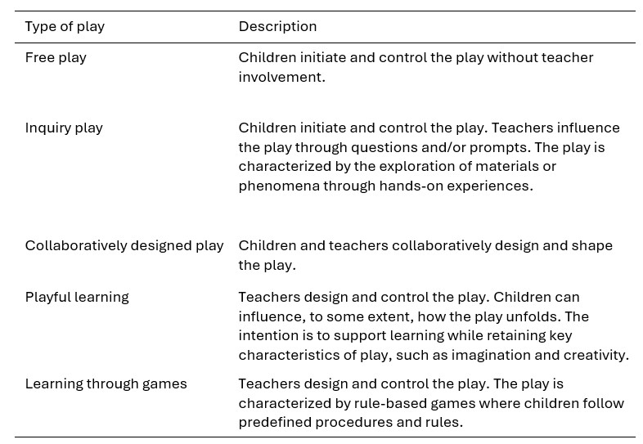
Although the play continuum has a central place in the review, distinctions between play types are not always clearly presented in empirical studies. We therefore clarify how different play types are defined and applied throughout the review, with a detailed overview provided in Table 2.
Method
To explore the scope and nature of existing research related to science learning and play-based pedagogies in ECEC, this study was conducted as a scoping review. This method is suitable for mapping a broad and heterogeneous field, such as research on play and science in ECEC, and for identifying patterns and tendencies in how research conceptualizes science learning and the role of teachers in play (Arksey & O’Malley, 2005). The review followed the methodological framework refined by Levac et al. (2010) and was guided by the Preferred Reporting Items for Systematic Reviews and Meta-Analyses Extension for Scoping Reviews (PRISMA-Scr) guidelines (Tricco et al., 2018). The process involved identifying the research question, locating and selecting relevant studies, charting the data, and summarizing and reporting the results.
Eligibility Criteria
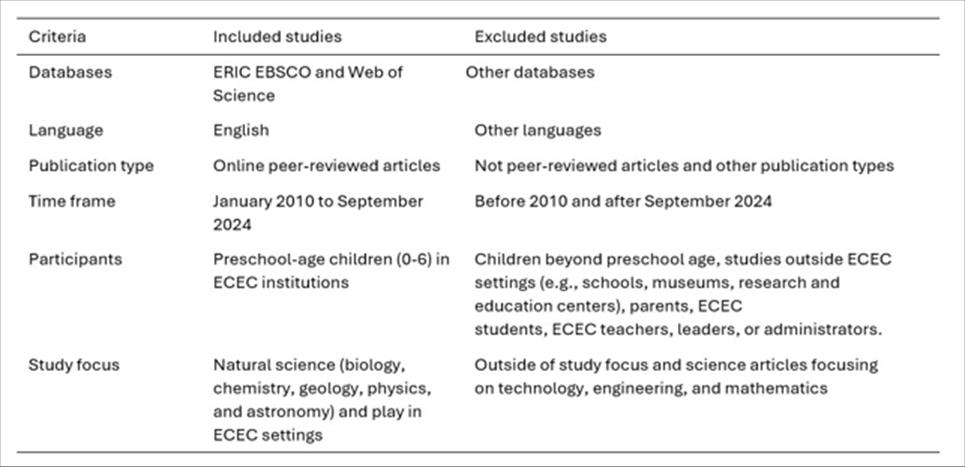
The scoping review included peer-reviewed articles published in English between 2010 and 2024, a period chosen to reflect recent developments in the field. No formal quality evaluation of the included articles was conducted, consistent with the exploratory aim of scoping reviews (Arksey & O’Malley, 2005). The selected studies involved children aged 0-6 years, corresponding to the typical age range of ECEC across international contexts, and were clearly situated in ECEC settings, such as kindergarten, daycare, or preschool. Studies containing wider age ranges were included only when findings for ECEC-aged children could be clearly distinguished from other age groups. The review focused on the interplay between science and play, particularly in the context of the natural sciences. Articles exclusively addressing play, science, or other STEM disciplines were excluded, as were studies targeting parents, ECEC students, or ECEC professionals. The inclusion and exclusion criteria applied during the selection process are outlined in Table 1.
Table 1. Inclusion and exclusion criteria
Information Sources and Search Strategy
Two databases were used to identify relevant studies: ERIC EBSCO (Education Resources Information Center/ERIC) and Web of Science (WoS), which provide extensive coverage of education and scientific journals, respectively. The following search string was used: ((Science) AND play AND (kinder* OR "early childhood" OR preschool OR "young children")). The terms kinder*, “early childhood”, preschool, and “young children” are variations referring to the same stage of formal education and care for young children. The search strategy was developed in consultation with a university librarian.
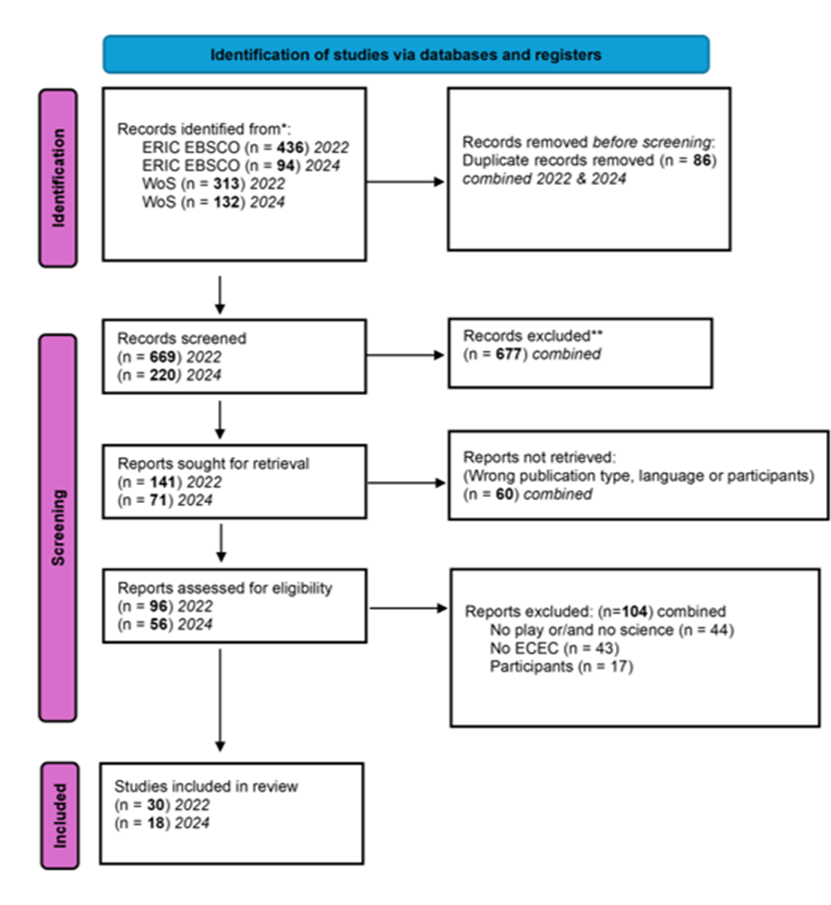
The literature search was performed in two stages: an initial search in April 2022, covering studies published between 2010 and 2020, followed by an update search in October 2024 to identify studies published between January 2021 and September 2024. This two-stage approach was used to ensure that the review captured both earlier and more recent publications within the field. The search and selection process is illustrated in the PRISMA-Scr flowchart (Figure 1) (Page et al., 2021).
Figure 1. The PRISMA-Scr flowchart
Selection of Sources and Data Charting
All search results were uploaded into the literature review management software Rayyan (Ouzzani et al., 2016) for duplicate removal and independent screening of titles and abstracts based on the inclusion criteria. The screening process was conducted individually by all authors, and lists of included studies were compared. Full-text articles were reviewed when necessary, and any uncertainties or disagreements were discussed and resolved through consensus. To further ensure the eligibility of the selected studies, the two authors performed a manual check for duplicates and reviewed all included and excluded articles.
Studies that met the inclusion criteria underwent an initial full-text review, followed by a more detailed evaluation to confirm their relevance. Data from each included study, such as author information, publication year, country, sample size, and children’s age, as well as key variables (type of play, degree of child and/or teacher guidance in play, and degree of specified learning objectives), were extracted into an Excel form. In this study, the term “teachers” refers to ECEC teachers and/or researchers involved in the design and/or implementation of play-based activities. A summary of the data material is provided in Table A1 in the Appendix.
Screening and data extraction were carried out by all authors in 2022, working in pairs, and by the first authors in 2024 for the update search. Given the qualitative and interpretive nature of the screening and coding process, consistency was ensured through iterative discussions among the authors.
Synthesis of Results
This scoping review employed deductive qualitative content analysis (Pollock et al., 2023), applying a predefined framework to classify key variables into five-point categories, coded from 1 to 5 (see Table A1). Articles addressing multiple categories within the same variable were divided into separate datasets and analyzed as independent data points (see Fridman et al., 2020; Weber et al., 2020). In some studies, narrow distinctions between intermediary categories (2, 3, 4) could lead to various code interpretations, which were resolved through collaborative discussions among the authors to ensure coding consistency. The data were summarized, and relationships between key variables were visualized using a bubble chart.
Results
Study Characteristics
The review identified 48 studies (encompassing 51 datasets) from different countries, with the majority originating from Sweden (n=10), Australia (n=9), and the USA (n=7) (Table A1). Research on science and play pedagogies showed a notable increase during the period from 2020 to 2024 (n=25). Furthermore, most studies focused on children aged three to six years, with only 10 studies including children under the age of three.
Based on the play types defined by Pyle and Danniels (2017), inquiry play (n=21) and playful learning (n=15) were the most frequently represented categories, while free play (n=10), learning through games (n=4), and collaboratively designed play (n=1) were less common. An overview of how these play types are defined and applied in this review is provided in Table 2.
Table 2. Description of play types based on Pyle and Danniels’ play continuum (2017)
The majority of studies focused on play activities that were either fully (n=15) or mainly (n=21) guided by teachers. Child-guided play was identified in 13 studies, with 9 characterized by full child control and 4 where children had more control than teachers over the play process. Additionally, shared guidance, where teachers and children contributed equally, was observed in 2 studies. Most play activities were structured around fully or mostly specified learning objectives (n=27 and n=13, respectively), indicating that learning goals shaped both the structure and progression of play. While mostly specified learning objectives allowed some flexibility in how play unfolded, fully specified learning objectives left limited room for children’s emerging interests and ideas.
In contrast, few studies described play activities without specified learning objectives (n=10 datasets, derived from 9 studies). These activities were characterized by children’s open-ended engagement with materials and their surroundings, without explicit learning aims guiding the play. In addition, one study (n=1) contained loosely defined learning objectives that did not clearly guide or structure the play. No studies were classified as having balanced learning objectives, where children’s open-ended play coexists with learning objectives without either dominating the play.
Percentages reported throughout the Results section are calculated based on 51 datasets. As some studies contributed more than one dataset, categories are not mutually exclusive, and percentages therefore do not necessarily sum to 100%. All percentages are rounded to whole numbers.
Child and/or Teacher Guidance vs Learning Objectives
A bubble chart analysis of the relationship between the degree of child and/or teacher guidance and the specified learning objectives in play showed that 35 studies (69%) clustered in the upper-right region of the chart, indicating a strong association between high levels of teacher guidance and well-defined learning objectives (Figure 2).
Figure 2. The relationship between the degree of child and/or teacher guidance and the degree of specified learning objectives.
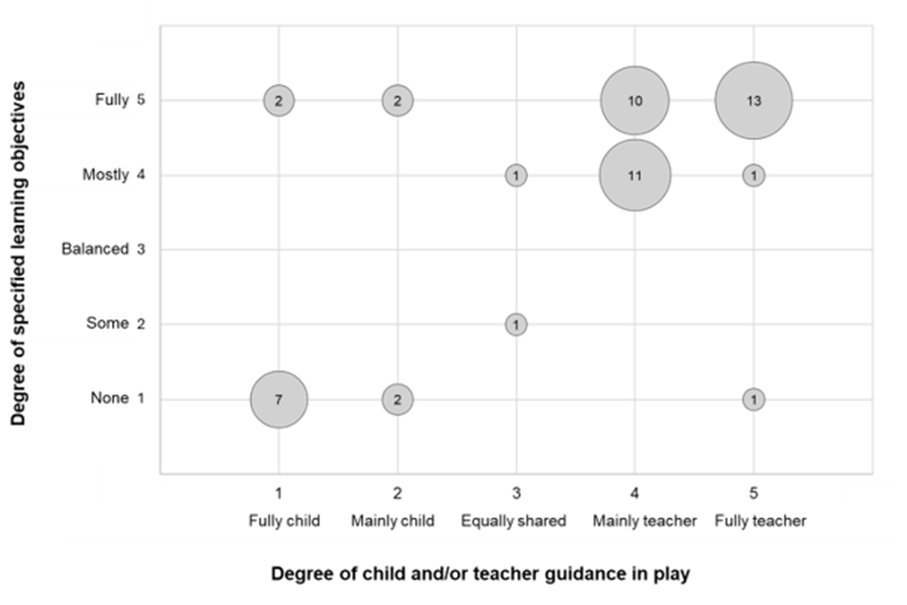
The x-axis represents a range from child-led to teacher-led guidance, with intermediate categories indicating varying degrees of shared guidance. The y-axis represents learning objectives, ranging from absent (None) to fully specified (Fully), with intermediate categories reflecting varying degrees of coexistence between goal-driven learning and open-ended play. Each bubble represents the number of studies with identical data values, with bubble size indicating frequency.
In these studies, teachers intentionally and actively lead children towards learning specific scientific concepts such as electricity (Gavrilas et al., 2025; Peppler et al., 2019), Earth’s shape and the day-night cycle (Güçhan-Özgül, 2021), and shadow formation (Herakleioti & Pantidos, 2016; Hsu et al., 2011). One study, in which children followed teacher-directed instructions such as mixing specific liquids in defined quantities, diverged from this pattern [point 5,1]. Rather than focusing on learning specific scientific concepts, the study emphasized children’s emerging exploration skills.
The left side of the chart represents studies that emphasize child-guided play (n=13, 25%). Nine of these studies, located in the lower-left region, focus on children’s spontaneous play without explicit learning objectives. Through interaction with various materials in their play environments, children experienced, for example, gravity and friction when climbing trees (Areljung et al., 2023; Speldewinde, 2025), acceleration and force when using a swing (Günther-Hansen, 2020), the formation of new substances by mixing water with earth or sand (Dale Tunnicliffe & Gkouskou, 2020), or encounters with living organisms such as slugs and ants (Wight et al., 2016). In contrast, four studies located in the upper-left region contain child-directed play with clearly defined learning objectives, such as understanding the balance scale (Nayfeld et al., 2011), mass theory (Weber et al., 2020), or the concept of projectile motion (Herodotou, 2018).
Notably, two studies in the middle region illustrate a shared approach, combining child- and teacher-guided play. These were based either on children’s ideas and imagination [point 3,2] (Sherfinski et al., 2022) or on predefined scientific themes centered around children’s interests [point 3,4] (Sundberg et al., 2016).
Child and/or Teacher Guidance vs Type of Play
An examination of whether child and/or teacher guidance is associated with specific types of play revealed that most studies focused on teacher-guided inquiry play (n=18, 35%) and playful learning (n=14, 27%) (Figure 3). A central feature of inquiry play, as highlighted in many studies, involved hands-on exploration of scientific phenomena guided by open-ended questions that stimulate reflection and understanding (e.g., Bulunuz, 2013; Dejonckheere et al., 2016; McNerney et al., 2020; Studhalter et al., 2024). In the case of playful learning, children engaged with scientific phenomena through, for example, teacher-guided storytelling and drama play (Walan & Enochsson, 2019), or imaginative role-play (Fleer, 2019, 2024; Frakgiadaki et al., 2023; 2024; Ärlemalm-Hagsér, 2013). Additionally, play categorized as learning through games was mainly played under teacher supervision, using digital tools such as tablets (van der Graaf et al., 2016) and touchscreens (Hsu et al., 2011), or traditional materials such as cards or boards (Strasser et al., 2023).
Figure 3. The relationship between the type of play and the degree of child and/or teacher guidance in play.
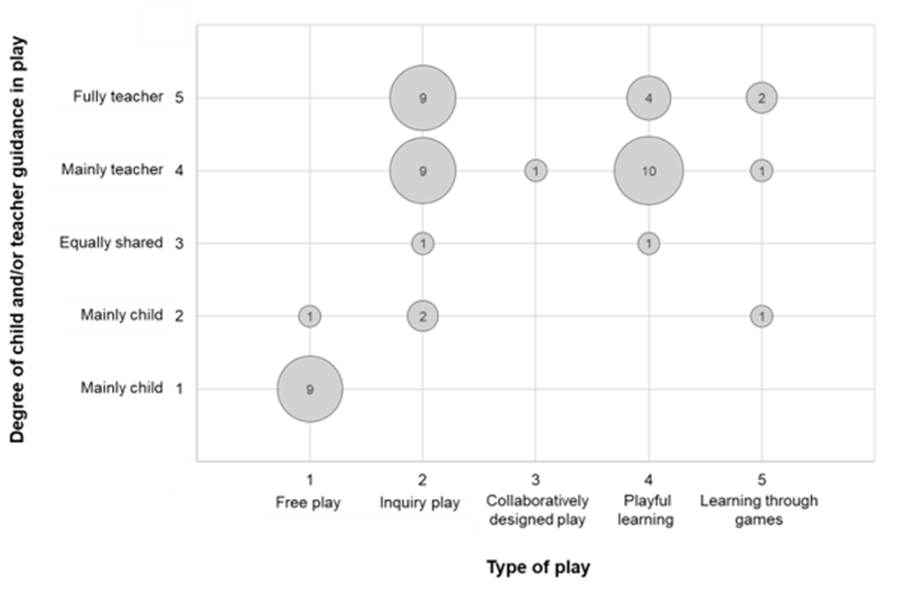
The x-axis represents the type of play (as defined in Table 2). The y-axis represents a range from child-led to teacher-led guidance, with intermediate categories indicating varying degrees of shared guidance. Each bubble represents the number of studies with identical data values, with bubble size indicating frequency.
In contrast, free play (n=10, 20%) was largely child-guided, consistent with its definition as play that is initiated and led by children without teacher intervention. For example, one study describes a girl, Emily, who played freely while interacting with a swing (Günther-Hansen, 2020), while another describes a boy who spontaneously built and played a “marimba” (van Vreden, 2018).
Learning Objectives vs Type of Play
An analysis of how different types of play were associated with learning objectives showed that most forms, excluding free play, were linked to fully or mostly specified scientific concepts (Figure 4). This aligns with the definition of free play as not guided by any defined learning objectives set by teachers. Notably, two studies categorized as free play contained fully specified learning objectives, which appear inconsistent with the core definition of free play [point 1,5] (Nayfeld et al., 2011; Weber et al., 2020). In both cases, the broader play interventions had explicit learning objectives, such as understanding the function of a balance scale or the concept of mass, while the free play component (referred to as "free choice time" by Nayfeld et al., 2011) served as a comparison condition in which children engaged freely with provided materials. Although these studies focused on specific learning objectives, the free play segments were not directly structured to achieve them, supporting their placement within the free play category.
Figure 4. The relationship between the type of play and the degree of specified learning objectives.
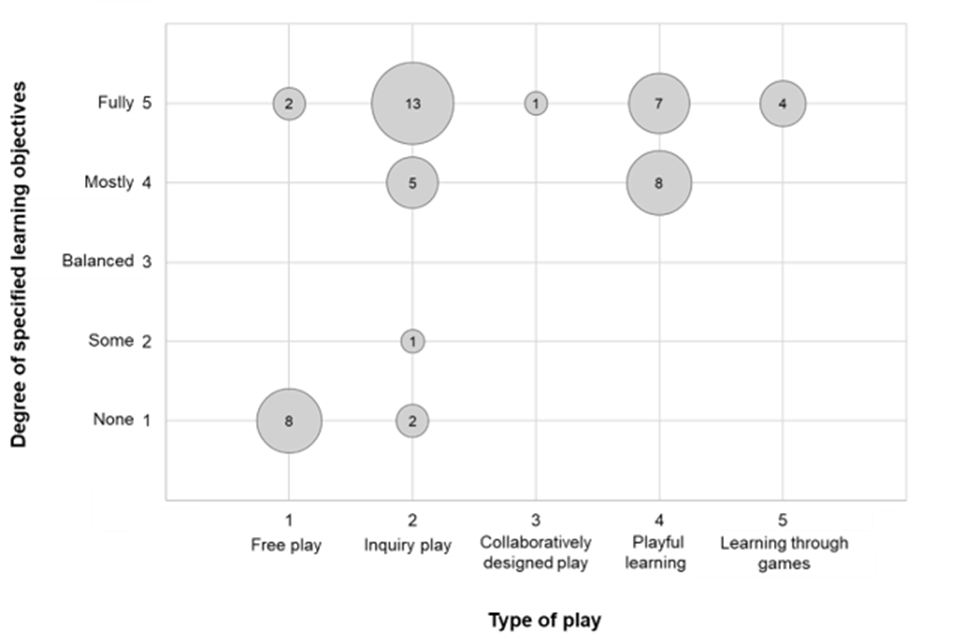
The x-axis represents the type of play (as defined in Table 2). The y‑axis represents learning objectives, ranging from absent (None) to fully specified (Fully), with intermediate categories indicating varying degrees of coexistence between goal-driven learning intentions and open‑ended play. Each bubble represents the number of studies with identical data values, with bubble size indicating frequency.
Interestingly, two studies on inquiry play, Fridman et al. (2020) and Sherfinski et al. (2022), either lacked or contained only loosely defined learning objectives [points 2,1 and 2,2]. In the study by Fridman and colleagues (2020), children explored the properties of liquids and used scientific tools in both open-ended (a) and more structured (b) contexts [2,1]. However, the focus was on how children interacted with these materials and demonstrated inquiry skills, rather than on achieving specific learning objectives. Similarly, the study by Sherfinski and colleagues (2022) examined children’s engagement with materials and the environment, shaped to some extent by formal learning goals and pedagogical practices [2,2].
Discussion
Science pedagogies in ECEC can often be excessively structured and curriculum-driven, resembling academic approaches more suited to older learners (Larimore, 2020). Such approaches can limit learning opportunities that emerge from children’s autonomous exploration and may suppress children’s natural curiosity and intrinsic motivation (Bjerknes et al., 2024; Larimore, 2020). In response, many ECEC teachers and researchers support the integration of science with play, allowing children to engage with scientific concepts in ways that are not only playful and developmentally appropriate but also meaningful (e.g., Bulunuz, 2013; Fleer, 2019; Glauser-Abou Ismail et al., 2022; Henriksson, Leden et al., 2025). Our analysis of 48 peer-reviewed studies focusing on science and play in ECEC reveals a prevailing trend: research has largely focused on play as a pedagogical tool to achieve specific educational objectives, often through teacher-directed activities. This reflects ongoing concerns that structured pedagogies may overshadow opportunities for child-led inquiry and spontaneous exploration. In the following sections, we examine how this tension is illustrated in existing research and explore how different types of play, particularly inquiry-based play, are used to navigate the continuum between child-initiated and teacher-guided approaches.
Interpreting Trends in Play-based Science Pedagogies
The majority of the reviewed studies contained play-based approaches characterized by high levels of teacher guidance and clearly defined learning objectives (Figure 2). This suggests that within science pedagogies in ECEC, there is a strong emphasis on both what and how children learn, even when playful methods are employed. In these studies, it was typically teachers who determined how play was structured to achieve specific educational outcomes.
However, a few studies deviate from this trend. For example, research by Areljung et al. (2023), Dale Tunnicliffe and Gkouskou (2020), Günther-Hanssen (2020), Speldewinde (2024), and Solis et al. (2017) explored how children engage with science concepts during free play. These studies highlight the potential of unstructured, child-initiated play as a context for scientific exploration, where learning emerges naturally through children’s curiosity, exploration, and interaction with various objects in their natural environment. In contrast, studies by Nayfeld et al. (2011), Weber et al. (2020), and Zeng and Ng (2024) emphasize the teacher’s important role in making free play more meaningful by facilitating, encouraging, and extending children’s scientific exploration and learning. Nayfeld et al. (2011) argue that the presence or interaction with science materials alone does not ensure children’s independent exploration or learning. Instead, structured support from teachers can enrich free play and foster specific scientific knowledge.
Similarly, a study comparing three groups of children who received different levels of teacher support during play found that the group with the most guidance developed a better understanding of the concept of mass (Weber et al., 2020). Although the group that engaged in free play with building blocks acquired some understanding of stability through autonomous exploration, their ability to verbalize this knowledge was lower compared to the guided play groups. These studies suggest that while free play may support curiosity-driven inquiry, teacher involvement and scaffolding may be crucial for supporting deeper conceptual understanding and creating meaningful scientific learning experiences. This highlights the importance of clearly defining the purpose of play in science learning. Hence, it is important to ask: Do we aim for children to develop conceptual understanding, or is the goal to nurture children’s connections with peers, objects, and nature (Aslanian et al., 2024)? Or do we want to achieve both?
Meaningful engagement and social interaction are core criteria of PBL, particularly in ECEC, where the goal is to support children’s holistic development (Broström 2017, p. 3). In this context, ECEC teachers play a crucial role in creating responsive environments that spark curiosity and encourage children’s engagement in various learning activities (e.g., Fleer, 2019; Güçhan-Özgül, 2021; Henriksson, Fridberg et al., 2025; Sikder, 2024; Vartiainen & Kumpulainen, 2020). Their role extends beyond facilitating play; they also introduce scientific content that may not naturally emerge in children’s spontaneous play (Henriksson, Leden et al., 2025). However, while teacher involvement can enrich play experiences, it raises an important question of how meaningful these activities are for children, especially if they lack interest in the chosen topics. Interest-driven and enjoyable activities are important for learning, as they enhance essential learning components such as memory, attention, and motivation (Bodrova et al., 2018).
To make learning more meaningful and aligned with children’s interests, narrative play is recognized as a valuable pedagogical approach within ECEC (Brėdikytė, 2022; Devi et al., 2018; Hakkarainen et al., 2013). Through imaginative scenarios that reflect children’s fantasies, curiosity, and lived experiences, this form of play creates opportunities for children to express their ideas and engage with scientific concepts in ways that are both meaningful and accessible to young learners (Fleer, 2009; 2019; Fleer et al., 2014). Recent studies by Fleer (2024) and Fragkiadaki et al. (2023; 2024) demonstrate that such an approach can effectively support science learning even among toddlers. These successful outcomes depend on dynamic and supportive learning environments shaped by teachers’ responsiveness, encouragement, and shared imagination. Moreover, Brėdikytė (2022) found that teachers’ active participation as play partners enhanced children’s communication and social interaction, especially benefiting children who might otherwise struggle to engage in play. Additionally, research shows that teacher participation in narrative play contexts can help address gender patterns in early science learning by creating more inclusive and motivating conditions for girls’ engagement in science activities (Stephenson et al., 2022).
Whose Play Is It? Teacher Role in Children’s Scientific Play
While teacher involvement in children’s play is often guided by specific learning objectives, research consistently shows that play is most beneficial when teachers adopt a facilitative role, scaffolding children’s play without dominating it (e.g., Gaviria-Loaiza et al., 2017; Johnson et al., 2005; Tesikova & Berta, 2026). This approach allows children to maintain ownership of the play, weaving in their own fantasies and ideas so that new learning concepts emerge naturally and become more engaging. However, it remains important to critically reflect on the extent to which such play genuinely represents children’s own fantasies and imaginations, especially when play themes are defined by the teacher.
Research describes a spectrum of teacher roles in children’s play, ranging from facilitators to mediators and co-players (e.g., Bubikova-Moan et al., 2019; Pyle & Danniels, 2017). These roles are fluid rather than fixed, shaped by the context, learning objectives, and the nature of the play itself. In this review, we did not aim to categorize these distinct roles. Instead, we focused on mapping the overall research trends on child-teacher involvement in play-based science learning. Across the reviewed studies, except those focusing on free play, we found that teachers consistently took on a dominant role in play. A high degree of teacher guidance was evident across all types of play, including inquiry play, collaboratively designed play, playful learning, and learning through games (Figure 3).
This tendency toward teacher-guided play may be linked to early childhood curricula that emphasize specific learning objectives, particularly within science education. Our findings show that, in most studies, children engaged with science through play that was intentionally designed to support learning specific science skills and/or concepts (Figure 4), often aligned with national curricular frameworks. For example, studies by Bulunuz (2013) and Güçhan-Özgül (2021) examined play activities based on the Turkish national preschool curriculum, focusing on the development of science skills such as exploration, prediction, and observation, as well as understanding of concepts like gravity, air, and the day–night cycle. Similarly, Gavrilas et al. (2025) described a teaching scenario on electricity that integrated hands-on activities and digital tools to build conceptual understanding, in line with the goals of the Greek kindergarten curriculum. These examples illustrate a common trend in research: play-based approaches to science learning are often designed not only to spark children’s curiosity and encourage exploration, but also to meet curriculum-driven objectives. In this context, teacher involvement plays a central role in guiding and structuring the learning experiences to ensure that play remains focused on intended learning outcomes.
At the same time, the emphasis on curriculum-driven play-based approaches may give rise to tensions in pedagogical practice. While many studies in our review emphasize the benefits of structured, curriculum-aligned play, Bubikova-Moan et al. (2019) point out that teachers often experience tension between curriculum demands, their professional beliefs, and the value of a child-centered approach to play. Play without a clear educational purpose is often viewed as less conducive to academic learning and school readiness. A common concern among researchers and ECEC teachers is that children may not develop essential science-related knowledge and skills if play occurs without teacher guidance (e.g., Dejonckheere et al., 2016; Henriksson, Leden et al., 2025; Pyle & Danniels, 2017).
In addition to curricular influences, these observed patterns can also be understood in relation to the methodological characteristics of the reviewed studies. The dominance of intervention-based and teacher-controlled study designs is likely to privilege forms of play that can be planned, structured, and measured in relation to specific learning outcomes, while underrepresenting child-initiated forms of play, such as free play. Consequently, the review may be biased toward research traditions that emphasize adult guidance and specific learning outcomes, while giving less attention to more open-ended and child-initiated play practices in ECEC. This raises important questions about how research methods shape both the focus of studies and the kinds of knowledge that are valued about play and science in early childhood.
Inquiry Play: Balancing Child-Initiated Inquiry and Teacher Guidance
Scientific inquiry skills, such as asking questions, making predictions, and sharing ideas, form the foundation of scientific thinking and are best nurtured through play-based learning environments where children actively engage with and explore the world around them (e.g., Bulunuz, 2013; Dejonckheere et al., 2016; Güçhan-Özgül, 2021). While children are naturally curious and active explorers, relying solely on spontaneous inquiry may not be sufficient for fostering deeper scientific understanding (McNerney et al., 2020; Russell & McGuigan, 2017). This innate curiosity provides a strong basis for scientific learning, but it requires thoughtful teacher guidance to help children notice, interpret, and make sense of the phenomena they encounter (García-Rodeja et al., 2024; Harlen, 2014; Vartiainen & Kumpulainen, 2020). To support this process, ECEC teachers should provide children with a variety of equipment and materials that spark curiosity and sustain engagement in scientific exploration, while ensuring that activities remain playful and captivating (Chookah et al., 2023; Samuelsson & Carlsson, 2008). In addition, Fridberg et al. (2019; 2020) emphasize the importance of connecting scientific exploration to children’s prior experiences, which are essential for understanding specific learning objectives.
While our analysis identified inquiry play as the most common form of guided play designed to meet specific learning objectives in early science education (see Figures 3 and 4), Pyle and Danniels (2017) placed inquiry play close to free play on their continuum of PBL. In their study, inquiry play is described as child-led exploration of materials and environments with minimal teacher intervention, where children direct the play based on their own interests. In contrast, the studies included in our review described inquiry play as a more guided and intentional process, in which teachers actively guided children’s exploration by providing materials, posing questions, and supporting their understanding of specific scientific concepts. This difference likely reflects diverse pedagogical approaches and theoretical perspectives, shaped by the specific contexts each study aimed to explore (Rönnebeck et al., 2016). In our review, inquiry play was linked to scientific concepts and inquiry processes, characterized by problem-solving activities, scientific exploration, and reflective thinking—suggesting a more intentional and learning-oriented approach.
For young children, exploring scientific concepts through inquiry is not inherently difficult, as long as the activities are meaningful and connected to their everyday experiences (Dejonckheere et al., 2016). Therefore, it is essential to create play-based learning environments adapted to children’s age and interests that balance teacher guidance with child-initiated inquiry (Fridman et al., 2020). Neither of these approaches is universally “best”; each promotes different aspects of children’s development. Teacher-guided inquiry can help reduce cognitive load and maintain focus on specific learning objectives, while open-ended child-initiated inquiry fosters spontaneity, creativity, and broader cognitive, emotional, and social development (Fridman et al., 2020). Taken together, these findings underscore the importance of adopting a balanced approach to inquiry play, one that values children’s natural curiosity while recognizing the need for intentional teacher support.
Conclusion
Our review indicates that most studies on play-based pedagogies and learning sciences in ECEC involve teacher-guided play activities (Pyle & Danniels, 2017), and that learning objectives often guide how these activities are structured and implemented. This raises important questions about how to best promote children’s intrinsic motivation and drive to learn natural science: Should the focus be on acquiring scientific concepts, or on promoting cognitive growth and reasoning skills? Some researchers argue that children’s curiosity and sense of wonder flourish when they encounter diverse emotions, especially through play, which in turn fuels children’s motivation to learn (e.g., Bjerknes et al., 2024). Although studies involving narrative play report increased learning and participation in imaginative play (e.g., Brėdikytė, 2022; Fleer, 2019), there is still limited understanding of how teacher involvement in play can effectively support intrinsic motivation and children’s drive to learn. At the same time, it is important to consider how methodological approaches in existing research may shape which types of play are studied and valued, potentially underrepresenting more open-ended and child-initiated forms of play. Therefore, further research is needed to explore how children’s emotions and science learning unfold in free play compared to play with varying degrees of teacher involvement in play-based settings.
Limitations
A potential limitation of this study was the ambiguity in coding intermediary categories (2, 3, 4) within the 1-5 system. Although consensus was reached through thorough discussions among authors, the subtle distinctions between these categories left room for varying interpretations, which may have influenced the coding outcomes. Additionally, as with most reviews, some studies may have been missed due to limitations in database coverage, language restrictions, or publication bias.
References
* Studies included in the scoping review
*Areljung, S., Bäckström, L., & Grenemark, E. (2023). Young children’s learning in physics: a (dis-)trustful play with gravity, friction and counterforces? European Early Childhood Education Research Journal, 31(4), 660–672. https://doi.org/10.1080/1350293X.2023.2177320
Arksey, H., & O’Malley, L. (2005). Scoping studies: towards a methodological framework. International Journal of Social Research Methodology, 8(1), 19–32. https://doi.org/10.1080/1364557032000119616
Arndt, S. (2020). Rethinking play, diversity and belonging in early childhood education. Beijing International Review of Education, 2(2), 226-243. https://doi.org/10.1163/25902539-00202006
Aslanian, T. K., Bjerknes, A.-L., & Andresen, A. K. (2024). Children’s holistic learning during self-initiated outdoor play in a Norwegian kindergarten. European Early Childhood Education Research Journal, 32(3), 371–382. https://doi.org/10.1080/1350293X.2023.2257911
Bjerknes, A.-L., Wilhelmsen, T., & Foyn-Bruun, E. (2024). A Systematic Review of Curiosity and Wonder in Natural Science and Early Childhood Education Research. Journal of Research in Childhood Education, 38(1), 50–65. https://doi.org/10.1080/02568543.2023.2192249
Bodrova, E., Leong, D., Germeroth, C., & Day-Hess, C. (2018). Leading children in their ‘leading activity’. In P. Smith & J. Roopnarine (Eds.), The Cambridge handbook of play: Developmental disciplinary perspectives (pp. 436–456). Cambridge University Press. https://doi.org/10.1017/9781108131384.024
Brėdikytė, M. (2022). Adult participation in the creation of narrative playworlds: challenges and contradictions. International Journal of Early Years Education, 30(3), 595-609. https://doi.org/10.1080/09669760.2022.2107895
Broström, S. (2017). A dynamic learning concept in early years’ education: A possible way to prevent schoolification. International Journal of Early Years Education, 25(1), 3-15. https://doi.org/10.1080/09669760.2016.1270196
Bubikova-Moan, J., Hjetland, H. N., & Wollscheid, S. (2019). ECE teachers’ views on play-based learning: a systematic review. European Early Childhood Education Research Journal, 27(6), 776–800. https://doi.org/10.1080/1350293X.2019.1678717
*Bulunuz, M. (2013). Teaching science through play in kindergarten: Does integrated play and science instruction build understanding? European Early Childhood Education Research Journal, 21(2), 226-249. https://doi.org/10.1080/1350293X.2013.789195
Bustamante, A. S., White, L. J., & Greenfield, D. B. (2017). Approaches to learning and school readiness in Head Start: Applications to preschool science. Learning and Individual Differences, 56, 112-118. https://doi.org/10.1016/j.lindif.2016.10.012
*Charara, J., Miller, E. A., & Krajcik, J. (2021). Knowledge in use: Designing for play in kindergarten science contexts. Journal of Leadership, Equity, and Research, 7(1).
Cheng, M. F., & Johnson, J. E. (2010). Research on children’s play: Analysis of developmental and early education journals from 2005 to 2007. Early Childhood Education Journal, 37, 249-259. https://doi.org/10.1007/s10643-009-0347-7
Chetty, R., Friedman, J. N., Hilger, N., Saez, E., Schanzenbach, D. W., & Yagan, D. (2011). How does your kindergarten classroom affect your earnings? Evidence from Project STAR. The Quarterly Journal of Economics, 126(4), 1593-1660. https://doi.org/10.1093/qje/qjr041
*Chookah, H. A., Agbenyega, J. S., Santos, I. M., & Habak, C. (2023). Play Affordances of Natural and Non-natural Materials in Preschool Children’s Playful Learning Tasks. International Journal of Early Childhood, 56, 585–603. https://doi.org/10.1007/s13158-023-00348-z
*Dale Tunnicliffe, S., & Gkouskou, E. (2020). Science in action in spontaneous preschool play – an essential foundation for future understanding. Early Child Development and Care, 190(1), 54-63. https://doi.org/10.1080/03004430.2019.1653552
*Dejonckheere, P. J. N., De Wit, N., Van de Keere, K., & Vervaet, S. (2016). Exploring the classroom: Teaching science in early childhood. International Electronic Journal of Elementary Education, 8(4), 537-557.
Devi, A., Fleer, M., & Li, L. (2018). ‘We set up a small world’: Preschool teachers’ involvement in children’s imaginative play. International Journal of Early Years Education, 26(3), 295–311. https://doi.org/10.1080/09669760.2018.1452720
Eidsvåg, G. M., & Rosell, Y. (2021). The power of belonging: Interactions and values in children’s group play in early childhood programs. International Journal of Early Childhood, 53, 83-99. https://doi.org/10.1007/s13158-021-00284-w
Fleer, M. (2009). Supporting scientific conceptual consciousness or learning in ‘a roundabout way’ in play-based contexts. International Journal of Science Education, 31(8), 1069–1089. https://doi.org/10.1080/09500690801953161
*Fleer, M. (2019). Scientific Playworlds: a Model of Teaching Science in Play-Based Settings. Research in Sciene Education, 49, 1257–1278. https://doi.org/10.1007/s11165-017-9653-z
Fleer, M. (2023). The role of imagination in science education in the early years under the conditions of a Conceptual PlayWorld. Learning Culture and Social Interaction, 42. https://doi.org/10.1016/j.lcsi.2023.100753
*Fleer, M. (2024). Conceptual PlayWorld for Infant-Toddlers: The Unique Nature of Becoming a Science Learner in the Early Years of Life. Research in Science Education, 54, 315-338. https://doi.org/10.1007/s11165-023-10145-2
Fleer, M., Gomes, J., & March, S. (2014). Science learning affordances in preschool environments. Australasian Journal of Early Childhood, 39(1), 38–48. https://doi.org/10.1177/183693911403900106
*Fragkiadaki, G., Fleer, M., & Rai, P. (2023). Science Concept Formation During Infancy, Toddlerhood, and Early Childhood: Developing a Scientific Motive Over Time. Research in Science Education, 53, 275–294. https://doi.org/10.1007/s11165-022-10053-x
*Fragkiadaki, G., Fleer, M., & Rai, P. (2024). The Hidden and Invisible: Supporting Science Learning in Infant-Toddler Group Settings. Journal of Research in Childhood Education, 38(2), 227–242. https://doi.org/10.1080/02568543.2023.2234957
Fridberg, M., Jonsson, A., Redfors, A., & Thulin, S. (2019). Teaching chemistry and physics in preschool: A matter of establishing intersubjectivity. International Journal of Science Education, 41(17), 2542–2556. https://doi.org/10.1080/09500693.2019.1689585
Fridberg, M., Jonsson, A., Redfors, A., & Thulin, S. (2020). The role of intermediary objects of learning in early years chemistry and physics. Early Childhood Education Journal, 48(5), 585-595. https://doi.org/10.1007/s10643-020-01016-w
*Fridman, R., Eden, S., & Spektor-Levy, O. (2020). Nascent Inquiry, Metacognitive, and Self-Regulation Capabilities Among Preschoolers During Scientific Exploration. Frontiers in Psychology, 11. https://doi.org/10.3389/fpsyg.2020.01790
Fung, C. K., & Cheng, D. P. (2012). Consensus or dissensus? Stakeholders’ views on the role of play in learning. Early Years, 32(1), 17-33. https://doi.org/10.1080/09575146.2011.599794
García-Rodeja, I., Barros, S., & Sesto, V. (2024). Inquiry-Based Activities with Woodlice in Early Childhood Education. Education Sciences, 14(7). https://doi.org/10.3390/educsci14070710
Gaviria-Loaiza, J., Han, M., Vu, J. A., & Hustedt, J. (2017). Children’s responses to different types of teacher involvement during free play. Journal of Childhood Studies, 42(3), 4-19. https://doi.org/10.18357/jcs.v42i3.17890
*Gavrilas, L., Papanikolaou, M.–S., & Kotsis, K. T. (2025). Exploring electricity in early childhood education: A 5E-based learning approach. Science Activities, 62(1), 53–94. https://doi.org/10.1080/00368121.2024.2406208
Ghafouri, F., & Wien, C. A. (2005). “Give us a privacy”: Play and social literacy in young children. Journal of Research in Childhood Education, 19(4), 279-291. https://doi.org/10.1080/02568540509595071
Glauser-Abou Ismail, N., Pahl, A., & Tschiesner, R. (2022). Play-based physics learning in kindergarten. Education Sciences, 12(5). https://doi.org/10.3390/educsci12050300
Gray-Lobe, G., Pathak, P. A., & Walters, C. R. (2023). The long-term effects of universal preschool in Boston. The Quarterly Journal of Economics, 138(1), 363-411. https://doi.org/10.1093/qje/qjac036
*Güçhan-Özgül, S. (2021). Integration of inquiry and play: Young children’s conceptual change in astronomy. Journal of Inquiry Based Activities (JIBA), 11(1), 1–15.
*Günther-Hanssen, A. (2020). A swing and a child: how scientific phenomena can come to matter for preschool children’s emergent science identities. Cultural Studies of Science Education, 15(4), 885-910. https://doi.org/10.1007/s11422-020-09980-w
Hakkarainen, P., Brėdikytė, M., Jakkula, K., & Munter, H. (2013). Adult play guidance and children’s play development in a narrative play-world. European Early Childhood Education Research Journal, 21(2), 213–225. https://doi.org/10.1080/1350293X.2013.789189
Hansel, R. R. (2015). Bringing blocks back to the kindergarten classroom. Young Children, 70(1), 44–51.
Harlen, W. (2014). Helping Children’s Development of Inquiry Skills. Inquiry in Primary Science Education, 1(1), 5–19.
*Henriksson, A., Fridberg, M., & Leden, L. (2025). Preschool Children’s Agency in Play-activities with Science Content. Early Childhood Education Journal, 53, 1303–1312. https://doi.org/10.1007/s10643-024-01729-2
Henriksson, A., Leden, L., Fridberg, M., & Thulin, S. (2025). Play-Activities with Scientific Content in Early Childhood Education. Early Childhood Education Journal, 53, 261–270. https://doi.org/10.1007/s10643-023-01593-6
*Herakleioti, E., & Pantidos, P. (2016). The Contribution of the Human Body in Young Children’s Explanations About Shadow Formation. Research in Science Education, 46, 21–42. https://doi.org/10.1007/s11165-014-9458-2
*Herodotou, C. (2018). Mobile games and science learning: A comparative study of 4 and 5 years old playing the game Angry Birds. British Journal of Educational Technology, 49(1), 6-16. https://doi.org/10.1111/bjet.12546
*Hsu, C. Y., Tsai, C. C., & Liang, J. C. (2011). Facilitating preschoolers’ scientific knowledge construction via computer games regarding light and shadow: The effect of the prediction-observation-explanation (POE) strategy. Journal of Science Education and Technology, 20(5), 482-493. https://doi.org/10.1007/s10956-011-9298-z
Johnson, J., Christie, J., & Wardle, F. (2005). Play, development and early childhood. Pearson Education, Inc.
Karila, K. (2012). A Nordic perspective on early childhood education and care policy. European Journal of Education, 47(4), 584-595. https://doi.org/10.1111/ejed.12007
Kotsopoulos, D., Makosz, S., Zambrzycka, J., & McCarthy, K. (2015). The effects of different pedagogical approaches on the learning of length measurement in kindergarten. Early Childhood Education Journal, 43(6), 531–539. https://doi.org/10.1007/s10643-014-0686-x
Lachman, S. J. (1997). Learning is a Process: Toward an Improved Definition of Learning. The Journal of Psychology, 131(5), 477–480. https://doi.org/10.1080/00223989709603535
Larimore, R. A. (2020). Preschool science education: A vision for the future. Early Childhood Education Journal, 48(6), 703-714. https://doi.org/10.1007/s10643-020-01033-9
Levac, D., Colquhoun, H., & O'Brien, K. K. (2010). Scoping studies: advancing the methodology. Implementation Science, 5. https://doi.org/10.1186/1748-5908-5-69
Maslow, A. H. (1943). A theory of human motivation. Psychological review, 50(4), 370. https://doi.org/10.1037/h0054346
*McNerney, K., Carritt, D., Dealey, H., & Ladbury, G. (2020). Using a scientific enquiry framework, focusing on questions, to promote enquiry skills in early childhood. Early Child Development and Care, 190(1), 30–42. https://doi.org/10.1080/03004430.2019.1653549
*Nayfeld, I., Brenneman, K., & Gelman, R. (2011). Science in the classroom: Finding a balance between autonomous exploration and teacher-led instruction in preschool settings. Early Education & Development, 22(6), 970-988. https://doi.org/10.1080/10409289.2010.507496
Nicolopoulou, A. (1993). Play, cognitive development, and the social world: Piaget, Vygotsky, and beyond. Human development, 36(1), 1-23. https://doi.org/10.1159/000277285
Ouzzani, M., Hammady, H., Fedorowicz, Z., & Elmagarmid, A. (2016). Rayyan—a web and mobile app for systematic reviews. Systematic Reviews, 5. https://doi.org/10.1186/s13643-016-0384-4
Page, M. J., McKenzie, J. E., Bossuyt, P. M., Boutron, I., Hoffmann, T. C., Mulrow, C. D., Shamseer, L., Tetzlaff, J. M., Akl, E. A., Brennan, S. E., Chou, R., Glanville, J., Grimshaw, J. M., Hróbjartsson, A., Lalu, M. M., Li, T., Loder, E. W., Mayo-Wilson, E., McDonald, S., ... & Moher, D. (2021). The PRISMA 2020 statement: an updated guideline for reporting systematic reviews. BMJ, 372. https://doi.org/10.1136/bmj.n71
Pekrun, R. (2014). Emotions and learning (Vol. 24). International Academy of Education (IAE).
*Peppler, K., Wohlwend, K., Thompson, N., Tan, V., & Thomas, A. (2019). Squishing Circuits: Circuitry Learning with Electronics and Playdough in Early Childhood. Journal of Science Education and Technology, 28, 118–132. https://doi.org/10.1007/s10956-018-9752-2
Pollock, D., Peters, M. D. J., Khalil, H., McInerney, P., Alexander, L., Tricco, A. C., Evans, C., de Moraes, É. B., Godfrey, C. M., Pieper, D., Saran, A., Stern, C., & Munn, Z. (2023). Recommendations for the extraction, analysis, and presentation of results in scoping reviews. JBI Evidence Synthesis, 21(3), 520–532. https://doi.org/10.11124/JBIES-22-00123
Pyle, A., & Danniels, E. (2017). A Continuum of Play-Based Learning: The Role of the Teacher in Play-Based Pedagogy and the Fear of Hijacking Play. Early Education and Development, 28(3), 274–289. https://doi.org/10.1080/10409289.2016.1220771
Rönnebeck, S., Bernholt, S., & Ropohl, M. (2016). Searching for a common ground – A literature review of empirical research on scientific inquiry activities. Studies in Science Education, 52(2), 161–197. https://doi.org/10.1080/03057267.2016.1206351Russell, T., & McGuigan, L. (2017). An updated perspective on emergent science. Early Child Development and Care, 187(2), 284–297. https://doi.org/10.1080/03004430.2016.1236847
Samuelsson, I. P., & Carlsson, M. A. (2008). The Playing Learning Child: Towards a pedagogy of early childhood. Scandinavian Journal of Educational Research, 52(6), 623–641. https://doi.org/10.1080/00313830802497265
*Sherfinski, M., Slocum, A., & Lough, J. (2022). How might place be pedagogical in Appalachia? New possibilities for early childhood classrooms in the Anthropocene. Pedagogy, Culture & Society, 30(5), 617–637. https://doi.org/10.1080/14681366.2020.1836674
*Sikder, S. (2024). Studying children’s small science and early engineering learning process to help shape their cultural identity in culturally valued play-based experience. Cultural Studies of Science Education, 19, 231-255. https://doi.org/10.1007/s11422-023-10209-9.
Skalstad, I., & Munkebye, E. (2021). Young children’s questions about science topics when situated in a natural outdoor environment: a qualitative study from kindergarten and primary school. International Journal of Science Education, 43(7), 1017-1035. https://doi.org/10.1080/09500693.2021.1895451
*Solis, S. L., Curtis, K. N., & Hayes-Messinger, A. (2017). Children’s exploration of physical phenomena during object play. Journal of Research in Childhood Education, 31(1), 122-140. https://doi.org/10.1080/02568543.2016.1244583
*Speldewinde, C. (2025). ‘Don’t pick, don’t lick’: Connecting young children’s risky play in nature to science education in Australian bush kinders. Early Childhood Education Journal, 53(4), 1133–1144. https://doi.org/10.1007/s10643-024-01661-5
*Stephenson, T., Fleer, M., & Fragkiadaki, G. (2022). Increasing Girls’ STEM Engagement in Early Childhood: Conditions Created by the Conceptual PlayWorld Model. Research in Science Education, 52, 1243–1260. https://doi.org/10.1007/s11165-021-10003-z
*Strasser, K., Balladares, J., Grau, V., Marín, A., & Preiss, D. (2023). Efficacy and perception of feasibility of structured games for achieving curriculum learning goals in pre-kindergarten and kindergarten low-income classrooms. Early Childhood Research Quarterly, 65, 396–406. https://doi.org/10.1016/j.ecresq.2023.08.006
*Studhalter, U. T., Jossen, P., Seeli, M., & Tettenborn, A. (2024). Tablet Computers in Early Science Education: Enriching Teacher–Child Interactions. Early Childhood Education Journal, 53, 2531-2545. https://doi.org/10.1007/s10643-024-01766-x
*Sundberg, B., Areljung, S., Due, K., Ekström, K., Ottander, C., & Tellgren, B. (2016). Understanding preschool emergent science in a cultural historical context through Activity Theory. European Early Childhood Education Research Journal, 24(4), 567–580. https://doi.org/10.1080/1350293X.2014.978557
Tal, C., Fares, E., Azmi, R. & Waab, W. (2008). Beyond learning and teaching in preschool free play centers in Daliat el-Carmel-Isfiya. Early Childhood Education Journal, 36(3), 281–289. http://doi.org/10.1007/s10643-008-0285-9
Tesikova, M., & Berta, A.-E. (2026). The Playworld Approach as a Way of Increasing Play Experiences for Students in Early Childhood Teacher Education Programs. In B. Isaksen, R. Johansen & J. Madsen (Eds.), Play-based Teaching in Higher Education (Vol. 51, pp. 23-43). Emerald Publishing Limited. https://doi.org/10.1108/S1479-368720260000051003
Tricco, A. C., Lillie, E., Zarin, W., O’Brien, K. K., Colquhoun, H., Levac, D., Moher, D., Peters, M. D., Horsley, T., & Weeks, L. (2018). PRISMA Extension for Scoping Reviews (PRISMA-ScR): Checklist and Explanation. Annals of Internal Medicine, 169(7), 467–473. https://doi.org/10.7326/M18-0850
*van der Graaf, J., Segers, E., & Verhoeven, L. (2016). Discovering the laws of physics with a serious game in kindergarten. Computers & Education, 101, 168-178. https://doi.org/10.1016/j.compedu.2016.06.006
*van Vreden, M. (2018). Music-inspired free play to foster scientific exploration in early childhood. South African Journal of Childhood Education, 8(2), 1-10. https://doi.org/10.4102/sajce.v8i2.560
*Vartiainen, J., & Kumpulainen, K. (2020). Playing with science: manifestation of scientific play in early science inquiry. European Early Childhood Education Research Journal, 28(4), 490–503. https://doi.org/10.1080/1350293X.2020.1783924
Vickerius, M., & Sandberg, A. (2006). The significance of play and the environment around play. Early Child Development and Care, 176(2), 207–217. https://doi.org/10.1080/0300443042000319430
Vosniadou, S. (2007). The conceptual change approach and its re-framing. In S. Vosniadou, A. Baltas, & X. Vamvakoussi (Eds.), Reframing the conceptual change approach in learning and instruction (pp. 1–15). Elsevier Science.
*Walan, S., & Enochsson, A. B. (2019). The potential of using a combination of storytelling and drama, when teaching young children science. European Early Childhood Education Research Journal, 27(6), 821–836. https://doi.org/10.1080/1350293X.2019.1678923
*Weber, A. M., Reuter, T., & Leuchter, M. (2020). The impact of a construction play on 5-to 6-year-old children’s reasoning about stability. Frontiers in Psychology, 11. https://doi.org/10.3389/fpsyg.2020.01737
*Wight, R. A., Kloos, H., Maltbie, C. V., & Carr, V. W. (2016). Can playscapes promote early childhood inquiry towards environmentally responsible behaviors? An exploratory study. Environmental Education Research, 22(4), 518-537. https://doi.org/10.1080/13504622.2015.1015495
Wood, E., & Hedges, H. (2016). Curriculum in early childhood education: Critical questions about content, coherence, and control. The curriculum journal, 27(3), 387-405. https://doi.org/10.1080/09585176.2015.1129981
*Zeng, H. Q., & Ng, S. C. (2024). Free Play Matters: Promoting Kindergarten Children’s Science Learning Using Questioning Strategies during Loose Parts Play. Early Childhood Education Journal, 53, 2373-2388. https://doi.org/10.1007/s10643-024-01741-6
*Ärlemalm-Hagsér, E. (2013). Minds on Earth Hour – a theme for sustainability in Swedish early childhood education. Early Child Development and Care, 183(12), 1782-1795. https://doi.org/10.1080/03004430.2012.746971
 ©2026
Martina Tesikova, Anne-Line Bjerknes, Therese Wilhelmsen, Ingunn Skalstad, Anne
Lene Kristiansen. This
is an Open Access article distributed under the terms of the Creative Commons
Attribution 4.0 International License
(http://creativecommons.org/licenses/by/4.0/), allowing third parties to copy
and redistribute the material in any medium or format and to remix, transform,
and build upon the material for any purpose, even commercially, provided the
original work is properly cited and states its license.
©2026
Martina Tesikova, Anne-Line Bjerknes, Therese Wilhelmsen, Ingunn Skalstad, Anne
Lene Kristiansen. This
is an Open Access article distributed under the terms of the Creative Commons
Attribution 4.0 International License
(http://creativecommons.org/licenses/by/4.0/), allowing third parties to copy
and redistribute the material in any medium or format and to remix, transform,
and build upon the material for any purpose, even commercially, provided the
original work is properly cited and states its license.
Appendix
Table A1. Overview of included studies and their categorization
Key variables were categorized using a 5-point scale as follows: Type of play (Pyle & Danniels, 2017), free play (1), inquiry play (2), collaboratively designed play (3), playful learning (4), learning through games (5). Degree of child and/or teacher guidance in play- fully child (1), mainly child (2), equally shared (3), mainly teacher (4), fully teacher (5). Degree of specified learning objectives- none (1), some (2), balanced- equal emphasis on open-ended play and learning objectives (3), mostly (4), fully (5).
N/A= not applicable; a, b, and c in the first author column indicate articles covering multiple categories within the same variables.
|
Articles |
Country |
N (children) |
Age (years) |
Type of play |
Child/teacher guidance |
Learning objectives |
|
Adbo & Vidal Carulla (2019) |
Sweden |
4 |
3 |
3 |
4 |
5 |
|
Areljung et al. (2023) |
Sweden |
16 |
2-4 |
1 |
1 |
1 |
|
Bulunuz (2013) |
Turkey |
26 |
5-6 |
2 |
5 |
5 |
|
Charara (2021) |
USA |
18 |
5 |
4 |
4 |
5 |
|
Chookah et al. (2023) |
UAE |
4 |
3-4 |
4 |
4 |
5 |
|
Dale Tunnicliffe & Gkouskou (2020) |
UK |
8 |
2-4 |
1 |
1 |
1 |
|
Dejonckheere et al. (2016) |
Belgium |
57 |
4-6 |
2 |
5 |
5 |
|
Desouza (2017) |
USA |
20 |
4 |
2 |
5 |
5 |
|
Fleer (2019) |
Australia |
26 |
3-6 |
4 |
4 |
4 |
|
Fleer (2024) |
Australia |
13 |
0.1-2.2 |
4 |
4 |
4 |
|
Frakgiadaki et al. (2023) |
Australia |
50 |
0.5-5.1 |
4 |
4 |
4 |
|
Frakgiadaki et al. (2024) |
Australia |
13 |
0.5-2 |
4 |
4 |
4 |
|
Fridman et al. (2020) a Open-ended |
Israel |
215 |
5-6 |
2 |
2 |
1 |
|
|
Fridman et al. (2020) b Structured |
Israel |
147 |
5-6 |
2 |
5 |
1 |
|
Gavrilas et al. (2025) |
Greece |
18 |
N/A |
2 |
4 |
5 |
|
Golubović-Ilić & Ćirković-Miladinović (2020) |
Serbia |
40 |
5 |
2 |
5 |
5 |
|
Güçhan-Özgül (2021) |
Turkey |
80 |
4-6 |
2 |
4 |
5 |
|
Günther-Hanssen (2020) |
Sweden |
1 |
5 |
1 |
1 |
1 |
|
Sweden |
4-5 |
2-4 |
4 |
4 |
4 |
|
|
Herakleioti & Pantidos (2016) |
Greece |
16 |
4-5 |
2 |
5 |
5 |
|
Herodotou (2018) |
UK |
32 |
4-5 |
5 |
2 |
5 |
|
Hsu et al. (2011) |
Taiwan |
50 |
6 |
5 |
5 |
5 |
|
Karlsson (2017) |
Sweden |
3 |
5-6 |
4 |
5 |
5 |
|
Australia |
40 |
N/A |
2 |
4 |
4 |
|
|
Larsson (2013) |
Sweden |
10 |
4-6 |
2 |
5 |
5 |
|
Ma et al. (2022) |
China |
34 |
4-5 |
4 |
4 |
4 |
|
McLean et al. (2015) |
Australia |
27 |
4 |
2 |
4 |
4 |
|
McNerney et al. (2020) |
UK |
11 |
3-5 |
2 |
5 |
5 |
|
Nayfeld et al. (2011) |
USA |
84 |
3-5 |
1 |
1 |
5 |
|
Peppler et al. (2019) |
USA |
45 |
3-5 |
2 |
4 |
5 |
|
Sherfinski et al. (2022) |
USA |
N/A |
3-5 |
2 |
3 |
2 |
|
Sikder (2024) |
Australia |
64 |
0.8-5 |
4 |
5 |
5 |
|
Solis et al. (2017) |
USA |
20 |
3-5 |
1 |
1 |
1 |
|
Australia |
220 |
4-5 |
1 |
1 |
1 |
|
|
Australia |
13 |
2.3-3.2 |
4 |
4 |
4 |
|
|
Strasser et al. (2023) |
Chile |
121 |
4.2-6 |
5 |
4 |
5 |
|
Studhalter et al. (2024) |
Switzerland |
41 |
4-6 |
2 |
4 |
5 |
|
Sundberg et al. (2016) |
Sweden |
N/A |
2-6 |
4 |
3 |
4 |
|
Teo et al. (2017) |
Singapore |
3 |
6 |
2 |
4 |
4 |
|
van der Graaf et al. (2016) |
Nederland |
71 |
4-6 |
5 |
5 |
5 |
|
van Schijndel et al. (2010) |
Nederland |
47 |
2-3 |
2 |
5 |
4 |
|
van Vreden (2018) |
South Africa |
N/A |
3-6 |
1 |
1 |
1 |
|
Vartiainen & Kumpulainen (2020) |
Finland |
31 |
5-6 |
2 |
4 |
4 |
|
Walan & Enochsson (2019) |
Sweden |
14 |
4-6 |
4 |
5 |
5 |
|
Weber et al. (2020) a Verbal + material |
Germany |
64 |
5-6 |
2 |
4 |
5 |
|
Weber et al. (2020) b Material |
Germany |
59 |
5-6 |
2 |
2 |
5 |
|
Weber et al. (2020) c Free play |
Germany |
60 |
5-6 |
1 |
1 |
5 |
|
Wight et al. (2016) |
USA |
64 |
3-5 |
1 |
1 |
1 |
|
Zeng & Ng (2024) |
Singapore |
5 |
4-5 |
1 |
2 |
1 |
|
Åkerblom et al. (2019) |
Sweden |
22 |
6 |
4 |
5 |
5 |
|
Ärlemalm-Hagsér (2012) |
Sweden |
17 |
5-6 |
4 |
4 |
5 |
References to included studies not in the above reference list
Adbo, K., & Vidal Carulla, C. (2019). Designing play-based learning chemistry activities in the preschool environment. Chemistry Education Research and Practice, 20(3), 542-553. https://doi.org/10.1039/C8RP00306H
Desouza, J. M. S. (2017). Conceptual play and science inquiry: using the 5E instructional model. Pedagogies: An International Journal, 12(4), 340–353. https://doi.org/10.1080/1554480X.2017.1373651
Golubović-Ilić, I., & Ćirković-Miladinović, I. (2020). Learning science in preschool by using research approach. Acta Didactica Napocensia, 13(1), 77-86.
Karlsson, A. B. (2017). "It vapors up like this": Children making sense of embodied illustrations of evaporation at a Swedish school. International Journal of Early Childhood Environment Education, 5(1), 39-56.
Kewalramani, S., & Veresov, N. (2022). Multimodal Creative Inquiry: Theorising a New Approach for Children’s Science Meaning-Making in Early Childhood Education. Research in Science Education, 52, 927–947. https://doi.org/10.1007/s11165-021-10029-3
Larsson, J. (2013). Contextual and Conceptual Intersubjectivity and Opportunities for Emergent Science Knowledge About Sound. International Journal of Early Childhood, 45, 101–122. https://doi.org/10.1007/s13158-012-0078-6
Ma, Y., Wang, Y., Fleer, M., & Li, L. (2022). Promoting Chinese children's agency in science learning: Conceptual PlayWorld as a new play practice. Learning, Culture and Social Interaction, 33. https://doi.org/10.1016/j.lcsi.2022.100614
McLean, K., Jones, M., & Schaper, C. (2015). Children’s Literature as an Invitation to Science Inquiry in Early Childhood Education. Australasian Journal of Early Childhood, 40(4), 49-56. https://doi.org/10.1177/183693911504000407
Teo, T. W., Yan, Y. K., & Ong, W. L. M. (2017). An investigation of Singapore preschool children’s emerging concepts of floating and sinking. Pedagogies: An International Journal, 12(4), 325–339. https://doi.org/10.1080/1554480X.2017.1374186
van Schijndel, T. J. P., Singer, E., van der Maas, H. L. J., & Raijmakers, M. E. J. (2010). A sciencing programme and young children’s exploratory play in the sandpit. European Journal of Developmental Psychology, 7(5), 603–617. https://doi.org/10.1080/17405620903412344
Åkerblom, A., Součková, D., & Pramling, N. (2019). Preschool children’s conceptions of water, molecule, and chemistry before and after participating in a playfully dramatized early childhood education activity. Cultural Studies of Science Education, 14(4), 879-895. https://doi.org/10.1007/s11422-018-9894-9