Vol 10, No 2 (2026)
https://doi.org/10.7577/njcie.6595
Article
Comparing Across Difference in Early Childhood Education: Common Challenges and Productive Juxtaposition in Bangladesh and Sweden
Annica Källebo
Stockholm University
Email: annica.kallebo@edu.su.se
Abstract
This explorative study compares early childhood education (ECE) in Bangladesh and Sweden using a most-different systems design, aiming to identify common challenges and to examine how comparison itself can proceed as a relational practice across very different systems. Drawing on ethnographic fieldwork in Dhaka and Stockholm, on notions of comparison as active connections and productive juxtaposition, and on commensuration as a social process, the paper uses vignettes as a representational form holding together space, time, and scales to analyze common challenges across contexts. The analysis works through paired ethnographic vignettes, approaching comparison as a relational process enacted through productive juxtaposition and multi-scalar analytical movements. Empirical findings suggest similarities in the function of teachers as time-brokers, in the function of pedagogy as a forum for negotiation between colliding value systems of pedagogical aims and societal norms, and in ECE functioning as an absorptive margin at the periphery of educational systems. The study shows that challenges in ECE are not reducible to questions of development, resourcing, or governance capacity alone, but are tied to how ECE is structurally organized and positioned in relation to wider institutional, cultural, and societal demands. Through reconsideration of juxtaposition, the study further problematizes 'where' difference may be located within a 'messy' system and discusses the scale and scope of the unit of comparison in ECE.
Keywords: early childhood education, juxtaposition, commensurability, criss-crossing
Introduction
There are many common challenges that signify early childhood education (ECE) worldwide, such as those connected to its non-compulsory educational status, issues of access and affordability, and disputed quality indicators (UNESCO & UNICEF, 2024). What also signifies ECE is that facing these challenges is done against compounded aspects of complexity. The notion of ECE as the most diverse education level (Sousa & Moss, 2022) reveals fragmented systems across multiple governance levels, practices embedded in complex local contexts, and policies that remain inadequately or inconsistently implemented across sectors and settings. This produces very different types of education and conditionalities for children within and across national contexts, consequently suggesting particular approaches for comparing ECE across different systems.
Despite ECE diversity, comparative research frequently reinforces the idea that 'similarity' must be established as a precondition for comparison and as the basis for determining whether comparison is meaningful. Tobin (2022) makes this explicit, suggesting that countries “should be similar enough along some key dimensions (...) to make comparison meaningful” (p. 299). But what would key dimensions be in the context of ECE? Similar policies, practices, governance structures, geographical location? In a field where these aspects vary so extensively, identifying what counts as a "key dimension" is itself contested terrain. Reinforcing the idea of similarity doesn't solve the problem of what is to be considered ‘meaningful’. Instead, it sidesteps it, directing comparative attention toward contexts that already 'resemble' each other. The risk, as Nóvoa (2018) observes, is that we end up perpetually comparing what is "similar to us," circling familiar territory rather than venturing outward, perhaps hindering us from understanding actual common challenges and conditions in the field.
However, this study takes a different approach by departing from dissimilarity, comparing ECE in Bangladesh and Sweden using a most-different systems design (Anckar, 2008). This is the third paper within a doctoral dissertation employing this design. These contexts are chosen for their dissimilarity across many of those aspects signifying ECE diversity, affording a generative condition through which what is relevant to compare emerges through relational inquiry. The study draws on Strathern's (2004) notion of comparison as active connections and productive juxtaposition, as well as Espeland and Stevens' (1998) work on commensuration as a social process. Taking an ethnographic and relational approach, the paper uses paired ethnographic vignettes as these hold together multiple scales, times and spaces within a single form while acting as the analytical units to compare three domains across ECE: the function of teachers, the function of pedagogy and the role of ECE in wider society. The paper aims to take comparison itself as the object of inquiry, examining the process through which contexts and phenomena can be brought into relation, to view the emergent common challenges that can be found across very different systems. The research questions are:
1. What common challenges emerge when comparing Bangladeshi and Swedish ECE through a most-different systems design?
2. What does such approach reveal about comparing ECE across contexts?
Framing the context
In comparative education research, the most-different systems design (Anckar, 2008) is traced back to John Stuart Mill’s System of Logic (1843), later elaborated into the “most similar systems” (MsS) and “most different systems” (MdS) approaches. While historically linked to causal-comparative traditions, these designs have also been taken up in case-oriented and qualitative research (Ragin, 1987). In this study, the MdS design is not employed to isolate causal variables, but as a generative comparative tool through which relational insights and emergent challenges in ECE can be made visible. This study centers the design as a key methodological and theoretical tool, and this section provides an overview and framing of the dissimilarity that characterizes the contexts of ECE in Bangladesh and Sweden. On a national level, these contexts are very different across multiple social, cultural, historic and economic conditions. While such characterizations are neither static nor exhaustive, and themselves reflect particular ways of narrating national trajectories, articulating the dissimilarity that underpins the MdS design requires, in broad terms, recognizing that modern Sweden is characterized by welfare state expansion emphasizing individual rights and autonomy within frameworks of social democratic governance and institutional trust, while modern Bangladesh is characterized by its trajectories of colonial rule, liberation struggle, collectivist family structures, religious community organization, and NGO intervention and international aid dependency.
Translating the MdS design into ECE-specific terminology, Sweden's unitary ECE system (European Commission, European Education and Culture Executive Agency [EACEA] & Eurydice, 2025) has developed within the highly institutionalized welfare state, while Bangladesh's split-phase ECE system (Källebo, 2024) has been shaped largely by NGOs and donor involvement. In terms of governance and provision, Sweden's ECE date back to the mid-nineteenth century, when childcare for industrial workers' families developed into pedagogically oriented kindergartens inspired by Fröbel (in Styf, 2012). By the early twentieth century these services became municipally organized, and by the 1970s ECE was embedded in the welfare state. A major reform came in 1996, when responsibility shifted to the Ministry of Education, followed by the introduction of the first national preschool curriculum in 1998. This move aligned ECE more with the broader education system. In today's unitary system offering children cohesive education throughout early childhood within single-settings, pedagogy is characterized by high child agency and active participation (e.g., Wahlgren & Günter, 2024). Participation rates are high amongst the 500,000 children: 52% of 1-year-olds, 92% of 3-year-olds, and 96% of 5-year-olds (Skolverket, 2024). Municipal provision dominates, though about 20% of preschools are private.
By contrast, Bangladeshi ECE is characterized by low governmental involvement and high fragmentation. Today, ECE is organized through daycares (for children 0.5-8 yrs) and preschool classes, 'play group' (3 yrs), 'nursery' (4 yrs), and 'kindergarten' (5 yrs, offered as pre-primary education). Very few providers offer both daycare and preschool within the same facility, characteristic of the split-phase system structure (Källebo, 2024). Pedagogical practices are often academic and rote-oriented (e.g., Bassett et al., 2022). Informal arrangements have long existed, such as Qawmi Madrasas before independence in 1947 and semi-formal Baby Classes within primary schools from the 1980s (Sikder & Banu, 2018). NGO advocacy in the 1990s led to policy development in the 2000s, including the Operational Framework for Pre-Primary Education (MoPME, 2008) and National Education Policy (MoE, 2010). However, implementation and provision remained reliant on NGOs and donor-driven initiatives (Akhter & Chaudhuri, 2013). By 2018, approximately 21% of Bangladesh's 17 million children under five were reported as enrolled in some form of ECE (World Bank, 2020). However, these figures require caution as categories are often conflated in reporting. Conditions within ECE vary widely. In governmental pre-primary classes, teacher–child ratios often exceed 1:30 (World Bank, 2020) (in private daycares the ratio may be 1:5), single-teacher classrooms are common, and primary staff are frequently reassigned to pre-primary classes due to the low number of qualified ECE teachers (Rahman et al., 2025). Private providers have expanded, particularly since the Labor Act (Bangladesh Labour Act, 2006, § 94), requiring companies with more than 40 female employees to provide childcare, and the Child Daycare Center Act (2021), which introduced the first comprehensive daycare regulation.
These differences across historical trajectories, governance structures, provision types, and how each system can be known and represented exemplify the diversity from which this study departs. The following section establishes how comparison may proceed as a relational practice.
Theoretical and methodological approach
Comparative education scholarship consistently demonstrates that educational practice is relational, constituted through culturally and historically situated interactions among teachers, learners, institutions, and communities (e.g. Schuelka & Engsig, 2022). Similarly, the educational systems within which practices are embedded are themselves relational formations produced through contextual, textual, and temporal-layered processes and interdependencies across actors, entities and levels (Källebo, 2024). From this perspective, neither practice nor systems can be treated as fixed or autonomous, but both form through relational processes.
If both the practices under study and the systems through which they are organized are relationally constituted, then the comparative act cannot reasonably proceed by treating them as fixed units or entities. Instead, comparison might be understood as a relational practice aligned with the nature of the phenomena it seeks to understand. While the relational nature of educational practice is widely acknowledged in comparative education scholarship, the implications for how comparison itself is designed are less explored. This study takes that step, treating the relational constitution of ECE practice and systems as a premise that shapes how comparison is conceptualized and enacted methodologically.
Comparison as relational practice
This section addresses how comparison can proceed across most-different ECE systems to reveal common challenges, which requires considering a foundational premise. In this study, comparison is considered a relational act that operates through processes that allow what becomes 'comparable' to surface through the act of relating contexts and phenomena to one another.
For this purpose, the study draws on Strathern's (2004; see also Holbraad & Pedersen, 2017) notion of comparison as active connections and productive juxtaposition, and Espeland and Stevens' (1998) work on commensuration as a social process. Together it brings the understanding about the possibility of relating contexts and phenomena to each other by creating a common frame; making the question about how things can be made ‘comparable’ into something that takes shape through the way contexts and phenomena actively are brought into relation.
Foundationally, the most-different systems design (Anckar, 2008) is the key methodological tool that invites the notion of productive juxtaposition, where the design's fundamental assumption of difference establishes a point of departure for the iterative movement that encompasses the whole process of inquiry, affording a generative condition for juxtaposing aspects of contextuality, textuality, and temporality across contexts. In CIE scholarship, juxtaposition has traditionally served a different function: Bereday (1964) conceived it among the four steps of comparison as a method for establishing similarities and differences using predetermined criteria. This study develops juxtaposition as a relational, generative process.
Distinguishing between comparability and commensurability is also an important premise. Here, comparability is understood as a fixed, binary-state and about whether things are comparable or not with a yes/no, achieved/not-achieved status, which is seen as contradicting the relational ontology of educational practice and its systems. Commensurability, by contrast, is relevant within a relational approach to comparison, as it is understood as a process, the active, social and ongoing work of relating things to each other through a non-linear, generative and dynamic process stretching temporal and spatial dimensions. While the understanding of commensuration as a social process that creates relations between dimensions draws on Espeland and Stevens (1998), this study extends this understanding into a methodological practice through which the researcher enacts commensuration as the comparative act across most different ECE systems. In this way, commensurability does not follow a straightforward path. Instead, it is explorative, generative and produces new insights through the way, and where the process unfolds in which its dynamic nature shapes and reshapes what becomes relevant for comparison.
The researcher acts as an agent that actively engages in this process of commensuration by making analytical moves, asking questions, abstracting and juxtaposing observations through which what becomes relevant, meaningful and analytically productive to compare emerges. In this study, this was within the domains of the function of the teacher, function of pedagogy and role of ECE. This way, the act itself generates its own relevant units of analysis as the researcher continuously considers, recognizes, and integrates aspects of contextuality, textuality and temporality. In the study, this is enacted through sustained ethnographic engagement in Bangladeshi and Swedish ECE, where the researcher works theoretically and conceptually to develop common frames of understanding as active connections through which phenomena can be viewed through, with and alongside one another.
Method
Several comparative education scholars have articulated approaches aligned with a relational understanding of comparison. Sobe (2018) introduces the concept of criss-crossing to describe comparative movements that operate across scale, time and setting. Bartlett and Vavrus (2017) similarly center movement in their comparative case study methodology, which systematically moves across vertical (from local practice to policy), horizontal (across multiple sites), and transversal (across temporal and historical) dimensions. These approaches demonstrate how contexts themselves are relationally constituted in which phenomena can be traced across scales.
This study enacted comparison as relational practice through criss-crossing as proposed by Sobe (2018), operationalizing Bartlett and Vavrus's (2017) three conceptual dimensions as movements while seeking aspects of contextuality, textuality and temporality across phenomena and contexts. In this study it implied moving vertically across scales (from daycares to policy), horizontally across sites within and between contexts (from different settings within communities and across national contexts), and transversally across time (historical trajectories and present temporalities) while attending to multiple simultaneous inquiries regarding the contextuality, textuality, and temporality of phenomena and contexts. In this way the researcher engages in the process of commensuration (Espeland & Stevens, 1998) and these movements form the comparison as active connections (Strathern, 2004).
Furthermore, understanding comparison as a relational practice means enacting it conceptually and analytically, but also by attending to the physical aspects of the comparative act.
In this sense, the study also considers criss-crossing an ethnographic data-collecting practice, occurring throughout all stages of movement. The criss-crossing movements reflected physical movement in fieldwork, traveling between Bangladeshi and Swedish ECE settings, observing ECE across multiple sites, timelines and material. The study combines broad sets of ethnographic data collected during winter and spring 2022/2023 in Bangladesh and Sweden. Six ECE settings and 12 departments have been included and studied through observations and interviews. Networks allowing access to various ECE settings and actors have been of critical importance in current study. In Bangladesh, this was made possible through continuous engagement with the ECE sector in Dhaka since 2019, including ECE advocates, experts, policymakers, NGO managers, and practitioners across private, NGO-run and governmental settings. These actors functioned as gatekeepers providing access, expertise, and trustworthiness, making it possible to observe practices across the split-phase system in Dhaka, from daycares to preschools, from NGO offices to pre-primary classes. In Sweden, as a former preschool teacher in Stockholm with deeper familiarity with the ECE sector, several connections and gatekeepers facilitated entry to municipal and private preschools, but settings deliberately were selected from districts outside prior professional engagement.
Vignette as representational form across scales, times, and spaces
There are several approaches to represent broad sets of ethnographic data. The vignette has been chosen as a form that can carry the layered meaning of ethnographic material and allows representation of the relational approach and its criss-crossing by holding together multiple scales, times, and spaces within a single form.
The vignette can be flexibly adapted for the purpose it aims to serve, and Schöneich (2021) outlines its threefold function: rhetorical (drawing readers into the scene), analytical (exemplifying abstract concepts), and evidentiary (bearing witness to the ethnographic setting).
The ethnographic material drawn on in this study was collected, revisited, and reinterpreted across the current doctoral project. In this study, the vignettes consist of ethnographic material collected across all stages of fieldwork and movement (criss-crossing). The selection of material is not a single instance of analysis but a process over time of selecting material to represent what the field reveals. Material has been selected as it captures recurring patterns of practices in the ECE sectors that, through the non-linear analysis, revealed shared challenges across contexts (evidentiary function). The process of writing up the vignettes is thus made in tandem with the analysis (analytical function) and, in which the writings that “writes-in” the researchers position and participation in the material connote the rhetorical function.
Vignette-pairings and analysis
Furthermore, as the vignette initially serves as a representational form for portraying ethnographic material that holds together multiple scales, it then serves as a unit of analysis through which the active, relational and social process of commensurability becomes visible. This is done by pairing vignettes 'vignette-to-vignette' in which these become the units of analysis that are juxtaposed, related to each other, and moved between. See Table 1.
Table 1. Overview of domains and vignettes
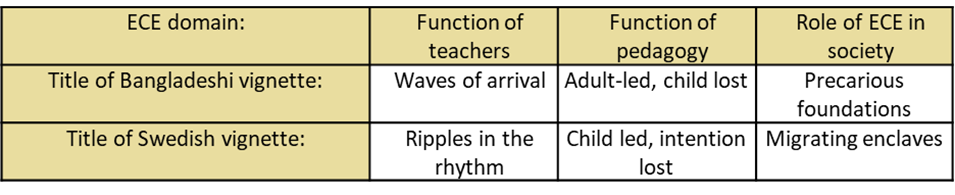
As showed above, portraying the domain of the function of teachers is done by bringing two vignettes into relation, pairing one vignette from Bangladeshi ECE, with one from Swedish ECE, entitled ‘Waves of Arrival’ and ‘Ripples in the Rhythm’ respectively. For the function of pedagogy, the Bangladeshi vignette ‘Adult-Led, Child-Lost’ is paired with the Swedish ‘Child-led, Intention Lost’. For the role of ECE in wider society the Bangladeshi vignette ‘Precarious Foundations’ is paired with the Swedish ‘Migrating Enclaves’.
Returning to the notion of productive juxtaposition (Strathern, 2004), pairing also invites a non-linear abductive analytical procedure, juxtaposing smaller elements, events and interpretations, allowing this process to unfold through recurring analytical movements: initial interpretation, disruption when one context (vignette) disturbs understanding of the other, and juxtaposition through which active connections form. These movements overlap and recur as commensuration unfolds, since understanding of both contexts and events changes through the comparative process itself. The researcher actively constructs relations between phenomena, allowing what becomes analytically productive to gradually surface through sustained engagement with the vignette-to-vignette pairing. Through this pairing across contexts, the analysis demonstrates how commensurability unfolded as a non-linear, generative process through which unexpected similarities surfaced across most-different systems, and what became analytically productive to compare gradually took shape.
The vignette thus serves a dual function: as the representational form holding together the layered meaning of the relational approach across scales, times, and spaces, and, through the vignette-to-vignette pairing, as emergent unit of analysis through which commensurability unfolds, affording the emergence of common challenges. The analytical work proceeded through repeated returns to the vignette pairings, where each return brought forward different aspects of the material. Initial readings produced context-specific interpretations, shaped by assumptions tied to each system’s conditions. These interpretations were then disrupted as one vignette was read through and alongside the other, generating questions that had not been anticipated from within either context alone. Through this process, what appeared as context-specific phenomena gradually revealed shared structural conditions, and the conceptual vocabulary through which these conditions could be named emerged from the sustained movement between vignettes.
In the next findings section the vignettes are presented, where the first domain connoting common challenges were found in the function of teachers and how they navigate daily work, the second in the function of pedagogy and how pedagogical practices are trapped in between value systems, and third in ECE's role in broader society and how settings respond to external pressures and transformations.
Findings
The function of the teacher
In the first domain, the function of teachers is examined through two vignettes from Bangladesh and Sweden, beginning with Bangladesh, focusing on how teachers navigate their daily work within ECE settings.
“Waves of Arrival”
The fabric of the carpet tells a story of countless feet jumping and dancing during the daycare’s morning gathering. Eleven children are present, scattered across the room, quietly anticipating the teacher’s first tones of the welcome song. They wait for it and also for more children to arrive. Some begin to silently mime the lyrics they know by heart, eyes fixed on the window, seemingly elsewhere. The teacher moves quickly towards the child caretaker and checks if more children are expected soon. Turning to me, she says, “I need to start the gathering, otherwise the parents in the waiting room will be upset if we run over time, some children need to leave for other preschools”. With a gentle, slightly strained smile, she settles at the edge of the carpet, trying to gather the children’s gazes. The eleven children present join in as the welcome song begins. As the familiar call-and-response unfolds, the children’s eyes brighten, each one waiting to hear their name being called in the song.
“Good morning to you, Shuri!” “Good morning to you, Mohammad! Good morning to you, Fari…” Before the full name is called, a twelfth child arrives, crying. In the commotion, Fariha, whose name was in the midst of being called, doesn’t get the chance to respond to her name. Instead, the teacher, now comforting the new arrival, continues with the next name: “Good morning to you, Manzoor!” Fariha glances at the teacher with quiet disappointment, unnoticed.
The welcome song continues as more children enter. The child caretaker returns, guiding in two more children, still groggy from sleep. The teacher keeps singing, navigating tears, shifting moods, and distracted gazes. Despite the emotional climate, some children upset from recent separations, others growing restless, the teacher pushes forward, acutely aware that every minute counts in the tightly packed, staggered schedule. The first song must end, so the next activity can begin before another arrival disrupts the flow. But as more children trickle in, the planned activities either pause or slow down to accommodate each arrival. The continuity of the learning experience is repeatedly suspended, creating an uneven collective rhythm of the group. Engagement overlaps with waiting. Focus dissolves into transition. Still seated, the children exchange knowing glances and cheeky smiles. Budding friendships flicker, tentative and easily interrupted by the unpredictable rhythms of attendance. Some children attend nine hours a day, five days a week. Others come only two mornings a week. A few drop-in occasionally, while some leave daycare mid-morning to attend preschool elsewhere. No two temporal patterns align as the teacher surveys the room again, adjusting the seating, recalculating who is present, who is leaving soon, and who has yet to arrive.
The next Swedish vignette offers an observation of how staffing conditions shape the teacher's work throughout the day.
On the edge of the sandbox in the morning, I glance toward the paved preschool yard where children are pacing, seemingly bored in the meagre outdoor environment waiting for something to start. The teachers, too, seem caught in a kind of limbo. One of the teachers, who has been struck by a cold, calls in to alert the others of her absence. As she has to stay home to rest, keeping the cold from spreading, something else spreads through the system, something far subtler but no less disruptive.
The absence of one teacher sends ripples through the organization, and a noticeable disruption of the day begins. No substitutes are allowed to be called in to ease the disruption; the municipal budget does not allow it. The teachers in the yard manage to ask some parents still dropping off their children to “please come and pick up as fast as possible in the afternoon”. As most of the children have arrived, tensions are already rising in the confined outdoor space. The planned activity, walking to the forest to collect chestnuts as part of the thematic project, has to be cancelled and replaced with free play in the larger park. While the children had been prepared the day before for the planned activity, the teachers now have to disguise this disruption as a spontaneous moment of fun. But the group of children sees right through it, as they drag themselves to the line to head to the park.
Throughout the day, with one less teacher, there is always a responsibility that falls behind and a need that remains unmet. Whether it is rushing a child to the toilet just in time, notifying the kitchen staff about the number of children to cook for, stepping in to prevent a disagreement over a spade from escalating into a first strike, or maintaining the fragile balance of keeping the children engaged during circle time and preventing chaos from unfolding, the disruptions set in motion are undeniable as high-set curricular intentions crumble into a pedagogy of crowd control.
Analysing the function of the teacher
In "Waves of Arrival," the constant recalculation by the teacher initially appeared to reflect strained organizational capacity or managerial issues as they struggled with unpredictable arrivals. The Bangladeshi teacher's constant checking with the caretaker, recalculating who is present and leaving, adjusting seating arrangements, all seemed to exemplify how teachers in under-resourced contexts must compensate for limited regulation, in which flexible enrollment appeared as market-driven accommodation that inevitably created temporal disruption in the ECE routine.
However, something else emerged in the analysis when moving into Swedish ECE. In "Ripples in the Rhythm," as the teacher in a comprehensively regulated system faced one staff absence, the entire temporal structure also unraveled. The planned forest walk became impossible, and curricular intentions crumbled into a ‘pedagogy of crowd control'. The Swedish teacher's work (asking parents for early pickup, disguising cancellations of plans, rushing between toilet needs and prevention of conflict) mirrored the Bangladeshi teacher's constant recalculation.
Moving between these observations formed the active connections through which both teachers were revealed to be engaged in the same fundamental work. That is, actively brokering between competing temporal demands that could not be simultaneously met.
This was not a question of level of resources per se, but the same teacher function operating across different conditions. The process of commensuration here involved abstracting from context-specific causes to view the shared production of situations where teachers had to coordinate multiple temporal demands without institutional support.
These active connections prompted interpretation of both vignettes through new questions. In "Waves of Arrival," the teacher's constant motion was not compensating for organizational capacity but seemed to constitute the work itself. Each moment involved brokering decisions: wait for arrivals or begin the song? Complete Fariha's name-call or comfort the crying arrival? The teacher continuously negotiated between institutional time, relational time, and pedagogical time. In Sweden, this reframing focused on similar negotiations. With one staff absence, the teacher must broker between institutional demands (no budget for substitutes), pedagogical intentions (the planned activity), children's expectations (prepared for chestnut activity), and care needs (toilet rushes, prevention of conflict).
Through this process, temporal fragility emerged as a structural vulnerability requiring continuous coordination of competing temporalities, a condition in which teachers within both contexts must function. Time-brokering surfaced as the teacher’s function responding to this condition, involving continuous negotiation between temporal demands requiring constant decisions about what to prioritize, postpone, or ‘give up’.
The function of pedagogy
In the second pair, the function of pedagogy is examined, focusing on how pedagogical practices unfold within settings. From the Bangladeshi ECE, the vignette offers an observation from an art class activity in Nursery.
“Adult-Led, Child-Lost”
The folder that keeps the templates, stencils and ‘copies’ collected weighs heavily on the preschool teachers’ arm. It has been filled by the manager, who prepared the full weeks’ material in specific sections. In the afternoon, when preschool class has ended, the teachers and manager spend time planning the next days’ teaching. During this time the manager delegates duties. The following day, the 4-year-olds in Nursery will have Art class and the manager has planned their lesson around making the Hungry Caterpillar, for them to bring home. The manager instructs the teacher to “prepare the material and cut-outs now so there is no stress tomorrow”. The teacher begins to draw the food-items that the caterpillar will ‘eat’ in tomorrow’s class and continues to cut them out; a banana, mango, guava, collecting them in a pile. Some minutes pass and as the food-items have been colored, the cut-outs are ready to be used as pedagogical material.
The next day Art class will begin. The teacher brings out the prepared cut-outs for the children to view, carrying the folder containing all stencils on her arms. All children get one stencil of the hungry caterpillar as the teacher eagerly asks ‘who is it on the copy? What does he do?’ The children reply in a choir of melted-together-words: cate-foo-hungr-pillar! The teacher takes out crayons from on top of the cabinet, one package for every child. ‘What color does he have’, the teacher repeats as she is moving between the round tables where children are occupied coloring the stencil. ‘Green and red’ the children reply, while the teacher moves in to correct small hands holding ‘wrongly-chosen’ colors. Away with orange, away with purple, away with yellow, the caterpillar must only be green and red.
As the children color, the paper cut-outs prepared the previous day circulate with the teacher who takes out 4-5 food items for each child and a glue stick. Some children get assigned three mangos and two guavas, others luckily get the full range of items to glue onto their caterpillar. Children eagerly hold the glue stick, and the teacher helps them to stabilize it with her hand, as she presses the back of the cut-outs against the now semi-stable glue stick, covering it with glue. In this hasty manoeuvre, as the child presses it onto the caterpillar, some glue is left on their fingers. The child locks in mesmerized by the sticky feeling rubbing the fingers together. But in a swift move, the teacher pulls out a tissue and wipes away the mess, and the child’s attention is reoriented toward task completion. Next, the teacher rushes onto the next child who have been idly awaiting their turn. After the teacher has circulated around all children, who now proudly hold up their caterpillars, it needs noting in their workbook. One after one, children bring their workbook and caterpillar to the teacher who checks off ‘arts, crafts and creativity’ which will be brought home to the evaluating eyes of their parents along with the caterpillar.
In the Swedish ECE context, the vignette offers an observation from a weekly school-preparatory activity with the 5-years old children.
Once a week, the oldest children, the five-year-olds, take over the empty department next to theirs with their teacher to do “activities that are more school preparatory.” This week, they are re-enacting Little Red Riding Hood.
The teacher gathers the children and asks, “Who will be the Hunter? The Mother? Little Red Riding Hood? The Grandmother?” Most children raise their hands, eagerly calling out when their favourite character is named, a rhythm so familiar it tells of the routineness of this particular activity. “And who will be the WOLF?” she says in a deep, playful voice, already bracing for what she knows will come. As expected, all children shout, “Me! Me! Me!” The wolf gets assigned. Those left out protest mildly, but the teacher reassures: “We’ll do the play many times before lunch, so we’ll rotate the wolf.”
The first group takes the stage as the others sit on the bench. The teacher rushes between children, adjusting the Hunter’s hat, placing the grandmother on the cushion-bed, and makes sure the Wolf ears land on the right child’s head. Her sweat breaks. Time is ticking. The children on the bench begin to lose patience, jiggling around as lunch is approaching. The teacher claps her hands and speeds up the pace, calling out, “We need to hurry up!”
As lines are delivered, it became clear that the role of the Wolf was assigned a timid child. And now, at this crucial moment, with the teacher’s stressed gaze fixed on them and the eyes of impatient peers waiting for their turn, the Wolf stumbles. The teacher, trying not to let the moment slip, gets down on her knees beside the Wolf, aligning her face with the child’s, and takes a breath and, without waiting, loud and clear delivers the signature line herself, so the whole group hears it: “ALL THE BETTER TO EAT YOU WITH, MY DEAR”! Lunch is already here and the grandmother that has waited silently on the cushion-bed, and the children on the bench can no longer keep their arms to themselves. The hats are beginning to fall off. The room feels like it might erupt at any moment.
Analysing the function of pedagogy
The Bangladeshi "Adult-Led, Child-Lost" observation initially appeared as teacher-centred instruction where standardized outputs, workbook documentation, and focus on "task completion" reflected pedagogy organized around individual achievement and accountability. But as the event in "Child-led, Intention Lost" unfolded, when the timid Wolf stumbled and the teacher delivered the line herself to keep the performance flowing, something parallel surfaced in the non-linear movement. This seemed to reveal more than a stressed teacher managing time pressure; this 'break' also revealed a parallel to Bangladesh. Just as the Bangladeshi teacher prioritized individual task completion, the Swedish teacher prioritized collective performance, both at the expense of child participation.
The contrast between collective pedagogical goals and the breakdown of individual opportunity suggested something deeper about the relationship between the 'individual' and 'collective' in ECE pedagogy, beyond the overt pedagogical actions visible in the setting. From this position, these active connections prompted examining how underlying cultural assumptions and values impact pedagogy and the function it serves for children encountering it.
Returning to both observations with new questions about the relationship between pedagogy and broader cultural values, the juxtaposition of contexts prompted recognition of a misalignment between the societal value systems and those that are harbored and expressed through pedagogy. The Bangladeshi case showed this clearly. The standardized caterpillar activity employed a 'whole-group' approach reflecting collectivist values, yet the teacher's corrections of ‘wrongly-chosen’ colours and wiping of glue from fingers revealed a pedagogy focused on individual achievement and accountability. Similarly, in Sweden, the play activity reflected individualistic values of personal expression through different roles, yet when the child stumbled, the teacher's intervention to save the performance revealed pedagogy focused on collective and group accomplishment over individual participation. These observations thus revealed a deeper pattern as Bangladesh's collectivist society, where daily life and relational expectations are organized around shared experience, produces pedagogy focused on individual advancement through measurable outcomes and standardized documentation. In contrast, Sweden's individualistic society, organized around personal autonomy and expression, produces pedagogy focused on collective responsibility, democratic participation, and group identity.
The process of commensuration required recognizing that what appeared as opposing pedagogical philosophies (individual vs collective) revealed pedagogy operating between cultural values and pedagogical aims pulling in opposite directions. What surfaced was a pedagogical counter-position as a structural condition requiring continuous mediation between competing value systems. Teachers must choose which value system should take precedence in pedagogical activities and which values to prioritize, and the function of pedagogy becomes the forum in which these negotiations take place.
The role of ECE in wider society
In the last pair of vignettes, the role of ECE in wider society is examined, focusing on outside pressures and ECE as an (educational) frontline. The first vignette presents an observation of how Sweden's declining birth-rates and shrinking number of enrolled children reshape conditions for ECE practice.
“Migrating Enclaves”
Following the flow of preschool life by spending time with a preschool group of 21 children, certain rhythms become visible in the way ‘outside-pressures’ changes the conditions for ECE practices. In this preschool, one consequence is that it has forced changes in the organization of daily life, creating age-segregated enclaves of children, which are each subject to attempts at differentiated pedagogical approaches by the teachers. The youngest children in the group (2.5 years-olds) are supposed to be offered a more “baby-fied” pedagogy and activities, according to the teachers. Songs slowed down with gentler cues, simplified language, and a day that rely on higher levels of adult scaffolding, so children can ‘maintain attention and emotional regulation’. Meanwhile, the older children (4-5 years old) in the same group, are expected to handle more structured tasks, like sitting for longer periods, follow extended sequences of instruction, and to be more accountable, like that associated with school readiness.
This single group of 21 children was up until recently two separated groups. But due to the low number of children at the preschool at large, it was necessary to merge groups, letting go of staff. Having such a broad spectrum of ages in the same group seems to cause many issues, and a strangely crowded routine has unfolded in light of it. Often, the differentiated pedagogical approaches seem to overlap or migrate, ending up targeting the wrong enclaves causing “baby-fied” pedagogy to land on the oldest children and vice versa. Five-year-olds are observed as they become chronically bored by the slow pace of storytelling, reading books that rely more on pictures than intriguing drama. Meanwhile, the 2.5-year-olds look utterly lost as teachers lead discussions about climate change without support, scaffolding or colorful pictures.
The next Bangladeshi vignette showcases a chain of observations highlighting the connection of global forces and local effects visible in ECE.
“Precarious foundations”
At the NGO's head office, I sit across from the central manager as she explains the organization's ECE expansion plans. The NGO runs a few preschools and is about to open more. Bangladesh is recognized as home to the largest NGO in the world (BRAC), this smaller organization targets the same societal injustices. But today, the main talk centres on declining international aid. Unlike prior to the pandemic, she explains, international donors have now begun to leave Bangladesh due to fast economic growth, targeting sub-Saharan Africa instead. Bangladeshi NGOs must now, more than ever, bring in local revenue. Preschools and daycares are considered profitable spaces to expand in, aligning with increasing public demand among the middle-high class. These revenues are necessary to support other social ventures of the NGO.
The local preschool manager explains that she is aware of the larger stakes behind these planned ECE setting expansions as she updates the prices of educational packages on the preschool's Facebook page. Now the price for half-time enrollment is 6500 Taka (46 euros) a month. While the teachers and caretakers seem to remain outside the loop regarding reasons for these updates, they are affected by the dynamics these changes create in their daily practice as the unregulated sector offers no standards to mediate between professional expertise and parental demands.
The larger stakes seem to influence relationships between teachers and parents, cementing dynamics that make them receptive to conflict and unmet expectations. Teachers explain that although they and their work with children intends to focus on "setting and developing educational standards," they instead find themselves focusing on what the preschool must do to maintain its position in a rapidly moving, competitive, and unregulated ECE sector. Parents unsatisfied with the focus on play instead of more structured learning, too high prices, or teachers' attitudes, make teachers and managers aware of the possibility that they may change preschools at the blink of an eye.
Analysing the role of ECE in wider society
In the Bangladeshi "Precarious Foundations", multiple societal pressures seemed to be overlapping. Economic transformation (NGOs requiring revenue as international aid declines), demographic shifts (emerging middle-class demanding services), lack of regulatory frameworks (no mediation between professional expertise and parental demands), professional struggles (newer occupational group struggling for authority). Each pressure appeared to directly shape ECE's position within wider society as a revenue generator, competitive market space, and site where educational identity and purposes get negotiated. Initially, the number of pressures seemed significant, perhaps reflecting an earlier mainstreaming stage where ECE had less time in the public spotlight.
With this understanding, the Swedish observation was initially analyzed as reflecting a further mainstreamed sector with longer institutional history facing singular demographic pressure. However, just as in the Bangladeshi observation, the Swedish pressure had transformative impact. Group mergers made differentiated and “age-appropriate” pedagogy impossible; baby-fied approaches landed on five-year-olds while 2.5-year-olds faced too abstract discussions. Moving between these pressures and their transformative impacts revealed that while both ECE contexts encountered societal pressures directly, managing them without systemic mechanisms to redistribute demands or the consequences it brought was the common challenge. The active connection was that ECE functioned from similar structural positions across different conditions, and it was not about multiple versus singular pressures.
This prompted approaching "Precarious Foundations" with new questions about absorption mechanisms. The Bangladeshi pressures were negotiated in everyday practice where teachers and parents negotiate what ECE 'is' and 'should' be, managers negotiate pricing and positioning, and NGOs negotiate ECE's revenue role. These negotiations happen continuously through relational dynamics where teachers operate from disadvantaged positions. ECE absorbs outside pressures by constantly adjusting, renegotiating, repositioning. In "Migrating Enclaves," absorption mechanisms operate similarly. The demographic pressure is absorbed through immediate organizational adjustments determined by resource allocation, sacrificing educational appropriateness, ultimately allowing children themselves to become absorptive mechanisms. Unlike primary schools with years to prepare for demographic shifts, ECE encounters changes immediately. Through this process, it reveals ECE as an absorptive margin absorbing external pressures. In Bangladesh, absorption through negotiated adjustment where educational purposes are subordinated to instrumental pressures and in Sweden, absorption through institutional reorganization where children themselves become the absorbers. While differences are found in who acts to absorb these pressures (teachers or children), it is through the active work of commensuration that ECE's role within wider society becomes visible as absorptive margin, the site where demographic, economic, and social transformations land and must be managed directly by individual settings.
Discussion
This study set out to examine what common challenges emerge when comparing Bangladeshi and Swedish ECE through a most-different systems design, and what this approach reveals about comparing ECE across contexts. The findings identified three common challenges. The first was the emergence of teachers as time-brokers. The second revealed pedagogy as a forum for negotiation between value systems where societal norms and pedagogical aims collide. The third showed ECE functioning as an absorptive margin on the periphery of educational systems. The study shows that challenges in ECE are not reducible to questions of development, resourcing, or governance capacity alone, but are tied to how ECE is structurally organized and positioned in relation to wider institutional, cultural, and societal demands.
Furthermore, through interrogation of the empirical findings, the paper aimed at taking the comparative process itself as the object of inquiry. At the outset, the paper laid out several considerations for conducting comparative ECE studies involving relational practices and the messy nature of ECE systems, and the consequences it affords the understanding of systems as ‘similar or different’ and as ‘meaningful’ to compare or not. It is important to note that there are compounding aspects of complexity for comparative methodology while comparing ECE in contexts labeled “most-different” as Bangladesh and Sweden may be labelled. ECE is often described as inherently local (e.g. Urban, 2012), and while assumptions of difference of the MdS design initially mirror aspects of methodological nationalism, it abruptly needs to re-settle the gaze upon “what” and “where” we may think this “difference” may be located, while moving from national to local.
With the assumption that compulsory schooling maps more coherently onto the national state than ECE does, where state curricula, national qualifications, centralized governance, and national policy formation make the nation-state a defensible analytical container, it does not do the same in ECE. It is more decentralized and fragmented, operating through mixed provision models exceeding state control where contextual variation is constitutive. As such, other methodological mechanisms and tools in CIE may need reconsideration. Taking the comparative method of juxtaposition as used in this study, initially in a Bereday-sense, who considered juxtaposition as a preparatory stage before comparisons took place, relying on a priori and inductive assumptions upon what an educational system” is” and may “contain” to establish their comparability.
However, it is difficult from the perspective of ECE, where diversity cascades through systemic levels, to establish one system’s “comparability” with another. What this study has done in response is to consider juxtaposition against ECE epistemology where its messiness (Guevara, 2022; Källebo, 2026) may necessitate a relational reconsideration of this comparative mechanism. In this study, juxtaposition is not a tool for comparison of predetermined units but considered a productive analytical process through which commensurability takes place. As such, it neither assumes systems as given entities nor as constitutive of its practices, nor treats comparisons across contexts as an activity placing predetermined phenomena side-by-side. Instead, determining what a system “is”, or what it may “contain” emerges as a result from multi-scalar movements across all stages of inquiry.
In this sense, the study has reconsidered juxtaposition, from a one-dimensional mechanism for ‘establishing difference’ between predetermined units, to applying it as a multi-dimensional mechanism for ‘generating insight through difference’. The combined methods together with the study’s use of vignette which functioned as a mediating interface representing the comparative act involved in these multi-scalar movements, allowed the productive juxtaposition to stretch across the whole research inquiry throughout the analytical work.
Additionally, problematizing ‘where’ difference may be located within an ECE system raises questions about the scale and scope of the comparative unit. As seen in this study, the unit of comparison does not exist before immersion, but constantly morphs, expands or collapses across space-time before it may stabilize and delimit. It may imply that “unit” connoting a fixed or pre-determined scope as becoming applied onto context, may shift into a more malleable shape like that of an aspect, dimension or moment of comparison that moves in symbiosis with how a context reveals itself.
References
Akhter, M., & Chaudhuri, J. (2013). Real Time Monitoring for the Most Vulnerable: Pre-Primary Education in Bangladesh. IDS BULLETIN, 44(2), 97–112. https://doi.org/10.1111/1759-5436.12020
Anckar, C. (2008). On the Applicability of the Most Similar Systems Design and the Most Different Systems Design in Comparative Research. International Journal of Social Research Methodology, 11(5), 389-401. https://doi.org10.1080/13645570701401552
Bangladesh Labour Act. (2006). Act No. XLII of 2006. Acts of Parliament (Bangladesh). minlaw.gov.bd
Bartlett, L., & Vavrus, F. (2017). Comparative Case Studies: An Innovative Approach. Nordic Journal of Comparative and International Education, 1(1). https:/doi.org/1.5-17.10.7577/njcie.1929
Bassett, L. K., Rahman, T., Keiko, I., Sharma, U., Naibur, R., & Golam, M. (2022). Playful Pre-Primary Education in Bangladesh: Study on Professional Development Needs of Pre-Primary Teachers and Headteachers. World Bank Group. http://documents.worldbank.org/curated/en/099330405112213758
Bereday, G. Z. F. (1964). Comparative Method in Education. Holt, Rinehart and Winston.
Child Daycare Centre Act. (2021). Act No. 10 of 2021. The Bangladesh Gazette (2021). minlaw.gov.bd
Espeland, W. N., & Stevens, M. L. (1998). Commensuration as a Social Process. Annual Review of Sociology, 24, 313–343. https://doi.org/10.1146/annurev.soc.24.1.313
European Commission/EACEA/Eurydice. (2025). Key data on early childhood education and care in Europe – 2025. Eurydice report. Publications Office of the European Union.
Guevara, J. (2022). Comparative studies of early childhood education and care: beyond methodological nationalism. Comparative Education, 58(3), 328–344. https://doi.org/10.1080/03050068.2022.2044603
Holbraad, M., & Pedersen, M. A. (2017). The Ontological Turn: An Anthropological Exposition. Cambridge University Press. https://doi.org/10.1017/9781316218907
Källebo, A. (2024). Exploring Child Standpoint Theory in Early Childhood Education: A Pathway for Cross-Cultural Comparisons. Nordic Journal of Comparative and International Education (NJCIE), 8(3). https://doi.org/10.7577/njcie.5713
Källebo, A. (2026). Förskolerektorers komplexa uppdrag. In N. Rönnström & P. Skott (Eds.), Rektorers yrkeskunnande och vetenskapliga lärande (pp. 207–223). Gleerups.
MoE Ministry of Education. (2010). National Education Policy (NEP) 2010. Dhaka, Ministry of Education.
MoPME Ministry of Primary and Mass Education. (2008). Operational Framework for Pre-Primary Education: Ministry of Primary and Mass Education. Government of The People’s Republic of Bangladesh.
Nóvoa, A. (2018). Comparing Southern Europe: the difference, the public, and the common. Comparative Education, 54(4), 548–561. https://doi.org/10.1080/03050068.2018.1528781
Ragin, C. C. (1987). The Comparative Method: Moving Beyond Qualitative and Quantitative Strategies. California University Press.
Rahman, A., Islam, M. S., & Boyd, W. (2025). Exploring the Landscape of Early Childhood Teacher Training in Bangladesh. International Journal of Early Childhood. https://doi.org/10.1007/s13158-025-00427-3
Schöneich, S. (2021). ‘On a Hot Day in the Field…’ - The Art of Writing Ethnographic Vignettes. Ethnoscripts, 23(1). https://doi.org/10.15460/ethnoscripts.2021.23.1.1666
Schuelka, M. J., & Engsig, T. T. (2022). On the Question of Educational Purpose: Complex Educational Systems Analysis for Inclusion. International Journal of Inclusive Education, 26(5), 448–465. https://doi.org/10.1080/13603116.2019.1698062
Sikder, S., & Banu, L. F. A. (2018). Early Childhood Care and Education in Bangladesh: A Review of Policies, Practices and Research. In M. Fleer & B. van Oers (Eds.), International Handbook of Early Childhood Education (pp. 569-587). Springer. https://doi.org/10.1007/978-94-024-0927-7_26
Skolverket. (2024). Barn och personal i förskola. https://siris.skolverket.se/siris/sitevision_doc.getFile?p_id=553820
Sobe, N. W. (2018). Problematizing Comparison in a Post-Exploration Age: Big Data, Educational Knowledge, and the Art of Criss-Crossing. Comparative Education Review, 62(3), 325–343. https://doi.org/10.1086/698348.
Sousa, D., & Moss, P. (2022). Concluding reflections: current issues and future directions for comparative studies in early childhood education. Comparative Education, 58(3), 402–416. https://doi.org/10.1080/03050068.2022.2071018
Strathern, M. (2004). Partial Connections. Altamira Press
Styf, M. (2012). Pedagogisk ledning för en pedagogisk verksamhet: om den kommunala förskolans ledningsstruktur [Doctoral dissertation]. Umeå University.
Tobin, J. (2022). Learning from comparative ethnographic studies of early childhood education and care. Comparative Education, 58(3), 297–314. https://doi.org/10.1080/03050068.2021.2004357
UNESCO & UNICEF. (2024). Global Report on Early Childhood Care and Education: The right to a strong foundation. https://doi.org/10.54675/FWQA2113
Wahlgren, C., & Günter, K. P. (2024). Portraits of Swedish natureculture identity – entanglements of (gender) equity and integration in early childhood education. Gender and Education, 36(5), 527–544. https://doi.org/10.1080/09540253.2024.2350521
World Bank. (2020). The Landscape of Early Childhood Education in Bangladesh. World Bank. https://documents1.worldbank.org/curated/en/720311583471084983/pdf/The-Landscape-of-Early-Childhood-Education-in-Bangladesh.pdf
 ©2026
Annica Källebo. This is an Open Access article distributed under the terms of
the Creative Commons Attribution 4.0 International License
(http://creativecommons.org/licenses/by/4.0/), allowing third parties to copy
and redistribute the material in any medium or format and to remix, transform,
and build upon the material for any purpose, even commercially, provided the
original work is properly cited and states its license.
©2026
Annica Källebo. This is an Open Access article distributed under the terms of
the Creative Commons Attribution 4.0 International License
(http://creativecommons.org/licenses/by/4.0/), allowing third parties to copy
and redistribute the material in any medium or format and to remix, transform,
and build upon the material for any purpose, even commercially, provided the
original work is properly cited and states its license.