Vol 10, No 3 (2026)
https://doi.org/10.7577/njcie.6646
Article
Student Councils in the Nordic region: From policy promises to meaningful participatory practices
Eva Harðardóttir
University of Iceland
Email: evahar@hi.is
Ragný Þóra Guðjohnsen
University of Iceland
Pernelle Rose Hansen
Aalborg Universitet
Najat Ouakrim-Soivio
University of Jyväskylä
Marleena Mustola
University of Jyväskylä
Mikko Hiljanen
University of Jyväskylä
Josephine Lau
University of Jyväskylä
Frida Birita Poulsen
University of the Faroe Islands
Johanna Jormfeldt
Linnaeus University
Abstract
Student councils are widely recognised as an integral part of school life across the Nordic countries, reflecting a strong social-democratic tradition in education. Yet few studies examine how these councils are operated in terms of selection processes, focus and student influence across the Nordic countries. Drawing on a range of data collected across five Nordic countries, this study analyses student councils through Lundy’s participation model along with theoretical concepts concerning certain contradictions in democratic education. The findings indicate that, although most systems mandate student councils in basic education and emphasize democratic selection processes, implementation remains uneven. Participation opportunities are often limited to older and more socially advantaged students; selection procedures are frequently opaque; and council agendas tend to focus on social events and minor school improvements, with limited follow-through on students’ proposals. Yet the study also identified promising practices, including hybrid and flexible access models and structured feedback loops, which may support more meaningful and inclusive democratic participation. We argue that student councils risk remaining symbolic unless schools embed inclusive access, transparent processes, reciprocal communication, and a wider and globally relevant agenda. These conclusions are brought together in a design-principles model aimed at strengthening the meaningful participation of children and youth in Nordic schools.
Keywords: Student councils, meaningful participation, Nordic model, citizenship, youth voices
Introduction
Democratic participation among young people is a central principle of education policy in the Nordic countries as reflected in Vision 2030 for the Nordic Region (Nordic Council of Ministers, 2019) and through enhanced cooperation between the Nordic Council and the Nordic Youth Council (Thomson, 2025). Within this context, student councils are intended to provide students with formal opportunities to participate in school governance, develop democratic competencies, and exercise influence over matters affecting their education and school life (Edelstein, 2010; Khan, 2006). At the same time, democratic participation in schools extends beyond student councils as it also takes place through everyday interactions and pedagogical practices within classrooms and the wider school environment (Biesta & Lawy, 2006). Student councils, therefore, represent one important arena for democratic participation, but not the only one. Yet, research across the region consistently points to a gap between the formal intentions of democratic education and students lived experiences of meaningful participation and influence (Finnsdóttir et al., 2026; Griebler & Nowak, 2012).
At the same time, recent research indicates declining civic knowledge and engagement among Nordic youth democratic knowledge and participation, raising concerns about how democratic education can be supported in schools (Damiani et al., 2025). These developments intensify debates whether student councils function as meaningful arenas for participation or remain primarily symbolic structures. Student councils are closely linked to international frameworks such as Article 12 of the UN Convention on the Rights of the Child, which establishes children’s right to be heard in matters affecting them (United Nations, 1989). Lundy’s (2007) model further specifies that meaningful participation requires space, voice, audience, and influence—conditions that student councils are expected to provide.
Despite their central role, there is
limited comparative research examining how student councils operate across
Nordic contexts, particularly in terms of selection processes, focus, and
student influence. This article addresses this gap through a mixed-method study
across five Nordic countries, asking:
(1) What policies govern student councils and how are they structured and
implemented?
(2) To what extent do they provide meaningful and inclusive opportunities for
participation?
Democratic education
Across the Nordic region, schools are expected not only to prepare young people for their role as citizens but also to function as social spaces where democratic participation is experienced in everyday practices. Nordic and European education policies commonly emphasize democracy and student welfare as key principles guiding educational practice (Biseth, 2009; Gunnulfsen et al., 2023) by developing democratic competences (Council of Europe, 2018). In this sense, democratic education is understood not only as the transmission of knowledge about democratic systems but also as a process in which students actively participate to gain competences. Meanwhile, scholars have raised concerns that competence-based approaches may risk reducing democracy to a measurable skill set if not grounded in ethical and relational dimensions. Jónsson and Rodríguez (2021), drawing on Dewey (1916), argue that democratic education must be firmly rooted in values and responsibility, where democracy is understood as a form of associated living rather than a set of predefined procedures and skills.
This perspective aligns with Biesta’s (2022) educational framework of qualification, socialization and subjectification, which provides a useful lens to examine the democratic role of the school. Qualification refers to the acquisition of knowledge and skills necessary for participation in society, whereas socialization concerns the processes through which individuals are introduced to existing social, cultural, and democratic traditions and norms, typically mediated by teachers or other authority figures. Both elements are widely recognized as central elements of schooling in the Nordic region. However, Biesta argues that democratic education cannot be reduced to these dimensions alone. The third element, subjectification, can be understood as a process through which individuals develop their individual citizenship by critically reflecting on their own position and relations to others. While the concept of subjectification has been criticized for being overly individualized and elusive (Guillemin, 2024), Biesta (2020; 2022) has provided an elaborate response by emphasising that the process of developing young people’s citizenship is highly relational and can thus only take place through concrete interactions, both in and outside of school. What matters here is creating an environment where young people are free to participate in everyday practices and decision-making processes.
In an era where the concept of freedom tends to appeal to individual freedom, there is the risk that it can be used to justify the absence of collective responsibility (Guðjohnsen, 2025). In that case, it is important to note that the freedom associated with educational subjectification should be understood not only as personal autonomy but as the capacity to engage with others in addressing the tensions and contradictions of democratic life (Guðjohnsen et al., 2024). This highlights the importance of examining not only the presence of participatory structures in educational settings but also their qualities and their impact on young people’s perspectives and opportunities for meaningful participation.
Meaningful participation
To examine how democratic participation operates within the school space, this study draws on the participation framework developed by Lundy (2007). Grounded in Article 12 of the United Nations Convention on the Rights of the Child (United Nations, 1989), the Lundy model conceptualizes meaningful participation through four interrelated dimensions: space, voice, audience, and influence. Together, these dimensions highlight that meaningful participation requires institutional conditions, including pedagogical approaches and access to social and cultural spaces. The model, therefore, shifts attention from the mere presence of participatory structures toward the quality of participation within them. Space and voice refer to the creation of safe and inclusive opportunities for children to articulate their perspectives, while audience and influence concern whether these perspectives are taken seriously and can shape outcomes. Within educational settings, this places responsibility on teachers and school leaders to create participatory structures that enable dialogue, feedback, and shared decision-making.
Opportunities to participate in classroom and school governance structures are commonly seen as supporting this aim (Kahne et al., 2016; Stoddard, 2014). Sant (2019) argues that democratic learning emerges when students have opportunities to express their views, listen to others, and engage in collective deliberation. From this perspective, student councils represent a key institutional arena for democratic participation in schools (Edelstein, 2010; Khan, 2006). However, research across industrialised countries suggests that participatory structures in schools may remain largely symbolic, with limited impact on decision-making processes (Finnsdóttir et al., 2026; Griebler & Nowak, 2012; Scarparolo & MacKinnon, 2024). This points to a broader participation–practice gap, where formal opportunities for participation do not necessarily translate into meaningful influence (Griffin, 2022).
It is essential that students experience themselves not only as learners within institutional structures but also as participants capable of contributing to the life of their school communities (Guðjohnsen et al., 2024; Schulz et al., 2023). Ensuring the dimensions of space, voice, audience, and influence as proposed by Lundy (2007) calls for a pedagogical approach that recognises children as fully active citizens rather than ‘citizens-in-waiting’ (Biesta & Lawy, 2006). In other words, the school must approach its students as individuals with integrity and the capacity to participate freely, while also attending to civic and ethical considerations such as fostering open and creative dialogue (Aðalbjarnardóttir & Harðardóttir, 2018; Freeman, 1996; Tujula et al., 2021). Student councils can be understood as potential institutional spaces where such principles of democratic education are enacted in practice (Edelstein, 2010).
Aims and practices of student councils
Student councils hold significant potential for democratic development. Verba, Schlozman, and Brady's (1995, pp. 424–425) important research demonstrates that high school government participation positively influences future political engagement, while Mager and Nowak's (2012) systematic review provides moderate evidence for democratic skill development through council participation. However, this potential is likely dependent on the quality of the students' experiences. Negative council experiences can actively discourage democratic development (Alderson, 2000; Andersson, 2018; Lundy, 2018; Sinclair, 2004). Meaningful agency – the genuine ability to effect change and improve one's school is thus essential for positive outcomes (Edelstein, 2010; Torney-Purta & Barber, 2005).
The challenge lies in current practice: student councils typically operate with constrained agency, as advisory rather than decision-making actors, in which meaningful participation is undermined (Andersson, 2018; Sousa & Ferreira, 2024). This structural limitation creates a fundamental tension between councils' democratic potential and their actual capacity to provide the agency necessary for positive developmental effects. The effectiveness of student councils depends on both access and structure. Kempner and Janmaat (2022) identify striking inequalities in who gains access to European school councils, while Rönnlund (2014) reveals how three interconnected dimensions determine council functionality: range (issues addressed), depth (participation quality), and width (student involvement). These dimensions create a reinforcing cycle where students avoid participation when they perceive it as meaningless, so deficiencies in range and depth inevitably reduce width (Rönnlund 2014).
Kempner and Janmaat (2022) state that school councils exemplify neither participative nor representative democracy effectively. Limited participation combined with representatives who fail to reflect their constituents will create a system that risks teaching powerlessness rather than achieving either normative democratic ideals or educational objectives. From a political science perspective, it is well-documented that socially disadvantaged groups tend to be underrepresented in political agendas (Elkjær & Iversen, 2020). This raises concerns about whether school councils risk reproducing rather than counteracting existing inequalities. For example, Tujula (2023) and Männistö (2020) have in fact argued that student councils may merely activate students who are already engaged.
At the same time, research indicates that many children and young people report that although they are encouraged to express their opinions in school, they seldom receive feedback or see concrete changes resulting from their input. This can create a feeling of symbolic participation, lacking genuine democratic influence (Lundy, 2007). Yet sociological research on well-being shows a reciprocal relationship between participation and well-being: meaningful participation can enhance well-being, and conversely, increased well-being can promote more active engagement (Fattore et al., 2016). Taken together, these perspectives highlight the importance of creating supportive school environments in which children and young people experience both genuine opportunities for influence and conditions that promote their well-being.
Student councils in the Nordic context
Although structures for participation are often in place in Nordic schools, decision-making processes frequently remain dominated by adults, with teachers or school leaders setting agendas and filtering outcomes. For example, Danish researchers point to how students’ contributions tend to be interpreted through rigid and dichotomous educational categories such as mature or immature, democratic or undemocratic which restrict what is recognised as genuine participation or agency (Lieberkind, 2020). Similarly, Finnish research points to how student councils are often closely supervised by staff, meaning that agendas and decisions are shaped through adult authority (Tiusanen, 2025; Tujula, 2023). Such control can result in limited influence on everyday school decisions and outcomes as has been reported by Swedish students (Alerby & Bergmark, 2019).
Issues of representation and inclusion also emerge as a common concern across the Nordic countries. An Icelandic study indicated how selection processes for student councils are frequently shaped by popularity dynamics, meaning that students who already hold significant social and cultural capital within the school are more likely to be elected (Finnsdóttir et al., 2026). In Finland, uneven representation across grade levels further limits whose voices are heard, and not all students have equal opportunities to participate in council activities (Tiusanen, 2025; Tujula, 2023). In some cases, such as in Sweden, students themselves question the legitimacy of representative structures, expressing a preference for more direct and inclusive forms of participation, such as referenda or broader consultation processes (Gilljam et al., 2010).
Another recurring pattern is the tendency for student councils to focus on organising social events or addressing practical matters rather than engaging with substantive educational issues. Finnish research indicated that student representatives are frequently excluded from formal decision-making bodies such as school boards and are instead assigned to committees dealing with peripheral aspects of school life, thereby limiting their influence on core educational matters (Tiusanen, 2025; Tujula, 2023). Likewise, Swedish researchers have reported how decision-making pathways from student proposals to concrete outcomes are often unclear, making it difficult for students to see how their input translates into change (Rönnlund, 2014). As a result, participation is frequently experienced by Nordic youth as symbolic rather than impactful (Almgren, 2006; Elvstrand, 2009; Eriksson & Bostedt, 2011; Rönnlund, 2011).
This disconnection is also reflected in students’ perceptions. Survey research suggests that many students question the effectiveness of student council elections, with only about half of Danish students reporting that their vote makes a meaningful difference in school life (Harada, 2021). Similarly, as noted in an Icelandic study, while school leaders may report that opportunities for democratic participation are embedded in school practices, far fewer students report having recent or meaningful opportunities to influence decisions or express their views (Guðjohnsen, 2025). Taken together, the research suggests that while student councils remain a central institutional mechanism for democratic participation in Nordic schools, their democratic potential is only partially realised.
Method
This study draws on mixed-method data, from five Nordic countries (Denmark, Finland, the Faroe Islands, Iceland, and Sweden). It aims to examine the policies governing student councils, how student councils are structured and implemented, and the extent to which they provide meaningful and inclusive opportunities for participation. Rather than offering a comprehensive quantitative comparison, the study combines policy analysis, survey data and interviews, to provide a comparative analytical exploration of student councils and democratic participation in the Nordic region from multiple perspectives.
A descriptive overview of the initial findings was presented in the Nordic Welfare Centre report Student councils and democratic participation in the Nordic region (Guðjohnsen & Harðardóttir, 2025). Building on that work, this article offers a more in-depth analysis, with particular attention to how the findings can be used to demonstrate the extent to which student councils function as meaningful and inclusive democratic arenas through which students can express their views, be heard, and influence decisions affecting their school lives.
Data sources and participants
Student councils within compulsory schools in the Nordic region operate within institutional, social and pedagogical contexts that cannot be fully understood through one single data source. Hence, this study adopted mixed methods and multi-source design, combining policy analysis, student survey data and qualitative interviews. The convergent design (Creswell & Plano Clark, 2018) facilitated a more comprehensive, multi-perspective understanding of meaningful participation in student councils across the regions.
Policy data were derived from mapping national policy frameworks in each country related to democratic participation through student councils. Researchers in each participating country collected official policy documents including national education acts, regulations and curriculum documents. Initially, seventeen policy documents were identified across the countries. To ensure comparability across education systems, the selection was narrowed down to twelve documents focusing specifically on compulsory education. The documents analyzed included national compulsory educational acts in the five countries, national curriculum and regulations pertaining to student councils.
Table 1. Policy documents from five Nordic countries
|
|
National Act |
Regulations and orders |
Curriculum |
|
Denmark |
Compulsory Education Act (Folkeskoleloven, 2024) |
Executive order on Student Councils in Compulsory Education (Børne- og Undervisningsministeriet, 2014) |
Common objectives for compulsory education (Børne- og Undervisningsministeriet, 2024) |
|
Faroe Islands |
Compulsory Education Act (Løgtingslóg um fólkaskúlan. (1997). |
Executive order on student councils in public schools (Mentamálaráðið, (2025) |
National Curriculum for compulsory school (NÁM, 2011) |
|
Finland |
Compulsory Education Act (Perusopetuslaki, 1998) |
|
National Core Curriculum for Compulsory Education (Opetushallitus, 2014) |
|
Iceland |
Compulsory Education Act (Lög um grunnskóla, 2008) |
|
National Curriculum Guide for Compulsory Schools (Aðalnámskrá grunnskóli, 2011/2013) |
|
Sweden |
The Swedish Education Act (Skollagen, 2010) |
|
The Swedish National Curriculum for Compulsory Schools (Skolverket, 2022) |
The student survey was administered online through Qualtrics in compulsory schools that were selected to ensure as much diversity as possible, both in terms of geographical context and socio-economic background. Participants included students in Grade 5 as well as students in Grades 9 or 10, depending on the organization of lower-secondary education in each participating country. In Iceland the data was collected in September 2023 but during November 2024 to April 2025 in the other Nordic countries. The total number of students who completed the survey was 2,205, with a relatively even distribution of girls and boys (52% girls and 48% boys). In Iceland and Denmark, students were evenly distributed between 5th grade and 9th/10th grade. In contrast, the majority of students from Finland, and all students from the Faroe Islands and Sweden, were in 9th grade. The questionnaire included 10 closed and open-ended questions that focused, for example, on students’ knowledge of student councils, experience of participating in a student council and the types of issues discussed in student councils.
Youth consultations were carried out through workshops with young experts in two Nordic youth summits arranged by the Nordic Welfare Centre: The Nordic Baltic Youth Summit [1]held in September 2024, and The Nordic Youth Disability Summit[2] held in November 2024. These consultations captured the reflections of young people aged 15–25, from across the Nordic and Baltic region. Participants were asked two questions: (1) how an ideal student council would look like and (2) what the main challenges are in operating student councils. Their answers were captured in the Mentimenter application as one-word or short sentences.
Interviews were conducted with young people serving on student councils and key informants, such as teachers responsible for student council activities, in a total of 19 compulsory schools across the Nordic region. Guided by the aim of identifying promising and innovative practices, schools were selected based on their demonstrated commitment to active student participation and their efforts to strengthen student councils through creative approaches. To ensure variation in context, schools were also selected to reflect diversity in size and geographical location, including both urban and rural areas. A common interview guide was used across all interviews to gain a deeper understanding of the factors that support active, meaningful, and inclusive participation in student councils.
Data analysis
The analytical approach in this study is informed by an expanded theoretical lens that integrates Lundy’s (2007) conceptual framework for children’s participation—structured around the four dimensions of space, voice, audience, and influence—along with theoretical concepts concerning certain contradictions within democratic education (Biesta, 2022; Jónsson & Rodriquez, 2021). This theoretical approach allows for a deep examination of the quality and depth of democratic participation as it is presented within the context of student councils in Nordic education contexts.
Ethics and limitations
The study follows established ethical principles for educational research involving children and young people (Alderson & Morrow, 2011). Participation in the survey, interviews, and consultations was voluntary, and students were informed about the purpose of the research and their right to withdraw at any stage (Braun & Clarke, 2013). Confidentiality was ensured for participating schools and students, and all data were anonymized prior to analysis. The research design and data collection procedures complied with relevant national ethical guidelines in the participating Nordic countries.
As with most comparative research across multiple national contexts, the study involves certain methodological limitations. First, although the project aimed to map student councils across the Nordic region, not all countries were equally represented. The findings should therefore be interpreted as an analytical exploration across several Nordic contexts rather than a comprehensive regional mapping. The empirical material was collected through a collaborative research effort across countries and research teams, resulting in variation in the number of participating schools and students. Survey response rates differed between countries: in some contexts, such as Iceland and the Faroe Islands, participation covered a large proportion of the relevant student population, while in others, such as Finland and Denmark, it included substantial but more selective samples. In Sweden, participation was lower due to time constraints and access to schools.
Although these differences limit strict comparability, the study does not aim to provide a purely quantitative comparison. Rather, it seeks to capture multiple perspectives on student participation through the integration of policy analysis, survey data, youth consultations, and qualitative interviews. Moreover, the combination of data sources allows for analytical triangulation (Patton, 1999), strengthening the trustworthiness of the findings. When interpreted collectively and analyzed through the theoretical framework employed in this study, the material provides important insights into the opportunities and challenges of democratic participation within student councils in Nordic schools.
Comparative findings on student councils in five Nordic countries
Policy landscapes
The following section presents findings from the policy analysis based upon 12 policy documents from five Nordic countries (see Table 1). These include National education acts, regulations and compulsory education curriculums and were all analysed with respect to their focus on student councils.
Across the Nordic countries examined, student participation is formally recognised as part of education policy with all systems emphasising students’ right to be heard and to influence school life. However, they differ in the degree to which participation is institutionalised, ranging from mandatory student councils embedded in legislation to more flexible approaches that emphasise participation without prescribing specific structures.
In Denmark, student councils have been embedded in education policy for several decades. Legislation introduced in 1974 enabled their establishment, and since 1986 they have been mandatory, as reflected in the Executive Order on Student Councils in compulsory schools (Børne- og Undervisningsministeriet, 2014). Schools are required to ensure councils are formed, even if students do not initiate them. All students have the right to vote and stand for election, and councils must adopt statutes regulating representation, elections, finances, and accountability. Councils elect their own chairperson, while school leaders must provide facilities and, where possible, financial support. Recent legislation further strengthens their role by requiring consultation on issues such as student safety and well-being. Similarly, in Finland, student councils have been mandatory since 2013 through amendments to the Compulsory Education Act 628/1998 (Perusopetuslaki, 1998). National guidelines require schools to establish student actors that enable participation, ensure students can express their views, and involve them in planning and developing school activities (Opetushallitus, 2016).
In the Faroe Islands, student participation has long been recognised, but its institutionalisation has been more recent and less consistent. The Public-School Act of 1997 acknowledged students’ right to representation, yet implementation was largely left to schools (Løgtingslóg um fólkaskúlan, 1997). A 2025 executive order has strengthened this framework by requiring councils in schools with grade five or higher and emphasising democratic dialogue, shared responsibility, and students’ rights to be heard in matters concerning learning and well-being (Mentamálaráðið, 2025). In Iceland, student councils are mandated by the Compulsory School Act (Lög um grunnskóla, 2008) and the National Curriculum (Aðalnámskrá grunnskóli, 2011/2013). Student councils are intended to provide a platform for student voice and to address social and welfare issues of concern to pupils. Similarly to other Nordic countries, school leaders are responsible for ensuring that councils are supported and able to function effectively (Aðalnámskrá grunnskóli, 2011/2013; Lög um grunnskóla, 2008). In contrast, Sweden adopts a less prescriptive approach. The Education Act (Skollagen, 2010) requires schools to support student participation and influence, whilst the national curriculum emphasises students’ right to contribute to decision-making. However, it does not mandate specific structures such as student councils, leaving the form of participation more open (Skolverket, 2022).
Survey and narrative findings on practices related to student councils
Most students across the Nordic countries reported that a student council existed in their school, with rates ranging from 91% to 100% in Denmark, the Faroe Islands, Finland, and Sweden. Iceland differed from the other countries, with 73% of students reporting the presence of a student council and a relatively high proportion indicating that they did not know whether one existed. Participation in student councils was generally reported by about one quarter to one third of students across the countries. Denmark had the highest participation rate (32%), while Iceland had the lowest (24%). Across all countries, most students reported participating in student councils for periods ranging from six months to three years, with involvement most commonly occurring during the teenage years.
Students’ knowledge on how members of student councils are selected varied considerably. Awareness of the selection process was highest in Denmark (86%), followed by the Faroe Islands (75%) and Sweden (59%). Lower levels of awareness were reported in Finland (49%) and Iceland (41%). Across Denmark, the Faroe Islands, Finland, Iceland, and Sweden, democratic classroom elections, in which candidates volunteered and presented themselves, were by far the most common method of selecting student council representatives. However, application-based procedures, teacher involvement, and occasional random selection were also reported, raising concerns about transparency, consistency, and fairness in some schools as reported by students across all five countries.
When asked about what issues student councils typically work on, students most commonly described student councils as forums for organising social activities and addressing practical issues related to the school environment and student well-being. Awareness of the councils’ activities varied considerably, with higher levels in Denmark, and Sweden and lower levels in Finland, and Iceland. While many students viewed councils as platforms for expressing ideas and improving school life, a substantial proportion reported limited knowledge of their role, suggesting that the visibility and communication of student council activities could be strengthened.
According to students, teachers and school leaders are important audiences for student council proposals, with about half or more of students across all five countries reporting that their ideas were considered. However, open-ended responses revealed a more nuanced picture. While students generally appreciated opportunities to discuss school issues with staff, some expressed a desire for clearer outcomes, better communication, and more consistent follow-through on proposals as evident from the following open-ended answer: “...it seems like they talk a lot about what they want to happen, but they don't do much” (Student 16, Q4). Practical suggestions were most often implemented, whereas more complex proposals were less likely to lead to action. Students also acknowledged that some ideas could not be realised due to limited school resources or feasibility constraints as noted by the following answer:
Most often they hear what we say, but ideas seldom come true and that is probably due to that sometimes, the ideas are not reasonable, and sometimes school does not have enough material/money (Student 22, Q9).
When asked about the influence of student councils, 20-50% of students reported that they could identify areas in their schools where student councils had made a difference. The highest levels were reported in the Faroe Islands and Denmark, while Iceland showed the lowest perceived influence. When students expressed their views and experiences of student councils, both in interviews and workshops during youth summits, it emerged that the young people who had participated in councils shared largely positive experiences. They did however describe the need for broader representation of the councils, emphasising more inclusivity. When asked about the challenges student councils face, students participating in the Nordic youth disability workshop mentioned elitism and inaccessibility when choosing members for the councils, noting that to be selected as a member, you had to have a strong social position within the school. One of the participants described this by saying:
We are not always a part of the informal meeting places that determine one's popularity or social status within the school. For example, if I think about my school, many of the popular kids gather outside the school, behind the dumpsters. This place is completely inaccessible to those of us using a wheelchair. This alone determines my chances of being able to run and receive support to become a member of a student council.
Other challenges facing student councils included the need for more meaningful activities that cater to and represent diversity of students interests and experiences, as noted by several students during qualitative interviews. A Danish boy made a general note of this by saying:
I think everyone would prefer a school where you have some say, rather than a place where you are just told what to do. I would much rather go to a school that gives you influence than a place where you are just pushed around.
An Icelandic girl, acting as the head of the student council in a rural school in Iceland, further noted that by allowing students to have a say in what kind of activities they work on student’s dedication would increase.
For example, when we were allowed to set up a local radio, and to choose whom we wanted to interview and what local or even global issues to put in focus, that became like one of the best projects all year.
Despite examples of this sort, most interviews revealed that student councils normally engage in predetermined school-based activities that do not offer a way of meaningfully addressing broader educational, civic or social matters. In addition, some complained, in line with the open-ended answers from the survey, about how lack of clear procedures often prevents good ideas, presented by student councils, being follow through by teachers and school leaders.
Some interesting examples of developing initiatives around student councils were mentioned in the interviews. In one semi-urban school in Iceland, teachers and students collaboratively agreed to alter the conventional elective access process and to take up an open application process instead when selecting members for the student council. One of two teachers specifically hired to manage the student council said:
We had become aware that those students who got elected to the council were almost always popular students with strong socio-economic background which resulted in exclusion of diverse voices and perspectives within the council. So, we sat down and asked ourselves important questions concerning what, why, how and for whom we wanted the student council to operate.
This teacher further mentioned that by working an application, students had to reflect on which activities they wanted to work on within the council and how these would contribute to improving the school.
This year we got 70 applications from a group that counts 120 students in total. Being a student council member is both respected and sought after even if the application process requires real work and dedication.
Another example, derives from a Danish municipality where they have experimented with more flexible democratic processes, noting that more children and young people participate when access to the democratic organs is not tied to a rigid election procedure. The group leader explained that from the children’s perspective, the possibility of “trying out” participation lowers the threshold:
I actually think that joining the board could be exciting — something I might want to try. And then you can join, and afterwards you can decide whether it’s for you or not. At least you have the opportunity.
In contrast, the traditional model — where you can only stand for election once a year, must ‘put yourself forward’, and be voted on — is experienced as rigid and emotionally demanding:
The very fixed structure meant that some didn’t dare. They thought no, no, because then I have to stand up in front of everyone, and people have to vote for me. That’s also what we hear from the classes sometimes — when they vote locally, they worry about whether it will just be the popular kids who get chosen, and whether they themselves are one of the popular ones.
By allowing children and young people to join continuously, rather than through a single annual election, the municipality reduces the social pressure associated with visibility, popularity and competition. This flexibility seemed to create more accessible and less intimidating entry points into democratic participation.
Discussions
This study examined student councils across five Nordic countries through a combination of policy analysis, student survey data, and qualitative insights from young people and teachers in charge of student councils. Across the cases, there is a shared commitment to student participation as part of democratic education, yet clear differences emerge in how participation is structured and how meaningfully it is experienced in practice. The discussion is organised around the two research questions guiding the study. Structure, rules, and implementation of student councils across the Nordic countries.
Structure, regulations and representation of student councils
The first research question concerned what policies apply on student councils in the Nordic countries and how they are structured, regulated and implemented. The findings reveal a largely harmonised policy perspective across the region, aligned with Vision 2030 (Nordic Council of Ministers, 2019). Most countries either require student councils by law or embed them firmly in national curricula at the compulsory education levels (e.g., Denmark, Faroe Islands, Finland) while Sweden adopts a less prescriptive approach, emphasising student organisation and participation without mandating specific structures.
Across the Nordic countries, responsibility for establishing and supporting student councils is typically placed with school leaders, who are expected to provide participatory spaces and ensure that councils function effectively (e.g., Denmark, Iceland). In some systems, councils are also linked to broader school or municipal governance structures, potentially extending students’ influence beyond the individual school (e.g., Denmark, Finland, Iceland). However, despite these formal arrangements, regulatory specificity and implementation guidance remain limited. As a result, the functioning and impact of student councils are often dependent on local school practices and adult priorities as indicated in previous studies (Griebler & Nowak, 2012). Student council representatives are generally selected through formal democratic procedures, most commonly class-based elections, with councils granted autonomy to define their own mandates and activities. However, both the interview data and previous research point to significant challenges in these processes. Students described limited transparency in selection and noted that elections can resemble popularity contests, privileging those with existing social capital. This reflects broader concerns in the literature about the inclusiveness of participatory structures (e.g., Finnsdóttir et al., 2026; Jónsson et al., 2021).
From the perspective of democracy understood not merely as formal representation but as an ethical and communicative practice embedded in everyday school culture (Biesta, 2022; Jónsson & Rodríguez, 2021), representation should reflect the diversity of the populations it serves. This resonates with a Deweyan view of democracy as a way of life, grounded in shared experiences, dialogue, and mutual recognition rather than limited to procedural arrangements. Yet the findings suggest that student councils often fall short of this ideal. Younger students, students with disabilities and those from diverse linguistic and cultural backgrounds appear to be underrepresented, while previous studies indicate that students from socioeconomically disadvantaged backgrounds are less likely to be selected (Kempner & Janmaat, 2022; Sinclair, 2004). These patterns point to structural inequalities embedded within formally democratic procedures and highlight a tension between democratic ideals and everyday practices, raising critical questions about whose voices are recognised, included, and legitimised in school decision-making.
Opportunities offered to students in student councils
The second research question examined the extent to which schools offer students meaningful and inclusive opportunities for participation through student councils. Most students knew whether student councils existed in their schools, apart from Icelandic students, 21% of whom reported not knowing whether their school had a student council or not. Whilst 24–32% of students, across the five countries, reported having participated in student councils, a larger proportion (22–50%), reported being able to identify areas where councils had made a difference. These were typically related to social and extracurricular matters, such as social events, facilities, or activities, rather than more substantive issues concerning learning, welfare, or school governance. Findings from interviews further support the conclusion that students were interested in student councils having broader and more meaningful influence within their learning communities.
These findings highlight a persistent gap between formal structures for participation and students lived experiences; a participation–practice gap also identified in previous research (e.g., Lundy, 2007; 2018; Griffin, 2022). Although student councils provide institutionalised opportunities for participation, they do not consistently translate into meaningful influence. In some cases, councils appear to function as consultative or symbolic platforms rather than as arenas for genuine decision-making (e.g. Scarparolo & MacKinnon, 2024). This gap can be further understood through Lundy’s (2007) model of participation. While the dimensions of space (providing a forum) and voice (enabling expression) are relatively well established in Nordic schools, the dimensions of audience (ensuring that students are listened to) and influence (ensuring that their views shape outcomes) are far less developed in practice. As a result, student participation often remains incomplete. One could also view this gap as an imbalance among the different purposes of democratic education, in which objectives of qualification reflected in structure and knowledge and socialization reflected in the existence of particular social events or establishments within the schools, override more civic objectives concerned with subjectification, critical thinking and transformative education (Biesta, 2022).
Moreover, students themselves expressed uncertainty about the purpose and functioning of student councils, including whether representatives are expected to speak on behalf of others or themselves. This ambiguity, also noted by Sinclair (2004), can undermine both accountability and engagement. For students outside the councils, it becomes difficult to assess their effectiveness, contributing to disengagement and a sense of limited agency. Findings suggest that while Nordic education systems have been successful in institutionalising participation, they have been less successful in ensuring that it is inclusive, visible, and impactful. The result is a system in which formal democratic rights exist, but their realisation in everyday school life remains uneven.
Toward meaningful democratic participation in schools
Findings suggest that student councils in the Nordic region should play a broader role in supporting students’ democratic engagement and learning. If children and young people repeatedly experience that participation in democratic arenas does not lead to visible influence or change, this may weaken their motivation to engage and contribute to feelings of political inefficacy. In this sense, participation risks becoming procedural rather than meaningful, potentially undermining both students’ democratic engagement and the development of democratic knowledge and competencies. These findings therefore point to the importance of ensuring that student councils are not merely symbolic structures, but arenas where students experience that their perspectives are taken seriously and can lead to tangible outcomes. This aligns with Biesta’s (2020) concept of subjectification, which emphasises the importance of individuals becoming active subjects capable of shaping their social and educational environments, and with Lundy’s (2007) framework, which highlights that meaningful participation depends on children and young people experiencing space, voice, audience, and influence. Without such opportunities, participation risks remaining procedural rather than transformative, limiting its contribution to democratic and civic education.
Taken together, the findings highlight several factors that are essential for ensuring that young people’s participation is inclusive, meaningful, and empowering. Building on these insights and informed by Jónsson and Rodríguez’s (2021) conceptualisation of democratic education as an ethical and culturally embedded practice, this study proposes a model that identifies the conditions necessary for student councils to become influential forums for student voice and engagement. The model emphasises participation that is experienced by young people as meaningful, inclusive, and well-structured, grounded in democratic practices, and conducive to the development of democratic values, civic awareness, and active citizenship. It consists of five interrelated elements that support student councils in realising their democratic potential: Open and inclusive access, Democratic communication, Global values and culture, Meaningful engagement and choice of issues, and Structure and administration.
Figure 1. Model for meaningful student participation
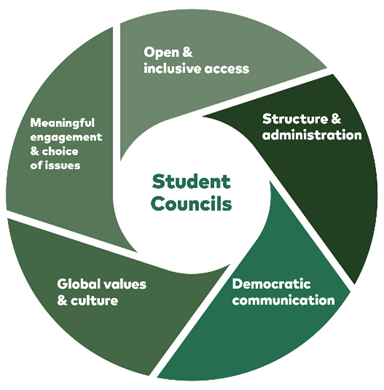
Together, these dimensions highlight that democratic participation cannot be reduced to formal representation alone but depends on the extent to which schools cultivate inclusive environments, dialogical practices, and opportunities for students to engage with issues that matter to them. In this sense, strengthening student councils requires not only formal structures but also intentional whole-school efforts that integrate participation into everyday practices and decision-making processes. As previous research suggests (Alderson, 2000; Guðjohnsen et al., 2024; Lundy, 2018), students must be recognised as present citizens with legitimate rights and responsibilities to influence their school lives and supported in developing the capacities to do so. This includes ensuring inclusive representation, clarifying the purpose and mandate of councils, and providing feedback mechanisms so that students can see how their contributions shape outcomes.
Conclusions and implications
Despite strong policy commitments to democratic participation in Nordic schools, this study identifies a persistent implementation gap. Student councils are widely established but often function as consultative structures with limited influence on decision-making. While opportunities for space and voice are generally present, audience and influence remain unevenly realised (Lundy, 2007). These findings highlight a broader challenge within democratic education: participation structures alone do not guarantee meaningful engagement. Rather, participation depends on how it is enacted in everyday school practices, including the extent to which students are recognised as legitimate contributors and able to influence issues that matter to them.
In response, this article proposes a Nordic model that conceptualises student councils as sites of interconnected democratic practices, including inclusive access, democratic communication, engagement with meaningful issues, global and ethical orientations, and supportive structures. The model proposed in this study provides a globally relevant framework for analysing and strengthening participation beyond formal representation. From a policy and practice perspective, this suggests the need to move beyond mandating student councils toward supporting their quality and impact. This includes clearer implementation guidance, professional development for school staff, and mechanisms that ensure transparency, feedback, and continuity in student participation. Strengthening student councils also requires addressing inequalities in representation and creating more inclusive pathways for participation across diverse student groups.
Ultimately, democratic participation in schools should be understood not only as preparation for future citizenship, but as a lived and ongoing practice. Student councils, when meaningfully enacted, can play a central role in this process. The model developed in this study offers a way forward for rethinking how schools can move from symbolic participation toward more inclusive and transformative democratic engagement.
References
Aðalbjarnardóttir, S., & Harðardóttir, E. (2018). Students’ attitudes towards immigrants’ rights: The role of democratic classroom discussions. In H. Ragnarsdóttir & S. C. Lefever (Eds.), Icelandic studies on diversity and social justice in Education (pp. 130–155). Cambridge Scholars Publishing.
Aðalnámskrá grunnskóli. (2011/2013). Aðalnámskrá grunnskóla: Almennur hluti 2011: Greinasvið 2011/2013 [The Icelandic National Curriculum Guide for Compulsory Schools: General section and subject areas]. https://www.adalnamskra.is/grunnskoli
Alderson, P. (2000). School students' views on school councils and daily life at school. Children & Society, 14(2), 121–134. https://doi.org/10.1111/j.1099-0860.2000.tb00160.x
Alderson, P., & Morrow, V. (2011). The ethics of research with children and young people: A practical handbook. SAGE. https://doi.org/10.4135/9781446268377
Alerby, E., & Bergmark, U. (2019). Democratic values and student participation in Swedish education: Essentials for a sustainable and equal society. In M. C. Beaton, D. B. Hirshberg, G. R. Maxwell, & J. Spratt (Eds.), Including the North: A comparative study of the policies on inclusion and equity in the Circumpolar North (pp. 145–160). University of Lapland. https://urn.fi/URN:ISBN:978-952-337-136-1
Almgren, E. (2006). Att fostra demokrater: Om skolan i demokratin och demokratin i skolan [Fostering democratic citizens]. [Doctoral dissertation, Uppsala University]. Uppsala University Publications. http://uu.diva-portal.org/smash/record.jsf?pid=diva2:168399
Andersson, E. (2018). The school as a public space for democratic experiences: Formal student participation and its political characteristics. Education, Citizenship and Social Justice, 14(2), 149–164. https://doi.org/10.1177/1746197918776657
Biesta, G. (2020). Risking ourselves in education: Qualification, socialization, and subjectification revisited. Educational Theory, 70(1), 89–104. https://doi.org/10.1111/edth.12411
Biesta, G. (2022). World-centred education: A view for the present. Taylor & Francis. https://doi.org/10.4324/9781003098331
Biesta, G., & Lawy, R. (2006). From teaching citizenship to learning democracy: Overcoming individualism in research, policy and practice. Cambridge Journal of Education, 36(1), 63–79. https://doi.org/10.1080/03057640500490981
Biseth, H. (2009). Democracy and education in a multicultural Scandinavia: What mandate is designated to educators? Intercultural Education, 20(3), 243–254. https://doi.org/10.1080/14675980903138590
Braun, V., & Clarke, V. (2013). Successful qualitative research: A practical guide for beginners. SAGE.
Børne- og Undervisningsministeriet. (2014). Bekendtgørelse om elevråd i folkeskolen (BEK nr. 695/2014) [Executive order on student councils in compulsory education]. Retsinformation. https://www.retsinformation.dk/eli/lta/2014/695
Børne- og Undervisningsministeriet. (2024). Bekendtgørelse om formål, kompetencemål og opmærksomhedspunkter for folkeskolens fag og emner (Fælles Mål) (BEK nr. 1715/2024) [Common objectives for compulsory education]. Retsinformation. https://www.retsinformation.dk/eli/lta/2024/1715
Council of Europe. (2018). Reference framework of competences for democratic culture (Volume 1-3). Context, concepts and model. Council of Europe Publishing. https://www.coe.int/en/web/reference-framework-of-competences-for-democratic-culture/rfcdc - Volume1
Creswell, J. W., & Plano Clark, V. L. (2018). Designing and Conducting Mixed Methods Research (3rd ed.). SAGE.
Damiani, V., Losito, B., & Schulz, W. (Eds.). (2025). IEA International Civic and Citizenship Education Study 2022 European Report. Springer. https://doi.org/10.1007/978-3-031-68631-3
Dewey, J. (1916). Democracy and education: An introduction to the philosophy of education. Macmillan.
Edelstein, W. (2010). Lýðræði verður að læra [Democracy must be learned]. Netla – Online Journal on Pedagogy and Education.
Elkjær, M. A., & Iversen, T. (2020). The Political Representation of Economic Interests: Subversion of Democracy or Middle-Class Supremacy? World Politics, 72(2), 254-290. https://doi.org/10.1017/S0043887119000224
Elvstrand, H. (2009). Delaktighet i skolans vardagsarbete [Participation in everyday school work]. (Doctoral dissertation, Linköping University). Linköping University Electronic Press. https://www.diva-portal.org/smash/get/diva2:229768/FULLTEXT01.pdf?fbclid=IwAR3pnE37KKScH9Fy7xHr8LgOWi9fREaPkJZw9T-dmcVWe9RSi6UODatJUSw
Eriksson, L., & Bostedt, G. (2011). Elevinflytande i spänningsfältet mellan skolans kunskapsuppdrag och demokratiska uppdrag: En studie av fyra skolor [Student influence in the tension between the school’s knowledge mission and democratic mission: A study of four schools] (Utbildningsvetenskapliga studier 2011:1). Mittuniversitetet. https://miun.diva-portal.org/smash/get/diva2:442283/FULLTEXT01.pdf
Fattore, T., Mason, J., & Watson, E. (2016). Children’s understandings of well-being: Towards a child standpoint. Springer. https://doi.org/10.1007/978-94-024-0829-4
Finnsdóttir, A. J., Harðardóttir, E., & Auðardóttir, A. M. (2026). Útilokuð eða útvalin: Val og aðgengi að nemendaráðum í íslenskum grunnskólum [Excluded or selected: Selection processes and accessibility of student councils in Icelandic compulsory schools]. Netla, Online Journal on Education and Pedagogy. https://doi.org/10.24270/netla.2026/4
Freeman, M. (Ed.). (1996). Children’s rights: A comparative perspective. Dartmouth Publishing.
Gilljam, M., Esaiasson, P., & Lindholm, T. (2010). The voice of the pupils: An experimental comparison of decisions made by elected pupil councils, pupils in referenda, and teaching staff. Educational Assessment, Evaluation and Accountability, 22(1), 73–88. https://doi.org/10.1007/s11092-009-9084-0
Griebler, R., & Nowak, P. (2012). Student councils: A tool for health promoting schools? Characteristics and effects. Health Education, 112(2), 105–132. https://doi.org/10.1108/09654281211203402
Griffin, C. P. (2022). Can you hear my voice? Using Lundy’s model of participation to elicit student voice in student support plans. Irish Learning Support Association Newsletter, Autumn 2022, 7–10.
Guðjohnsen, R. Þ. (2025). Moral and citizenship education in Iceland: A historical and contemporary perspective. In K. Tirri (Ed.), Nordic perspectives on moral and citizenship education (pp. 97–114). Brill. https://doi.org/10.1163/9789004745902_006
Guðjohnsen, R. Þ., & Harðardóttir, E. (2025). Student councils and democratic participation in the Nordic region. Nordic Welfare Centre. https://doi.org/10.52746/VEXG8822
Guðjohnsen, R. Þ., Jordan, K. E., Jónsson, Ó. P., Aðalbjarnardóttir, S., & Garðarsdóttir, U. E. (2024). Good citizenship and sustainable living: Views, experiences, and opportunities among young people in Iceland. In N. Snow (Ed.), Routledge Handbook: Self, virtue and the public life project (pp. 59–78). Routledge. https://doi.org/10.4324/9781003367857-5
Guillemin, E. (2024). Biesta’s world-centred education: subjectification revisited? Journal of Philosophy of Education, 59(2), 274-289. https://doi.org/10.1093/jopedu/qhae057
Gunnulfsen, A. E., Ärlestig, H., & Storgaard, M. (2023). Making sense of Nordic school leadership: Four perspectives on similarities and variations. In A. E. Gunnulfsen, H. Ärlestig, & M. Storgaard (Eds.), Education and democracy in the Nordic countries: Making sense of school leadership, policy, and practice (pp. 173–182). Springer. https://doi.org/10.1007/978-3-031-33195-4_11
Harada, A. (2021). How to involve a diverse group of young people in local government decision making: A case study of Danish youth councils. Compare: A Journal of Comparative and International Education, 53(3), 436–452. https://doi.org/10.1080/03057925.2021.1976615
Jónsson, Ó. P., Guðmundsson, B., Øyehaug, A. B., Didham, R. J., Wolff, L. A., Bengtsson, S., Andreasen Lysgaard, J., Gunnarsdóttir, B. S., Árnadóttir, S. M., Rømoen, J., Sund, M., Cockerell, E., Plummer, P., & Brückner, M. (2021). Mapping education for sustainability in the Nordic countries. Nordic Council of Ministers. https://doi.org/10.6027/temanord2021-511
Jónsson, Ó. P., & Rodriguez, A. G. (2021). Educating democracy: Competences for a democratic culture. Education, Citizenship and Social Justice, 16(1), 62–77. https://doi.org/10.1177/1746197919886873
Kahne, J., Hodgin, E., & Eidman-Aadahl, E. (2016). Redesigning civic education for the digital age: Participatory politics and the pursuit of democratic engagement. Theory & Research in Social Education, 44(1), 1–35. https://doi.org/10.1080/00933104.2015.1132646
Kempner, I., & Janmaat, J. G. (2022). School councils across Europe: Democratic forums or exclusive clubs? Brill. https://doi.org/10.1163/9789004541375
Khan, F. (2006). Who participates in school councils and how? Prospects, 36(1), 97–119. https://doi.org/10.1007/s11125-006-7584-y
Lieberkind, J. (2020). Democracy and togetherness: Between students’ educational and political status—A study of primary and lower secondary education in Denmark. Multicultural Education Review, 12(1), 17–30. https://doi.org/10.1080/2005615X.2020.1720134
Lundy, L. (2007). ‘Voice’ is not enough: Conceptualising Article 12 of the United Nations Convention on the Rights of the Child. British Educational Research Journal, 33(6), 927–942. https://doi.org/10.1080/01411920701657033
Lundy, L. (2018). In defence of tokenism? Implementing children’s right to participate in collective decision-making. Childhood, 25(3), 340–354. https://doi.org/10.1177/0907568218777292
Lög um grunnskóla. (2008). Lög um grunnskóla, nr. 91/2008 [Compulsory School Act]. Alþingi/Government of Iceland. https://www.althingi.is/thingstorf/thingmalalistar-eftir-thingum/ferill/?ltg=135&mnr=285
Løgtingslóg um fólkaskúlan. (1997). Løgtingslóg no. 125 frá 20. juni 1997 um fólkaskúlan [Compulsory Education Act]. Lógasavnið, Government of the Faroe Islands. https://logir.fo/Logtingslog/125-fra-20-06-1997-um-folkaskulan-sum-seinast-broytt-vid-logtingslog-nr-34-fra-28
Mager, U., & Nowak, P. (2012). Effects of student participation in decision making at school: A systematic review and synthesis of empirical research. Educational Research Review, 7(1), 38–61. https://doi.org/10.1016/j.edurev.2011.11.001
Mentamálaráðið. (2025). Kunngerð no. 119 frá 2. juli 2025 um næmingaráð og landsráð fyri næmingaráð fólkaskúlans [Executive order on student councils in compulsory education]. Lógsavnið/Government of the Faroe Islands. https://logir.fo/Kunngerd/119-fra-02-07-2025-um-naemingarad-og-landsrad-fyri-naemingarad-folkaskulans
Männistö, P. (2020). The state of democracy education in Finnish primary school education [Doctoral dissertation, University of Jyväskylä]. JYX – University of Jyväskylä Digital Repository. https://jyx.jyu.fi/jyx/Record/jyx_123456789_72316
Nordic Council of Ministers. (2019). Vision 2030 for the Nordic region. Nordic Council of Ministers. https://www.norden.org/en/declaration/our-vision-2030
Opetushallitus. (2014). Perusopetuksen opetussuunnitelman perusteet 2014 [National core curriculum for compulsory education 2014]. Opetushallitus/Utbildningsstyrelsen. https://www.oph.fi/sites/default/files/documents/perusopetuksen_opetussuunnitelman_perusteet_2014.pdf
Patton, M. Q. (1999). Enhancing the quality and credibility of qualitative analysis. Health Services Research, 34(5 Pt 2), 1189–1208. https://pmc.ncbi.nlm.nih.gov/articles/PMC1089059/
Perusopetuslaki. (1998). Perusopetuslaki 628/1998 [Compulsory Education Act]. Suomen säädöskokoelma https://www.finlex.fi/fi/lainsaadanto/saadoskokoelma/1998/628?utm_source=chatgpt.com
Rönnlund, M. (2011). Demokrati och deltagande: Elevinflytande i grundskolans årskurs 7–9 ur ett könsperspektiv [Democracy and participation: Pupils’ influence in lower secondary schools from a gender perspective] [Doctoral dissertation, Umeå University]. Umeå University Electronic Publications. https://umu.diva-portal.org/smash/get/diva2:443227/FULLTEXT04.pdf
Rönnlund, M. (2014). Justice in and through education? Students’ participation in decision-making. Journal of Social Science Education, 13(2), 104–113. https://doi.org/10.4119/jsse-695
Sant, E. (2019). Democratic education: A theoretical review (2006–2017). Review of Educational Research, 89(5), 655–696. https://doi.org/10.3102/0034654319862493
Scarparolo, G., & MacKinnon, S. (2024). Student voice as part of differentiated instruction: Students’ perspectives. Educational Review, 76(4), 774–791. https://doi.org/10.1080/00131911.2022.2047617
Schulz, W., Ainley, J., Fraillon, J., Losito, B., Agrusti, G., Damiani, V., & Friedman, T. (2023). Education for citizenship in times of global challenge: IEA International Civic and Citizenship Education Study 2022 international report. International Association for the Evaluation of Educational Achievement (IEA). https://www.iea.nl/sites/default/files/2023-11/ICCS2022-International-Report.pdf
Sinclair, R. (2004). Participation in practice: Making it meaningful, effective, and sustainable. Children & Society, 18(2), 106–118. https://doi.org/10.1002/chi.817
Skollagen. (2010). Skollag (2010:800) [Education Act, Sweden]. Sveriges Riksdag. https://www.riksdagen.se/sv/dokument-och-lagar/dokument/svensk-forfattningssamling/skollag-2010800_sfs-2010-800
Skolverket. (2022). Läroplan för grundskolan samt för förskoleklassen och fritidshemmet (Lgr22) [The Swedish National Curriculum for Compulsory Schools]. Skolverket. https://www.skolverket.se/undervisning/grundskolan/laroplan-lgr22-for-grundskolan-samt-for-forskoleklassen-och-fritidshemmet/curriculums/LGR22?schoolType=GR&tosHeading=Kursplaner&hasSubjects=tru
Sousa, I., & Ferreira, E. (2024). Students’ participation in democratic school management: A systematic literature review. Journal of Social Science Education, 23(1), 1–20. https://doi.org/10.11576/jsse-6333
Stoddard, J. (2014). The need for media education in democratic education. Democracy & Education, 22(1). https://democracyeducationjournal.org/home/vol22/iss1/4/
Thomson, I. (2025). Redogörelse för Nordiska ministerrådets arbete med barn och unga 2024–2025 (PolitikNord 2025:726). Nordic Council of Ministers. https://doi.org/10.6027/politiknord2025-726
Tiusanen, M. (2025). Oppilaskuntatoiminnan tavoitteista toteutukseen: Oppilaiden näkemyksiä vaikuttamisesta [Doctoral dissertation, University of Turku]. Turun yliopiston julkaisuja – Annales Universitatis Turkuensis, Series B (Vol. 709). https://urn.fi/URN:ISBN:978-952-02-0031-2
Torney-Purta, J., & Barber, C. (2005). Democratic school engagement and civic participation among European adolescents: Analysis of data from the IEA Civic Education Study. Journal of Social Science Education, 4(3). https://doi.org/10.4119/jsse-324
Tujula, M. (2023). Aktiiviseksi koulussa ja yhteiskunnassa: Kouludemokratian toteuttaminen peruskoulussa [Doctoral dissertation, University of Helsinki]. Helsinki Studies in Education (No. 165). http://hdl.handle.net/10138/357034
Tujula, M., Rautopuro, J., Löfström, J., & Niilo-Rämä, M. (2021). Koulun yhteisöllinen ilmapiiri ja oppilaiden yhteiskunnallisen vaikuttamisen orientaatio: yhteyksiä etsimässä. Nuorisotutkimus, 39(3), 36-57. https://journal.fi/nuorisotutkimus/issue/view/8458
United Nations. (1989). Convention on the Rights of the Child. https://www.ohchr.org/en/instruments-mechanisms/instruments/convention-rights-child
Verba, S., Schlozman, K. L., & Brady, H. E. (1995). Voice and equality: Civic voluntarism in American politics. Harvard University Press. https://doi.org/10.2307/j.ctv1pnc1k7
 ©2026 E. Harðardóttir, R. Þ. Guðjohnsen,
P. R. Hansen, N. Ouakrim-Soivio, M. Mustola, M. Hiljanen, J. Lau, F. B.
Poulsen, J. Jormfeldt. This is an Open Access article
distributed under the terms of the Creative Commons Attribution 4.0
International License (http://creativecommons.org/licenses/by/4.0/), allowing
third parties to copy and redistribute the material in any medium or format and
to remix, transform, and build upon the material for any purpose, even
commercially, provided the original work is properly cited and states its
license.
©2026 E. Harðardóttir, R. Þ. Guðjohnsen,
P. R. Hansen, N. Ouakrim-Soivio, M. Mustola, M. Hiljanen, J. Lau, F. B.
Poulsen, J. Jormfeldt. This is an Open Access article
distributed under the terms of the Creative Commons Attribution 4.0
International License (http://creativecommons.org/licenses/by/4.0/), allowing
third parties to copy and redistribute the material in any medium or format and
to remix, transform, and build upon the material for any purpose, even
commercially, provided the original work is properly cited and states its
license.