Vol 10, No 3 (2026)
https://doi.org/10.7577/njcie.6652
Article
Barriers to Curriculum Internationalization at an African Open Distance e-Learning University: A Qualitative Case Study of the University of South Africa
Cebisa Nkhumeleni
University of South Africa
Ayobami Precious Adekola
University of South Africa
Email: nkhumc1@unisa.ac.za
Abstract
Internationalization of the curriculum (IoC) is widely proclaimed as a priority across universities, but in the Global South, the disconnect between policy statements and what happens in curricula remains substantial and insufficiently understood. This article investigates why that gap endures at the University of South Africa (UNISA), the continent’s largest open, distance, and e-learning (ODeL) institution. Drawing on critical theory and Leask’s framing of IoC, and viewing curriculum as a layered construct intended, enacted, and achieved, the study used semi-structured interviews with 39 purposively selected participants (30 students, five lecturers, three senior managers, and the director of the international office) alongside documentary analysis of national and institutional policy texts, interpreted through reflexive thematic analysis. The findings point to three interconnected sets of constraints: systemic and resourcing limitations; policy and political obstacles, including claims of curriculum sovereignty and unrealized institutional policies; and pedagogical and cultural impediments, especially the discretionary use of IoC, an ongoing Eurocentric orientation, and a lack of explicit aims and assessed outcomes. These constraints do not function in isolation; instead, they interact in a mutually reinforcing loop of institutional inertia, in which limited resources preserve existing pedagogical arrangements, thereby dampening pressure to implement change. The study advances comparative and international education by arguing that the policy–practice gap in an African ODeL context is not simply a technical implementation problem but reflects a political economy of curriculum, and by clarifying the circumstances in which internationalization and decolonization are experienced as competing agendas rather than complementary ones. The article concludes with implications for institutional leaders, policymakers, and academic developers working in similar distance-education and Global South contexts.
Keywords: Internationalization of the curriculum, open distance e-learning, policy-practice gap, decolonization, South African higher education
Introduction
In the contemporary higher education sector, it has become common for universities to articulate ambitious policies and strategic plans for internationalizing the curriculum. These policies typically espouse commitments to developing global citizens, fostering intercultural competence, and infusing international and intercultural dimensions throughout teaching, learning, and research (Knight, 2004; Leask, 2015). However, a significant and persistent gap often exists between policy aspirations and implementation realities, particularly in large, complex institutions in the Global South that face unique historical and resource-related challenges (Jowi, 2012). More than a decade after Jowi's influential analysis, this gap persists and, in some institutions, has widened in the post-pandemic period (de Wit & Altbach, 2021; Marinoni, 2024).
The University of South Africa (UNISA) provides a compelling case. As Africa's largest Open Distance e-Learning (ODeL) institution, with a student population drawn from more than 40 countries (Nkhumeleni, 2021), UNISA offers an extraordinary platform for internationalizing the curriculum. Despite this global footprint, however, the institution has struggled to translate its international character into a coherent curriculum strategy. Evidence suggests that there are "no strategies for the internationalization of both the curriculum and how content was delivered" and that internationalization continues to be treated as "a peripheral topic" handled without a systematic long-term strategy (Nkhumeleni, 2021, pp. i, 126). Similar patterns have been documented across several African universities, where curriculum internationalization efforts remain fragmented, under-resourced, and poorly integrated with broader transformation agendas (Heleta & Chasi, 2023; Woldegiyorgis et al., 2018). That footprint has expanded significantly since then: the university now reports students living in 110 countries outside South Africa (University of South Africa, 2025).
This paper seeks to understand the underlying causes of this policy–practice gap. It is framed by the central research question: What are the current challenges and constraints in the internationalization of the curriculum at UNISA? Drawing on rich qualitative data from students, lecturers, and senior managers, the analysis argues that the challenges are not isolated, manageable problems but constitute an interlocking system of historical, financial, political, and pedagogical barriers. Together, these barriers create a powerful institutional inertia that relegates curriculum internationalization to a discretionary, under-resourced, and often-neglected activity. This concern is heightened by post-COVID shifts toward virtual exchange and digital internationalization, which have exposed African ODeL institutions to new opportunities and new inequities (de Wit & Altbach, 2021; Mittelmeier et al., 2022).
The analysis is structured around three questions. First, how do the designers, instructors, and students in UNISA’s programs interpret the internationalization of the curriculum? Second, what limits its enactment, and how do these limiting factors connect to each other? Third, what are the implications for institutions expected to advance internationalization and decolonization simultaneously? To address these questions while keeping different forms of evidence distinct, the curriculum is approached as a layered construct. Drawing on van den Akker’s (2003) differentiation of the intended, implemented, and attained curriculum, senior managers and the director of the international office describe what is planned and prescribed; lecturers describe what is put into practice through teaching; and students describe what is ultimately achieved and experienced. From this perspective, the policy–practice gap is the distance between these layers, rather than a shortcoming attributable to any one group.
By dissecting this system of constraints through a critical theoretical lens, this article aims to provide a deeper understanding of the formidable challenges to implementing internationalization policy in similar ODeL and Global South contexts, and to offer evidence-based recommendations for institutional leaders, policymakers, and academic developers working to bridge the gap between internationalization policy and pedagogical practice.
This contribution is comparative in two ways. In substantive terms, UNISA serves as a limiting case for the claim, largely formulated in residential Global North institutions, that curriculum internationalization results from mobility and campus diversity: the university already enrolls a transnational student population at a scale that no mobility scheme could match, yet that demographic mix is not reflected in internationalized curricula. In analytic terms, the account offered here identifies mechanisms rather than merely portraying a one-off institution, and those mechanisms can be applied to other open and distance systems, including Nordic ones, where resourcing, workload, and curricular governance are organized quite differently.
Literature Review
Defining and Situating Curriculum Internationalization
Knight's (2004) widely adopted definition frames internationalization as "the process of integrating an international, intercultural or global dimension into the purpose, functions or delivery of post-secondary education" (p. 11). Leask (2015) extended this to the curriculum itself, defining curriculum internationalization as the incorporation of international, intercultural, and global dimensions into content, learning outcomes, assessment, and delivery. More recent formulations emphasize internationalization for all students, not only for the mobile minority (de Wit & Hunter, 2015), and foreground equity, inclusion, and meaningful student engagement in their domestic learning environments (de Wit et al., 2015).
Operationalizing Internationalization of the Curriculum
Internationalization of the curriculum is more limited in scope than internationalization overall and is often mistakenly treated as the same thing. Drawing on Leask (2015), this study defines IoC as the intentional integration of international, intercultural, and global perspectives into four visible components of a program: articulated learning outcomes; curriculum content and required readings/materials; teaching and learning practices, including the purposeful use of an interculturally diverse student cohort; and assessment. This definition is intentionally specific because it allows implementation to be examined and verified. A program can be said to have internationalized its curriculum only when these four components can be demonstrated to have been modified. By contrast, mobility data, partnership arrangements, and international enrolment numbers indicate institutional internationalization rather than IoC and maintaining that distinction is central to this article's analysis.
In an African context, three caveats are important. First, IoC is not limited to the formal curriculum; it also encompasses the informal and hidden curricula, in which students, rather than curriculum designers, are the primary observers (Leask, 2015; Leask & Carroll, 2011). Second, “international” should not be treated as synonymous with “Northern”: for a continental student body, intercultural learning grounded in Zimbabwean, Angolan, or Ghanaian scholarship constitutes internationalization, and when it is missing, that absence is itself a result to be noted rather than a neutral condition. Third, in South Africa, IoC is bound up with the issue of whose knowledge is recognized as legitimate, the central concern raised by decolonial scholarship (Heleta, 2016; Le Grange, 2016; Ndlovu-Gatsheni, 2018). IoC is thus framed as a matter of curriculum governance rather than student mobility.
Scholars have increasingly argued that internationalization must be repositioned as a means rather than an end, serving broader institutional missions of quality, access, and social contribution (Brandenburg & de Wit, 2011; de Wit, 2011), and more recent work has interrogated the commodified, recruitment-driven logic that has dominated practice (de Wit & Altbach, 2021; Hunter et al., 2022). In the African context, scholars have further argued that internationalization must be decoupled from Westernization and decolonized to serve African epistemic and developmental priorities (Heleta, 2016; Jooste & Heleta, 2017).
The Policy–Practice Gap in Internationalization
The challenge of implementing educational reform is well-documented. Fullan (1991) described an “implementation plunge,” a predictable dip in performance when initiatives requiring new skills, knowledge, and behaviors are introduced. The concept is directly relevant to internationalization of the curriculum, which demands that academic staff move beyond traditional practices and engage with challenging intercultural and global perspectives (Leask, 2014; Sanderson, 2011). Macro-level barriers in the African context compound this challenge, among them the historical dominance of Western academic concepts, brain drain, and unequal partnerships with the Global North (Singh et al., 2005; Teferra, 2015).
At the institutional level, successful internationalization requires a comprehensive, integrated approach embedded in the university’s culture, policies, and organizational processes (Knight, 2008). Jowi (2012) observed that progress is often slow due to “little or no senior-level interest or enthusiasm” (p. 156), pointing to a gap between formal adoption of internationalization as a strategic goal and allocation of the resources, expertise, and institutional will to realize it. Marinoni (2024) reported that while 90% of surveyed institutions globally include internationalization in strategic plans, fewer than half have implementation mechanisms or performance indicators, a gap most pronounced in African and Latin American institutions.
Barriers to Internationalization in African Higher Education
African higher education faces distinctive constraints. Altbach and colleagues (2009) documented the chronic under-funding, limited research capacity, and infrastructural deficits shaping the sector, while Jowi (2012) and King (2014) highlighted dependence on external funding and partnerships that reproduce asymmetrical power relations. Ellingboe (2008) observed that academic staff with international experience often fail to transfer it into their curricula, especially consequential where staff development is limited.
The transformation imperative rooted in South Africa's post-apartheid history adds a further layer of complexity. Universities are mandated to redress historical racial imbalances, promote epistemic justice, and center African knowledge systems (Hoppers, 2001; Moll, 2004). The #RhodesMustFall and #FeesMustFall movements of 2015–2016 intensified calls for decolonization of the curriculum (Heleta, 2016), and subsequent scholarship has examined how decolonization and internationalization can be reconciled rather than opposed (Heleta & Chasi, 2023; Jooste & Heleta, 2017). However, as this study demonstrates, these agendas are frequently experienced by staff and students as competing priorities, with internationalization perceived as secondary, foreign, or even antithetical to transformation.
The national policy landscape has changed as well. South Africa did not have a national policy on internationalization until the Policy Framework for Internationalization of Higher Education in South Africa was approved in 2019 and formally promulgated in November 2020 (Department of Higher Education and Training, 2019; Jooste & Hagenmeier, 2022). The Framework outlines objectives, guiding principles, and institutional roles, and it obliges universities to craft their own internationalization policies, yet it engages only lightly with curriculum issues. Heleta (2023) contends that it reiterates dominant Eurocentric understandings instead of connecting internationalization to transformation and decolonization, whereas Jooste and Hagenmeier (2022) argue that it provides guidance but not the tools needed for thoroughgoing internationalization. In this way, the national instrument reflects the system-level gap between policy and practice that this article identifies at the institutional level.
ODeL institutions present additional complexities. As Leask and Carroll (2011) noted, internationalization strategies developed for residential campuses do not translate straightforwardly into distance-learning contexts. Scholarship on digital and virtual internationalization has underscored both the potential of ODeL platforms to democratize international learning and the persistent digital divide limiting access for many African students (Mittelmeier et al., 2022), leaving institutions such as UNISA to navigate a landscape in which internationalization, digital transformation, and decolonization intersect in contradictory ways.
Theoretical Framework
This study is grounded in critical theory, as developed by Horkheimer (1972) and extended by the Frankfurt School and contemporary critical educationists (Kellner, 2013; Levinson, 2011; McLaren, 2003). Critical theory is particularly well suited to the study of curriculum internationalization because it is simultaneously exploratory, practical, and normative: it seeks to understand the social conditions of education, to intervene in them, and to orient that intervention toward emancipation and justice (Horkheimer, 1972; Levinson, 2011).
Three insights from critical theory shape the analytic framing of this study. First, no social practice, including education, is innocent or neutral; all institutional processes are informed by political interests and moral commitments (Levinson, 2011). This insight directs attention to the power relations embedded in what counts as "international" knowledge, whose perspectives are centered, and whose are marginalized. Second, critical theory treats curriculum as both a site of transmission of dominant knowledge and a potential site of resistance and cultural production (McLaren, 2003; Rose, 1990). Third, critical multiculturalism, drawing on May and Sleeter (2010) and Sleeter and Grant (2006), insists that responsive internationalization requires attention to how unequal power relations are produced and maintained through curricula, pedagogies, and institutional practices.
The study also draws on Leask’s (2010; 2015) framework for internationalization of the curriculum, which situates curricular decisions within nested spheres of influence: the global context; national policy and institutional context; disciplinary knowledge and practice; the formal, informal, and hidden curriculum; and the systematic development of student knowledge, skills, and attitudes. The framework organizes attention across these levels, while critical theory supplies the lens for interpreting the relations among them, consistent with calls for critical and decolonial approaches moving beyond technical-rational accounts of implementation failure (Heleta & Chasi, 2023).
Method
Setting and Participants
UNISA is Africa's largest Open Distance e-Learning institution, with a 2017 enrolment exceeding 324,000 students drawn from more than 40 countries (Nkhumeleni, 2021). Headquartered in Pretoria, South Africa, UNISA comprises eight colleges and a graduate school of business leadership, spanning Accounting Sciences, Agriculture and Environmental Sciences, Economic and Management Sciences, Education, Graduate Studies, Human Sciences, Law, and Science, Engineering and Technology (University of South Africa, 2025). The institution's scale, diversity, and ODeL modality make it a theoretically compelling case for examining the internationalization of the curriculum in the Global South. At the time this was written, the university had over 370,000 enrolled students, characterized itself as a global mega-university, and stated that its student body included residents of 110 countries beyond South Africa (University of South Africa, 2025).
Institutional and National Context
Three aspects of the case are especially relevant to the analysis. First is the institution’s scale and makeup. UNISA confers over 54,000 qualifications annually and enrolls more than 40,000 postgraduate students, including over 10,000 at master’s and doctoral levels; women make up 70.7 percent of the student population, and 62 percent of students are between 25 and 39 years old (University of South Africa, 2025). Individual colleges exceed the size of most South African universities: the College of Education has nearly 95,000 students, while the College of Law enrolls more than 82,000, making it the largest law faculty in Africa. As a result, curriculum decisions are made on an industrial scale, and any adjustment to outcomes, content, materials, or assessment entails similarly substantial switching costs. Curricular inertia at UNISA is therefore both logistical and political.
The second feature concerns the institutional mandate. UNISA presents itself as an African university and indicates that curriculum reform aimed at advancing Africa-centered knowledge systems is a core element of its transformation and decolonization project, while at the same time naming internationalization as a strategic priority and advancing a science-diplomacy agenda through partnerships spanning Africa, Europe, and Asia (University of South Africa, 2025). Both priorities are formally sanctioned. What is missing from authoritative institutional statements, however, is an explanation of how these two orientations intersect within the curriculum. The findings presented below show what unfolds in the space created by that silence.
The third feature is the national frame. South African universities work within a post-1994 transformation imperative set out in Education White Paper 3 (Department of Education, 1997) and, from 2019 onward, within the national internationalization policy referenced above. Public subsidy per student has been under ongoing strain, and the #RhodesMustFall and #FeesMustFall movements have made the legitimacy of curriculum content an explicitly political issue (Heleta, 2016; Le Grange, 2016). Any discussion of curriculum internationalization at a South African university is therefore inseparable from this history.
After obtaining institutional ethical clearance, the primary researcher recruited 39 participants through purposive sampling (Merriam & Tisdell, 2015) to ensure diversity across stakeholder groups, disciplinary affiliations, and national backgrounds. The sample comprised 30 students (15 undergraduate and 15 postgraduate, distributed across home students, English-speaking international students from sub-Saharan Africa, and Francophone and Lusophone international students from sub-Saharan Africa) and 9 key informants, including 3 senior managers, 5 lecturers, and the director of the UNISA International Office. Participant composition is summarized in Tables 1 and 2.
Sampling Rationale and Inclusion Criteria
Given that the curriculum is the object of study, the construction of the sample needed clear justification. At UNISA, curriculum design and approval are undertaken by academic staff, college structures and senior management; students do not create curricula. This does not imply, however, that students lack knowledge of IoC. Within the layered framework used here, students are the only participants with direct access to the attained curriculum—what they actually receive in the form of content, materials, activities and assessment (van den Akker, 2003)—as well as to the informal and hidden curriculum where intercultural learning may or may not occur (Leask, 2015; Leask & Carroll, 2011). Students are therefore authoritative regarding how internationalization was experienced, but not authoritative on institutional strategy, resourcing and policy, which must instead be supported by staff or management perspectives or documentary sources. The student sample was stratified by national and linguistic position and by level of study, yielding equal numbers of home students, English-speaking international students from sub-Saharan Africa, and Francophone or Lusophone international students from sub-Saharan Africa, with an equal division of undergraduates and postgraduates within each stratum so that experiences of comparable curricula could be compared across positions. Key informants were chosen based on formal responsibility for curriculum design, teaching, or the institutional internationalization portfolio, and Table 2 specifies the rationale for including each subgroup. When a participant occupied more than one status, most commonly a lecturer who was also registered for a postgraduate qualification, the role in which they were responding was clarified at the start and used to assign their analytic category.
Ethical approval was obtained from the UNISA Research Ethics Review Committee (reference 2015_URERC_017_AR) and from the University of Bath Research Ethics Committee, the two institutions across which the doctoral research informing this article was conducted. The submission was classified as low risk and reviewed via the expedited route. Participants were recruited by email. After institutional permission was secured, purposively selected individuals were sent a letter explaining the project’s objectives, what participation would involve, and the expected benefits to the institution, together with standard guidance. Those who consented were invited to recommend additional contacts within the university, extending purposive sampling through chain referrals. An information sheet was shared in advance, and the interview questions were provided one to two days beforehand. Written consent was obtained prior to each in-person interview, while telephone participants gave recorded verbal consent. The fieldwork took place within the approved period, and the interview and institutional data reported here are from 2017. As invitations were sent and acceptances were not recorded separately, no response rate can be reported.
Table 1. Student participants by stratum and level of study (n = 30)
|
Student stratum |
Undergraduate |
Postgraduate |
Total |
|
Home students |
5 |
5 |
10 |
|
English-speaking international students (sub-Saharan Africa) |
5 |
5 |
10 |
|
Francophone and Lusophone international students (sub-Saharan Africa) |
5 |
5 |
10 |
|
Total |
15 |
15 |
30 |
Table 2. Key informants by role and basis for inclusion (n = 9)
|
Key-informant subgroup |
n |
Basis for inclusion |
|
Senior managers |
3 |
Academic-governance and resourcing responsibility at the institutional level |
|
Lecturers |
5 |
Direct responsibility for curriculum design, delivery, and assessment |
|
Director, International Office |
1 |
Custodianship of the institutional internationalization portfolio |
|
Total |
9 |
|
Procedures
A qualitative, exploratory case study design was employed (Yin, 2009) to facilitate a deep, contextually rich investigation of the complex processes and perceptions surrounding the internationalization of the curriculum at UNISA. Semi-structured interviews were the primary data source. An interview guide was developed around three overarching research questions concerning (a) what constitutes an internationalized curriculum, (b) what challenges and constraints hinder internationalization, and (c) what characteristics should anchor a model for internationalized curriculum and student learning experiences. Interviews ranged from 45 to 90 minutes, were audio-recorded with participant consent, and transcribed verbatim. Documentary analysis of institutional policy texts, strategic plans, and enrolment data complemented the interviews and supported triangulation. The documentary strand is outlined here because interview evidence alone cannot demonstrate what the institution and the state have formally undertaken. Two sets of documents were examined. National documents included Education White Paper 3 (Department of Education, 1997), the Policy Framework for Internationalization of Higher Education in South Africa (Department of Higher Education and Training, 2019), and section 6 of the Constitution of the Republic of South Africa (Republic of South Africa, 1996, s. 6), which regulates language provision in public institutions. Institutional documents included the university’s published mission and strategy statements, its language policy, and student internationalization profile data for 2014–2017 extracted from the institutional learning management system. The make-up of this corpus is itself noteworthy: no standalone institutional policy on internationalization of the curriculum was found, despite participants’ belief that such a policy existed; this mismatch is examined below. The documents were read in relation to the four components of the IoC operationalization and coded for whether IoC is defined, whether accountability is allocated to a specified office, whether resources are provided, and whether implementation is tracked.
Data Analysis
Interview data were subjected to thematic analysis (Braun & Clarke, 2006), using inductive coding alongside deductive consideration of the conceptual framework. The analysis started once data collection had finished and was conducted in five stages. First, the dataset was compiled and read multiple times to build familiarity. Second, the research questions were refined into targeted sub-questions so that overlapping or unclear material could be separated prior to coding, which helped keep the datasets manageable and limited double-counting of accounts appearing across student, lecturer, and management interviews. Third, the corpus was open-coded to surface recurring material. Fourth, a closed-coding phase consolidated codes into categories, and categories were grouped into themes according to shared meaning rather than shared topic; theme candidates that could not be supported across more than one participant group were merged or removed. Fifth, themes were labeled and defined with boundary statements clarifying inclusions and exclusions, and the links among the three barrier domains were formalized as the cycle shown in Figure 1.
Coding was done by hand rather than with qualitative analysis software, and data collection proceeded until sustained engagement with the corpus yielded no new categories. The researcher who carried out the fieldwork also undertook the coding, and the second author checked the analysis against the coded extracts. Trustworthiness was supported through four measures. Interview data and documentary sources were triangulated, and institutional statistics were used to evaluate claims made in interviews. Participants were given the opportunity to review their transcripts and the written analysis, and to request that any identifying or commercially sensitive information be removed. Analytical judgments were documented in a dated audit trail alongside the archived, organized dataset. Reflexivity was approached as an ongoing responsibility rather than a one-off statement: the researcher worked as a staff member at the institution under study, which enabled access but also introduced a risk of over-identifying with institutional accounts of inaction. That risk was addressed by requiring documentary verification of institutional assertions and by treating student accounts that contradicted them as analytically primary (Merriam & Tisdell, 2015).
Table 3 follows one theme from the raw extract through the initial code and sub-theme to the final theme, making the path from data to claim transparent and allowing the process to be replicated.
Table 3. Worked example of the analytic audit trail from extract to theme
|
Data extract (abridged) |
Initial code |
Sub-theme |
Theme |
|
“The course makes no mention of international goals, aims, or learning outcomes … the prescribed book is South African Human Resource Management for the Public Sector” (SP22) |
No stated international outcomes; nationally bounded prescribed text |
Absence of clear goals, aims, and outcomes |
Pedagogical and cultural barriers |
|
“This [internationalized curriculum] is not a requirement at all … it becomes a very unspoken practice which needs one's conscience to recognize this issue” (LP16) |
IoC not mandated; left to individual discretion |
Discretionary and inconsistent application |
Pedagogical and cultural barriers |
|
“There are limitations brought about by limited funding arrangements and the availability of international scholars” (LP15) |
Funding constrains access to international expertise |
Financial constraints and infrastructural issues |
Systemic and resource barriers |
Participants are labeled with a code that specifies their group and case number: SP denotes student participants, LP denotes lecturer participants, MP denotes senior manager participants, and IOD denotes the director of the international office. The case numbers match those used in the original dataset, and each quotation below includes this code so readers can assess whether the participant is appropriately placed to comment on the claim being presented.
Results
Analysis surfaced three interlocking domains of constraint that, taken together, impede the internationalization of the curriculum at UNISA: (a) systemic and resource barriers, (b) policy and political barriers, and (c) pedagogical and cultural barriers.
Two conventions shape how this is presented. Assertions about institutional strategy, policy, and resourcing are supported by staff, management, or documentary evidence, while student accounts indicate what was actually received at the point of delivery. Quotations are chosen for clarity rather than to suggest how common a view is; a theme was kept only when it was evidenced across more than one participant category.
Systemic and Resource Barriers
Financial Constraints and Infrastructural Issues
A recurring theme across lecturer and management interviews was the impact of South Africa’s constrained economic environment and the consequent reduction in state subsidies. This pressure directly inhibits investment in non-core initiatives and in curriculum internationalization, which requires investment in staff development, curriculum redesign, and technological infrastructure, and was consistently described as under-resourced. LP15, a lecturer, explained:
Except for the MBA program, where international experts from industries and academic institutions across the world engage and impart knowledge, as well as international study tours, mostly, other programs are highly localized. International experience sharing, exchanges and teaching arrangements are highly important. However, there are limitations brought about by limited funding arrangements and the availability of international scholars always.
For an ODeL institution, technology is paramount. Participants identified inadequate and unreliable internet connectivity, both at the institution and for students across the continent, as a critical barrier that severely curtails the potential for rich, interactive, international online learning. Analyses of pandemic-era emergency remote teaching have reinforced the centrality of digital infrastructure and underscored that the digital divide is itself an equity and internationalization issue (Mittelmeier et al., 2022).
Staff Expertise and Turnover
A second systemic weakness was the lack of staff expertise in internationalizing the curriculum. Although the university encouraged an internationalized experience, participants reported that few lecturers were knowledgeable about internationalized content or available to mentor students in it. LP23 identified “human resources (professional expertise) and physical infrastructure” as central problems, and LP16 added that most programs lacked dedicated teaching staff for internationalization, while affiliated scholars were “expected to have a good international understanding of their discipline and profession,” an expectation rarely matched by systematic development opportunities. LP19 observed a gap between institutional aspirations and staff capabilities:
As much as the coordinators are expected to apply their understanding of the cultural foundation of knowledge, there seems to be a gap in terms of what they understand as knowledge and what should be applied as practice.
My observation is that there is greater comfort with theory. LP16 confirmed this:
All teaching staff are encouraged and required to continually develop their understanding of the discipline and related professions internationally. As much as this is a required standard of teaching, my experience and engagements with colleagues show a different picture.
This expertise deficit is compounded by staff turnover, as experienced academics leave for better opportunities, a pattern consistent with the long-documented brain drain in African higher education (Singh et al., 2005; Teferra, 2015; Woldegiyorgis et al., 2018). Ellingboe’s (2008) observation that academic staff with international experience often fail to translate that experience into internationalized curricula was echoed in participants' accounts.
Policy and Political Barriers
Resistance and the Politics of Curriculum Sovereignty
Beyond resources, implementation was constrained by a challenging policy and political environment. Participants from all stakeholder groups reported resistance rooted in concerns about curriculum sovereignty, a fear that embracing international standards would dilute the local focus and autonomy of the curriculum, and this was especially pronounced in disciplines such as Law. LP15 stated:
The LLB Program offered in South Africa is premised on South African law and legal systems and is associated with values and historical background. In South Africa, aspects such as introducing curriculum transformation within the LLB program are something that has been spoken about for some time. Therefore, it has become extremely important to introduce aspects of African Jurisprudence and heighten the level of courses such as Customary Law, to the level that will influence the entire curriculum to be more localized than more internationalized.
SP08 similarly insisted that "the application of the indigenous law is important in litigation and court applications." These responses reflect a broader political tension between global engagement and national priorities, one in which internationalization risks being read as an extension of the very Western-centric imposition that transformation agendas seek to dismantle. This tension is foregrounded in post-2015 decolonial scholarship, which argues that authentic internationalization in African universities must be re-articulated as a decolonial project rather than opposed to one (Heleta & Chasi, 2023).
Unimplemented Policies
Participants generally believed that policies and guidelines on internationalized higher education existed but were not implemented. Several reported a “lack of conceptual clarity about ‘internationalization’ of student learning experiences” (SP17). LP16 confirmed that “reasons for internationalization of the curriculum in the program are never discussed,” while SP17 observed that “the goals are articulated, but the conscious effort to make it even more definitive is lacking severely,” and SP20 added that this “is reflected in the lack of assessments.”
The pattern exemplifies orphaned policy documents that articulate institutional commitment to internationalization but remain unfunded, unstaffed, and unaccompanied by implementation plans. This is consistent with Jowi’s (2012) observation that senior-level enthusiasm and institutional provisions are often weak in African universities, and with Marinoni’s (2024) finding that African institutions are among those most likely to report high-level policy commitments alongside limited implementation mechanisms.
Preoccupation With Redressing Historical Injustice
The legacy of apartheid has created an urgent and non-negotiable mandate for South African universities to redress historical racial imbalances. Participants recognized this as a critical national priority, yet also identified institutional preoccupation with the transformation agenda as a stumbling block for other initiatives, describing an intense focus on racial redress that overshadowed strategic priorities such as internationalization, which were perceived as secondary or even irrelevant to the core transformation mission. One senior manager participant observed that “international funding, in general, comes with stipulations and expectations which in most instances do not cater to the local advancement of the South African child,” and noted that the #FeesMustFall movement had intensified student skepticism toward agendas perceived as externally imposed.
Rather than treating transformation and internationalization as necessarily opposed, recent scholarship has asked whether and how the two agendas can be integrated (Heleta & Chasi, 2023; Jooste & Heleta, 2017). Participants’ accounts suggest that, in the absence of institutional leadership that explicitly articulates such integration, the agendas continue to be experienced as competing claims for limited resources and attention.
Pedagogical and Cultural Barriers
Discretionary and Inconsistent Application
A pervasive finding was that internationalization is rarely mandatory at UNISA, with its application left to individual lecturers’ discretion, resulting in a haphazard and inconsistent approach. SP07 observed: “Students are encouraged to participate in the intercultural interactions, but the onus is on them as to whether to take up intercultural interactive opportunities in the classroom environment or not.” SP04 added, “Tasks are the same for all groups/students regardless of cultural differences,” and SP06 noted, “Culture is never a matter of discussion.”
LP16, a lecturer, confirmed the discretionary pattern: "This [internationalized curriculum] is not a requirement at all, especially for undergraduate students, but in an informal education setting, it becomes a very unspoken practice which needs one's conscience to recognize this issue." SP02 reported that "there are no specific assessment tasks requiring different cultural perspectives. Students engage in different cultural perspectives depending on their research interests." The hidden, discretionary presence of internationalization aligns with Rizvi and Lingard's (2010) contention that economic motives are deeply implicated in universities' engagement with global programs, and that cultural meanings are often reduced in favor of the marketable aspects of internationalization.
Eurocentric Bias in Application
Despite institutional encouragement of internationalized perspectives, participants identified persistent bias in how international content is selected and taught: a preference for dominant, typically Eurocentric viewpoints, with localized South African content occasionally substituted but rarely intercultural content from elsewhere in Africa or the Global South. SP07 articulated this directly:
…expert knowledge is required, but it must be a dominant view from the West. The program does not offer enough support for non-European students, especially black South African students who may be having problems acclimatizing to a learning environment that excludes or/and/or disregards their existence.
LP15 observed that the science curriculum "is, however, mainly applicable in the western epistemological framework" and that the discipline had "over the years been taught without the necessary contexts." This pattern aligns with Samuel and Burney's (2003) observation of a "mono-cultural focus" manifested in Eurocentric curricula and with De Vita and Case's (2003) characterization of internationalization as "ethnocentric Western didacticism." The finding also reinforces Heleta's (2016) diagnosis that South African university curricula remain deeply Eurocentric more than two decades after the democratic transition and that superficial engagement with international content often reinforces rather than disrupts this pattern.
Absence of Clear Goals, Aims, and Outcomes
Participants reported a pervasive lack of clearly defined goals, aims, and learning outcomes for internationalization at the course and program level. Without specific objectives, lecturers were unsure of what was expected of them, and there was no framework for assessing whether students were developing intercultural competencies. SP22 shared:
The course makes no mention of international goals, aims, or learning outcomes. The course content is based on the "public sector in South Africa." Even the prescribed book is South African Human Resource Management for the Public Sector.
LP15 elaborated:
There are no goals or outcomes that focus on internationalization within the whole curriculum. There would be specific outcomes that focus on internationalization in courses such as international law; however, for the basic law curriculum, which focuses on private, public, mercantile, and criminal and procedural law, dynamic influences that create a relationship between law and politics, law and economics, and law and social and cultural issues will always emerge.
This lack of conceptual clarity, as Leask (2010, 2015) has argued, leads to inaction and maintenance of the status quo: goals that are not specified, assessed, and linked to demonstrable student capabilities are unlikely to shape teaching practice.
Discussion of Findings
The challenges identified are not a checklist of independent problems; they constitute a self-reinforcing system producing powerful institutional inertia. The barriers are causally linked, forming a feedback loop that makes meaningful change exceptionally difficult, and this systemic character explains the persistent gap between internationalization policy and practice at UNISA.
This inertia can be traced as follows. Financial constraints limit investment in staff development and competitive salaries, fuelling turnover and a chronic lack of expertise in complex pedagogical areas such as internationalization. That deficit, combined with political and moral pressure to prioritize historical redress, encourages a pedagogical path of least resistance: it is simpler for under-trained and over-stretched academics to rely on familiar, often Eurocentric curricular models than to undertake sustained curriculum redesign (Ellingboe, 2008; Leask, 2014). The result is a status quo neither truly international nor adequately decolonized.
This conservative pedagogical culture generates no bottom-up demand for implementation of the university’s formal internationalization policies, which therefore remain orphaned, unfunded, and unstaffed. Because they are not implemented, no dedicated resources are allocated, reproducing the initial financial constraint. The loop closes, making substantive reform difficult even for well-intentioned leaders and academics. Figure 1 presents this cycle.
Figure 1. The self-reinforcing cycle of institutional inertia
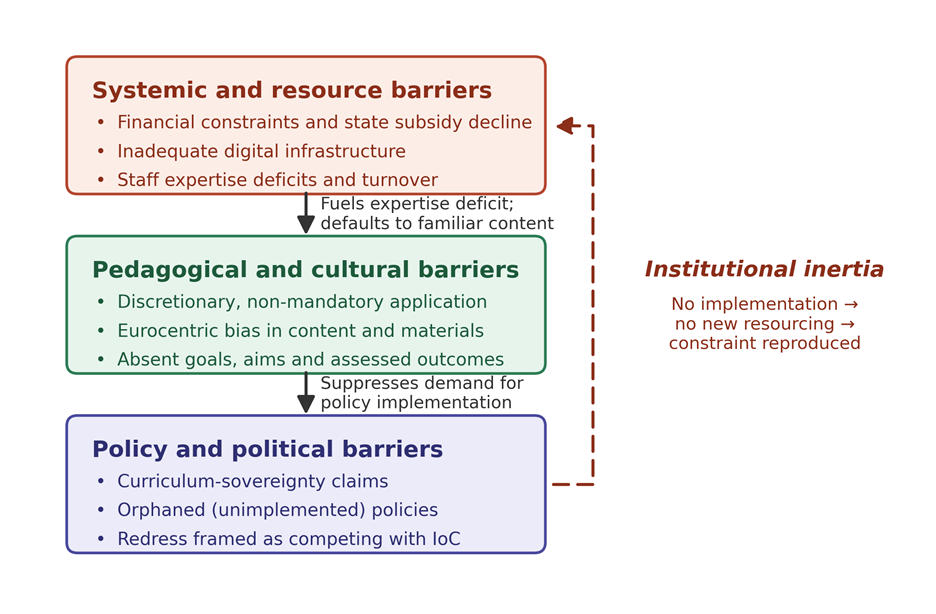
The solid arrows depict the causal mechanisms linking the three barrier domains, as derived from thematic analysis of participant interviews. The dashed arrow on the right indicates the feedback loop by which an unimplemented policy reproduces the initial resource constraint, thereby generating self-reinforcing institutional inertia.
From the lens of critical theory (Horkheimer, 1972; Levinson, 2011; McLaren, 2003), this inertia is not simply a technical implementation failure. It is a political economy of curriculum in which dominant, often Eurocentric, knowledge is reproduced because the structural conditions that would enable its displacement, namely adequate resourcing, staff capability, institutional will, and integrated policy, are systematically unavailable. The discretionary, biased, and unfocused application of internationalization is therefore better understood not as a failure of individual commitment but as the predictable outcome of a structure in which the path of least resistance perpetuates existing knowledge hierarchies (Heleta & Chasi, 2023; Jooste & Heleta, 2017).
Internationalization, De-internationalization, or Decolonization?
These findings raise a clear question that warrants an equally clear response. If South African curricula continue to be largely Western in their content, orientation, and required texts, are they not already internationalized, and does that mean the more suitable solution is de-internationalization rather than additional internationalization? This is a genuine question. Heleta (2016) and Le Grange (2016) both note the ongoing presence of Eurocentric material in South African universities more than two decades after 1994, while Ndlovu-Gatsheni (2018) situates that continuity within a broader framework of epistemic dependency. At first glance, study participants portray a curriculum dominated by the Global North and lacking engagement with the wider world, Africa included.
The answer depends on the operational definition laid out above. What participants recount is not a genuinely internationalized curriculum, but a provincial curriculum that elevates one local tradition to the status of the universal. Eurocentric material is not the same as international material; it is simply content from a single region presented as though it has no regional origin. Judged against the four components, the curricula described here fall short across the board: there are no explicit international learning outcomes, the resources are confined either to South Africa or to the global North, the intercultural diversity of the student body is not used deliberately, and intercultural learning is not assessed. The lack of Angolan, Ghanaian, or Ethiopian content is as much an internationalization failure as the lack of an African epistemological position is a decolonization failure. On this account, the two agendas converge in their diagnosis: both reject a curriculum that leaves one tradition unnamed and treats it as universally valid.
That common diagnosis does not remove the tension, and this study should not be taken to suggest that it does. Decolonization asks whose knowledge is legitimized and under what conditions; internationalization, in its prevailing institutional form, asks how a university situates itself in a global marketplace. When internationalization is implemented through mobility tallies, rankings, and counts of partnerships, it is best understood as a continuation of the very arrangement that decolonial scholarship challenges, and the resistance participants expressed in terms of curriculum sovereignty becomes understandable rather than parochial. Heleta and Chasi (2023) and Jooste and Heleta (2017) contend that the agendas can be aligned only if internationalization is rearticulated from the South. The evidence offered here clarifies the institutional prerequisite for such alignment: an authoritative, institution-level statement that explains how the agendas connect with respect to curriculum content, learning outcomes, and assessment. Without this, staff, confronted with competing directives and limited time, will default to the measured mandate, and the internationalization of the curriculum will not be measured.
The comparative point is that the policy–practice gap described here cannot be explained simply by a lack of resources, because well-resourced systems also report marked discrepancies between internationalization strategies and what is enacted in curricula (Marinoni, 2024). What sets the South African case apart is that curriculum internationalization must be justified in competition with an earlier and morally more compelling claim to the same curricular space. Comparative studies of open and distance institutions in other contexts could clarify which parts of the cycle shown in Figure 1 are driven by scarcity and which reflect lingering curricular politics.
Implications for Practice
Overcoming these barriers demands a holistic intervention addressing the interlocking financial, political, and pedagogical constraints simultaneously. Piecemeal solutions are likely to fail because they do not disrupt the cycle of inertia. Targeted recommendations are offered for three constituencies.
For University Leadership
Internationalization must be explicitly linked to the university’s core missions of access, quality, and transformation rather than positioned as a competing priority. This requires ring-fenced funding for staff development, digital infrastructure, and curriculum redesign, as well as a leadership narrative in which internationalization is integral to a decolonized, globally engaged, African-centered curriculum (Heleta & Chasi, 2023; Jooste & Heleta, 2017).
For Policymakers
The focus must shift from creating new policy documents to developing resourced, accountable implementation plans for existing ones, with specific goals, timelines, performance indicators, and responsibilities assigned to named units. At the national level, the Department of Higher Education and Training and bodies such as the International Education Association of South Africa should work toward a framework integrating internationalization with the transformation, decolonization, and SDG agendas (de Wit & Altbach, 2021).
For Academic Development
The university must invest in continuous, discipline-specific professional development that offers practical, sustained strategies for internationalizing the curriculum and pedagogy in an ODeL context, rather than one-off theoretical training. Sanderson’s (2011) dimensions of the internationalized teacher offer a starting point. Development should be accompanied by incentives and recognition that make internationalization visible in workload models and promotion criteria (Mittelmeier et al., 2022).
Limitations
This study has several limitations. It is based on a single institutional case, limiting generalizability. Although diverse across stakeholder groups and national backgrounds, 39 participants cannot capture the full range of experience across UNISA’s colleges. Some key informants may have presented institutionally favorable accounts, mitigated here by triangulating with documents and more critical student voices. The fieldwork also pre-dates COVID-19 and its consequences for ODeL internationalization. Three additional limitations arise from the study’s design. Because deans and chairs of college curriculum committees were not interviewed, curriculum approval processes are reconstructed from senior management interviews and documents rather than examined firsthand. The document set is also limited to publicly accessible and institutionally issued materials and excludes committee minutes, which could have indicated where internationalization initiatives were proposed and then rejected. Lastly, the analysis considers what participants and documents report about curricula, not the curricula themselves; a systematic review of module descriptors, required reading lists, and assessment tasks against the four elements applied here would provide direct evidence of the gap this study indirectly identifies and would represent the most obvious next step.
Conclusion
This study has argued that the persistent gap between internationalization policy and practice at UNISA is best understood as the product of an interlocking system of systemic, policy-political, and pedagogical barriers that reinforce one another, producing institutional inertia. Through a critical theoretical lens and Leask's framework, the analysis has shown how financial constraints, staff expertise deficits, curriculum-sovereignty politics, unimplemented policies, discretionary application, Eurocentric bias, and undefined learning outcomes coalesce to relegate internationalization to a peripheral, under-resourced activity. Breaking this cycle will require integrated strategic action that links internationalization to transformation, implements resources rather than merely articulates policy, and invests in the sustained capability of academic staff. For similar institutions in the Global South, the findings suggest that meaningful curriculum internationalization is less a technical policy-design challenge than a political and pedagogical project of institutional reinvention. Three arguments are advanced. First, UNISA’s policy–practice gap is actively generated rather than simply tolerated: lacking explicit outcomes, clear accountability, dedicated resources, and ongoing monitoring, a formally approved commitment remains inactive, and each omission reinforces the others. Second, the perceived tension between internationalization and decolonization among staff and students is the product of institutional quiet rather than an inherent incompatibility; when no authoritative position specifies how the two agendas relate in terms of content and assessment, they are experienced as competing demands on the same limited attention. Third, the ODeL model shifts the nature of the challenge instead of resolving it. With students based in over a hundred countries, the institution already has, at no extra cost, the intercultural asset that residential universities pay for through mobility schemes, and the failure to translate that asset into the curriculum is the clearest sign of the inertia described. In comparative and international education, this case indicates that the key analytic issue is no longer whether institutions adopt internationalization policies, since most now do, but whether curricular governance provides the four elements of definition, assignment, resourcing, and monitoring, without which policy adoption has no effect.
References
Altbach, P. G., Reisberg, L., & Rumbley, L. E. (2009). Trends in global higher education: Tracking an academic revolution. UNESCO. https://unesdoc.unesco.org/ark:/48223/pf0000183168
Brandenburg, U., & de Wit, H. (2011). The end of internationalization. International Higher Education, 62, 15–17. https://doi.org/10.6017/ihe.2011.62.8533
Braun, V., & Clarke, V. (2006). Using thematic analysis in psychology. Qualitative Research in Psychology, 3(2), 77–101. https://doi.org/10.1191/1478088706qp063oa
Department of Education. (1997). Education White Paper 3: A programme for the transformation of higher education (Notice 1196 of 1997). Government Gazette No. 18207. Government Printer.
Department of Higher Education and Training. (2019). Policy framework for internationalisation of higher education in South Africa. Department of Higher Education and Training. https://www.dhet.gov.za/Policy%20and%20Development%20Support/Policy%20Framework%20for%20Internationalisation%20of%20Higher%20Education%20in%20South%20Africa.pdf
De Vita, G., & Case, P. (2003). Rethinking the internationalization agenda in UK higher education. Journal of Further and Higher Education, 27(4), 383–398. https://doi.org/10.1080/0309877032000128082
de Wit, H. (2011). Globalization and internationalization of higher education. Revista de Universidad y Sociedad del Conocimiento, 8(2), 241–248. https://doi.org/10.7238/rusc.v8i2.1247
de Wit, H., & Altbach, P. G. (2021). Internationalization in higher education: Global trends and recommendations for its future. Policy Reviews in Higher Education, 5(1), 28–46. https://doi.org/10.1080/23322969.2020.1820898
de Wit, H., & Hunter, F. (2015). The future of internationalization of higher education in Europe. International Higher Education, 83, 2–3. https://doi.org/10.6017/ihe.2015.83.9073
de Wit, H., Hunter, F., Howard, L., & Egron-Polak, E. (Eds.). (2015). Internationalization of higher education. European Parliament. https://www.europarl.europa.eu/RegData/etudes/STUD/2015/540370/IPOL_STU(2015)540370_EN.pdf
Ellingboe, B. J. (2008). Divisional strategies to internationalize a campus portrait: Results, resistance, and recommendations from a case study at a U.S. university. In J. A. Mestenhauser & B. J. Ellingboe (Eds.), Reforming the higher education curriculum: Internationalizing the campus (pp. 198–228). American Council on Education/Oryx Press.
Fullan, M. (1991). The new meaning of educational change (2nd ed.). Teachers College Press.
Heleta, S. (2016). Decolonisation of higher education: Dismantling epistemic violence and Eurocentrism in South Africa. Transformation in Higher Education, 1(1). https://doi.org/10.4102/the.v1i1.9
Heleta, S. (2023). Critical review of the policy framework for internationalization of higher education in South Africa. Journal of Studies in International Education, 27(5), 817–833. https://doi.org/10.1177/10283153221121395
Heleta, S., & Chasi, S. (2023). Rethinking and redefining internationalisation of higher education in South Africa using a decolonial lens. Journal of Higher Education Policy and Management, 45(3), 261–275. https://doi.org/10.1080/1360080X.2022.2146566
Hoppers, C. A. O. (2001). Indigenous knowledge systems and academic institutions in South Africa. Perspectives in Education, 19(1), 73–86. https://hdl.handle.net/10520/EJC87061
Horkheimer, M. (1972). Critical theory: Selected essays (M. J. O'Connell, Trans.). Herder and Herder.
Hunter, F., McAllister-Grande, B., Proctor, D., & de Wit, H. (2022). The evolving definitions of internationalization: A question of values. In D. K. Deardorff, H. de Wit, B. Leask, & H. Charles (Eds.), The handbook of international higher education (2nd ed., pp. 53–74). Routledge. https://doi.org/10.4324/9781003447863
Jooste, N., & Hagenmeier, C. (2022). Policy framework for the internationalization of higher education in South Africa: A compass for comprehensive internationalization? Journal of Studies in International Education, 26(4), 415–435. https://doi.org/10.1177/10283153221105318
Jooste, N., & Heleta, S. (2017). Global citizenship versus globally competent graduates: A critical view from the South. Journal of Studies in International Education, 21(1), 39–51. https://doi.org/10.1177/1028315316637341
Jowi, J. O. (2012). African universities in the global knowledge economy: The good and ugly of internationalization. Journal of Marketing for Higher Education, 22(1), 153–165. https://doi.org/10.1080/08841241.2012.705799
Kellner, D. (2013). Critical theory, Marxism, and Modernity. Johns Hopkins University Press.
King, R. (2014). Globalization and higher education: Reflections on South-South cooperation. Centre for Higher Education Research and Information.
Knight, J. (2004). Internationalization remodeled: Definition, approaches, and rationales. Journal of Studies in International Education, 8(1), 5–31. https://doi.org/10.1177/1028315303260832
Knight, J. (2008). Higher education in turmoil: The changing world of internationalization. Sense. https://doi.org/10.1163/9789087905224
Leask, B. (2010). Beside me is an empty chair: The student experience of internationalisation. In E. Jones (Ed.), Internationalisation and the student voice (pp. 3–17). Routledge. https://doi.org/10.4324/9780203848760
Leask, B. (2014). Internationalizing the curriculum and all students' learning. International Higher Education, 78, 5–6. https://doi.org/10.6017/ihe.2014.78.5798
Leask, B. (2015). Internationalizing the curriculum. Routledge. https://doi.org/10.4324/9781315716954
Leask, B., & Carroll, J. (2011). Moving beyond 'wishing and hoping': Internationalisation and student experiences of inclusion and engagement. Higher Education Research & Development, 30(5), 647–659. https://doi.org/10.1080/07294360.2011.598454
Le Grange, L. (2016). Decolonising the university curriculum. South African Journal of Higher Education, 30(2), 1–12. https://doi.org/10.20853/30-2-709
Levinson, B. A. U. (2011). Beyond critique: Exploring critical social theories and education. Paradigm. https://doi.org/10.4324/9781315631226
Marinoni, G. (2024). Internationalization of higher education: Current trends and future scenarios. IAU 6th global survey. International Association of Universities. https://iau.global/all-publications/internationalization-of-higher-education-current-trends-and-future-scenarios
May, S., & Sleeter, C. E. (2010). Introduction. Critical multiculturalism: Theory and praxis. In S. May & C. E. Sleeter (Eds.), Critical multiculturalism: Theory and praxis (pp. 1–16). Routledge. https://doi.org/10.4324/9780203858059-4
McLaren, P. (2003). Life in schools: An introduction to critical pedagogy in the foundations of education (4th ed.). Allyn & Bacon.
Merriam, S. B., & Tisdell, E. J. (2015). Qualitative research: A guide to design and implementation (4th ed.). Jossey-Bass.
Mittelmeier, J., Rienties, B., Gunter, A., & Raghuram, P. (2022). Conceptualizing internationalization at a distance: A "third category" of university internationalization. Journal of Studies in International Education, 26(3), 266–282. https://doi.org/10.1177/1028315320906176
Moll, I. (2004). Curriculum responsiveness: The anatomy of a concept. In H. Griesel (Ed.), Curriculum responsiveness: Case studies in higher education (pp. 1–19). South African Universities Vice-Chancellors Association.
Ndlovu-Gatsheni, S. J. (2018). Epistemic freedom in Africa: Deprovincialization and decolonization. Routledge. https://doi.org/10.4324/9780429492204
Nkhumeleni, C. (2021). The internationalisation of curricula in higher education institutions in South Africa: The student learning experience at the University of South Africa [Doctoral thesis, University of Bath]. University of Bath Research Portal. https://researchportal.bath.ac.uk/en/studentTheses/the-internationalisation-of-curricula-in-higher-education-institu
Republic of South Africa. (1996). Constitution of the Republic of South Africa, 1996. Government Printer. https://www.justice.gov.za/constitution/SAConstitution-web-eng.pdf
Rizvi, F., & Lingard, B. (2010). Globalizing education policy. Routledge. https://doi.org/10.4324/9780203867396
Rose, M. (1990). Lives on the boundary: A moving account of the struggles and achievements of America's educationally underprepared. Penguin.
Samuel, E., & Burney, S. (2003). Racism, eh? Interactions of South Asian students with mainstream faculty in a predominantly white Canadian university. Canadian Journal of Higher Education, 33(2), 81–114. https://doi.org/10.47678/cjhe.v33i2.183437
Sanderson, G. (2011). Internationalisation and teaching in higher education. Higher Education Research & Development, 30(5), 661–676. https://doi.org/10.1080/07294360.2011.598455
Singh, M., Kenway, J., & Apple, M. W. (2005). Globalizing education: Perspectives from above and below. In M. W. Apple, J. Kenway, & M. Singh (Eds.), Globalizing education: Policies, pedagogies, and politics (pp. 1–29). Peter Lang. https://doi.org/10.3726/978-1-4539-1538-5
Sleeter, C. E., & Grant, C. A. (2006). Making choices for multicultural education: Five approaches to race, class, and gender (5th ed.). Wiley.
Teferra, D. (2015). Manifestations of higher education internationalisation: The unparalleled Ethiopian experience. In A. W. Wiseman & N. Popov (Eds.), Comparative sciences: Interdisciplinary approaches (Vol. 26, pp. 311–333). Emerald. https://doi.org/10.1108/S1479-367920140000026017
University of South Africa. (2025). UNISA fast facts. University of South Africa. https://www.unisa.ac.za/static/corporate_web/Content/About/Documents/19611_UNISA%20Facts%20Sheets%20Brochure_February%202025_D3%20(002).pdf
van den Akker, J. (2003). Curriculum perspectives: An introduction. In J. van den Akker, W. Kuiper, & U. Hameyer (Eds.), Curriculum landscapes and trends (pp. 1–10). Kluwer Academic Publishers. https://doi.org/10.1007/978-94-017-1205-7_1
Woldegiyorgis, A. A., Proctor, D., & de Wit, H. (2018). Internationalization of research: Key considerations and concerns. Journal of Studies in International Education, 22(2), 161–176. https://doi.org/10.1177/1028315318762804
Yin, R. K. (2009). Case study research: Design and methods (4th ed.). Sage.
 ©2026
Cebisa Nkhumeleni, Ayobami Precious Adekola. This is an Open Access article
distributed under the terms of the Creative Commons Attribution 4.0
International License (http://creativecommons.org/licenses/by/4.0/), allowing
third parties to copy and redistribute the material in any medium or format and
to remix, transform, and build upon the material for any purpose, even
commercially, provided the original work is properly cited and states its
license.
©2026
Cebisa Nkhumeleni, Ayobami Precious Adekola. This is an Open Access article
distributed under the terms of the Creative Commons Attribution 4.0
International License (http://creativecommons.org/licenses/by/4.0/), allowing
third parties to copy and redistribute the material in any medium or format and
to remix, transform, and build upon the material for any purpose, even
commercially, provided the original work is properly cited and states its
license.