Vol 10 No 5 (2026)
https://doi.org/10.7577/njcie.6717
Article
Language learning in vocational practice: Experiences of adult students with migrant background in Norway
Helene Killmer
OsloMet – Oslo Metropolitan University
Email: helene.killmer@oslomet.no
Sigrun Saur Stiklestad
OsloMet – Oslo Metropolitan University
Abstract
In Nordic countries, adult vocational education and training (VET) is increasingly mobilised to integrate linguistically diverse populations into the labour market. While policy frameworks place primary responsibility for language proficiency on the individual, a gap exists between low educational entry requirements and the comparatively high-level communicative demands of care-oriented workplaces. This study examines how adult students with migrant backgrounds in Norwegian Child and Youth Care and Health Care Worker programmes experience learning Norwegian within workplace placements. Using a sequential qualitative design, we conducted focus group interviews with 17 adult VET students with migrant backgrounds in Phase 1, followed by a collaborative reflection phase with 9 different students in Phase 2 to refine the thematic categories. Data analysis followed a reflexive thematic approach. Participants described key facilitators for their vocational language learning, including (1) proactive student strategies such as clarification requests; (2) supportive conversation partners who provide explicit communicative scaffolding; and (3) interactions with service users (children and elderly patients). Conversely, participants identified interactional barriers, such as rapid speech rate, social exclusion in staff areas, and fear of communicative mistakes. Overall, vocational language learning is experienced as a co-constructed phenomenon that depends on how interlocutors include learners in workplace interactions. These findings highlight the importance of supportive communicative environments in vocational placements and underscore the need for specialized training for teachers and workplace mentors to foster inclusive practices. This study aligns with the focus and scope of the NJCIE by investigating how integration of adults with migrant backgrounds, language learning, and vocational education and training intersect within the Nordic welfare and educational model. Furthermore, its focus on localized workplace interactions and institutional barriers contributes critical comparative insights into how broader international challenges of migration and labor market inclusion are experienced and negotiated at the micro-level.
Keywords: VET, adult students with migrant background, language learning, facilitators, barriers
Introduction
In Europe, adult vocational education and training (VET) is increasingly mobilised as a key policy instrument for labour market integration targeting a linguistically diverse population (OECD, 2025). Within these policy frameworks, primary responsibility for majority-language proficiency is frequently placed on individuals (Flubacher & Yeung, 2016; Pájaro, 2022). In Norway, completing upper secondary education functions as an essential threshold for stable employment, particularly amid severe, ongoing labour shortages in the healthcare and social services sectors (Meld. St. 21 (2020–2021); NAV, 2026). Consequently, adult VET in health and youth care serves as a crucial institutional site where integration policy, professional qualification, and target language acquisition converge.
Health and youth care curricula treat communicative competence as an indispensable precondition for professional practice (Utdanningsdirektoratet, 2021a; 2021b). Because relational and care work is enacted through language and interaction (Andersen, 2021) within text-intensive educational environments (Hellne-Halvorsen, 2019), language demands in these fields are high. This creates a structural paradox: while VET entry requirements remain low to encourage broad participation, workplace placements demand comparatively high levels of proficiency (B1/B2). Adults with migrant background must therefore develop Norwegian alongside complex vocational skills in real time. In practice, integrated language and vocational training often founders when workplaces offer limited opportunities for collaborative interaction (Sandwall, 2010), as genuine participation relies on mastering both everyday and professional communication (Brouwer & Wagner, 2004).
While existing VET literature has extensively examined educator, workplace mentor, and institutional perspectives (e.g., Blixen & Hellne-Halvorsen, 2022; Paul, 2023; Wik & De Korne, 2025), adult students' lived experiences of workplace language learning remain under-researched. Recent empirical studies examining student perspectives (e.g., Andreassen, 2024; Asghari, 2025; 2026; Stiklestad & Monrad-Krohn, 2025) tend to emphasize educational transitions and structural pathways rather than situated, day-to-day language learning in practice. This study addresses this empirical gap by investigating how adult students in Norwegian Child and Youth Care and Health Care VET with migrant background experience target language learning, navigate barriers, and mobilize their linguistic repertoires within workplace settings.
Adult vocational education in Norway
VET is a key component of the public education system, granting adults aged 19 and older a statutory right to upper secondary credentials and vocational requalification under the Education Act (2023). This framework is moving toward modularised training, taking place largely within companies (Utdanningsdirektoratet, 2026). This shift reinforces the workplace as a primary learning arena, particularly for adult VET students who must develop professional competence and language skills in parallel.
Traditionally, VET is organized around two school years followed by two company-based years (Norwegian Directorate for Education and Training, 2020), grounded in the premise that vocational competence develops through participation across both arenas (Hiim, 2017). A central element during the school years is the subject Vocational Specialization (Yrkesfaglig Fordypning, YFF), which facilitates alternation between school and workplace. Through this interplay, students gain hands-on experience (Utdanningsdirektoratet, 2020).
However, the success of this dual-arena model relies heavily on students' language skills. Because formal language entry requirements for adult upper secondary education are absent, participants may begin training with low proficiency (Education Act, 2023). Yet, national guidelines recommend an exit proficiency corresponding to B1–B2 upon completion (Direktoratet for høyere utdanning og kompetanse, 2021; Prop. 89 L, 2019–2020). This creates a structural mismatch between low entry thresholds and comparatively high exit expectations (Pájaro, 2022). Consequently, students must rapidly develop target language skills during workplace placements, effectively shifting the primary burden of language learning onto the students.
Language learning in vocational practice
For students with migrant background, transitioning to employment is tightly bound to target language learning (e.g., Billett, 2001). Literature shows that successful language learning relies on a combination of active workplace participation, proactive learning strategies, and instructional support, though these are frequently restricted by institutional and linguistic barriers. Concurrently, research points to students' prior linguistic resources as an essential, yet contested, learning resource.
Language learning is closely linked to opportunities for active participation in workplace practice. In Finland, Kärkkäinen et al. (2025) similarly found that workplaces offering genuine opportunities for participation (such as being included in tasks and interacting with co-workers) were central to students' learning. More specifically, research in Swedish VET (Sandwall, 2010) identified task allocation by supervisors as the primary gatekeeping mechanism for learning. Although students with migrant background employ active strategies like imitation to learn vocational language (Finland: Kärkkäinen et al., 2025), structured support remains essential. In Sweden, Hållsten et al. (2022) found that teacher feedback (including positive feedback, corrections, and adjustments) functioned as an effective tool for developing language and vocational competence. Additionally, Andersen’s (2025) findings from Norway suggest that when teachers deliberately combine instructions with explicit language support, students' professional and language learning can be strengthened. Yet, while teachers ideally function as language instructors (Norway: Blixen & Hellne-Halvorsen, 2022), VET educators across the Nordic region and broader European contexts frequently lack the linguistic awareness necessary to facilitate these processes: in Sweden, Paul (2023) found that teachers' approaches to language learning depended on local school resources rather than a consistent standard. In the Netherlands, Wildeman et al. (2023) found that teachers varied widely in their awareness of subject-specific language demands, with awareness alone not reliably translating into language-supportive teaching.
Students with migrant background also encounter institutional and linguistic barriers that constrain workplace participation. In Finland, Kärkkäinen et al. (2025) found that some vocational teachers held stereotypical views of students’ suitability for particular trades due to the studtents’ migrant background. Furthermore, due to sparse feedback, some students were unsure whether they were being trained at all. A related concern emerges from Sandwall's (2010) Swedish study, which revealed that students had rarely access to genuine learning opportunities, because structured support was minimal. These difficulties are compounded by regional dialects, which hinder comprehension both at school and in placements. In Norway, Andreassen and Kjelaas (2025) documented how a teacher's use of his own regional dialect left a student unable to fully follow oral instructions. A comparable pattern emerged in Switzerland: Meier and Styger (2026) found that the use of dialect could produce exclusion. Collectively, these barriers risk creating excluding environments that stall both language and vocational development.
Extensive research confirms that students' broader linguistic repertoires serve as vital tools for mastering vocational content and deepening conceptual understanding across Nordic countries. In Norway, Kjelaas et al. (2025) found that students' and teachers' use of gesture and multiple languages, gave students communicative scaffolding that strengthened their ability to demonstrate vocational competence. In Finland, Mustonen and Strömmer (2024) found that translanguaging deepened students’ understanding of field-specific content while enabling them to actively build their multilingual resources as future professionals. However, teachers frequently resist translanguaging and translation tools (Norway: Beiler & Dewilde, 2020), reflecting competing educational ideologies across Nordic countries that view multilingualism alternately as a problem, right, or resource as Alisaari and colleagues (2023) have shown in Denmark, Finland, Norway and Sweden. Meier and Styger (2026) found that multilingualism fosters client rapport and a positive workplace climate, though they also found it requires delicate social navigation: participants described discomfort when colleagues who did not share a given language felt excluded. Thus, despite clear benefits, multilingual repertoires remain marginalized in formal education.
Taken together, evidence from Nordic (Norway, Sweden, Finland) and broader international contexts (Switzerland, the Netherlands) demonstrates that these challenges transcend national borders. However, there remains limited insight into how these conditions are directly experienced and negotiated by adult students with migrant background themselves in everyday workplace situations.
A sociolinguistic approach to second language learning
Target language learning is theorized as emerging through participation in social interaction (Firth & Wagner, 1997; 2007). From this perspective, learning opportunities are shaped by how participation is organized, negotiated, and made available in concrete social settings. We use this approach as an interpretive lens to understand how students themselves make sense of their workplace interaction. This perspective is developed through three key dimensions: situated participation, interactional co-construction, and translanguaging as a linguistic resource.
Situated learning theory holds that workplace contexts function as essential conditions for language learning, which occurs through participation in concrete work tasks and social interaction (Billett, 2001; Lave & Wenger, 1991). Access to vocational practice is thus a key precondition for language learning. This study investigates how students experience such access to gain insight into the factors they identify as shaping their learning opportunities.
Participation in social interaction is not ensured by physical presence alone, but is interactionally co-constructed through interlocutors' actions (Goodwin, 2000). Language learning does not reside solely within the individual but emerges through interactional processes where interlocutors enable or constrain participation. This shifts analytical attention away from deficit-oriented views of learners toward interactional practices that produce or restrict learning opportunities in vocational contexts. We draw on this concept to interpret students' accounts of being included in or excluded from workplace interaction.
Translanguaging involves the flexible deployment of a speaker's entire linguistic repertoire for communication and learning (Cummins, 2017; García & Wei, 2014). Rather than viewing multilingualism as a deficiency, this framework theorizes all languages in a student's repertoire as supportive tools. To understand the role of language repertoires in vocational settings, we examine how students describe and reflect on their own translanguaging practices within their learning processes.
Together, these three dimensions provide an interpretive framework for analysing participants' accounts of their language learning, focusing on opportunities for participation as experienced and perceived by the students themselves.
This study
This study examines how adult students with migrant background experience learning Norwegian through vocational education and training (VET), with a specific focus on practice-based learning situations within adult upper secondary education. Particular attention is given to how students experience opportunities and challenges related to vocational language learning in workplace settings, as well how they draw upon their broader linguistic resources in these experiences. The present study seeks to answer the following research questions:
1. How do students experience vocational language learning through participation in vocational practice?
2. How do students experience challenges related to language learning within the VET context?
3. How do students experience the role of their broader linguistic resources in their language learning processes throughout their vocational education?
Method
The study follows a sequential qualitative design conducted across two distinct phases (Phase 1: January–March 2023 and Phase 2: February–March 2026). First, exploratory focus group interviews with adult VET students with migrant background were conducted, followed by a thematic analysis to identify themes, sub-themes, and codes (Clarke & Braun, 2022). Second, a collaborative reflection phase was conducted through individual and dyadic interviews with a second cohort of VET students, whose demographic composition—including age, gender distribution, VET track, and placement settings—closely mirrored that of the initial cohort. In this phase, participants were presented with preliminary findings from the first phase and invited to reflect on whether the themes and categories corresponded with their own experiences, noting similarities, differences, or additional perspectives. Rather than treating participants’ responses as a static validation of predefined findings, this phase was designed to systematically explore agreement, divergence, and the emergence of new perspectives to refine the analytical categories (Urry et al., 2024).
Researcher positionality
Participants were recruited through the second author’s professional network. All interviews were conducted by this author. The researcher held no evaluative role in relation to the participants. The author was conscious of their proximity to the empirical material and implemented specific reflexivity strategies to maintain analytical distance in line with established qualitative principles (Finlay, 2002; Malterud, 2011). The interviewer maintained a reflexive research journal throughout data collection to continuously examine personal assumptions and interpersonal dynamics. Furthermore, analytical distance was operationalized through regular, structured analysis meetings with the first author—who had no prior connection to the participants or data collection—allowing for critical peer debriefing and collaborative refinement of codes and themes to ensure interpretations remained grounded in the data.
Setting and Participants
All data were collected across three adult vocational education schools in the Oslo region in Norway. Ethical approval has been obtained from SIKT (Norwegian Agency for Shared Services in Education and Research, Ref. nos. 353003 and 519621). This study was embedded within a larger research project exploring how teachers and adult VET students with migrant backgrounds experience workplace placement, focusing on the interplay between their backgrounds, language skills, and theoretical learning.
The sample can be characterised as a strategic sample, with some elements of convenience sampling (Tjora, 2021). Students in their second year (or equivalent advanced stage) of vocational education were recruited, as they possessed active experience alternating between school and workplace learning environments. The sampling strategy aimed to capture variation in participants’ educational backgrounds, language proficiency, and vocational programmes, as these factors shape how participants experience language learning under different conditions. The inclusion of participants from both healthcare and child and youth care programmes allowed for comparison across two care-oriented vocational fields where language plays a central role in professional practice. The sample is thus analytically oriented towards capturing a range of experiences rather than aiming for representativeness. All participants were born outside Norway. They followed the Curriculum in Norwegian for linguistic minorities with a short period of residence in Norway – upper secondary education, curriculum code NOR09‑05 (Utdanningsdirektoratet, 2025). The curriculum is designed for adult immigrants participating in Norwegian language training and aims to support language learning, communication, and participation in education, working life, and society through active use of the Norwegian language.
Participants comprised 26 adult VET students across healthcare and child/youth care programmes in two sequential phases: Phase 1 (n=17, four focus groups) and Phase 2 (n=9, five individual or dyadic reflection sessions; see Table 1 and Table 2). Participants in both phases were at analytically equivalent stages of upper secondary VET or modularized training (Module 4; Utdanningsdirektoratet, 2024) and actively engaged in workplace placements.
Table 1. Participants (HCW – healthcare work, CYC – child and youth care work)
|
Participant |
First/Second data collection group |
Program |
Age |
Practice place |
|
P1 |
1 |
HCW |
34 |
Home care service |
|
P2 |
1 |
HCW |
38 |
Home care service |
|
P3 |
1 |
HCW |
41 |
Home care service |
|
P4 |
1 |
HCW |
24 |
Home care service |
|
P5 |
1 |
HCW |
39 |
Home care service |
|
P6 |
1 |
HCW |
34 |
Home care service |
|
P7 |
1 |
HCW |
28 |
Home care service |
|
P8 |
1 |
HCW |
49 |
Day activity centre |
|
P9 |
1 |
CYC |
50 |
Kindergarten |
|
P10 |
1 |
CYC |
38 |
Kindergarten |
|
P11 |
1 |
CYC |
29 |
Kindergarten |
|
P12 |
1 |
CYC |
35 |
Kindergarten |
|
P13 |
1 |
CYC |
49 |
Kindergarten |
|
P14 |
1 |
CYC |
41 |
Kindergarten |
|
P15 |
1 |
CYC |
39 |
Kindergarten |
|
P16 |
1 |
CYC |
35+ |
Kindergarten |
|
P17 |
1 |
CYC |
42 |
Kindergarten |
|
P18 |
2 |
HCW |
42 |
Nursing home |
|
P19 |
2 |
HCW |
34 |
Day activity centre |
|
P20 |
2 |
HCW |
29 |
Nursing home |
|
P21 |
2 |
HCW |
34 |
Nursing home |
|
P22 |
2 |
CYC |
33 |
School and kindergarten |
|
P23 |
2 |
CYC |
43 |
Kindergarten and After-school care |
|
P24 |
2 |
CYC |
33 |
Kindergarten |
|
P25 |
2 |
CYC |
33 |
Kindergarten and school |
|
P26 |
2 |
CYC |
43 |
Kindergarten |
Data collection
Data collection was carried out in two distinct phases: Phase 1: January–March 2023; Phase 2: February–March 2026. Table 2 summarizes all interview sessions.
In the first phase, four focus group interviews—each consisting of three to five participants. The present study analyses a subset of the larger project's interview data by focusing on key items concerning language learning: “Have you encountered challenges at your practice place due to language difficulties?”; “Have you used your native language as a resource at your practice place when interacting with children/service users, or among colleagues who share the same native language?”; and “In your school lessons, you have learned theory and professional terminology. Can you give examples of how this has been useful during placement?”
In the second phase, five semi-structured interviews were conducted by the second author, utilizing individual (n=1) or dyadic (n=4) formats. Selecting smaller group formats was a deliberate methodological choice to create space for detailed, interactive reflection on the Phase 1 preliminary findings. To guide these collaborative reflection sessions, an interview protocol was developed based on the preliminary analysis of Phase 1 data targeting three core thematic dimensions derived inductively from Phase 1: (1) pathways to vocational language learning, (2) structural and socio-emotional barriers to workplace inclusion, and (3) the deployment of multilingual resources as a learning and communication resource. Following the inductive emergence of these three core domains from Phase 1, the formal research questions for the study were phrased to reflect these empirically generated dimensions.
Table 2. Overview of Interviews (HCW – healthcare work, CYC – child and youth care work)
|
Interview number |
First/Second data collection group |
Number of participants |
Program |
|
1 |
1 |
3 |
HCW |
|
2 |
1 |
5 |
HCW |
|
3 |
1 |
5 |
CYC |
|
4 |
1 |
4 |
CYC |
|
5 |
2 |
2 |
HCW |
|
6 |
2 |
2 |
HCW |
|
7 |
2 |
2 |
CYC |
|
8 |
2 |
2 |
CYC |
|
9 |
2 |
1 |
CYC |
Data analysis
All interviews were audio-recorded and transcribed verbatim. Phase 1 transcripts were generated manually by the second author, while Phase 2 utilised Autotekst automated transcription software (University of Oslo, n.d.) provided by the University of Oslo, with accuracy verified by both authors. Data analysis followed Braun and Clarke’s (2022) reflexive thematic approach, within an interconnected hybrid inductive-deductive approach (Fereday & Muir Cochrane, 2006). The first stage utilized an inductive, data-driven approach characterized by open, "unmotivated looking" at the Phase 1 transcripts without imposing a predefined coding framework. Both authors independently familiarized themselves with the dataset before generating initial codes in NVivo (Lumivero, 2024). Through iterative comparison and collaborative alignment meetings, three overarching empirical domains naturally emerged from the participants' shared experiences: (1) facilitators for language acquisition, (2) structural and socio-emotional barriers to inclusion, and (3) the deployment of multilingual resources as a learning and communicative resource. Based on these inductively derived domains, the study’s research questions were formulated and the semi-structured reflection protocol for Phase 2 was developed.
In the second stage, these three themes served as the baseline for evaluating the Phase 2 collaborative reflection interviews. After reading the new transcripts independently, the first author mapped the data against the initial codes. Where the new interviews aligned with Phase 1, the existing codes were reinforced; where participants offered new angles or challenged earlier ideas, codes were revised or new ones added. Through regular alignment meetings, both datasets were merged into a single, comprehensive codebook (available upon request due to word limits). While the data were analysed inductively, sociolinguistic concepts—such as situated learning, interactional co-instruction, and translanguaging—were subsequently used in the discussion to interpret and theoretically ground the inductively generated findings.
Results
Participants' descriptions of learning Norwegian on the job fall into three main themes: (1) Facilitators of vocational language learning, (2) Barriers to vocational language learning, and (3) The role of the linguistic repertoire.
Facilitators
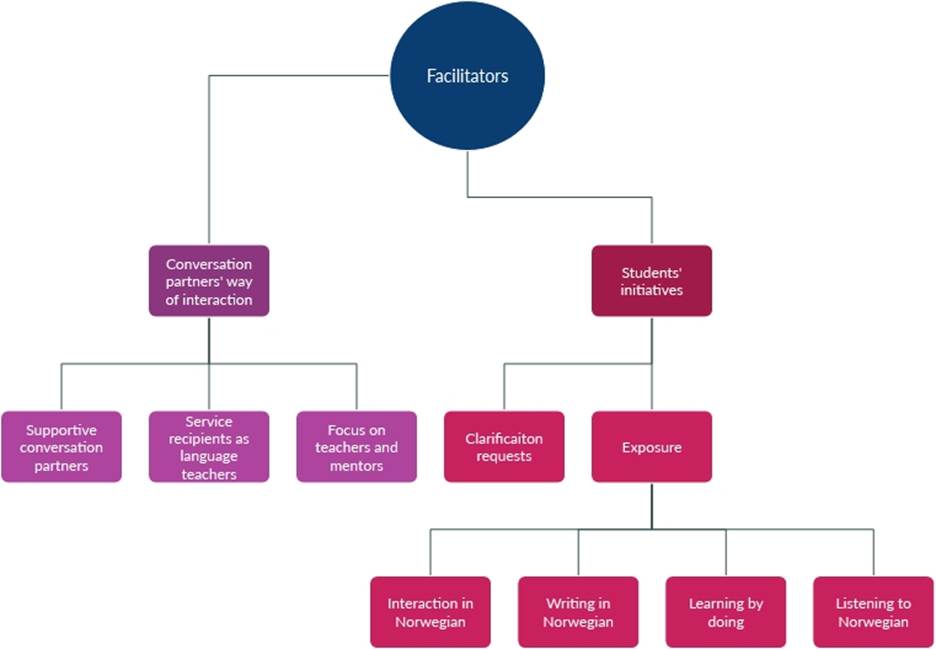
Facilitators compromise three pathways: (1) Conversation partners’ way of interaction; (2) Organisation of education; and (3) Students’ initiatives (Figure 1).
Conversation partners’ way of interaction
First, participants emphasize that supportive conversation partners in the workplace play an important role for their opportunities to learn Norwegian. Interlocutors who speak clearly with short sentences and show willingness to understand make workplace participation easier. Positive corrections and constructive feedback encourage further communication: “Some correct you. Some teach you new things. And that is so exciting. It is such a good feeling. Then you want to speak more and ask more. Even if you say something incorrectly, they correct you in a good way.” (HCW student, Phase 1). Another healthcare student similarly emphasized how supportive feedback provided safety and motivation: “They give me positive feedback. If I make mistakes, they say: "’It is okay. You are new.’ They help me. They give me support and motivation. I feel very safe when they talk like that.” (HCW student, Phase 2).
Second, participants highlight service recipients as language teachers, noting that interactions with children and elderly patients function as unique learning arenas. Students noted that children reduce communicative stress and aid pronunciation: “I learned from the children. Especially pronunciation” (CYC student, Phase 1). In healthcare, participants describe learning as occurring through shared activities—solving crosswords, reading newspapers, and singing songs—positioning elderly patients as supportive partners offering slow speech and rich vocabulary. However, it was also noted that specific language use among service recipients can also present barriers to learning (se section about barriers).
Finally, participants experience the focus on teachers and mentors as particularly helpful since they are described as skilled facilitators who actively adapt their communication to learners' needs. Unlike other conversation partners who may not adjust their speech, participants perceive educators as having the specific competence required. They speak clearly and slowly to ensure comprehension. As one student explained: “So they take us into consideration—how we speak, what level we are at. So, they speak exactly as we need” (CYC student, Phase 2). Participants view the educator as a reliable model for correct and accessible language. These experiences illustrate a sharp distinction between everyday social interactions and structured environments where communication is purposefully adjusted to facilitate vocational development. Overall, participants' accounts suggest that access to language learning depends not merely on exposure to Norwegian, but on how interactions are actively shaped by others in the workplace.
Students’ initiatives
Participants describe engaging in various proactive initiatives to facilitate learning Norwegian. Two main pathways within this subtheme have been identified, namely seeking clarification through active communication and intentionally exposing themselves to different Norwegian contexts.
First, participants describe taking a proactive stance through clarification requests as an important initiative for navigating workplace settings. This reflects a conscious will to overcome shyness and linguistic barriers through the strategy of "opening the mouth"—asking questions, requesting repetitions, and seeking explanations. As one participant explained: “We ask what this word means. Can you repeat? We must ask. If we don’t ask, we can’t learn.” (HCW student, Phase 1). However, healthcare students emphasize that opportunities to take initiative are situational. In acute tasks or patient emergencies, asking questions or requesting clarification must be postponed, as immediate care takes precedence: “If it is acute, you cannot just ask what it means. You have to wait and observe first”. Furthermore, student experiences are not homogeneous; some report that fear and shyness due to language insecurity prevent them from taking a proactive stance (see Barriers section).
Second, participants strategically expose themselves to Norwegian for improving their language skills through interaction in Norwegian, writing in Norwegian, learning by doing and listening to Norwegian.
A majority of participants describes active interaction in Norwegian across different arenas of life as important for their language learning. Many participants report adopting strict rules of speaking Norwegian at school and at the workplace. They state that they do so even with peers who share their non-Norwegian linguistic resources to ensure social inclusion and learning
Participants report using writing in Norwegian as a conscious initiative for internalizing new vocabulary and professional concepts. Participants perceive the act of writing as an important strategy for remembering new concepts, noting that they "remember what [they] write and read" much better than through reading alone. For some participants who describe to not feel proficient in writing yet, using it as a learning tool serves a dual purpose: it helps them master professional content while simultaneously practicing and improving their written Norwegian.
Furthermore, participants highlight learning by doing hands-on workplace experiences as a key initiative for grasping professional terminology. In their accounts, participants express that theoretical concepts introduced at school became easier to understand once observed and applied in practical settings. For instance, participants noted that terms such as "confidentiality," "ergonomics," and "user participation" gain clearer contextual meaning when encountered during daily workplace tasks. As one student recalled, practical application helped anchor an unfamiliar professional term in her memory: “That situation stayed in my brain. I will never forget it. She asked me to get a rollator. I did not know what it was. But after I found out, I never forgot the word.” (HCW student, Phase 2). From the participants' perspectives, these accounts illustrate how workplace placements serve as meaningful arenas for contextualizing vocational vocabulary taught in the classroom.
Finally, participants describe listening to Norwegian through digital media as a deliberate initiative to improve their comprehension. Participants report actively using platforms like YouTube, news broadcasts, children’s TV, and social media for improving their Norwegian listening skills and exposing themselves to various Norwegian dialects to be able to understand their service recipient (author note: The Norwegian language consists of many different dialects and people typically remain speaking their dialect also when speaking to people with a different dialect or multilingual speakers). Taken together, these self-reported initiatives indicate that participants perceive themselves as active agents constructing their own learning opportunities.
Figure 1. Facilitators for vocational language learning according to vocational education students
Barriers
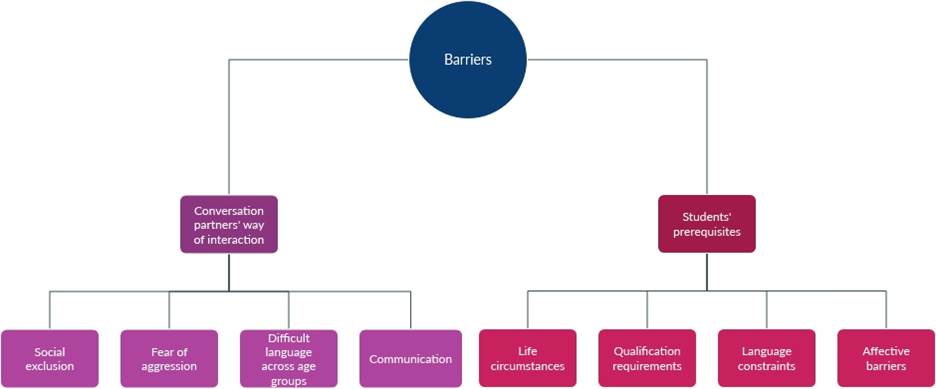
Participants describe three main barriers to vocational language learning in practice: (1) Conversation partners’ way of interaction; (2) Qualification requirements; and (3) Students’ prerequisites (Figure 2).
Conversation partners’ way of interaction
In contrast to their role as facilitators described previously, participants described conversation partners’ way of interaction as a potential barrier to vocational language learning. Specifically, participants identified four distinct hindrances: social exclusion, fear of aggression, difficult language across age groups, and communication (such as rapid speech).
First, participants highlight how social environment at placements can lead to social exclusion and feelings of being "invisible": “She didn't look at us. She didn't look us in the eyes. She didn't smile. It was as if we were invisible. It affected me a lot. One day when we were finished and took the metro home, I started crying. I wondered: ‘Is it because I am from [country]?’ Later, I began avoiding her too. I stopped smiling, saying hello, or greeting her in the morning.” (CYC student, Phase 1). Such exclusion was described as particularly acute in staff rooms during breaks, where private conversations left participants feeling isolated. Furthermore, participants encountered colleagues who pretend not to understand them: “Some ignore you. They pretend they do not understand you, even if you say it correctly. It is not a good feeling. For example, then you do not get the person to talk or say anything more. It does not mean that you do not know the language, but they ignore you.” (HCW student, Phase 1). Consequently, participants describe withdrawing from interaction when they experience social exclusion.
Second, participants express fear aggression triggered by communication mistakes. A participant in healthcare reports feeling unsafe or intimidated during interactions, noting that the fear of physically aggressive reaction may make engagement highly stressful.
Third, participants note that the language used by individuals at their practice place can be difficult to understand. They experience this across age groups. Some child and youth care students explain that they find children difficult to communicate with due to their use of slang and speaking English, which makes their speech less accessible. Similarly, some healthcare students point out that elderly may use "old" language that is challenging to understand. For a contrary experience – individuals students encounter acting as language teacher – see the section about facilitators.
Finally, participants identify fast speech rates as a communication barrier that restricts participation in workplace dialogue. As one student noted: “If they speak too fast, we can miss important information” (HCW student, Phase 2). Another student echoed this frustration: “Yes, and sometimes when I talk to Norwegians, because they speak very fast. So, then I don’t understand” (HCW student, Phase 1). Collectively, these findings highlight a central tension in the data: while workplace interaction offers essential learning opportunities, it can simultaneously restrict access to practice depending on how individual encounters unfold.
Students’ prerequisites
Participants describe several individual prerequisites that they experience as constraints on their language learning process. They note life circumstances, qualification requirements, language constraints and affective barriers as influencing factors.
First, under life circumstances, participants detail how competing familial and age-related realities obstruct their language learning. The data indicate that participants` daily domestic responsibilities—such as cooking, cleaning, and assisting children with homework—leave them with "only a little time" for dedicated study. This time constraint is further exacerbated by an ongoing cognitive burden. Participants who immigrated later in life noted that parental worries and structural adaptation "take up a lot of space in the head," leaving little remaining cognitive capacity to focus on learning, even when the student is highly motivated.
Second, participants mention that formal qualification requirements—both within educational curricula and workplace practice—frequently create significant linguistic barriers for them. Specifically, participants describe a demanding dual linguistic burden: mastering specialized, concrete professional jargon required on-site while simultaneously comprehending highly abstract, theoretical vocabulary mandated by the educational institution. For instance, institutional language concepts such as formal "competency goals" prove particularly challenging to decode. Consequently, participants report struggling to translate these complex theoretical frameworks into "their own words" when completing mandatory reflections, illustrating how institutional and professional language standards can restrict their ability to demonstrate their actual vocational understanding.
Third, participants feel their professional competence is sometimes locked inside due to language constraints. They report lacking the specific Norwegian words to express the knowledge they already possess. Students highlight for example a structural gap where they can comprehend textbook chapters but lack the linguistic flexibility to paraphrase or reflect on the material using their own Norwegian words.
Finally, participants report experiencing affective barriers, primarily characterized by shyness and a fear of evaluation. For child and youth care students, interacting with parents is perceived as significantly more intimidating than communicating with children. Participants describe a fear that linguistic mistakes might undermine their professional competence and erode parental trust. Participants highlight that this perceived intersection of language proficiency and professional legitimacy makes parental encounters emotionally demanding, often leading to interaction avoidance and increased emotional strain. While these affective constraints served as barriers for many, students note that these interactional experiences vary depending on interpersonal dynamics and their own initial confidence (with proactive engagement discussed further under Students' initiatives as a facilitator). As one child and youth care student reflected on this contrast: “I didn’t really have that much of a challenge with language, but my challenge was that I didn’t feel so secure communicating with the children’s parents. I was secure with the children. But the parents, I was afraid of them (laughs)” (CYC student, Phase 1).
Figure 2. Barriers for vocational language learning according to vocational education students
The role of the linguistic repertoire
Students describe that they deploy their linguistic repertoires as academic study strategies and professional care tools, though deployment remained subject to workplace rules. Two subthemes emerged in this theme: (1) Learning strategy; and (2) Workplace (see Figure 3 below).
Learning strategy
Participants described drawing on their full linguistic repertoire as a study tool to navigate vocational theory: “My mother tongue is protein for understanding the subject” (HCW student, Phase 2). This learning strategy relies on translation as a bridge for conceptual understanding. As one participant explained: “If I understand what a symptom or disease means in Norwegian, I check it in my first language and watch videos about it. Then it is easier to understand” (HCW student, Phase 2). Participants describe that this process involves checking symptoms or diseases in prior languages within their repertoire via videos or texts to better grasp the Norwegian equivalent. A common strategy described by participants is keeping bilingual notes, writing down professional terms in both Norwegian and another language from their repertoire to ensure the concepts "set in the brain." When Norwegian text is unclear, students report translating whole sentences to find the logical connection, rather than translating individual words word-by-word. However, participants also emphasized the difficulties associated with relying on their broader linguistic repertoire, expressing awareness that it is not a perfect bridge because languages do not always align seamlessly. Students point out that direct translations can present significant difficulties when a Norwegian word and its translated equivalent fail to match at a fundamental level, causing key professional concepts to change meaning during the translation process.
Practice place
Students report that their opportunities for using their broader linguistic repertoire at the practice place vary significantly, characterized by conditions of no opportunity, opportunity, and workplace rules.
First, several participants describe experiencing no opportunity to utilize their full linguistic repertoire, noting that they never met a patient or service recipient who shared elements of their non-Norwegian linguistic repertoire during their placement.
Conversely, when presented with an opportunity, others recount that drawing on shared linguistic resources serve as a vital tool for bridging communication gaps with vulnerable individuals, such as children and elderly patients. In these situations, participants describe acting as essential informal interpreters within clinical and pedagogical settings. In healthcare, participants explain how this involves translating a patient’s religious needs (like prayer) to a supervisor or identifying the source of a patient’s pain: ”I spoke [non-Norwegian language] with him. It was easier for us. What the patient is saying. He was in a lot of pain. Sometimes crying. When we spoke [non-Norwegian language], I told the staff what he was saying. How it makes it easier for him not to have pain. It was good for him.” (HCW student, Phase 1). Similarly, child and youth care participants observe that the presence of a staff member sharing a child's linguistic background creates an immediate sense of safety. One participant noted that a [country name] child who cried constantly became calm and playful once they could communicate in their shared language. Participants highlight that utilizing shared linguistic resources allows children to express basic daily needs—such as wanting to eat, play, or use the restroom—which they are not yet equipped to articulate in Norwegian, thereby fostering a supportive relational bond between the student and the child.
At the same time, participants describe navigating explicit and implicit workplace rules and expectations surrounding Norwegian language use. Participants acknowledge that speaking a language other than Norwegian in front of colleagues who do not understand it "does not look good" and can create suspicion or feelings of exclusion. Consequently, many students report strictly enforcing a personal rule of speaking only Norwegian at work to maintain professional standing. Participants’ accounts portray the deployment of the broader linguistic repertoire as a situational and relational resource rather than a stable or uniformly accepted aspect of vocational practice.
Figure 3. The
role of the linguistic repertoire for vocational language learning according to
vocational education students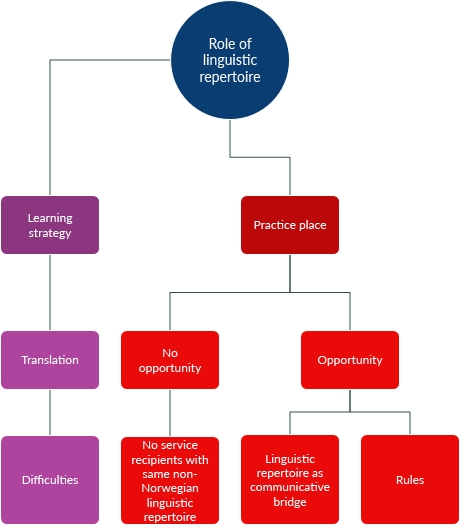
Discussion
This study examined how adult students with migrant background experience learning Norwegian through VET, focusing on their participation in practice-based learning situations. While participants reported using active strategies to improve their language skills across school and workplace settings, they perceived their learning opportunities as dependent on enabling and constraining conditions. Specifically, workplace inclusion, interpersonal co-construction, and translanguaging were highlighted as vital learning resources, while remaining vulnerable to situational, interactional, and structural constraints.
Workplace inclusion as a condition for learning
Participants directly linked language learning opportunities to their inclusion in work tasks and workplace interactions, supporting situated views of learning (Billett, 2001; Lave & Wenger, 1991). Language learning and vocational competence were described as closely intertwined, with authentic workplace settings serving as vital contexts for mastering professional terminology, supporting previous findings from Finland (Kärkkäinen et al., 2025) and Sweden (Sandwall, 2010). However, participants described access to these learning situations as uneven. Social exclusion—such as being made to feel "invisible" in staff break rooms or encountering colleagues who pretended not to understand them—are highlighted as restricting students' interactional participation. Our findings extend previous insight by documenting that informal social exclusion during workplace breaks functions as an equally critical barrier as exclusion during work tasks. Consequently, participants described that feeling socially excluded prompted withdrawal from social interaction, constraining opportunities for learning, mirroring how isolation restricts vocational participation in Finnish VET (Kärkkäinen et al., 2025). According to our participants, active workplace participation thus depended not only on student engagement, but on whether workplace interactions fostered inclusion or marginalization.
The dual nature of interpersonal co-construction
Participants experienced language learning as interactionally co-constructed (Goodwin, 2000), depending heavily on how interlocutors communicated with them. They note that different interlocutors created distinct conditions for participation. Teachers, mentors, and colleagues who adjusted their speech or offered "positive corrections" and constructive feedback are perceived as providing crucial support, confirming findings from Swedish research regarding the value positive feedback (Hållsten et al., 2022). Descriptions of educators who demonstrated linguistic awareness by adapting communication to learners' needs offer empirical support for recent European calls to integrate language-aware teaching strategies across vocational curricula in Sweden (Paul, 2023) and the Netherlands (Wildeman et al., 2023).
Participants experienced interactions with children and elderly patients as offering supportive, low-stress learning opportunities. According to them, activities like reading newspapers or singing traditional songs with elderly residents provided manageable communication speeds and rich cultural insights. However, fast-paced, acute healthcare settings were perceived as further limiting opportunities for clarification, forcing immediate action over learning. Our findings thus shed light on specific conversational settings, extending previous research by demonstrating that a fine-grained analysis of concrete workplace interactions is crucial for understanding which situations actively foster or hinder language learning.
Participation was experienced as constrained when interlocutors did not adapt their communication. Participants noted that colleagues who spoke rapidly or ignored students presented interactional barriers. This reflects structural exclusion documented across Nordic VET settings (Kärkkäinen et al., 2025; Sandwall, 2010). Service recipients were presented by participants with mixed dynamics: child and youth care students described struggling with children's slang and English, while healthcare students found the "old language" of elderly patients difficult to parse. The participants describe that this challenge is compounded by Norwegian regional dialects, echoing findings in Norwegian (Andreassen & Kjelaas, 2025) and Swiss VET where regional dialects create communicative strain for students (Meier & Styger, 2026). Overall, these accounts highlight interactionally shaped conditions for participation rather than individual linguistic deficits, framing language learning as a co-constructed process dependent on others' willingness to include the learner.
Translanguaging as a constrained resource
Aligning with translanguaging perspectives (Cummins, 2017; García & Wei, 2014), participants described drawing on their full linguistic repertoires as essential tool for understanding vocational content—characterizing prior linguistic resources, for instance, as "protein for understanding the subject." These individual learning strategies (e.g. keeping bilingual notes) closely align with translanguaging trajectories documented among students in Finland (Mustonen & Strömmer, 2024; Kärkkäinen et al., 2025) and Norway (Andreassen, 2024; Beiler & Dewilde, 2023; Kjelaas et al., 2025). Furthermore, multilingualism was experienced as a professional asset that fostered care, communication, and relational trust, such as calming a distressed child or clarifying an elderly patient's needs, providing further empirical evidence for Meier and Styger's (2026) observation in Swiss VET that multilingual skills may foster a positive workplace climate.
However, participants also noted that full linguistic deployment was frequently constrained by institutional rules and social expectations. Participants highlighted actively self-regulating their language use, recognizing that speaking languages other than Norwegian in front of monolingual colleagues risk triggering suspicion or social exclusion, echoing Meier and Styger’s (2026) findings in Switzerland. Such findings illustrate how macro-level educational and workplace ideologies by colleagues, teachers, mentors and educational systems that frame multilingualism as a deficit or barrier (Alisaari et al., 2023; Beiler & Dewilde, 2020; Meier & Styger, 2026) translate into micro-level interactional self-censorship and language choices at work. Consequently, students described adhering to target-language rules to project professionalism, reflecting broader European educational tendencies to view multilingualism as a problem rather than a resource (Alisaari et al., 2023). Thus, while translanguaging was valued as a resource for learning and care, its use remained constrained by workplace norms according to the participants.
Implications for practice and policy
Participants' accounts demonstrate that language learning is situated, interactionally co-constructed, and socially regulated. Although emerging from Norway, these findings address core challenges—such as interactional workplace barriers and the need for language-aware mentorship—that resonate across European adult VET systems (Kärkkäinen et al., 2025; Wildeman et al., 2023).
First, at the systemic level, VET frameworks would benefit from explicitly legitimizing translanguaging practices as part of vocational competence. Reconciling monolingual workplace norms with multilingual realities offers valuable insights for international VET policies. In practice, this could involve integrating language assistants or bilingual helpers to support students' linguistic resources and foster inclusive learning spaces (Wik & De Korne, 2025).
Second, educational institutions should promote broader vocational language-learning strategies for all students. Initiatives could explicitly highlight supportive interactional practices, such as student clarification requests, mentor positive feedback, and adapted communication.
Finally, targeted support should extend to both schools and workplaces. For VET educators, professional development in Norwegian as an L2 can build awareness of how language learning is co-constructed and how multilingualism serves as a resource (Andersen, 2024). Concurrently, workplace placement sites should provide systematic training for supervisors and colleagues on supportive communication and active strategies for including students with migrant background in workplace interaction.
Conclusion
This study demonstrates how language learning in VET is experienced as being shaped by social and interactional organization. First, participants’ accounts indicate that opportunities for language learning are not a neutral outcome of workplace presence but depend on a student’s perceived workplace context. Second, vocational language learning was described as an interactionally co-constructed process that depended on others’ willingness and communicative practices to include them in interaction. Finally, students’ multilingual repertoires were experienced as important resources for both learning and professional practice but were also described as socially regulated and situationally constrained. Taken together, participants’ accounts illustrate that the everyday challenges experienced by adult VET students in Norway reflect broader international dynamics surrounding workplace inclusion, language policy, and migrant integration. Overall, the study highlights participants' experiences of vocational language learning as a situated, co-constructed process, shaped by interactional practices and institutional conditions rather than individual learner characteristics.
Acknowledgements
The authors would like to acknowledge the support of the school leadership teams and vocational teachers in facilitating access to informants for this study. We are especially grateful to the students who took part in the interviews and generously shared their experiences and reflections. Their contributions have been essential to this research.
References
Alisaari, J., Møller Daugaard, L., Dewilde, J., Harju-Autti, R., Heikkola, L. M., Iversen, J. Y., Kekki, N., Pesonen, S., Reath Warren, A., Straszer, B., & Yli-Jokipii, M. (2023). Mother tongue education in four Nordic countries—Problem, right or resource? Apples - Journal of Applied Language Studies, 17(2). https://doi.org/10.47862/apples.113671
Andersen, M. J. W. (2024). Vocational teachers as policy actors: “Multilingualism as a resource” in Norwegian vocational education. Apples - Journal of Applied Language Studies, 18(1), 135–157. https://doi.org/10.47862/apples.136338
Andersen, T. (2021). Språkkompetanse hos voksne innvandrere i helsefagarbeiderutdanningen. Skandinavisk Tidsskrift for Yrker Og Profesjoner I Utvikling, 6(1). https://doi.org/10.7577/sjvd.4526
Andersen, T. (2025). Utvikling av språk- og fagkompetanse hos voksne innvandrere i helsefagarbeiderutdanningen: Erfaringer fra aksjonsforskning i videregående skole. In A. L. Sylte, E. B. Hellne-Halvorsen, H. Hiim, & N. Aakernes (Eds.), Profesjonsrelevant lærerutdanning i samarbeid med praksisfeltet (s. 167–195). Cappelen Damm Akademisk. https://doi.org/10.23865/cdf.267.ch7
Andreassen, U. S. (2024). “We don’t have it in my mother tongue”: A newly arrived student’s stance towards using his first language in the transition from introduction class to technical VET. Apples - Journal of Applied Language Studies, 18(1). https://doi.org/10.47862/apples.136167
Andreassen, U. S., & Kjelaas, I. (2025). Teachers’ dialect use and the newly arrived learner in a technical VET programme in Norway. Nordic Journal of Vocational Education and Training, 15(2), 23–52. https://doi.org/10.3384/njvet.2242-458X.2515223
Asghari, H. (2025). Newly arrived women’s educational and professional choices. Vocations and Learning, 18(1), 1–22. https://doi.org/10.1007/s12186-025-09356-7
Asghari, H. (2026). Vocational education and integration: A life course perspective on immigrants in the Swedish labour market. In M. Wanke & M. Pogorzelska (Eds.), Intercultural encounters in complex societies: Connecting people across super-diversities (pp. 35–51). Springer Nature Switzerland AG. https://doi.org/10.1007/978-3-032-17707-0_3
Asghari, H., & Stiklestad, S. S. (2026). Å tre frem og bli anerkjent: Migranters fortellinger om utdanningsoverganger i svensk og norsk yrkesopplæring. Skandinavisk Tidsskrift for Yrker Og Profesjoner I Utvikling, 11(1), 23–43. https://doi.org/10.7577/sjvd.6450
Beiler, I. R., & Dewilde, J. (2020). Translation as Translingual Writing Practice in English as an Additional Language. The Modern Language Journal, 104(3), 533–549. https://doi.org/10.1111/modl.12660
Beiler, I. R., & Dewilde, J. (2023). Pedagogical translanguaging in adult basic education. LESLLA Symposium Proceedings, 17(1), 5–21.
Billett, S. (2001). Learning in the workplace: Strategies for effective practice. Allen & Unwin.
Blixen, T. B., & Hellne-Halvorsen, E. B. (2022). All teachers are language teachers: A Norwegian study on how teachers in vocational education and training programs experience and reflect on complementary literacy practices and didactic strategies in multicultural classrooms. In L. M. Herrera, M. Teräs, P. Gougoulakis, & J. Kontio (Eds.), Migration and inclusion in work life: The role of VET (pp. 307–341). Bokförlaget Atlas.
Brouwer, C. E., & Wagner, J. (2004). Developmental issues in second language conversation. Journal of Applied Linguistics, 1(1), 29–47. https://doi.org/10.1558/japl.v1.i1.29
Clarke, V., & Braun, V. (2022). Thematic analysis: A practical guide. SAGE Publications Ltd.
Cummins, J. (2017). Teaching for transfer in multilingual school contexts. Bilingual and Multilingual Education, 3, 103–115.
Direktoratet for høyere utdanning og kompetanse. (2021). Læreplan i norsk for voksne innvandrere – Nivå A1–B2 [Curriculum in Norwegian for adult immigrants – Levels A1–B2]. https://hkdir.no/dokumenter/laereplan-i-norsk-for-voksne-innvandrere
Education Act. (2023). Act relating to Primary and Secondary Education and Training (the Education Act) (LOV-2023-06-09-30). Lovdata. https://lovdata.no/dokument/NL/lov/2023-06-09-30
Fereday, J., & Muir-Cochrane, E. (2006). Demonstrating Rigor Using Thematic Analysis: A Hybrid Approach of Inductive and Deductive Coding and Theme Development. International Journal of Qualitative Methods, 5(1), 80–92. https://doi.org/10.1177/160940690600500107
Finlay, L. (2002). “Outing” the researcher: The provenance, process, and practice of reflexivity. Qualitative Health Research, 12(4), 531–545. https://doi.org/10.1177/104973202129120052
Firth, A., & Wagner, J. (1997). On Discourse, Communication, and (Some) Fundamental Concepts in SLA Research. The Modern Language Journal, 81(3), 285–300. https://doi.org/10.1111/j.1540-4781.1997.tb05480.x
Firth, A., & Wagner, J. (2007). Second/Foreign Language Learning as a Social Accomplishment: Elaborations on a Reconceptualized SLA. The Modern Language Journal, 91(s1), 800–819. https://doi.org/10.1111/j.1540-4781.2007.00670.x
Flubacher, M.-C., & Yeung, S. (2016). Discourses of integration: Language, skills, and the politics of difference. Multilingua, 35(6). https://doi.org/10.1515/multi-2015-0076
García, O., & Wei, L. (2014). Translanguaging: Language, bilingualism and education. Palgrave Macmillan.
Goodwin, C. (2000). Action and embodiment within situated human interaction. Journal of Pragmatics, 32(10), 1489–1522.
Hiim, H. (2017). Ensuring curriculum relevance in vocational education and training: Epistemological perspectives in a curriculum research project. International Journal for Research in Vocational Education and Training, 4(1), 1-19. https://doi.org/10.13152/IJRVET.4.1.1
Hållsten, S., Eklund Heinonen, M., & Söderlundh, H. (2022). Individualization in vocational training for immigrants: Developing professionalism and language through feedback. In L. M. Herrera, M. Teräs, P. Gougoulakis, & J. Kontio (Eds.), Migration and inclusion in work life: The role of VET (pp. 267–306). Atlas.
Hellne-Halvorsen, E. B. (2019). To kontekster - to skrivepraksiser? Skriving i skole og bedrift i fag- og yrkesopplæringen: [Two contexts – two writing practices? Writing in school and enterprises of Technical and Vocational Education and Training]. Nordic Journal of Vocational Education and Training, 9(1), 43–65. https://doi.org/10.3384/njvet.2242-458X.199143
Kärkkäinen, K., Virolainen, M. H., Virtanen, A., & Tynjälä, P. (2025). Work-Based Learning in Migrant Education: The Case of Finnish Vocational Education. Social Sciences, 14(5). https://doi.org/10.3390/socsci14050275
Kjelaas, I., Brekke, A. L., Theodorsen, H., Price, K. S., & Andreassen, U. S. (2025). Transspråking på yrkesfag: En nøkkel til elevens kompetanse: [Translanguaging in vocational programmes: A key to the student’s competence]. Nordic Journal of Vocational Education and Training, 15(5), 140–163. https://doi.org/10.3384/njvet.2242-458X.25155140
Lave, J., & Wenger, E. (1991). Situated learning: Legitimate peripheral participation. Cambridge University press.
Lumivero. (2024). NVivo qualitative data analysis software (Version 14) [Computer software]. Lumivero. https://lumivero.com/
Malterud, K. (2011). Kvalitative metoder i medisinsk forskning: En innføring (3. utg.). Universitetsforlaget.
Meld. St. 21 (2020–2021). Fullføringsreformen – med åpne dører til verden og fremtiden. Kunnskapsdepartementet. https://www.regjeringen.no/no/dokumenter/meld.-st.-21-20202021/id2840771/
Meier, G., & Styger, E. (2026). Language socialisation in vocational education and training (VET): New directions for language education. Research Papers in Education, 41(2), 236–268. https://doi.org/10.1080/02671522.2025.2571972
Mustonen, S., & Strömmer, M. (2024). Becoming a multilingual health professional in vocational education—Two adult migrants’ translanguaging trajectories. Journal of Multilingual and Multicultural Development, 45(9), 3678–3693. https://doi.org/10.1080/01434632.2022.2116451
NAV. (2026). NAVs bedriftsundersøkelse 2026: Vedvarende mangel på helsepersonell (NAV-rapport 2026:2). Arbeids- og velferdsdirektoratet. https://doi.org/10.60847/NAV.6225
Norwegian Directorate for Education and Training. (2020). Norwegian vocational education and training (VET). https://www.udir.no/in-english/norwegian-vocational-education-and-training/
OECD. (2025). Education at a Glance 2025: OECD Indicators. OECD Publishing. https://doi.org/10.1787/1c0d9c79-en
Pájaro, V. (2022). Scripts and texts as technologies of refugee governmentality in the Norwegian introduction programme. In M. Monsen & G. B. Steinen (Eds.), Language learning and forced migration (pp. 49–69). Multilingual Matters. https://doi.org/10.21832/9781800412262-007
Paul, E. (2023). ‘The wrong’ kind of students or ‘Santa’s workshop’? Teaching practices for newly arrived migrant students in Swedish upper secondary VET. Vocations and Learning, 16(1), 157–177. https://doi.org/10.1007/s12186-023-09313-2
Prop. 89 L (2019–2020). Lov om integrering gjennom opplæring, utdanning og arbeid (integreringsloven). Arbeids‑ og inkluderingsdepartementet. https://www.regjeringen.no/no/dokumenter/prop.-89-l-20192020/id2699012/
Sandwall, K. (2010). “I Learn More at School”: A Critical Perspective on Workplace‐Related Second Language Learning In and Out of School. TESOL Quarterly, 44(3), 542–574. https://doi.org/10.5054/tq.2010.229270
Stiklestad, S. S., & Monrad-Krohn, M. B. (2025). Elever med minoritetsbakgrunn i voksenopplæringen i helsearbeiderfaget: Yrkesdidaktikk i møte med elevenes læreforutsetninger relatert til faget yrkesfaglig fordypning. Skandinavisk Tidsskrift for Yrker Og Profesjoner I Utvikling, 10(1), 62–81. https://doi.org/10.7577/sjvd.6257
Tjora, A. (2021). Kvalitative forskningsmetoder i praksis (4. utg.). Gyldendal.
University of Oslo. (n.d.) Autotekst. https://autotekst.uio.no/en
Urry, K., Chur-Hansen, A., & Scholz, B. (2024). From member checking to collaborative reflection: A novel way to use a familiar method for engaging participants in qualitative research. Qualitative Research in Psychology, 21(3), 357–374. https://doi.org/10.1080/14780887.2024.2355972
Utdanningsdirektoratet. (2020). Yrkesfaglig fordypning for de yrkesfaglige utdanningsprogrammene (UFF) [Vocational specialization for vocational education programmes]. https://www.udir.no/utdanningslopet/videregaende-opplaring/felles-for-fagopplaringen/yrkesfagleg-fordjuping/yrkesfaglig-fordypning-for-de-yrkesfaglige-utdanningsprogrammene-yff/
Utdanningsdirektoratet. (2021a). Læreplan i Vg2 barne- og ungdomsarbeiderfaget (BUA02-03) [Curriculum for Vg2 Child and Youth Care]. https://data.udir.no/kl06/v201906/laereplaner-lk20/BUA02-03.pdf?lang=nob
Utdanningsdirektoratet. (2021b). Læreplan i Vg2 helsearbeiderfag (HEA02-04) [Curriculum for Vg2 Healthcare Worker]. https://data.udir.no/kl06/v201906/laereplaner-lk20/HEA02-04.pdf?lang=nob
Utdanningsdirektoratet. (2024). Læreplan i helsearbeiderfaget – modulstrukturert opplæring for voksen (HEA05-01) [Curriculum in healthcare work for modularized adult education]. https://www.udir.no/lk20/hea05-01?lang=nob
Utdanningsdirektoratet. (2025). Læreplan i norsk for språklige minoriteter med kort botid I Norge – videregående opplæring (NOR09-05) [Curriculum in Norwegian for linguistic minorities with a short period of residence in Norway – upper secondary education].https://www.udir.no/lk20/NOR09-05
Utdanningsdirektoratet. (2026). Modulstrukturert opplæring for voksne i videregående [Modularized training for adults in upper secondary education]. https://www.udir.no/laring-og-trivsel/lareplanverket/modulstrukturert/
Wik, J.-M., & De Korne, H. (2025). Læreres og språkhjelperes erfaringer med flerspråklig undervisningspraksis i voksenopplæringen: Utfordringer og muligheter. NOA-Norsk Som Andrespråk, 41(1). https://doi.org/10.52145/noa.v41i1.2459
Wildeman, E., Koopman, M., & Beijaard, D. (2023). Content and language integrated learning in technical vocational education: Teachers’ practical knowledge and teaching behaviour. Journal of Vocational Education & Training, 75(3), 479–500. https://doi.org/10.1080/13636820.2021.1899269
 ©2026
Helene Killmer, Sigrun Saur Stiklestad. This is an Open Access article
distributed under the terms of the Creative Commons Attribution 4.0
International License (http://creativecommons.org/licenses/by/4.0/), allowing
third parties to copy and redistribute the material in any medium or format and
to remix, transform, and build upon the material for any purpose, even
commercially, provided the original work is properly cited and states its
license.