Vol 10, No 3 (2026)
https://doi.org/10.7577/njcie.6788
Article
Evidence under fire: What studies of gamification in Ukrainian higher education can and cannot show — a systematic review (2015–2025)
Oleksii Dotsenko
V. N. Karazin Kharkiv National University
Email: dotsenko@karazin.ua
Abstract
This systematic review examines what research on gamification in Ukrainian higher education shows about students' academic achievement, and what its designs and reporting allow a reader to conclude. Following PRISMA 2020, eight databases were searched for studies published in English or Ukrainian in 2015–2025; after peer review, excluded records were re-screened and citation searching was added. Effects were synthesised by vote counting of effect directions, and risk of bias was appraised with an adapted Mixed Methods Appraisal Tool. Forty-eight studies met the criteria; although the search covered 2015–2025, the earliest was published in 2017, and 42 appeared from 2020 onward, during the COVID-19 pandemic and the full-scale war. None was randomised and none was at low risk of bias. Of 30 studies measuring achievement, 29 reported a positive direction of effect and one a mixed result. Only 12 reported a significance test, and a standardised between-group effect could be computed for five; the four unconfounded estimates ranged from g = 0.50 to 0.77. Eleven of the 12 tests were significant, against about seven expected at the effect size reported by international meta-analyses, and the one non-significant result was reported alongside a conclusion that the intervention worked. Sensitivity analyses showed that the scarcity of null results was not produced by the review's selection rules. The direction of the evidence is favourable; its certainty is very low. Three descriptive measures — the share of studies from which an effect can be computed, the strongest design present and the share of null results — summarise what the corpus can support; their values were similar before and after February 2022. For comparative and international education, the review shows how such measures can inform decisions to draw on evidence from partner systems or to build research capacity with them.
Keywords: meta-research, reporting quality, publication bias, academic achievement, war
Introduction
Gamification — the use of game-design elements in non-game contexts (Deterding et al., 2011) — is widely used in higher education to raise engagement and, it is claimed, learning (Hamari et al., 2014). Meta-analyses of the international literature report small to moderate positive effects on cognitive learning outcomes, with considerable heterogeneity and variable study quality (Bai et al., 2020; Sailer & Homner, 2020). This review synthesises the empirical studies of gamification with students of Ukrainian higher-education institutions (HEIs) published in 2015–2025. It has two aims: to establish what these studies show about effects on academic achievement, and to describe what their designs and reporting allow a reader to conclude from them. It contributes the first systematic synthesis of this national literature and a worked example of three descriptive measures, computable from any completed review, that summarise how far a body of studies can support conclusions about effects.
The second aim does not depend on what the review found. A synthesis of one country's studies of a widely studied intervention is unlikely to change international estimates of its effect, whichever direction its results take, because those estimates already combine controlled studies from many systems. What a national synthesis can add is an account of the evidence as a particular system produces it — the designs used, what is reported, what can be extracted — and that account is informative whether the studies prove strong or weak. The review protocol specified only the first aim. The three measures were defined after data extraction; they rest on items the protocol already required to be extracted (design, reported statistics and direction of effect) and are reported as descriptive analyses rather than as pre-specified outcomes (Section 2.8).
Ukrainian higher education and research since 2020
The review period includes two shocks to Ukrainian higher education. The shift to emergency remote teaching during the COVID-19 pandemic (Hodges et al., 2020) created pressure to find digital formats that could hold students' attention at a distance. The full-scale invasion of February 2022 added air-raid interruptions, damage to campuses and the displacement of staff and students. Berdyansk State Pedagogical University, in occupied territory, was relocated and moved its teaching online (Tsybuliak et al., 2023); among 172 of its lecturers surveyed, 40.8% of those who had left the occupied area reported that their research had become less effective (Suchikova et al., 2023); almost all students and staff surveyed in four universities in May 2022 reported a deterioration of their psycho-emotional state (Kurapov et al., 2023); and teaching continued under wartime conditions (Lavrysh et al., 2025). Nationally, papers by Ukrainian scientists declined by about 10%, and 22% of leading universities suffered destruction of physical capital (Ganguli & Waldinger, 2023).
The conditions of publication matter as well. Publication requirements for academic degrees and titles, which count papers in Scopus-indexed journals, have been followed by a steep rise in the Scopus output of Ukrainian academics since 2011, much of it in local journals (Hladchenko, 2022), and papers in titles later discontinued from Scopus continue to count in academic evaluation (Nazarovets, 2022). Instructors therefore had strong reasons to evaluate new digital formats and to publish the evaluations, and limited means to evaluate them rigorously. Research on education in emergencies has noted the methodological fragility of evidence generated in crisis-affected systems (Burde et al., 2017). Whether such conditions leave a trace in specific literature is an empirical question that this review can address only descriptively.
Relevance for comparative and international education
Comparative education has long treated the production of educational knowledge as shaped by the conditions in which it takes place (Crossley & Watson, 2003) and has documented asymmetries in whose findings enter international evidence and on what terms (Collyer, 2018). These concerns are practical for Nordic and other systems that host displaced Ukrainian students and researchers, fund partnerships with Ukrainian universities and draw on evidence from partner systems when borrowing policy (Steiner-Khamsi, 2004). A reader weighing a partner system's evidence needs to know not only how much has been published but how much of it can be synthesised. The measures in this review are proposed for that purpose. We make no claim about how the literature of other countries compares; the measures are defined so that such comparisons can be made from existing reviews.
Three measures and their antecedents
None of the three measures is new as an idea. Each adapts an established approach from meta-research or evidence synthesis; the contribution lies in reporting them together, at the level of the corpus, as a routine part of a review.
The extractability rate is the share of studies from which a standardised effect can be computed. Reviews routinely report how many studies could be pooled, and reporting standards specify the statistics that make pooling possible (Appelbaum et al., 2018). The rate turns that count into a descriptor of the literature rather than of the review.
The design ceiling is the strongest design present in the corpus. It condenses the starting point of the GRADE approach, in which the certainty of a body of evidence begins from the designs of its studies (Guyatt et al., 2008). Design matters for interpretation because, in education, quasi-experiments, small samples and researcher-made measures yield systematically larger effects than randomised, large-scale studies with independent measures (Cheung & Slavin, 2016).
The null-result share is the proportion of studies whose results do not support a benefit. It adapts Fanelli's (2010; 2012) proportion of papers reporting support for their hypothesis — which varies between disciplines and countries and has risen over time — to the corpus of a single review and is complemented here by a test for an excess of significant findings (Ioannidis & Trikalinos, 2007).
Review questions
The pre-specified question (RQ1) was whether, among students of Ukrainian HEIs, gamification is associated with higher academic achievement than non-gamified instruction, and how consistent the reported effect is across disciplines and designs. In PICOS terms: students of Ukrainian HEIs (P); any gamification or game-based learning intervention (I); non-gamified instruction, a baseline or none (C); academic achievement as the primary outcome and engagement, motivation or attitudes as secondary outcomes (O); any empirical design (S). The second question (RQ2), added after extraction, asks what the extractability rate, design ceiling and null-result share show about the conclusions this literature can support.
Methods
The review is reported according to PRISMA 2020 (Page et al., 2021) and the synthesis according to the Synthesis Without Meta-analysis (SWiM) guideline (Campbell et al., 2020).
Protocol and amendments
The protocol was fixed before screening but not registered; it is deposited with the supplementary materials. Four amendments are reported. First, the information sources were expanded during the review from OpenAlex, PubMed and arXiv to eight databases (Section 2.3). Second, the protocol excluded studies without an achievement outcome; during screening, empirical evaluations reporting only engagement, motivation or attitudes were also admitted. This change was not recorded at the time; these studies are analysed separately and do not enter the achievement synthesis. Third, the protocol specified one round of backward and forward citation searching, which was not carried out before the first submission of this article and was carried out during revision (Section 2.4). Fourth, the three measures (Section 2.8) were added after data extraction, and the sensitivity analyses (Section 2.9) in response to peer review.
Eligibility criteria
Studies were eligible if they reported data collected by the authors from students of a Ukrainian HEI about a gamification or game-based learning intervention used in their studies, were published in 2015–2025 and were written in English or Ukrainian. Studies were excluded if they were conceptual, descriptive or review articles without their own data; if the participants were not higher-education students (for example, school pupils, applicants or staff only); if the setting could not be confirmed as a Ukrainian HEI; or if the intervention was not gamification or game-based learning. The publication year is the year of first publication, including online-first publication.
Information sources and search
OpenAlex (seven Boolean strings in English and Ukrainian, plus a pass restricted to authors affiliated with Ukrainian institutions) and PubMed were searched first; DOAJ, CORE and Semantic Scholar were added to cover open-access and repository-indexed venues; and Scopus, ERIC and the Open Ukrainian Citation Index (OUCI) were added to cover subscription-indexed and Ukrainian national literature. arXiv was queried but yielded no on-topic record. The strings combined three concept blocks — gamification, higher education and students, and Ukraine — and the searches were run in July 2026 (Scopus, ERIC and OUCI on 7 July). Web of Science was not accessible to the author when the searches were run. Google Scholar was not used, because its searches cannot be reproduced and it displays at most 1,000 results per query (Gusenbauer & Haddaway, 2020); OUCI and the citation searching in OpenAlex (Section 2.4) were used instead to reach Ukrainian journals. Full strings are given in the supplementary search-strategy file.
Citation searching
During revision, the references of all 39 reports included through the database route (backward) and the works citing them (forward) were retrieved from OpenAlex in September 2026. After removal of records already screened and records outside 2015–2025, records whose titles and abstracts contained no game-related term, or no link to Ukraine by term, author country or affiliation, were removed automatically. The remaining records were screened at title and abstract and, where retained, assessed in full against the criteria in Section 2.2.
Selection process and tools
Records were retrieved and deduplicated (by DOI, then by normalised title) with Python scripts written for the review. Screening decisions, reasons and extracted data were recorded in a structured spreadsheet log (supplementary workbook); no dedicated screening platform was used. The author screened titles and abstracts and assessed full texts. The 77 records of the eligibility pool were also screened independently by a large language model (Claude, Anthropic) given an independently worded rubric; agreement between the author's and the model's binary advance/exclude decisions was calculated as Cohen's κ, and the author resolved disagreements against the protocol, defaulting to exclusion where empirical status or setting could not be confirmed. Where an indexing source withheld the abstract, the full text was retrieved before a decision.
To test whether the null-result share depended on the selection rules (Section 2.9), every excluded record concerning games or gamification with any link to Ukraine was re-read after peer review (187 records). This showed that the title and abstract screen had excluded eligible studies, most often because their abstracts did not name the country, and that four eligibility decisions had been taken without the abstract or inconsistently with the protocol. Thirty full texts were assessed against the criteria in Section 2.2; 17 studies (18 reports) were added, and one previously included survey of lecturers without student data or an intervention was removed. Each excluded report was assigned one primary reason.
Data extraction and effect sizes
For each study we extracted the institution and region, discipline, sample size, design, gamification tools and mechanics, duration, outcome measures, reported results, direction of effect, whether an achievement outcome was measured, and whether statistics were reported. Where means, standard deviations and group sizes, or individual scores, were reported for two groups, Hedges' g and its 95% confidence interval were computed; where only a 2 × 2 table of attainment levels was reported, the log odds ratio was converted to a standardised difference (Chinn, 2000).
Risk of bias
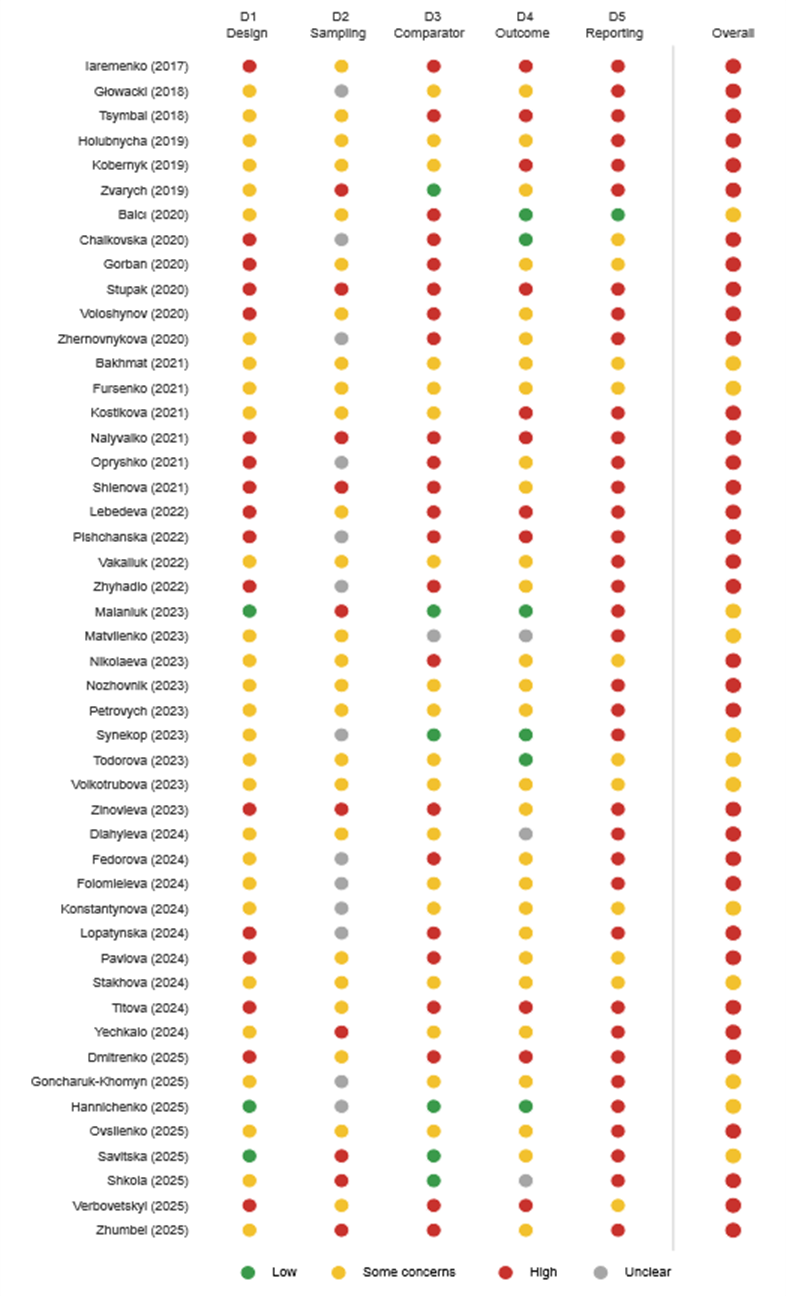
Risk of bias was appraised on five domains adapted from the Mixed Methods Appraisal Tool (Hong et al., 2018): design appropriateness, sampling, comparator, objectivity of outcome measurement and completeness of reporting. Each domain and an overall judgement were rated as low risk, some concerns, high risk or unclear.
Synthesis and the three measures
Because most studies did not report the statistics needed for pooling, no meta-analysis was performed. Effects on achievement were synthesised by vote counting based on the direction of effect, with a harvest plot by discipline; computed effect sizes are tabulated but not pooled. One scheme is used throughout for the direction of effect on achievement: positive (all reported achievement comparisons favour gamification), mixed (some do and some do not), null (no difference) or negative (the comparison favours non-gamified instruction). Direction is coded from the reported values regardless of statistical significance; whether a significance test was reported, and its result, are coded separately.
The three measures are defined as follows:
extractability rate: the proportion of studies with an achievement outcome from which a standardised between-group effect and its confidence interval can be computed from the reported statistics (the proportion reporting any statistics is given for comparison);
design ceiling: the strongest design in the corpus on the ordering randomised trial, quasi-experiment with a concurrent control group, historical control, single-group pre–post design, and survey, case study or descriptive report;
null-result share: the proportion of studies with an achievement outcome whose result does not support a benefit, that is, a null or negative direction or a difference reported as not statistically significant.
Sensitivity analyses
The null-result share was examined in three ways. Selection: each excluded record that a relaxed version of one selection rule would readmit (outcome and evaluation rules, setting, population, publication window, descriptive reports, records without outcome data) was coded for direction of effect, and the share was recomputed with these records readmitted, rule by rule and all together. Definition: the share was recomputed by direction only, with mixed results counted as containing a null, across all outcomes, and at the level of outcomes rather than studies. Expectation: for the achievement studies with a comparison group, the numbers of negative directions and non-significant results expected from sampling variation alone were computed for true effects of g = 0.25, 0.36 and 0.49 — the behavioural, motivational and cognitive estimates of Sailer and Homner (2020) — and 15–45 students per group. The number of significant results among studies reporting a test was compared with the number expected from their power, following Ioannidis and Trikalinos (2007), with the probability of the observed number taken from the Poisson-binomial distribution. Code and coding are supplementary files.
Use of artificial intelligence
Generative AI tools (Claude, Anthropic; Claude Opus 4.8, Claude Fable 5, Claude Opus 5 and Claude Opus 5.5, used through the Claude desktop application and Claude Code between July and September 2026) were used under the author's supervision for programmatic database querying, citation searching and deduplication, an independent second screen of the 77 records of the eligibility pool (Section 2.5), preparation of the screening and extraction tables, the computations described in Sections 2.6 and 2.9, generation of figures and language editing. All eligibility decisions, risk-of-bias judgements and interpretations were made or verified by the author, who takes full responsibility for the content. AI tools are not listed as authors.
Results
Study selection
Figure 1 shows the selection process. The database searches identified 1,204 records (OpenAlex 703; PubMed 2; DOAJ, CORE and Semantic Scholar 385; Scopus, ERIC and OUCI 114). After removal of 599 duplicates, 605 records were screened, 405 were excluded at title and abstract, and 200 reports were assessed in full. Of these, 161 were excluded: 107 contained no empirical evaluation of a gamification intervention, 24 did not concern gamification or game-based learning, 17 did not involve higher-education students, 10 had a setting that could not be confirmed as a Ukrainian HEI, two were published outside 2015–2025, and one reported no outcome data. The database route yielded 38 studies in 39 reports; one study was published twice with the same results (Tsymbal, 2018; 2019). Citation searching identified 1,080 further records, of which 62 were screened and 17 assessed in full; 10 studies were included, none of which had been retrieved by the database searches. The review includes 48 studies in 49 reports.
Figure 1. PRISMA 2020 flow of study selection through database searching and citation searching, including the post-review re-screen
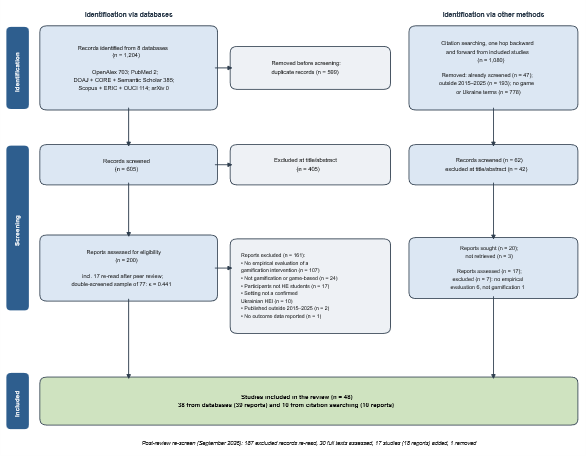
On the 77 double-screened records, agreement between the author and the language model was κ = 0.441, moderate on the Landis and Koch (1977) scale. Disagreements concentrated in records whose abstracts did not state whether data had been collected from students or whether the setting was a Ukrainian HEI, which the two rubrics resolved differently. The re-screen and the citation searching confirm that this literature cannot be screened reliably from titles and abstracts: together they contributed 27 of the 48 included studies.
The excluded randomised study
One record, indexed as a randomised trial with 308 undergraduates (Rui & Wei, 2025), was excluded at full text on two grounds. Its setting could not be confirmed as a Ukrainian HEI: both authors list a Chinese institution first and a Ukrainian one second, the corresponding addresses are Chinese, and the report does not state where participants were recruited. And its outcomes — motor coordination, attention and memory — are neither achievement outcomes nor the review's secondary outcomes.
Study characteristics
The 48 studies were published in 2017–2025 (Figure 2): no eligible study appeared in 2015–2016, 42 were published from 2020 onward and 30 from 2022 onward. Forty-four were written in English and four in Ukrainian. Foreign-language teaching was the largest field (20 studies), followed by teacher education (10), IT and engineering (4), management (4), multidisciplinary samples (4), arts and humanities (3), library science (2) and dentistry (1). The designs were quasi-experiments with a concurrent control group (24), a quasi-experiment with a historical control (1), surveys (11), single-group pre–post studies (4), case studies (3), mixed-methods studies (3) and descriptive reports (2). Seventeen studies did not report on their sample size. One study of service members on an English course at a military academy was included as a borderline case of the population criterion (Todorova, 2023). Table 1 summarises the studies.
Figure 2. Included studies by year of publication (n = 48)
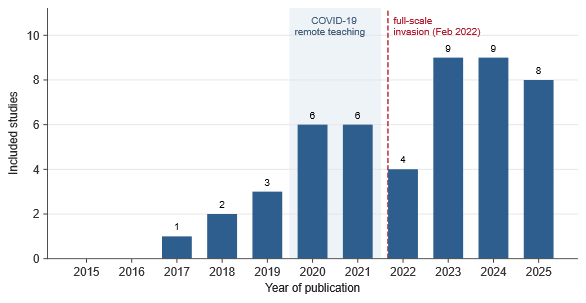
Table 1. Characteristics of the 48 included studies
|
Study |
Discipline |
Design |
N |
Gamification |
Achievement |
Statistics |
|
Iaremenko (2017) |
Languages |
Survey |
120 |
Kahoot! |
— (motivation) |
none |
|
Głowacki et al. (2018) |
Languages |
Quasi-experiment |
NR |
Kahoot! |
positive |
none |
|
Tsymbal (2018) |
Languages |
Survey |
112 |
Kahoot! |
— (motivation) |
none |
|
Holubnycha et al. (2019) |
Languages |
Quasi-experiment |
240 |
Quizlet |
positive |
none |
|
Kobernyk & Kalashnik (2019) |
Teacher education |
Quasi-experiment |
57 |
role-play, quests |
positive |
none |
|
Zvarych et al. (2019) |
Languages |
Quasi-experiment |
NR |
role-play, quests |
positive |
none |
|
Balcı et al. (2020) |
IT, engineering |
Survey |
347 |
VR, simulation |
— (attitudes) |
reported |
|
Chaikovska & Zbaravska (2020) |
Languages |
Pre–post |
NR |
Quizlet |
positive |
none |
|
Gorban & Skachenko (2020) |
Arts, humanities |
Case study |
44 |
Kahoot! |
positive |
reported |
|
Stupak (2020) |
Management |
Survey |
25 |
role-play, quests, points, badges |
— (perceptions) |
none |
|
Voloshynov et al. (2020) |
Languages |
Historical control |
120 |
role-play, quests, Moodle |
positive |
none |
|
Zhernovnykova et al. (2020) |
Teacher education |
Pre–post |
NR |
quiz tools, language apps |
positive |
none |
|
Bakhmat & Chaikovska (2021) |
Languages |
Quasi-experiment |
96 |
Quizlet |
positive |
g = 0.66 |
|
Fursenko et al. (2021) |
Languages |
Quasi-experiment |
57 |
Quizlet |
positive |
g = 0.75 |
|
Kostikova et al. (2021) |
Languages |
Quasi-experiment |
280 |
role-play, quests |
— (self-assessed skills) |
none |
|
Nalyvaiko et al. (2021) |
Teacher education |
Case study |
NR |
ClassCraft |
— (motivation, attitudes) |
none |
|
Opryshko & Nazarovets (2021) |
Library science |
Case study |
NR |
points, badges |
— (motivation, attitudes) |
none |
|
Shlenova (2021) |
Library science |
Survey |
NR |
not specified |
— (motivation, attitudes) |
none |
|
Lebedeva et al. (2022) |
Management |
Survey |
~300/year |
role-play, quests |
— (preferences) |
none |
|
Pishchanska et al. (2022) |
Arts, humanities |
Descriptive |
NR |
not specified |
— (no clear outcome) |
none |
|
Vakaliuk et al. (2022) |
Teacher education |
Quasi-experiment |
216 |
VR, simulation |
positive |
none |
|
Zhyhadlo (2022) |
Languages |
Descriptive |
NR |
quiz tools, Kahoot! |
positive |
none |
|
Malaniuk et al. (2023) |
Multidisciplinary |
Quasi-experiment |
NR |
points, badges |
mixed |
none |
|
Matviienko et al. (2023) |
Languages |
Mixed methods |
43 |
not specified |
positive |
none |
|
Nikolaeva et al. (2023) |
Languages |
Quasi-experiment |
44 |
role-play, quests |
positive |
d = 1.32† |
|
Nozhovnik et al. (2023) |
Languages |
Quasi-experiment |
55 |
other |
positive |
reported |
|
Petrovych et al. (2023) |
Teacher education |
Quasi-experiment |
47 |
VR, simulation |
— (motivational readiness) |
none |
|
Synekop et al. (2023) |
Languages |
Mixed methods |
NR |
not specified |
positive |
none |
|
Todorova (2023) |
Languages |
Quasi-experiment |
56 |
Quizlet |
positive |
d = 0.77 |
|
Volkotrubova et al. (2023) |
Teacher education |
Quasi-experiment |
460 |
not specified |
positive |
reported |
|
Zinovieva & Kolot (2023) |
Multidisciplinary |
Pre–post |
30 |
other |
— (emotional intelligence) |
none |
|
Diahyleva et al. (2024) |
Languages |
Quasi-experiment |
73 |
Moodle, points, badges, role-play, quests |
positive |
none |
|
Fedorova et al. (2024) |
Management |
Survey |
NR |
other |
— (emotional intelligence) |
none |
|
Folomieieva et al. (2024) |
Multidisciplinary |
Quasi-experiment |
86 |
ClassCraft, points, badges |
positive |
none |
|
Konstantynova et al. (2024) |
Multidisciplinary |
Quasi-experiment |
200 |
points, badges, role-play, quests |
positive |
reported |
|
Lopatynska et al. (2024) |
Languages |
Survey |
NR |
Kahoot! |
— (motivation, attitudes) |
none |
|
Pavlova et al. (2024) |
Teacher education |
Pre–post |
124 |
Moodle, points, badges |
positive |
reported |
|
Stakhova (2024) |
Teacher education |
Quasi-experiment |
115 |
Kahoot! |
positive |
g = 0.50 |
|
Titova & Kryvoruchko (2024) |
IT, engineering |
Survey |
73 |
quiz tools, Kahoot! |
— (preferences) |
none |
|
Yechkalo et al. (2024) |
IT, engineering |
Quasi-experiment |
23 |
points, badges, role-play, quests |
positive |
none |
|
Dmitrenko et al. (2025) |
Teacher education |
Survey |
36 |
role-play, quests, quiz tools |
— (preferences) |
none |
|
Goncharuk-Khomyn et al. (2025) |
Dentistry |
Quasi-experiment |
60 |
VR, simulation |
— (motivation, self-efficacy) |
reported |
|
Hannichenko & Zhebko (2025) |
Management |
Quasi-experiment |
NR |
Moodle, points, badges, role-play, quests |
positive |
none |
|
Ovsiienko et al. (2025) |
Languages |
Quasi-experiment |
40 |
Kahoot! |
positive, n.s. |
none |
|
Savitska et al. (2025) |
Arts, humanities |
Quasi-experiment |
NR |
role-play, quests, VR, simulation |
positive |
none |
|
Shkola et al. (2025) |
Languages |
Quasi-experiment |
NR |
VR, simulation |
positive |
none |
|
Verbovetskyi & Oleksiuk (2025) |
Teacher education |
Survey |
53 |
Kahoot!, quiz tools, Moodle, other |
— (self-assessed skills) |
none |
|
Zhumbei et al. (2025) |
IT, engineering |
Mixed methods |
NR |
points, badges, role-play, quests |
positive |
none |
Note. N = total sample; NR = not reported. Achievement: direction of effect on academic achievement; "—" marks studies without an achievement outcome, with the outcome measured in parentheses; n.s. = difference reported as not significant. Statistics: g = Hedges' g; d = standardised difference from a 2 × 2 table (Chinn, 2000); "reported" = statistics reported but insufficient for a standardised between-group effect. † The gamified group also received teacher consultation. Tsymbal (2018) was published again with the same results (Tsymbal, 2019).
Gamification designs
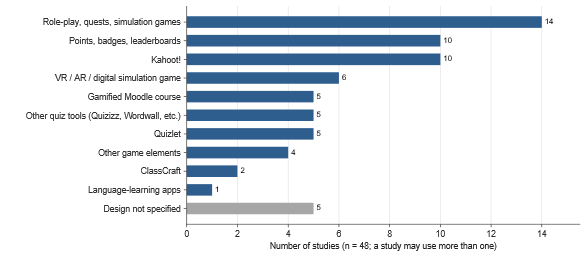
Role-play, quests and simulation games were the most frequent designs (14 studies), followed by Kahoot! (10) and points, badges and leaderboards (10); virtual-reality or digital simulation games, Quizlet, other quiz tools and gamified Moodle courses appeared in five or six studies each (Figure 3). Five studies did not specify the mechanics used.
Figure 3. Gamification designs reported in the included studies (a study may use more than one)
Effects on academic achievement
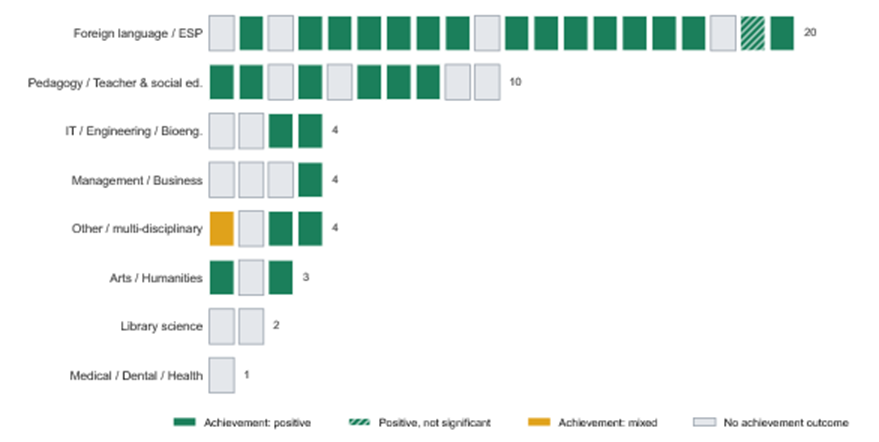
Thirty studies measured academic achievement. Twenty-nine reported a positive direction of effect and one a mixed result; none reported a null or negative direction (Figure 4). In one of the 29, the authors reported the difference as not significant and progress as inconsistent, yet concluded that the intervention was effective (Ovsiienko et al., 2025). The 18 studies without an achievement outcome measured motivation, attitudes or self-efficacy (9), preferences or perceptions (4), self-assessed skills (2), emotional intelligence (2) or no clearly defined outcome (1). All 16 achievement studies in foreign-language teaching reported a positive direction (Figure 5).
Figure 4. Direction of effect in the 30 studies with an academic-achievement outcome
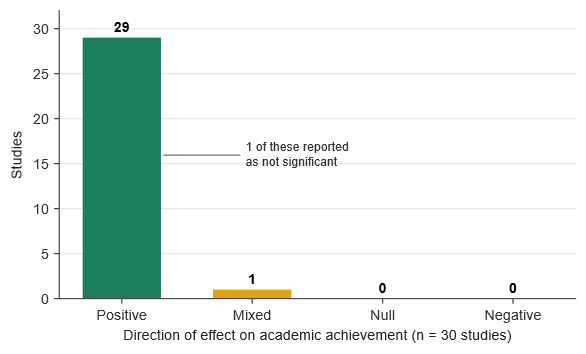
Figure 5. Direction of effect on achievement by discipline (harvest plot); each block is one study
A standardised effect could be computed for five studies: g = 0.50 [0.13, 0.87] for digital competence taught with Kahoot! (Stakhova et al., 2024); g = 0.66 [0.25, 1.06] and g = 0.75 [0.21, 1.28] for vocabulary learning with Quizlet (Bakhmat & Chaikovska, 2021; Fursenko et al., 2021); d = 0.77 [0.15, 1.40] for vocabulary learning with Quizlet among service members (Todorova, 2023); and d = 1.32 [0.11, 2.53] in a comparison confounded by additional teacher consultation in the gamified group (Nikolaeva et al., 2023). The four unconfounded estimates are positive and close to or above the cognitive-outcome estimate of international meta-analyses (g = 0.49; Sailer & Homner, 2020). All four come from small quasi-experiments with researcher-made tests, designs that tend to yield larger effects (Cheung & Slavin, 2016).
Extractability and design ceiling
Twelve of the 48 studies (25.0%) reported statistics of any kind, including 10 of the 30 achievement studies. A standardised between-group effect could be computed for five of the 30 (16.7%), or four (13.3%) with an unconfounded contrast; this is the extractability rate. The other studies reported percentages, distributions of attainment levels, means without dispersion or significance statements without test values. Several reports were internally inconsistent: one sample was published twice with different sample sizes and identical percentages, group sizes differed within a report, and one set of standard deviations was incompatible with the test scale (details in the supplementary extraction file). The design ceiling is the quasi-experiment with a concurrent, non-equivalent control group, used by 24 studies; none randomised.
Neither measure changed with the full-scale invasion. Among achievement studies published in 2017–2021, two of 10 permitted a standardised effect; among those published in 2022–2025, three of 20. Controlled designs were somewhat more frequent from 2022 (17 of 30 studies, against 8 of 18 before), and significance tests much more frequent (11 of 20 achievement studies, against one of 10).
Risk of bias
Thirty-five studies were at high risk of bias overall and 13 raised some concerns; none was at low risk (Figure 6). Completeness of reporting was the weakest domain (high risk in 36 studies), followed by the comparator (23). Of the 30 achievement studies, 19 were at high risk. The certainty of the evidence on achievement is therefore very low: the positive vote count comes from studies whose designs cannot exclude confounding and whose results can rarely be checked.
Figure 6. Risk-of-bias ratings of the 48 studies on five domains adapted from the Mixed Methods Appraisal Tool
Null results and their sensitivity
On the definition in Section 2.8, the null-result share is one of 30 (3.3%): no achievement study reported a null or negative direction, and one reported a non-significant difference (Ovsiienko et al., 2025). Table 2 shows how this figure depends on the review's choices.
It does not depend on selection. The 27 studies added after peer review include the one non-significant result, and readmitting the 22 records that remain excluded, under any relaxed rule or all of them together, adds no null or negative result. It depends somewhat on definition: counted at the level of outcomes, three studies report a null — no significant difference in three motivation-related outcomes (Goncharuk-Khomyn et al., 2025), unchanged external motivation (Malaniuk et al., 2023), and the achievement result above.
Sampling variation alone makes the absence of negative directions weak evidence. For the 22 achievement studies with a comparison group, a true effect of g = 0.49 and 15–45 students per group would be expected to produce between 0.2 and 2.0 negative directions, and the probability of none is 0.13–0.80; single-group pre–post designs make a negative direction improbable in any case. Significance tests tell a different story. Only 12 of the 30 achievement studies reported a test, and 11 of the 12 were significant. At their reported group sizes, about seven significant results would be expected at g = 0.49, five at g = 0.36 and three at g = 0.25; the probability of 11 or more is .007, < .001 and < .001, respectively — an excess of significant findings in the sense of Ioannidis and Trikalinos (2007).
Table 2. Sensitivity of the null-result share
|
Analysis |
Result |
|
Base (Section 2.8): null or negative direction, or a non-significant difference |
1 of 30 achievement studies |
|
Direction only |
0 of 30 |
|
Mixed results counted as containing a null |
2 of 30 |
|
All outcomes, study level, direction only |
0 of 47 |
|
All outcomes, outcome level: at least one null outcome |
3 of 48 |
|
Studies added after peer review (re-screen 17, citation searching 10) |
1 of 27 |
|
Remaining exclusions readmitted under relaxed rules (22 records) |
no null or negative result added |
|
Negative directions expected by chance: 22 two-group studies, g = 0.49, 15–45 per group |
0.2–2.0 expected; P(none) = 0.13–0.80 |
|
As above, g = 0.36 |
1.0–3.6 expected; P(none) = 0.02–0.37 |
|
Significance tests on achievement |
12 of 30 studies; 11 significant against 7.0 expected at g = 0.49; P(≥ 11) = .007 |
Note. Readmitted records were coded from abstracts and included studies from full texts. One study without an achievement outcome had no codable direction. Expectations assume normally distributed outcomes and a two-sided test at α = .05; reported group sizes were used, 20 per group where none was reported, and the one single-group study with a test was entered as two groups of 62.
Discussion
Principal findings
Forty-eight studies published in 2017–2025 evaluated gamification with students of Ukrainian HEIs. Where achievement was measured, the reported direction was almost uniformly positive, and the few computable effects were moderate. The designs were weak: no study was randomised and most were at high risk of bias. A standardised effect could be computed for one achievement study in six, and the significance tests that were reported were more often significant than their power would predict.
What the review adds to the evidence on gamification
For the question whether gamification improves achievement, the relevant evidence base is the body of controlled studies pooled in international meta-analyses (Bai et al., 2020; Sailer & Homner, 2020). The Ukrainian studies agree with those estimates in direction and, where effects could be computed, in size, but they cannot refine them: most report no effect size, none is randomised, and the four computable effects come from designs that tend to inflate estimates (Cheung & Slavin, 2016). For that question, their contribution is confirmatory at most. For practitioners in Ukraine, the review indicates that gamified formats, especially quiz and flashcard platforms in language teaching, have been used widely without a reported negative effect, but it does not establish how large any benefit is or which mechanics matter.
Interpreting the three measures
The findings are that a standardised effect can be computed for five of 30 achievement studies, that the strongest design is the quasi-experiment with a non-equivalent control group, and that 11 of the 12 reported tests were significant while 18 of the 30 studies reported no test. What follows is interpretation.
The most economical reading of the null-result share is that it reflects reporting practice. Most studies describe effects rather than test them, as percentages, attainment levels or means without dispersion, so "no difference" is rarely an available conclusion; where tests are reported, significant results are more frequent than power allows. Publication bias, selective reporting within studies and flexible analysis would each produce this pattern, and the data cannot distinguish between them (Ioannidis & Trikalinos, 2007). The one non-significant result was reported together with a conclusion of effectiveness, so even this study does not present its null finding as such.
It is tempting to attribute the whole profile to the crisis in which most studies were published, and the context in Section 1.1 makes that plausible. The data do not support attributing it to the war specifically: the extractability rate and the design ceiling were the same before and after February 2022, and the later studies reported tests more often. The profile is better described as a characteristic of this field of research in Ukraine over the review period. It predates the full-scale invasion and is consistent with publication requirements that reward output rather than reporting quality (Hladchenko, 2022; Nazarovets, 2022), although the review cannot test that explanation. Whether the profile differs from that of gamification research in other systems cannot be established from one corpus.
Indicative benchmarks
The only comparison these data allow is with published aggregates of the international literature, and it is indicative only, because those aggregates come from reviews with different questions and criteria. Sailer and Homner (2020) pooled 19 effect sizes for cognitive outcomes, and Bai et al. (2020) 30 interventions with 3,202 participants; the Ukrainian corpus yields four unconfounded effects from 30 achievement studies. These figures do not compare research systems. They indicate that most Ukrainian studies are not in a form that international syntheses can use. A comparison of systems would require the three measures to be computed on other national corpora with the same definitions, which is straightforward because any systematic review extracts the items on which they rest.
Limitations
The search did not cover Web of Science, Google Scholar, Russian-language publications, dissertations or institutional repositories beyond CORE, where unpublished and null evaluations are most likely to be found. Citation searching found 10 studies that the database searches had missed, which suggests that further eligible studies exist. The original title and abstract screen was carried out by one reviewer and excluded eligible studies; this was corrected by the re-screen and the citation searching, but these were also carried out by one reviewer. The only independent screen, of 77 records, was made by a language model rather than a second human reviewer, and its agreement with the author was moderate. Moderate agreement signalled a risk that eligible studies had been overlooked, and the re-screen confirmed it by adding 17 studies that the original screen had excluded. Directions of effect were coded by one reviewer from the reported values. The three measures and the sensitivity analyses were defined after data extraction, and the expectation analyses rest on the assumptions stated under Table 2. Finally, the review describes the profile of the corpus; it cannot attribute that profile to its context.
Implications
For researchers, the implications are to report means, standard deviations and group sizes for every outcome, to test differences rather than describe them, to specify the gamification mechanics used, and to report non-significant results as findings; one non-significant result in 30 studies suggests that such results currently go unreported or are recast. For teachers, the evidence supports cautious adoption rather than avoidance. Gamified formats can be introduced as a supplement to instruction rather than a replacement for it, starting with the formats whose effects could be computed in this corpus: quiz and flashcard platforms for vocabulary and knowledge practice. Each mechanic should be tied to a stated learning outcome, and that outcome, not only students' enjoyment, should be assessed. A simple local evaluation — a pre-test, a comparison section or earlier cohort taking the same test, and a record of means, standard deviations and group sizes — would let each course add to the evidence that this review found missing, including evaluations that show no difference.
For editors and funders, in Ukraine and in partner systems, the extractability rate is a low-cost indicator of whether published or funded evaluations can contribute to syntheses, and could be tracked alongside publication counts. For authors of reviews, the three measures cost nothing once extraction is complete and make visible what a literature can support.
Conclusion
The published studies of gamification in Ukrainian higher education point in a favourable direction, but they cannot show how large the benefit is or rule out that it reflects design and reporting: a standardised effect can be computed for one achievement study in six, none is randomised, and reported significance tests are more often significant than their power would predict. These features were present before the full-scale invasion as well as after it. Reporting the extractability rate, design ceiling and null-result share routinely would let reviewers, funders and partner systems see what a literature can support without new data collection.
Declarations
Protocol. Fixed before screening and not registered; deposited with the supplementary materials. Amendments are reported in Section 2.1.
Funding. None.
Competing interests. The author declares no competing interests.
Ethics approval. Not applicable: the review synthesises published literature and involved no human participants or personal data.
Data availability. The protocol, search strategy, PRISMA counts, screening log with the post-review re-screen, citation-searching log, extraction and risk-of-bias tables, sensitivity-analysis code and coding, and all figures are openly available on Zenodo at https://doi.org/10.5281/zenodo.21471668 (version 2.0.0).
Reporting. Reported according to PRISMA 2020 (Page et al., 2021; checklist provided as a supplementary file) and SWiM (Campbell et al., 2020).
References
References marked with an asterisk (*) are the 49 reports of the 48 included studies.
Appelbaum, M., Cooper, H., Kline, R. B., Mayo-Wilson, E., Nezu, A. M., & Rao, S. M. (2018). Journal article reporting standards for quantitative research in psychology: The APA Publications and Communications Board task force report. American Psychologist, 73(1), 3–25. https://doi.org/10.1037/amp0000191
Bai, S., Hew, K. F., & Huang, B. (2020). Does gamification improve student learning outcome? Evidence from a meta-analysis and synthesis of qualitative data in educational contexts. Educational Research Review, 30. https://doi.org/10.1016/j.edurev.2020.100322
*Bakhmat, N., & Chaikovska, O. (2021). Web-based professional vocabulary learning with the high school students. In Proceedings of the International Conference on Economics, Law and Education Research (ELER 2021) (pp. 318–324). Atlantis Press. https://doi.org/10.2991/aebmr.k.210320.054
*Balcı, M. A., Akgüller, Ö., Kaya, E., Rzhevska, N., Dobroskok, I., Basiuk, L., & Kosa, T. (2020). Potential of game «PLANT TISSUE CULTURE» in bioengineering education as distance laboratory classes. Computer Applications in Engineering Education, 29(4), 855–863. https://doi.org/10.1002/cae.22311
Burde, D., Kapit, A., Wahl, R. L., Guven, O., & Skarpeteig, M. I. (2017). Education in emergencies: A review of theory and research. Review of Educational Research, 87(3), 619–658. https://doi.org/10.3102/0034654316671594
Campbell, M., McKenzie, J. E., Sowden, A., Katikireddi, S. V., Brennan, S. E., Ellis, S., Hartmann-Boyce, J., Ryan, R., Shepperd, S., Thomas, J., Welch, V., & Thomson, H. (2020). Synthesis without meta-analysis (SWiM) in systematic reviews: Reporting guideline. BMJ, 368. https://doi.org/10.1136/bmj.l6890
*Chaikovska, O., & Zbaravska, L. (2020). The efficiency of Quizlet-based EFL vocabulary learning in preparing undergraduates for state English exam. Advanced Education, 7(14), 84–90. https://doi.org/10.20535/2410-8286.197808
Cheung, A. C. K., & Slavin, R. E. (2016). How methodological features affect effect sizes in education. Educational Researcher, 45(5), 283–292. https://doi.org/10.3102/0013189X16656615
Chinn, S. (2000). A simple method for converting an odds ratio to effect size for use in meta-analysis. Statistics in Medicine, 19(22), 3127–3131. https://doi.org/10.1002/1097-0258(20001130)19:22<3127::AID-SIM784>3.0.CO;2-M
Collyer, F. M. (2018). Global patterns in the publishing of academic knowledge: Global North, global South. Current Sociology, 66(1), 56–73. https://doi.org/10.1177/0011392116680020
Crossley, M., & Watson, K. (2003). Comparative and international research in education: Globalisation, context and difference. RoutledgeFalmer.
Deterding, S., Dixon, D., Khaled, R., & Nacke, L. (2011). From game design elements to gamefulness: Defining "gamification". In Proceedings of the 15th International Academic MindTrek Conference: Envisioning Future Media Environments (pp. 9–15). ACM. https://doi.org/10.1145/2181037.2181040
*Diahyleva, O., Yurzhenko, A., & Kononova, O. (2024). Gamification techniques in Maritime English online courses: Motivating learners in virtual environments. Advances in Mobile Learning Educational Research, 4(1), 965–972. https://doi.org/10.25082/AMLER.2024.01.008
*Dmitrenko, N., Stakhova, I., & Franchuk, N. (2025). Heimifikatsiia yak zasib rozvytku vmin hovorinnia maibutnikh uchyteliv anhliiskoi movy u pochatkovii shkoli [Gamification as a means of developing the speaking skills of prospective English teachers in primary school]. Innovations in Preschool and Primary Education, (4), 86–97. https://doi.org/10.31652/3041-2439-2025-4-9
Fanelli, D. (2010). "Positive" results increase down the hierarchy of the sciences. PLoS ONE, 5(4). https://doi.org/10.1371/journal.pone.0010068
Fanelli, D. (2012). Negative results are disappearing from most disciplines and countries. Scientometrics, 90(3), 891–904. https://doi.org/10.1007/s11192-011-0494-7
*Fedorova, Y., Bondarenko, T., Mikuš, J., Korniush, H., & Nesterenko, R. (2024). Shaping emotional intelligence with gamification techniques. In Towards a hybrid, flexible and socially engaged higher education (pp. 455–463). Springer. https://doi.org/10.1007/978-3-031-53022-7_45
*Folomieieva, N., Pelekh, V., Haidamashko, I., Sivak, N., & Koriakin, O. (2024). Gamification in the educational process of higher education institutions. Revista Amazonia Investiga, 13(73), 331–343. https://doi.org/10.34069/AI/2024.73.01.28
*Fursenko, T., Bystrova, B., & Druz, Y. (2021). Integrating Quizlet into aviation English course. Advanced Education, 8(17), 118–127. https://doi.org/10.20535/2410-8286.217990
Ganguli, I., & Waldinger, F. (2023). War and science in Ukraine (NBER Working Paper No. 31449). National Bureau of Economic Research. https://doi.org/10.3386/w31449
*Głowacki, J., Kriukova, Y., & Avshenyuk, N. (2018). Gamification in higher education: Experience of Poland and Ukraine. Advanced Education, 5(10), 105–110. https://doi.org/10.20535/2410-8286.151143
*Goncharuk-Khomyn, M., Bilyschuk, M., Pishkovtsi, A.-M., Lokota, I., Ivaskevych, V., Marian-Yovbak, V., & Bilei, A. (2025). Usage of virtual reality and gamification to enhance pre-clinical endodontic teaching process: First experience among Ukrainian dental students. Journal of International Dental and Medical Research, 18(1), 166–174.
*Gorban, Y., & Skachenko, O. (2020). Experience of use of Kahoot! digital tool in the university library activities. Ukrainian Journal on Library and Information Science, (5), 66–79. https://doi.org/10.31866/2616-7654.5.2020.205730
Gusenbauer, M., & Haddaway, N. R. (2020). Which academic search systems are suitable for systematic reviews or meta-analyses? Evaluating retrieval qualities of Google Scholar, PubMed, and 26 other resources. Research Synthesis Methods, 11(2), 181–217. https://doi.org/10.1002/jrsm.1378
Guyatt, G. H., Oxman, A. D., Vist, G. E., Kunz, R., Falck-Ytter, Y., Alonso-Coello, P., & Schünemann, H. J. (2008). GRADE: An emerging consensus on rating quality of evidence and strength of recommendations. BMJ, 336(7650), 924–926. https://doi.org/10.1136/bmj.39489.470347.AD
Hamari, J., Koivisto, J., & Sarsa, H. (2014). Does gamification work? A literature review of empirical studies on gamification. In Proceedings of the 47th Hawaii International Conference on System Sciences (pp. 3025–3034). IEEE. https://doi.org/10.1109/HICSS.2014.377
*Hannichenko, T., & Zhebko, O. (2025). Gamification as an innovative approach to teaching English to master's students in management. Zhytomyr Ivan Franko State University Journal. Pedagogical Sciences, (3(122)), 327–342. https://doi.org/10.35433/pedagogy.3(122).2025.22
Hladchenko, M. (2022). Implications of publication requirements for the research output of Ukrainian academics in Scopus in 1999–2019. Journal of Data and Information Science, 7(3), 71–93. https://doi.org/10.2478/jdis-2022-0016
Hodges, C., Moore, S., Lockee, B., Trust, T., & Bond, A. (2020, March 27). The difference between emergency remote teaching and online learning. EDUCAUSE Review. https://er.educause.edu/articles/2020/3/the-difference-between-emergency-remote-teaching-and-online-learning
*Holubnycha, L., Kostikova, I., Kravchenko, H., Simonok, V., & Serheieva, H. (2019). Cloud computing for university students' language learning. Revista Romaneasca pentru Educatie Multidimensionala, 11(4), 55–69. https://doi.org/10.18662/rrem/157
Hong, Q. N., Fàbregues, S., Bartlett, G., Boardman, F., Cargo, M., Dagenais, P., Gagnon, M.-P., Griffiths, F., Nicolau, B., O'Cathain, A., Rousseau, M.-C., Vedel, I., & Pluye, P. (2018). The Mixed Methods Appraisal Tool (MMAT) version 2018 for information professionals and researchers. Education for Information, 34(4), 285–291. https://doi.org/10.3233/EFI-180221
*Iaremenko, N. V. (2017). Enhancing English language learners' motivation through online games. Information Technologies and Learning Tools, 59(3), 126–133. https://doi.org/10.33407/itlt.v59i3.1606
Ioannidis, J. P. A., & Trikalinos, T. A. (2007). An exploratory test for an excess of significant findings. Clinical Trials, 4(3), 245–253. https://doi.org/10.1177/1740774507079441
*Kobernyk, O. M., & Kalashnik, N. V. (2019). Developing students' skills into pedagogical improvisation using didactic games. Zhytomyr Ivan Franko State University Journal. Pedagogical Sciences, (2(97)), 51–60. https://doi.org/10.35433/pedagogy.2(97).2019.51-60
*Konstantynova, T., Dundiuk, V., Hurievska, O., Zhulkanych, B., & Shevchuk, O. (2024). Gamification of the educational process in distance education. Eduweb, 18(2), 167–182. https://doi.org/10.46502/issn.1856-7576/2024.18.02.12
*Kostikova, I., Holubnycha, L., Girich, Z., & Movmyga, N. (2021). Soft skills development with university students at English lessons. Revista Romaneasca pentru Educatie Multidimensionala, 13(1), 398–416. https://doi.org/10.18662/rrem/13.1/378
Kurapov, A., Pavlenko, V., Drozdov, A., Bezliudna, V., Reznik, A., & Isralowitz, R. (2023). Toward an understanding of the Russian-Ukrainian war impact on university students and personnel. Journal of Loss and Trauma, 28(2), 167–174. https://doi.org/10.1080/15325024.2022.2084838
Landis, J. R., & Koch, G. G. (1977). The measurement of observer agreement for categorical data. Biometrics, 33(1), 159–174. https://doi.org/10.2307/2529310
Lavrysh, Y., Lytovchenko, I., Lukianenko, V., & Golub, T. (2025). Teaching during the wartime: Experience from Ukraine. Educational Philosophy and Theory, 57(3), 197–204. https://doi.org/10.1080/00131857.2022.2098714
*Lebedeva, I., Norik, L., & Lebedev, S. (2022). Development of human potential: Design thinking as a way of improving professional competencies of economists. Economics of Development, 20(1), 43–52. https://doi.org/10.57111/devt.20(1).2022.43-52
*Lopatynska, I., Bratanych, O., Biletska, I., Cherednychenko, V., & Pustovoichenko, D. (2024). Evaluating the efficacy of Kahoot as a computer-assisted language learning tool in higher education. Eduweb, 18(1), 152–163. https://doi.org/10.46502/issn.1856-7576/2024.18.01.11
*Malaniuk, N., Hubarieva, D., Sviatenko, T., Gogunskaya, I., & Parfanovich, I. (2023). Means of gamification of learning during martial law. Revista Amazonia Investiga, 12(61), 236–247. https://doi.org/10.34069/AI/2023.61.01.24
*Matviienko, O. V., Kuzmina, S., & Yanishevska, Z. (2023). Gamified English language learning in Ukraine: Critical divide between tradition and innovation. Arab World English Journal, (9), 161–172. https://doi.org/10.24093/awej/call9.11
*Nalyvaiko, O., Zhukova, O., Ivanenko, L., Shvedova, Y., & Nekrashevych, T. (2021). Gamification as a new format of projects method in blended learning conditions studying disciplines of the pedagogical cycle. Revista Romaneasca pentru Educatie Multidimensionala, 13(4), 17–30. https://doi.org/10.18662/rrem/13.4/468
Nazarovets, S. (2022). Analysis of publications by authors of Ukrainian institutes in Scopus-delisted titles. Learned Publishing, 35(4), 499–515. https://doi.org/10.1002/leap.1464
*Nikolaeva, S., Chernysh, V., Boiko, H., & Galynska, O. (2023). Business simulation games in developing pre-service restaurant managers' speech interaction competence using GPTChat. Advanced Education, 10(22), 27–37. https://doi.org/10.20535/2410-8286.276166
*Nozhovnik, O., Harbuza, T., Teslenko, N., Okhrimenko, O., Zalizniuk, V., & Durdas, A. (2023). Chatbot gamified and automated management of L2 learning process using Smart Sender platform. International Journal of Educational Methodology, 9(3), 603–618. https://doi.org/10.12973/ijem.9.3.603
*Opryshko, T., & Nazarovets, S. (2021). Case study: Citizen science in digital humanities context. In Digital Humanities Workshop (DHW 2021) (pp. 198–203). ACM. https://doi.org/10.1145/3526242.3526246
*Ovsiienko, L., Kulyk, O., Kardash, L., Makarchuk, O., & Boyko, S. (2025). Language shifts in the digital age: The transformation of lexical and grammatical structures under the influence of social networks. Metaverse Basic and Applied Research, 4. https://doi.org/10.56294/mr2025180
Page, M. J., McKenzie, J. E., Bossuyt, P. M., Boutron, I., Hoffmann, T. C., Mulrow, C. D., Shamseer, L., Tetzlaff, J. M., Akl, E. A., Brennan, S. E., Chou, R., Glanville, J., Grimshaw, J. M., Hróbjartsson, A., Lalu, M. M., Li, T., Loder, E. W., Mayo-Wilson, E., McDonald, S., … Moher, D. (2021). The PRISMA 2020 statement: An updated guideline for reporting systematic reviews. BMJ, 372. https://doi.org/10.1136/bmj.n71
*Pavlova, N., Shrol, T., & Poliukhovych, N. (2024). Gamification as a educational technology for professional training. Interdisciplinary Studies of Complex Systems, (24), 146–163. https://doi.org/10.31392/iscs.2024.24.146
*Petrovych, O., Zavalniuk, I., Bohatko, V., Poliarush, N., & Petrovych, S. (2023). Motivational readiness of future teachers-philologists to use the gamification with elements of augmented reality in education. International Journal of Emerging Technologies in Learning, 18(3), 4–21. https://doi.org/10.3991/ijet.v18i03.36017
*Pishchanska, V., Altukhova, A., Prusak, Y., Kovmir, N., & Honcharov, A. (2022). Gamification of education: Innovative forms of teaching and education in culture and art. Eduweb, 16(2), 119–133. https://doi.org/10.46502/issn.1856-7576/2022.16.02.8
Rui, P., & Wei, W. (2025). Gamification and neurogaming to improve motor coordination and cognitive abilities in musicians and athletes. Acta Psychologica, 261. https://doi.org/10.1016/j.actpsy.2025.105857
Sailer, M., & Homner, L. (2020). The gamification of learning: A meta-analysis. Educational Psychology Review, 32(1), 77–112. https://doi.org/10.1007/s10648-019-09498-w
*Savitska, V., Gomotiuk, O., Stefanyshyn, O., Rashid, M. A., Lengyelfalusy, T., & Šurín, S. (2025). Educational possibilities of gamification in the formation of soft & hard skills among students of socionomic professions. Journal of Education Culture and Society, 16(2), 819–839. https://doi.org/10.15503/jecs2025.3.819.839
*Shkola, I., Dmitrenko, N., Kondratieva, O., Shymanovych, I., & Moroz, A. (2025). Gamification methods for developing lexical competence of engineering students. Environment. Technology. Resources. Proceedings of the International Scientific and Practical Conference, 3, 269–275. https://doi.org/10.17770/etr2025vol3.8543
*Shlenova, M. (2021). Gamification as a tool for increasing the learning efficiency of future librarians. Visnyk of Kharkiv State Academy of Culture, (59), 53–58. https://doi.org/10.31516/2410-5333.059.05
*Stakhova, I., Kushnir, A., Franchuk, N., Kolesnik, K., Lyubchak, L., & Vatso, M. (2024). Enhancing the digital competence of prospective primary school teachers through utilizing Kahoot! International Electronic Journal of Elementary Education, 16(4), 467–478. https://doi.org/10.26822/iejee.2024.346
Steiner-Khamsi, G. (2004). Globalization in education: Real or imagined? In G. Steiner-Khamsi (Ed.), The global politics of educational borrowing and lending (pp. 1–11). Teachers College Press.
*Stupak, O. (2020). Educational technologies in training future managers. Advanced Education, 7(15), 97–104. https://doi.org/10.20535/2410-8286.200229
Suchikova, Y., Tsybuliak, N., Lopatina, H., Shevchenko, L., & Popov, A. I. (2023). Science in times of crisis: How does the war affect the efficiency of Ukrainian scientists? Problems and Perspectives in Management, 21(1), 408–424. https://doi.org/10.21511/ppm.21(1).2023.35
*Synekop, O., Lavrysh, Y., Lytovchenko, I., Chuhai, O., & Lukianenko, V. (2023). Use of games in ESP classes: Perceptions from students and teachers. International Journal of Emerging Technologies in Learning, 18(16), 74–86. https://doi.org/10.3991/ijet.v18i16.41275
*Titova, L., & Kryvoruchko, I. (2024). Cloud services as a means of gamification in the training of future teachers. Information Technologies in Education, (2(56)), 6–13. https://doi.org/10.14308/ite000783
*Todorova, N. (2023). Effect of Quizlet use on Ukrainian service members' English vocabulary acquisition. Advanced Education, 11(23), 29–41. https://doi.org/10.20535/2410-8286.281048
Tsybuliak, N., Suchikova, Y., Gurenko, O., Lopatina, H., Kovachov, S., & Bohdanov, I. (2023). Ukrainian universities at the time of war: From occupation to temporary relocation. Torture Journal, 33(3), 39–64. https://doi.org/10.7146/torture.v33i3.136256
*Tsymbal, S. (2018). Gamified training sessions as means of enhancing students' motivation in learning English. Psychological Journal, 7(17), 151–161. https://doi.org/10.31108/1.2018.7.17.10
*Tsymbal, S. V. (2019). Enhancing students' confidence and motivation in learning English with the use of online game training sessions. Information Technologies and Learning Tools, 71(3), 227–235. https://doi.org/10.33407/itlt.v71i3.2460
*Vakaliuk, T. A., Osova, O. O., Chernysh, O. A., & Bashkir, O. I. (2022). Checking digital competence formation of foreign language future teachers using game simulators. Information Technologies and Learning Tools, 90(4), 57–75. https://doi.org/10.33407/itlt.v90i4.4816
*Verbovetskyi, D. V., & Oleksiuk, V. P. (2025). Methodology of training future computer science teachers to implement game-based learning: A case study. CEUR Workshop Proceedings, 4060, 232–249. https://doi.org/10.55056/ceur-ws.org/vol-4060/paper03.pdf
*Volkotrubova, A., Tymoshchuk, O., Struk, O., Shevchenko, V., & Boiaryshcheva, T. (2023). Learning gamification tools for the development of students' cognitive independence. Revista EDaPECI, 23(2), 48–60. https://doi.org/10.29276/redapeci.2023.23.218686.48-60
*Voloshynov, S. A., Popova, H. V., Yurzhenko, A. Y., & Shmeltser, E. O. (2020). The use of digital escape room in educational electronic environment of maritime higher education institutions. CTE Workshop Proceedings, 7, 347–359. https://doi.org/10.55056/cte.364
*Yechkalo, Y. V., Tkachuk, V. V., Shurupova, K. A., Zinchenko, V. M., & Puhach, A. V. (2024). Gamification in higher education: Methodology. CEUR Workshop Proceedings, 3844, 96–106. https://doi.org/10.55056/ceur-ws.org/vol-3844/paper13.pdf
*Zhernovnykova, O. A., Peretiaha, L. Ye., Kovtun, A., Korduban, M. V., Nalyvaiko, O., & Nalyvaiko, N. A. (2020). Tekhnolohiia formuvannia tsyfrovoi kompetentnosti maibutnikh uchyteliv zasobamy heimifikatsii [The technology of forming digital competence of future teachers by means of gamification]. Information Technologies and Learning Tools, 75(1), 170–185. https://doi.org/10.33407/itlt.v75i1.3036
*Zhumbei, M., Apelt, H., Savchuk, N., Akimov, O., & Tsymbal, I. (2025). Leveraging gamification to sustain student motivation and emotional resilience in higher education during wartime: Case studies from Ukraine. LatIA, 3. https://doi.org/10.62486/latia2025345
*Zhyhadlo, O. (2022). Application of digital game-based tools for formative assessment at foreign language lessons. Information Technologies and Learning Tools, 87(1), 139–150. https://doi.org/10.33407/itlt.v87i1.4703
*Zinovieva, T., & Kolot, S. (2023). Enhancing students' emotional intelligence with game-based learning as an ICT tool. Open Educational E-Environment of Modern University, (15), 46–61. https://doi.org/10.28925/2414-0325.2023.154
*Zvarych, I., Kalaur, S., Prymachenko, N. M., Romashchenko, I. V., & Romanyshyna, O. (2019). Gamification as a tool for stimulating the educational activity of students of higher educational institutions of Ukraine and the United States. European Journal of Educational Research, 8(3), 875–891. https://doi.org/10.12973/eu-jer.8.3.875
 ©2026
Oleksii Dotsenko. This is an Open Access article distributed under the terms of
the Creative Commons Attribution 4.0 International License
(http://creativecommons.org/licenses/by/4.0/), allowing third parties to copy
and redistribute the material in any medium or format and to remix, transform,
and build upon the material for any purpose, even commercially, provided the
original work is properly cited and states its license.
©2026
Oleksii Dotsenko. This is an Open Access article distributed under the terms of
the Creative Commons Attribution 4.0 International License
(http://creativecommons.org/licenses/by/4.0/), allowing third parties to copy
and redistribute the material in any medium or format and to remix, transform,
and build upon the material for any purpose, even commercially, provided the
original work is properly cited and states its license.