Devised theatre in lower secondary school
A space of opportunity for democracy?
DOI:
https://doi.org/10.7577/ar.6460Keywords:
Aesthetic learning processes, democracy, devised theatre, community of practice, citizenship, space of possibilitiesAbstract
In this article, the authors examine how theatre work in a lower secondary school can be developed as an arena for student participation and democracy. The research was conducted as participatory action research at “Lia” lower secondary school. Tenth-grade students and five teachers took part in change processes related to an established annual theatre production. The aim of the change process was to strengthen student participation, democracy and shared ownership in the theatre project. The data material consists of observation notes from practical work at the school and interviews with the teachers. The analysis is based on the concept space of possibilities, and the findings are organised into three categories: structural conditions, the community of practice and aesthetic-pedagogic actions. The analysis shows that both internal and external structures, the teacher community and aesthetically oriented pedagogy contributed to enabling or hindering change towards enhanced pupil participation and democracy. This took place through unconventional approaches to curricula and regulations, and because of teachers’ holistic responsibility for the process, the final product, and student well-being. The changes were enabled through pedagogical framing conducted by teachers. However, the changes were limited to strengthening citizenship-related behaviour between students within frameworks developed by the teachers. The researchers envisage a next step in the process in which students are involved in planning and organizing the work processes of the theatre production.
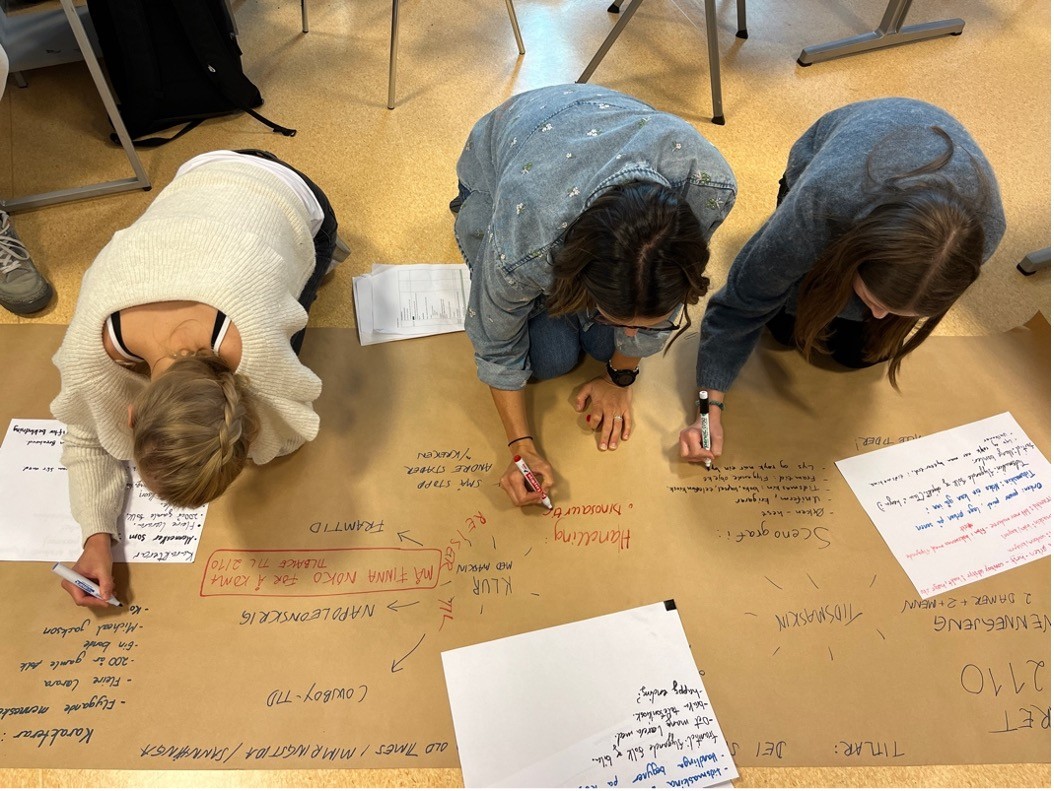
Photo: Kari Holdhus
Downloads
References
Austring, B. D., & Sørensen, M. C. (2006) Æstetik og læring. Hans Reitzels Forlag.
Bernsen, A. S., & Thoresen, E. (2024). Processmodell for utforskende praksis – barn som medskapere. BUKS - Tidsskrift for Børne- Og Ungdomskultur, 40(69), 20. https://doi.org/10.7146/buks.v40i69.150383
Biesta, G. J. (2009). Good education in an age of measurement: On the need to reconnect with the question of purpose in education. Educational Assessment, Evaluation and Accountability (formerly: Journal of Personnel Evaluation in Education), 21(1), 33-46. https://doi.org/10.1007/s11092-008-9064-9
Biesta, G. J. (2014). Utdanningens vidunderlige risiko. Fagbokforlaget.
Biesta, G. J. (2015). How does a competent teacher become a good teacher? On judgement, wisdom and virtuosity in teaching and teacher education. Philosophical perspectives on teacher education, 1–22. https://doi.org/10.1002/9781118977859.ch1
Bobetsky, V. V. (2008). The magic of middle school musicals: Inspire your students to learn, grow, and succeed. Bloomsbury Publishing PLC.
Borgebund, H., & Børhaug, K. (2023). Demokratiopplæring gjennom demokratisk erfaring. Nordidactica, 13(2023:3), 46.
Brown, B. (2010). The power of vulnerability. TED.
Christophersen, C., & Thorgersen, C. F. (2015). “I think the arts are as prominent as any subject”: A study of arts education in two Scandinavian schools. Nordic Journal of Art & Research, 4(1). https://doi.org/10.7577/if.v4i1.1368
Eidsaa, R. M. & Notland, H. A. (2006). Spektro/Musikal. Fagbokforlaget.
Elmies-Vestergren, A. (2025). Frigjøring eller umyndiggjøring: Et kritisk perspektiv på læreplanens konsept om demokratisk deltakelse i skolen. Nordisk tidsskrift for pedagogikk og kritikk, 11(1). https://doi.org/10.23865/ntpk.v11.6481
Griffiths, H. (2012). Write an Opera Teachers’ Notes. London: Royal Opera House and Den Norske Opera & Balett.
Grile, C.H. & Hill, A. (2025) Devising Democracy. In A. E. Hacker Daniels (red.). Casting the Art of Rhetoric with Theater and Drama: Taking Center Stage. Bloomsbury.
Haseman, B. (2006). A manifesto for performative research. Media International Australia, 118(1), 98–106. https://doi.org/10.1177/1329878X0611800113
Hiim, H. (2020). Likheter og forskjeller mellom tilnærminger til aksjonsforskning. I S. Gjøtterud, H. Hiim, D. Husebø & L. H. Jensen (Red.). Aksjonsforskning i Norge, Volum, 2, 25-54. https://doi.org/10.23865/noasp.121.ch1
Helleve, I., Ulvik, M., & Smith, K. (2018). «Det handler om å finne sin egen form» Læreres profesjonelle handlingsrom − hvordan det blir forstått og utnyttet. Acta Didactica Norge. https://doi.org/10.5617/adno.4794
Holdhus, K. (2019). When students teach creativities: Exploring student reports on creative teaching. Qualitative Inquiry, 25(7), 690–699. https://doi.org/10.1177/1077800418801377
Holdhus, K. (2023). Conveying pupil access to wellbeing through relational care in music education. I K. Hendricks (Red.). The Oxford handbook of care in music education, 421–432. https://doi.org/10.1093/oxfordhb/9780197611654.013.38
Haagensen, C. (2016). Devising–exploring and expressing life-based experiences. BUKS-Tidsskrift for Børne-& Ungdomskultur, 33(61), 7–7. https://doi.org/10.7146/buks.v33i61.23391
Haagensen, C. (2018). Gruppeprosesser og faseinndeling i egenskapt teater. I V. Aune & C. Haagensen (Red.). Teaterproduksjon. Ti produksjonsestetiske innganger, 179–198.
Johnstone, K. (2018). Impro. Bloomsbury publishing.
Karlsen, A. M. F., & Afdal, G. (2023). Mulighetsrommet som et sosialt og relasjonelt fenomen. I O. B. Øien, S. L. Heggernes & A. M. F. Karlsen (Red.) Flerstemmige perspektiver i Norsk utdanningsforskning. Cappelen Damm Akademisk. https://doi.org/10.23865/noasp.212.ch7
Knutsen, H. og Ørvig, A. (2006). Scenepresentasjon: Framføringsprosjekter med barn og unge. Høgskoleforlaget.
Kolaas, S. S. (2021). «Vi leker ikke teater!» Lærerfellesskapet i valgfaget produksjon for scene som profesjonelt kunnskapslandskap. Journal for Research in Arts and Sports Education, 5(1). https://doi.org/10.23865/jased.v5.2724
Kolaas, S. S., & Angelo, E. (2022). Samkunst for selve livet: Om danning og livsmestring i valgfaget produksjon for scene. Norsk pedagogisk tidsskrift, (2), 145–158. https://doi.org/10.18261/npt.106.2.6
Kolaas, S. S., & Knigge, J. (2021). Det store bildet: En kartlegging av faget sal og scene i Norge i 2019. I B. T. Bandlien, I. O. Olaussen, M. Letnes & E. Angelo (Red.). Utdanning i kunstfag: Samarbeid, kvalitet og spenninger. Cappelen Damm akademisk. https://doi.org/10.23865/noasp.152.ch12
Kunnskapsdepartementet (2020) Overordnet del – verdier og prinsipper for opplæringen. Fastsatt som forskrift ved kongelig resolusjon. Læreplanverket for kunnskapsløftet 2020 Tverrfaglige temaer: Demokrati og medborgerskap.
Lehmann, N. O. (2014). En mangfoldighed af andethedserfaringer: Om æstetik på flere måder. Tidsskrift for Børne- Og Ungdomskultur, 57, 25–36.
Levitt, H. M. (2021). Essentials of critical-constructivist grounded theory research. American Psychological Association. https://doi.org/10.1037/0000231-000
Maapalo, P. (2019). Øyeblikksbilder fra trearbeidspraksiser: Didaktiske og relasjonelle mulighetsrom for arbeid i materialet tre i kunst- og håndverksfaget. [PhD-avhandling]. NTNU.
Naughton, C., Biesta, G., & Cole, D. (Eds.). (2017). Art, artists and pedagogy: Philosophy and the arts in education. Routledge. https://doi.org/10.4324/9781315143880
Oddey, A. (1994) Devising. Devising theatre: a practical and theoretical handbook. Routledge.
Pierce, J. L.; Kostova, T. & Dirks, K.T. (2003). The State of Psychological Ownership: Integrating and Extending a Century of Research. Review of General Psychology, 7 (1). https://doi.org/10.1037/1089-2680.7.1.84
Randers-Pehrson, A. (2016). Tinglaging og læringsrom i en kunst og håndverksdidaktisk kontekst. [PhD-avhandling]. Universitetet i Oslo. https://www.duo.uio.no/handle/10852/53503
Rasmussen, B., & Gjærum, R. G. (2017). Fagovergripende diskurs: en fremtid for kunstfagene i norsk skole. Norsk pedagogisk tidsskrift, 101(2), 192–196. https://doi.org/10.18261/issn.1504-2987-2017-02-09
Schmidt, P. (2019). Policy as practice: A guide for music educators. Oxford University Press. https://doi.org/10.1093/oso/9780190227029.001.0001
Shusterman, R. (2008). Body consciousness: A philosophy of mindfulness and somaesthetics. Cambridge University. Press. https://doi.org/10.1017/CBO9780511802829
Smegen, I., & Ben-Horin, O. (2020). Inquiry-Based Learning: A Guidebook to Writing a Science Opera (Vol. 4). Brill. https://doi.org/10.1163/9789004436510
Sætra, E., & Stray, J. H. (2019). Hva slags medborger? En undersøkelse av læreres forståelse av opplæring til demokrati og medborgerskap. MF Open. https://doi.org/10.7577/njcie.2441
Sørensen, M. C., & Boysen, M. W. (2021). Forskerpositionen mellem facilitator og faglig ekspert i aktionsforskning. Forskning og forandring, 4(2), 86–105. https://doi.org/10.23865/fof.v4.3310
Utdanningsdirektoratet (2020). Læreplan, Produksjon for scene. Fastsatt som forskrift. Læreplanverket for Kunnskapsløftet. 2020.
Vangsnes, V., & Økland, N. T. (2017). Læraren som leiar av demokratiske prosessar i dramaklasserommet. I A. B. Sæbø, S. Eriksson & T.-H. Allern (Red.) Drama, teater og demokrati - Antologi 1- I barnehage, skole, museum og høyere utdanning, 159–174. Fagbokforlaget.
WASO (u.å.). Inquiry based learning. Write a science opera online guidebook.
Wenger, E. (2008). Praksisfællesskaber: Læring, mening og identitet. København: Hans Reizels Forlag.
Downloads
Published
How to Cite
Issue
Section
License
Copyright (c) 2026 Kari Holdhus, Kirsti Aksnes

This work is licensed under a Creative Commons Attribution 4.0 International License.
Authors who publish with this journal agree to the following terms:
- Authors retain copyright and grant the journal right of first publication with the work simultaneously licensed under a Creative Commons Attribution License that allows others to share the work with an acknowledgement of the work's authorship and initial publication in this journal.
- Authors are able to enter into separate, additional contractual arrangements for the non-exclusive distribution of the journal's published version of the work (e.g., post it to an institutional repository or publish it in a book), with an acknowledgement of its initial publication in this journal.
- Authors are permitted and encouraged to post their work online (e.g., in institutional repositories or on their website) prior to and during the submission process, as it can lead to productive exchanges, as well as earlier and greater citation of published work (See The Effect of Open Access).