Glass craft
A new generation of designers and craftworkers rooted in re-interpretation of Portuguese traditions
DOI:
https://doi.org/10.7577/formakademisk.6305Keywords:
Glassblowing, stained-glass, craftworkers, art and design, case studiesAbstract
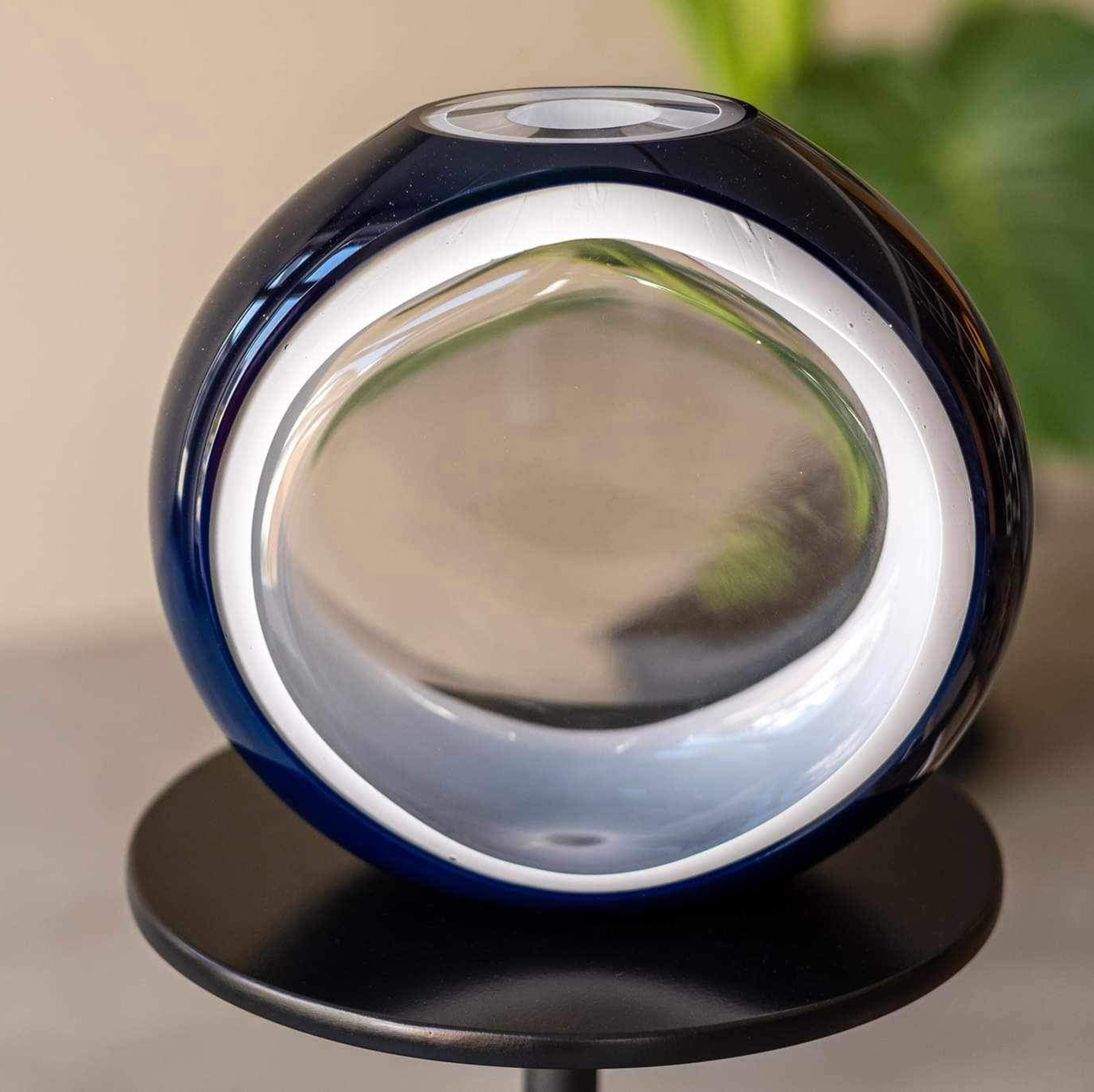
It is in the dialogue between the craftsworker and the designer/artist that the collaborative process of personal and professional interrelationships is established, whereby one person sometimes conceives of the design and the craft worker makes the piece. However, this interpretation is not at all linear, and in the specific case of glass (blown and architectural), owing to its technical complexity, it demands expert work by those who execute it. This paper will focus on the Portuguese glass panorama—that is, the relationship between studios, artists, and craftworkers—presenting innovative works and explaining the dialogues that occur during the process of glassblowing—the stories and methodologies. The paper will analyse designers’ creations; students’ research projects; and the last work done at Antunes heritage stained-glass studio, which I contributed to.
References
Almeida, T. (2024). L'Art et l'Artisanat de l'Immatérialité du Verre I – Dialogues autour du Verre Soufflé [The Art and Craft of the Immateriality of Glass I – Dialogues on Blown Glass]. In D. Loureiro (coord). Abecedaire (pp. 160-170). i2ADS.
Almeida, T. & Lochorey E. (2021). Stained Glass Workshop Heritage in Portugal with more than 100 Years. International Journal of Art and Art History, 9(1), 1-12. https://doi.org/10.15640/ijaah.v9n1a1
Almeida, T. (2021). A Study of the Contemporary Portuguese Stained Glass: Artists and Works. International Journal of Architecture, Arts and Applications, 7(2), 24-32 . https://doi.org/10.11648/j.ijaaa.20210702.11
Almeida, T. (2020). Design Glass Objects: The Portuguese Panorama. Arts, 9(3), 79. https://doi.org/10.3390/arts9030079
Barros, C. (1969). Real Fábrica de vidros da Marinha Grande, II centenário 1769-1969. Fábrica – Escola Irmãos Stephens, reedição [Royal Glass Factory of Marinha Grande, 2nd Centenary 1769-1969. Factory – Stephens Brothers School, reissue.]. Edições Magno.
Bart, C. (2019). Material and Mind. The MIT Press. https://doi.org/10.7551/mitpress/12199.001.0001
Bell, J. (2009). Mirror of the world – A New history of Art. Thames & Hudson.
Brinck, I. (2024). Craft thinking. A relational approach to making and design. In Groth, C. Nimkulrat, N. (ed). Craft and Design Practice from an Embodied Perspective (pp 30-29). Routledge. https://doi.org/10.4324/9781003328018-5
Busch, O. (2013). Colaborative Craft Capabilities. The Bodyhood of Shared Skills. The journal of Modern Craft, 6(2), 135-146. https://doi.org/10.2752/174967813X13703633980731
Clarke, B. (Ed.). (1979). Architectural stained glass. John Murray.
Domer, P. (1997). The Culture of Craft. Manchester University Press.
Fabri, R. (1967). Color. A complete guide for artists. Watson-Guptill Publications.
Gage, J. (2006). Color and Meaning. Art, Science and Symbolism. Thames & Hudson.
Greenhalgh, P. (Ed). (2002). The Persistence of Craft: the Applied Art Today. Herbert Press. https://doi.org/10.5040/9781789942774
Groth, C. & Kimmel, M. (2024). Dynamic affordances in human‑material “dialogues”. In Groth, C. Nimkulrat, N. (ed). Craft and Design Practice from an Embodied Perspective (pp. 17-29). Routledge. https://doi.org/10.4324/9781003328018
Groth, C., & Gulliksen, M.S. (2024). Thinking through hands in education. In C. Groth, & T. Schilhab. (Eds.) Embodied Learning and Teaching Using the 4E Cognition Approach. Exploring Perspectives in Teaching Practices (pp. 83-92). Routledge. https://doi.org/10.4324/9781003328018-4
Groth, C. (2017). Making Sense Through Hands. Design and Craft Practice Analysed as Embodied Cognition. [Doctoral dissertation, Aalto University]. https://aaltodoc.aalto.fi/handle/123456789/24839
Heller, E. (2007). A psicologia das cores. (Editorial Gustavo Gili). Le Livros. https://jonasjr.wordpress.com/wp-content/uploads/2018/09/a_psicologia_das_cores_emocao_razao_eva-heller.pdf
Hemmings, J. (2023). Can That Be Taught? Lessons in Embodied Knowledge from Memoir Writing for Craft & Design Education. In B. Veres & R. Shusterman. Somaesthetics and Design Culture (pp. 77–106). Brill. https://doi.org/10.1163/9789004536654_005
Kandinsky. (1987). Do Espiritual na Arte, primeira edição, colecção: Arte e Sociedade [On the Spiritual in Art, first edition, collection: Art and Society]. Martins Fontes. (Original date 1910) https://auh308.wordpress.com/wp-content/uploads/2013/03/sem-9-kandinsky.pdf
Marques E. M. (2000). Relatório parcelar – AAVV, Memória e identidades profissionais – reprodução de sistemas sócio-técnicos [Partial report – AAVV, Memory and professional identities – reproduction of socio-technical systems](final report Praxis/PCSH/P/ANT/44/96)– FCSH-UNL (pp. 211-268).
Marques E. M. (2013). Os '10 minutos': conhecimento técnico, hierarquia e força de trabalho entre os vidreiros da Marinha Grande [The '10 minutes': technical knowledge, hierarchy and workforce among the glassworkers of Marinha Grande.]. In B. Monteiro & J. D. Pereira (eds). []De pé sobre a terra: estudos sobre a indústria, o trabalho e o movimento operário em Portugal [Standing on the ground: studies on industry, labor and the labor movement in Portugal]. (pp. 1073-1093). Universidade Nova de Lisboa. http://hdl.handle.net/10362/11192
Medici, T., Coutinho, I., Alves, L., Gratuze, B., Vilarigues, M. (2017). Looking through late medieval and early modern glass in Portugal. In S. Wolf, A. Pury-Gysel (Eds.)., Annales du 20e congrès de l’association international pour l’histoire du verre [Annals of the 20th Congress of the International Association for the History of Glass] (pp. 412-420). AIHV.
Mello, R. & Almeida, T. (2022). What will happen to glass museums in industrial areas, considering that production sites are shifting?. Reviews on glass, 5-10. https://glass.mini.icom.museum/wp-content/uploads/sites/12/2023/04/Baja-review_on_glass_10_compressed-1.pdf
O’Connor, E. (2024). Becoming with glass Medium and materiality in embodied knowledge. In C. Groth, & N. Nimkulrat (Eds.). Craft and Design Practice from an Embodied Perspective (pp. 40-51). Routledge. https://doi.org/10.4324/9781003328018-6
Ravetz, A., Kettle, A., Felcey, H. (Eds). (2017). Collaboration Through Craft. Bloomsbury Publishing. https://doi.org/10.5040/9781350007130
Redol, P. (2014). Os vitrais da capela-mor do Mosteiro da Batalha – 1.ª parte [The stained glass windows of the chancel of the Batalha Monastery – Part 1]. In Cadernos de estudos leirienses [Leiria Studies Notebooks](No. 1 (May 2014), 159-168.] Textiverso. https://www.academia.edu/9151546/Os_vitrais_da_capela-mor_do_Mosteiro_da_Batalha_-_1.a_parte
Shales, E. (2017). The Shape of Craft. Reaktion Books.
Santos, C. P. (2022). Authorship in glass design in Portugal – four cycles: from 50 ́s to contemporaneity. In M.A. Barucco, E. Cattaruzza, & R. Chiesa. Antifragile Glass. Proceedings of the Antifragile Glass Conference – Venice, November 18th, 2022 (pp. 88-97). Arteferma. https://www.anteferma.it/aob/index.php/antefermaopenbooks/catalog/view/3/12/115
Downloads
Published
How to Cite
Issue
Section
License
Copyright (c) 2026 Teresa Almeida

This work is licensed under a Creative Commons Attribution 4.0 International License.
Authors who publish with this journal agree to the following terms:
- Authors retain copyright and grant the journal right of first publication with the work simultaneously licensed under a Creative Commons Attribution 4.0 License that allows others to share the work with an acknowledgement of the work's authorship and initial publication in this journal.
- Authors are able to enter into separate, additional contractual arrangements for the non-exclusive distribution of the journal's published version of the work (e.g., post it to an institutional repository or publish it in a book), with an acknowledgement of its initial publication in this journal.
- Authors are permitted and encouraged to post their work online (e.g., in institutional repositories or on their website) prior to and during the submission process, as it can lead to productive exchanges, as well as earlier and greater citation of published work (See The Effect of Open Access).
- The author(s) must manage their economic reproduction rights to any third party.
- The journal makes no financial or other compensation for submissions, unless a separate agreement regarding this matter has been made with the author(s).
- The journal is obliged to archive the manuscript (including metadata) in its originally published digital form for at least a suitable amount of time in which the manuscript can be accessed via a long-term archive for digital material, such as in the Norwegian universities’ institutional archives within the framework of the NORA partnership.
The material will be published OpenAccess with a Creative Commons 4.0 License which allows anyone to read, share and adapt the content, even commercially under the licence terms:
This work needs to be appropriately attributed/credited, a link must be provided to the CC-BY 4.0 licence, and changes made need to be indicated in a reasonable manner, but not in any way that suggests that the licensor endorses you or your use.
Cited by