Crafting Individualism
Cross-Cultural Expressions in Contemporary Jewellery – related Practice
DOI:
https://doi.org/10.7577/formakademisk.6320Keywords:
Individualism, cross-culture, practice-based research, craft, jewelleryAbstract
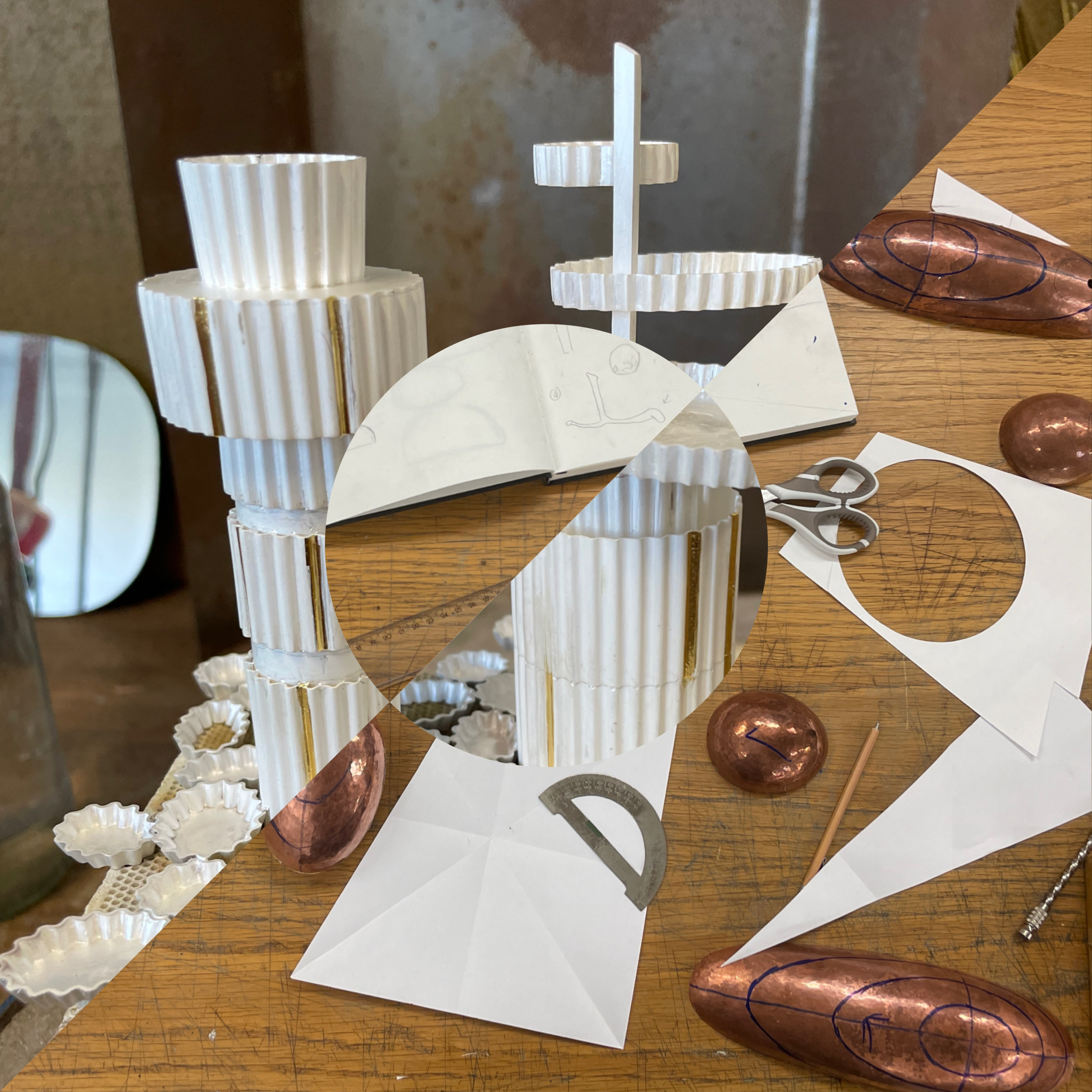
This article presents a cross-cultural study employing a heuristic research methodology through design (RtD) to investigate how individualism, rooted in Chinese and Western cultural contexts, informs contemporary jewellery practices. By focusing on divergent creative priorities—Western work emphasising individual viewpoint versus Chinese reinterpretations that balance personal expression with collective cultural identity—the study explores the creative process of interaction of cross-cultural crafts. Based on the author’s experience navigating these cultural contexts, the research reflects on two parallel jewellery practices created from a shared creative motif. These projects reveal how cultural contexts influence artistic decision-making processes and outcomes. Contrary to assumptions of binary cultural opposition, the findings demonstrate a hybridised creative stance emerging from the interplay of Chinese and Western individualism. The study contributes to the global discourse on cultural diversity in contemporary jewellery by contextualising the growing presence of Chinese jewellers in Europe. It offers a framework to help European educators and curators interpret Chinese works through a cultural lens while providing practical insights for Chinese artists adapting to European creative paradigms.
References
Adamson, G. (2007). Thinking through craft (English ed.). Berg.
Bürger, P. (1984). Theory of the avant-garde. University of Minnesota Press. https://doi.org/10.3817/0984061186
Buswell, R. E., & Lopez, D. S. (2013). The Princeton dictionary of Buddhism (1 ed.). Princeton University Press. https://doi.org/10.1515/9781400848058
Candy, L. (2020). Reflection through research. In The Creative Reflective Practitioner: Research through making and practice (1 ed., pp. 234-250). Routledge. https://doi.org/10.4324/9781315208060-6
Cao, B. (2020). Chinese Contemporary Jewelry Design. Schiffer Publishing.
Collingwood, R. G. (1938). The principles of art. Clarendon Press.
Cunningham, J. (2008). Contemporary European narrative jewellery : the prevalent themes, paradigms and the cognitive interaction between maker, wearer and viewer observed through the process, production and exhibition of narrative jewellery. [The Glasgow School of Art].
Deng, X. (2010).中西艺术精神比较 [Comparative Essence of China-Western Artistic Ethos]. Hundred School in Arts, 26(04), 44-56+43. https://doi.org/10.3969/j.issn.1003-9104.2010.04.009
Drutt, H. W., & Dormer, P. (1995). Jewelry of our time : art, ornament, and obsession. Thames and Hudson.
Frayling, C. (1993). Research in Art and Design. Royal College of Art Research Papers, 1(1), 1-5. https://antle.iat.sfu.ca/wp-content/uploads/2018/08/Frayling.pdf
Hang, J. (2014).工艺美术”在中国的五次误读 [Five Historical Misreadings of "Craft Art" in China]. Literature & Art Studies, (06), 114-123.
Hang, J. (2024).中国传统工艺的当代价值研究 [A Study of the Contemporary Value of Traditional Chinese Craftsmanship]. Chinese Journal of Art Studies, (03), 143-144.
Krauss, R. E. (1985). The originality of the avant-garde and other modernist myths.i
Li, Y., & Zhang, Y. (2023). 道家审美机制的建构与反思——以《庄子·养生主》之“庖丁解牛”为中心 [The Construction and Reconsideration of the Daoist Aesthetic Paradigm — Centering on "The Butcher Ding’s Ox-Dissection" in Zhuangzi·Yangsheng Zhu]. Journal of Aesthetic Education, 14(5), 104-111. https://doi.org/10.20073/j.cnki.2095-0012.2023.05.014
Ma, Y. (2025). Ma Yuan Water Paint. The Palace Museum. https://www.dpm.org.cn/collection/paint/229607.html
Mazanti, L. (2020). Super-Objects: Craft as an Aesthetic Position. In M. E. Buszek (Ed.), Extra/ordinary: Craft and contemporary art (pp. 59-82). Duke University Press. https://doi.org/10.1515/9780822392873-007
Moustakas, C. E. (1990). Heuristic research : design, methodology, and applications. Sage. https://doi.org/10.4135/9781412995641
Niushoushan. (2025). Sarira of the Buddha. Nanjing Niushoushan Cultural Tourism Group Co. Retrieved 13 May, 2026 from https://www.niushoushan.net/Shirley.html
Pevsner, N. (2003). Pioneers of modern design from William Morris to Walter Gropius (Rev. ed.). Penguin.
Phillips, C. (2019). Jewels & jewellery (Revised and expanded edition. ed.). Thames and Hudson.
Risatti, H. (2007). A theory of craft : function and aesthetic expression. University of North Carolina Press.
Rothwell, S. (2023). Not So Hidden Messages. Jewellery Studies, (1), 4.
Schön, D. A. (2008). The Reflective Practitioner : How Professionals Think in Action. Basic Books. http://ebookcentral.proquest.com/lib/ed/detail.action?docID=1113868
Song, J. (2023). 中国画中的色彩观与造境意识浅谈 [The Aesthetic Dialogue of Chromatics and Spatial Poetics in Traditional Chinese Painting]. Art Market, (03), 86-87.
Stevenson, A. (2011). Oxford dictionary of English (3rd / edited by Angus Stevenson). Oxford University Press.
Su, H. (2006). 中西艺术审美比较刍议 [Comparative Perspectives on China-Western Artistic Aesthetics]. Journal of Minzu University of China, (06), 136-139. https://doi.org/10.15970/j.cnki.1005-8575.2006.06.026
Throne, R. (2019). Autoethnography and heuristic inquiry for doctoral-level researchers emerging research and opportunities. IGI Global. https://doi.org/10.4018/978-1-5225-9365-2
Tian, X., & Lan, C. (2024).试述色彩对国画意境塑造的影响 [The Impact of Colour on the Aesthetic Ideation of Traditional Chinese Painting]. Art Market, (07), 84-85.
Veiteberg, J. (2001). Jewellery – The art of small objects and large subjects. In L. F. (Ed.), Nordisk Smycke Triennale 2 (pp. 18–25). Nyt Nordisk Forlag Arnold Busck.
Wang, C. (2023). 论艺术形式创制的有物性和无物性——从意义发生看中西艺术范式差异 [Present‑Thingness and Absent‑Thingness in Artistic Formulation — Paradigmatic Divergences between Chinese and Western Art through the Emergence of Meaning]. Academic Research, (11), 152-161+178.
Wang, X., & Sun, Q. (2022). Integration: Ancient and Modern. China National Arts & Crafts Society. https://www.brgallery.com/article/5/“熔古·铸今”:中国国际当代金属艺术展.html
Watkins, D. (1993). The best in contemporary jewellery. Batsford.
Ye, L. (1985). 中国美学史大纲 [Outline of the History of Chinese Aesthetics]. Shanghai People's Publishing House.
Zhang, L. (2022). The Chinese practice of Yi Jing (意境) and its application to animation (Doctoral Thesis). Sure/ The University of Sunderland. https://sure.sunderland.ac.uk/id/eprint/14724/
Zong, B. (1981). 美学的散步 [Aesthetic Meanderings]. Hongfan.
Downloads
Published
How to Cite
Issue
Section
License
Copyright (c) 2026 Qiwei Liu, Sarah Kettley, Keeryong Choi, Collette Paterson

This work is licensed under a Creative Commons Attribution 4.0 International License.
Authors who publish with this journal agree to the following terms:
- Authors retain copyright and grant the journal right of first publication with the work simultaneously licensed under a Creative Commons Attribution 4.0 License that allows others to share the work with an acknowledgement of the work's authorship and initial publication in this journal.
- Authors are able to enter into separate, additional contractual arrangements for the non-exclusive distribution of the journal's published version of the work (e.g., post it to an institutional repository or publish it in a book), with an acknowledgement of its initial publication in this journal.
- Authors are permitted and encouraged to post their work online (e.g., in institutional repositories or on their website) prior to and during the submission process, as it can lead to productive exchanges, as well as earlier and greater citation of published work (See The Effect of Open Access).
- The author(s) must manage their economic reproduction rights to any third party.
- The journal makes no financial or other compensation for submissions, unless a separate agreement regarding this matter has been made with the author(s).
- The journal is obliged to archive the manuscript (including metadata) in its originally published digital form for at least a suitable amount of time in which the manuscript can be accessed via a long-term archive for digital material, such as in the Norwegian universities’ institutional archives within the framework of the NORA partnership.
The material will be published OpenAccess with a Creative Commons 4.0 License which allows anyone to read, share and adapt the content, even commercially under the licence terms:
This work needs to be appropriately attributed/credited, a link must be provided to the CC-BY 4.0 licence, and changes made need to be indicated in a reasonable manner, but not in any way that suggests that the licensor endorses you or your use.
Cited by