Reconstruction of Akershus’ rose window
How Emanuel Vigeland revealed light by darkness
DOI:
https://doi.org/10.7577/formakademisk.6343Keywords:
Stained-glass, reconstruction, Oslo, Vigeland, medievalAbstract
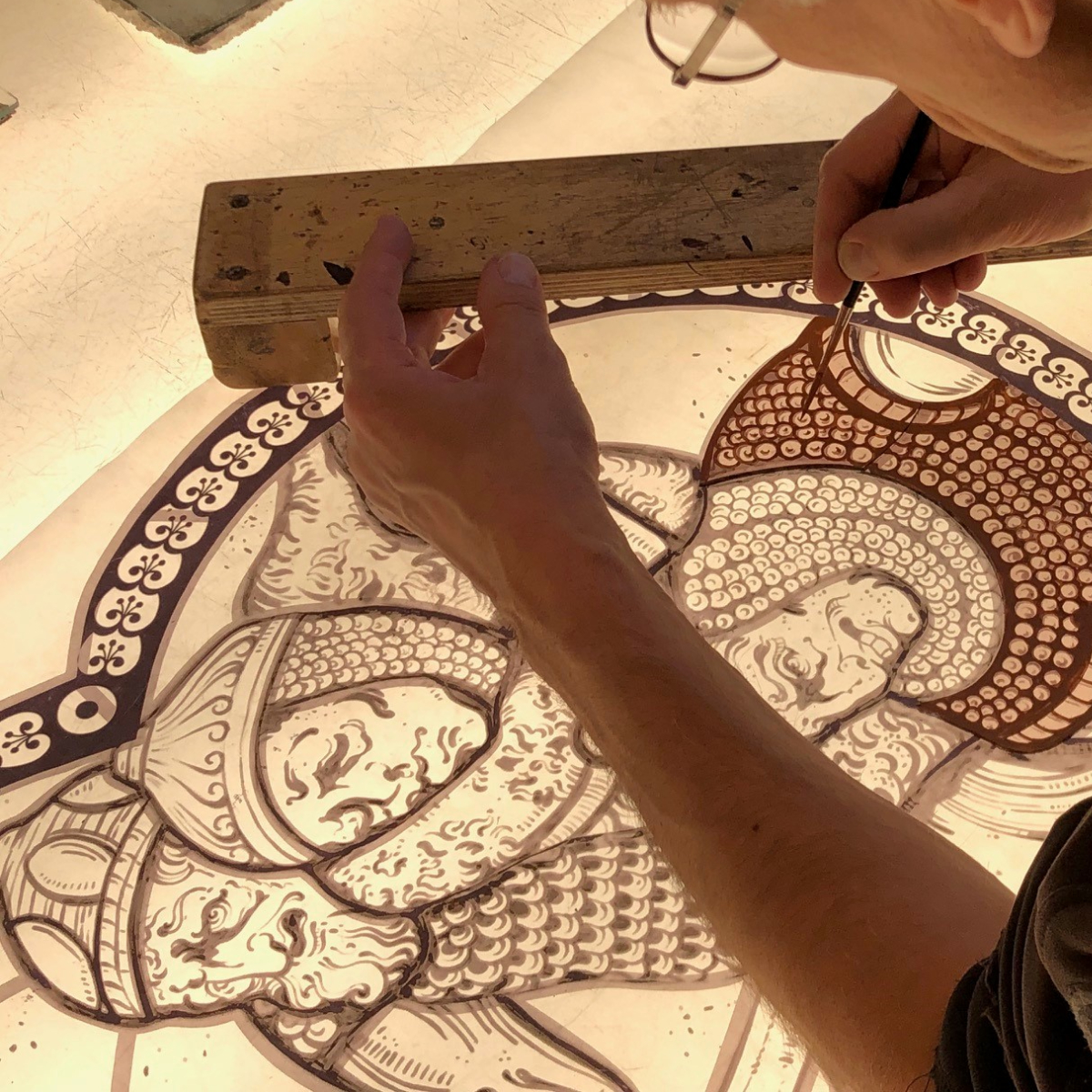
Emanuel Vigeland was a Norwegian artist who created and realized the rose window in 1919/20 for the fortification Akershus in Oslo, becoming the representative place for the new Norwegian dynasty. He was self-taught glass painter and studied medieval stained-glass in France as well as lightning of sacred places down to Italy and was heavily influenced by the British Arts and Crafts Movement. In his work he focused on darkness and created thereby light. In 1943, the DS Selma in service of the SS, exploded in the Oslo harbor. The explosion destroyed the rose window. The few remaining panels were conserved, restored, and reinstalled in 2001. 2 years later, the artists’ original sketches were found by chance, as well as fragments of the shattered panels. In addition to 2 historical photos, a basis for the reconstruction of the missing fields was given and a pluridisciplinary and meticulous journey began recreating the rose window in 2022.
References
Albrektsen, L. (1999). Monumentalkunstneren [The Monumental Artist]. In N. Messel (Ed.), Emanuel Vigeland (1875–1948), Vigeland-museets skrifter 16 (pp. 23–38). The Vigeland Museum.
Berg, H. & Hauglid, K. (2023). Rosevinduet i Olav Vs hall på Akershus slott. Krigsdrama, kulturskatt og mysterium i flere akter [The rose window in Olav V’s Hall at Akershus Castle. A war drama, a cultural treasure, and a mystery in several acts.], St. Hallvard, 1, 24–37.
Brandi, C. (2022). Teoria del Restauro. La nave di Teseo.
Faye, A. (2000). Glassmaleriene i Nidaros domkirke [The stained-glass windows in Nidaros Cathedral]. Two vols. Nidaros domkirkes restaureringsarbeiders forlag.
Furnes, T. K. (2013). Emanuel Vigeland – Vita. Dreyers forlag.
Hauglid, K. (2024). Emanuel Vigeland’s stained glass – life, death, and comforting angels. In J. Simpson & A.-M. von Bonsdorff (Eds.), Gothic modern. From Edvard Munch to Käthe Kollwitz (pp. 132–139). Ateneum Finnish National Gallery/Hirmer Publishers.
Lee, L., Seddon, G., & Stephens, F. (1976). Stained glass. Crown Publishers.
Malmström, K. (1975). Oscarskyrkan. Sveriges kyrkor (Stockholm IX: 2). Riksantikvarieämbetet.
‘Nye glasmalerier av Emanuel Vigeland’ [New stained-glass windows by Emanuel Vigeland], Morgenbladet, no. 546, 31 October 1917.
Schaufler, R. (2024). Vålerenga kirke. Kirken, brannen og kunsten [Vålerenga Church. The church, the fire, and the art.]. Reiner Schaufler.
Tangevold, E. B. (2024). Reetablering av norsk glassmaleri 1900–1913 [The Re-establishment of Norwegian Stained Glass 1900–1913]. Kunst og Kultur, 107(1–2), 14–32. https://doi.org/10.18261/kk.107.1-2.3
Tschudi-Madsen, S. (2001). 50 år for Akershus 1951–2001. Akershus slotts venners jubileumsskrift [50 Years for Akershus 1951–2001: Anniversary Publication of the Friends of Akershus Castle]. Andresen & Butenschøn.
Venice Charter. (n.d.). https://www.icomos.org/charters-and-doctrinal-texts/
Wadell, M.-B. (1999). Tidlige malerier [Early paintings]. In N. Messel (Ed.), Emanuel Vigeland (1875–1948), Vigeland-museets skrifter 16 (pp. 9–22). The Vigeland Museum.
Downloads
Published
How to Cite
Issue
Section
License
Copyright (c) 2026 Christa Heidrich, Kjartan Hauglid

This work is licensed under a Creative Commons Attribution 4.0 International License.
Authors who publish with this journal agree to the following terms:
- Authors retain copyright and grant the journal right of first publication with the work simultaneously licensed under a Creative Commons Attribution 4.0 License that allows others to share the work with an acknowledgement of the work's authorship and initial publication in this journal.
- Authors are able to enter into separate, additional contractual arrangements for the non-exclusive distribution of the journal's published version of the work (e.g., post it to an institutional repository or publish it in a book), with an acknowledgement of its initial publication in this journal.
- Authors are permitted and encouraged to post their work online (e.g., in institutional repositories or on their website) prior to and during the submission process, as it can lead to productive exchanges, as well as earlier and greater citation of published work (See The Effect of Open Access).
- The author(s) must manage their economic reproduction rights to any third party.
- The journal makes no financial or other compensation for submissions, unless a separate agreement regarding this matter has been made with the author(s).
- The journal is obliged to archive the manuscript (including metadata) in its originally published digital form for at least a suitable amount of time in which the manuscript can be accessed via a long-term archive for digital material, such as in the Norwegian universities’ institutional archives within the framework of the NORA partnership.
The material will be published OpenAccess with a Creative Commons 4.0 License which allows anyone to read, share and adapt the content, even commercially under the licence terms:
This work needs to be appropriately attributed/credited, a link must be provided to the CC-BY 4.0 licence, and changes made need to be indicated in a reasonable manner, but not in any way that suggests that the licensor endorses you or your use.
Cited by