Memory of Textile Crafts
A learning game for dialogues in textile design education
DOI:
https://doi.org/10.7577/formakademisk.6348Keywords:
Textile Crafts, Dialogue Tool, Design Education, Learning Game, Textile TechniquesAbstract
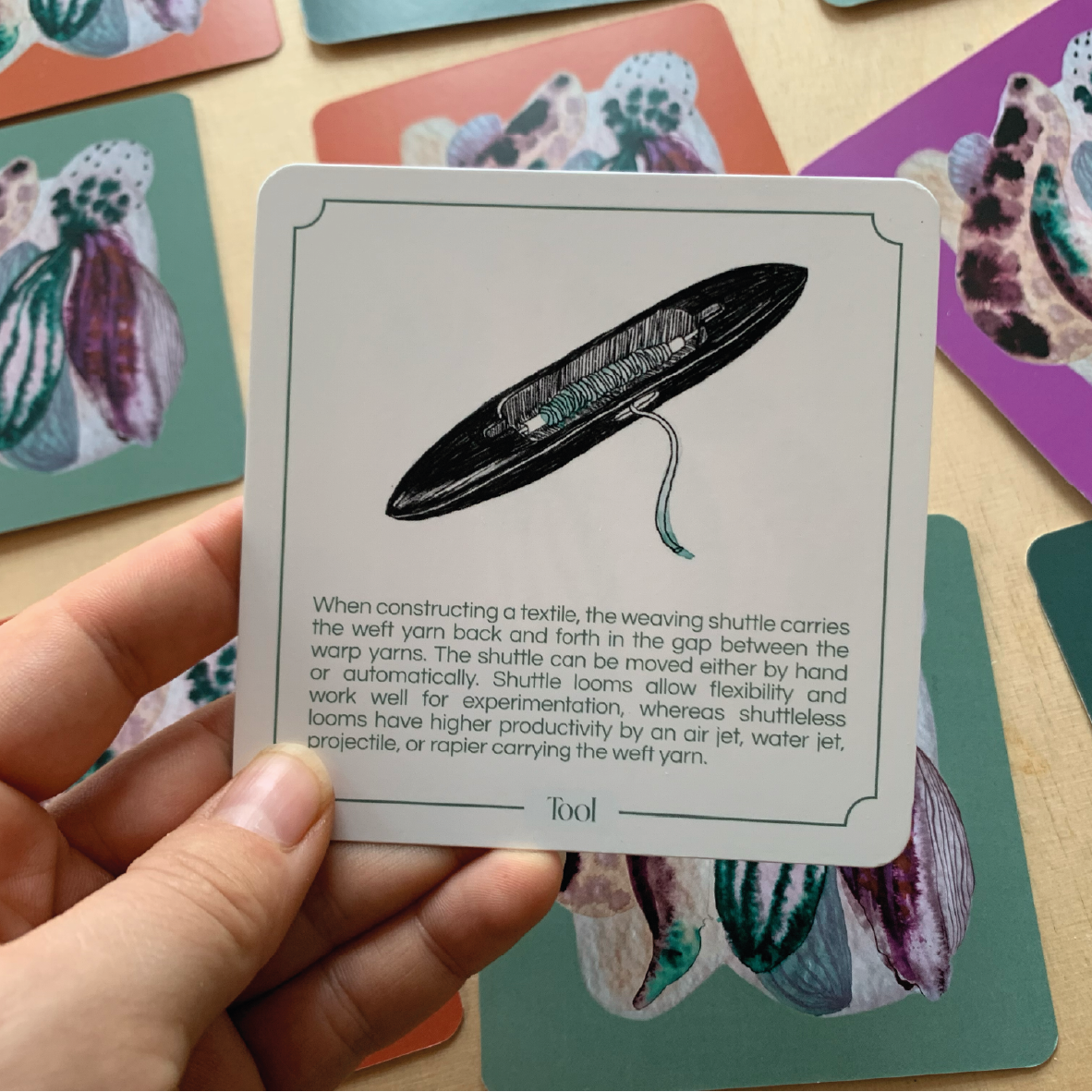
This article presents the development of and first experiences in teaching practice with ‘Memory of Textile Crafts’, a memory game-like learning game to facilitate discussion around textile techniques in (textile) design education. In the game, students are asked to collaboratively find matches of four technique cards representing one of seven specific textile techniques and to further discuss the techniques through general construction logics, qualities and contexts. The learning game is introduced in different contexts, whereof two cases from teaching are described and discussed here. Here we see its agility to combine with exercises and integrate it in teaching to address different cognitive levels of learning. Furthermore, the article proposes a Compass of Textile Logics to frame textile techniques as transformations between levels and logics.
References
Adamson, G. (2013). The invention of craft. Bloomsbury. https://doi.org/10.5040/9781350036123
Anderson, L. W., Krathwohl, D. R., Airasian, P. W., Cruikshank, K. A., Mayer, R. E., Pintrich, P. R., Raths, J., & Wittrock, M. C. (2014). A taxonomy for learning, teaching, and assessing: A revision of Bloom’s taxonomy of educational objectives. Pearson Education Limited.
Bak-Andersen, M. (2018). When matter leads to form: Material driven design for sustainability. Temes de Disseny, 34, 10–33. https://doi.org/10.46467/TdD34.2018.10-33
Bakker, A. B. (2005). Flow among music teachers and their students: The crossover of peak experiences. Journal of Vocational Behavior, 66(1), 26–44. https://doi.org/10.1016/j.jvb.2003.11.001
Bloom, B. S., & Krathwohl, D. R. (1956). Taxonomy of educational objectives: The classification of educational goals. David McKay.
Brekke Koppen, M. (1982). Indføring i billedvævning [Introduction to tapestry]. Notabene.
Dalgaard, L., & Adam, P. (Eds.). (2024). VÆV! Design – materialer – håndværk [WEAVE! Design – materials – craftsmanship]. Forlaget Mellemværket.
Destex. (n. d.). Industrial and creative design in advanced textile manufacturing. www.destexproject.eu
Dumitrescu, D., & Motta, M. (2023). Material practices in transition: From analogue to digital in teaching textile and fashion design. DIID, 1, 908. https://doi.org/10.30682/diiddsi23t5i
European Commission. (2024). EU strategy for sustainable and circular textiles 2024. https://environment.ec.europa.eu/strategy/textiles-strategy_en
Fashionary. (2021). Textilepedia: The complete fabric guide. Fashionary.
Fashion Seeds. (n.d.). Fashion Design for Sustainability: Resources for Tutors. www.fashionseeds.org
Garone, P., & Nesteriuk, S. (2019). Gamification and learning: A comparative study of design frameworks. In V. G. Duffy (Ed.), Digital human modeling and applications in health, safety, ergonomics and risk management: Healthcare applications (pp. 473–487). Springer International Publishing. https://doi.org/10.1007/978-3-030-22219-2_3
Gohl, E. P. G., & Vilensky, L. D. (1984). Textile science: An explanation of fibre properties. Guilford Publications.
Hall, C. A., Hasling, K. M., & Ræbild, U. (2025). Design for recyclability: Textiles. In U. Barth (Ed.), Springer handbook of circular plastics economy (pp. 583–601). Springer. https://doi.org/10.1007/978-3-031-66209-6_29
Hallett, C., & Johnston, A. (2014). Fabric for fashion: The complete guide. Laurence King Publishing.
Hasling, K. M., & Ravnløkke, L. (2021). Micro-scale curriculum development in design for sustainability education. In E. Brandt, T. Markussen, E. Berglund, G. Julier, & P. Linde (Eds.), Proceedings of Nordes 2021: Matters of Scale, (pp. 418-422). Nordes. https://doi.org/10.21606/nordes.2021.47
Hasling, K. M., & Ræbild, U. (2017). Sustainability Cards: Design for longevity. In C.A. Bakker & R. Mugge (Eds). PLATE 2017 Conference Proceedings, (pp. 166-170). IOS Press BV. https://doi.org/10.3233/978-1-61499-820-4-166
Hasling, K. M., & Ræbild, U. (2021). Building sustainable material narratives with Material Pathways. In H. Grierson, E. Bohemia, & L. Buck (Eds.), Proceedings of the 23rd International Conference on Engineering and Product Design Education. The Design Society. https://doi.org/10.35199/EPDE.2021.4
Hatch, K. L. (1993). Textile science. Tailored Text Custom Publishing.
Karana, E., Barati, B., Rognoli, V., & Zeeuw van der Laan, A. (2015). Material driven design (MDD): A method to design for material experiences. International Journal of Design, 2(9), 35–54. https://www.ijdesign.org/index.php/IJDesign/article/view/1965
Klein, B. D., Rossin, D., Guo, Y. M., & Ro, Y. K. (2010). An examination of the effects of flow on learning in a graduate-level introductory operations management course. Journal of Education for Business, 85(5), 292–298. https://doi.org/10.1080/08832320903449600
Krogh, P. G., & Koskinen, I. (2021). Drifting by intention: Four epistemic traditions from within constructive design research. Springer. https://doi.org/10.1007/978-3-030-37896-7
Lund, E. (1971). Jeg syr selv [I sew myself.] (Politikens håndbogsserie). Politiken.
Paterson, A. S. (Ed.). (1900). The big book of needlecraft. Odhams Press Ltd.
Petersen, M. (Ed.). (1995). Bonniers store håndarbejdsleksikon: Teknikker og traditioner (1–20) [Bonnier's big needlework encyclopedia: Techniques and traditions (1–20)]. Bonniers Bøger.
Porsild, M. (1974). Det store håndarbejdsleksikon [The big needlework encyclopedia]. Huset for Håndarbejde.
Redström, J. (2017). Making design theory. MIT Press. https://doi.org/10.7551/mitpress/11160.001.0001
Ræbild, U., & Hasling, K. M. (2018). Sustainable Design Cards: A learning tool for supporting sustainable design strategies. In K. Niinimäki (Ed.), Sustainable fashion in a circular economy (pp. 128-151). Aalto University.
Salolainen, M., Fagerlund, M., & Leppisaari, A.-M. (2022). Interwoven: Exploring materials and structures. Aalto University. https://textiles.aalto.fi/interwoven/
Sterling, S. (2010). Transformative learning and sustainability: Sketching the conceptual ground. Learning and Teaching in Higher Education, 5, 17–28.
The Craft Library. (n.d.). Material Library. www.crafthub.eu/material/
Tolnov Larsen, A. (2025). From fiber to form: Exploring design qualities of mechanically recycled textiles [PhD dissertation]. Royal Danish Academy – Architecture, Design and Conservation.
Downloads
Published
How to Cite
Issue
Section
License
Copyright (c) 2026 Karen Marie Hasling , Louise Ravnløkke

This work is licensed under a Creative Commons Attribution 4.0 International License.
Authors who publish with this journal agree to the following terms:
- Authors retain copyright and grant the journal right of first publication with the work simultaneously licensed under a Creative Commons Attribution 4.0 License that allows others to share the work with an acknowledgement of the work's authorship and initial publication in this journal.
- Authors are able to enter into separate, additional contractual arrangements for the non-exclusive distribution of the journal's published version of the work (e.g., post it to an institutional repository or publish it in a book), with an acknowledgement of its initial publication in this journal.
- Authors are permitted and encouraged to post their work online (e.g., in institutional repositories or on their website) prior to and during the submission process, as it can lead to productive exchanges, as well as earlier and greater citation of published work (See The Effect of Open Access).
- The author(s) must manage their economic reproduction rights to any third party.
- The journal makes no financial or other compensation for submissions, unless a separate agreement regarding this matter has been made with the author(s).
- The journal is obliged to archive the manuscript (including metadata) in its originally published digital form for at least a suitable amount of time in which the manuscript can be accessed via a long-term archive for digital material, such as in the Norwegian universities’ institutional archives within the framework of the NORA partnership.
The material will be published OpenAccess with a Creative Commons 4.0 License which allows anyone to read, share and adapt the content, even commercially under the licence terms:
This work needs to be appropriately attributed/credited, a link must be provided to the CC-BY 4.0 licence, and changes made need to be indicated in a reasonable manner, but not in any way that suggests that the licensor endorses you or your use.
Cited by