Crafting lines
Cultural Transmission and Embodied Knowledge in Romani Travellers’ Craftsmanship
DOI:
https://doi.org/10.7577/formakademisk.6349Keywords:
Crafting lines, embodied knowledge, Guttormsgaard Archive, Romani wire workshop, design cultureAbstract
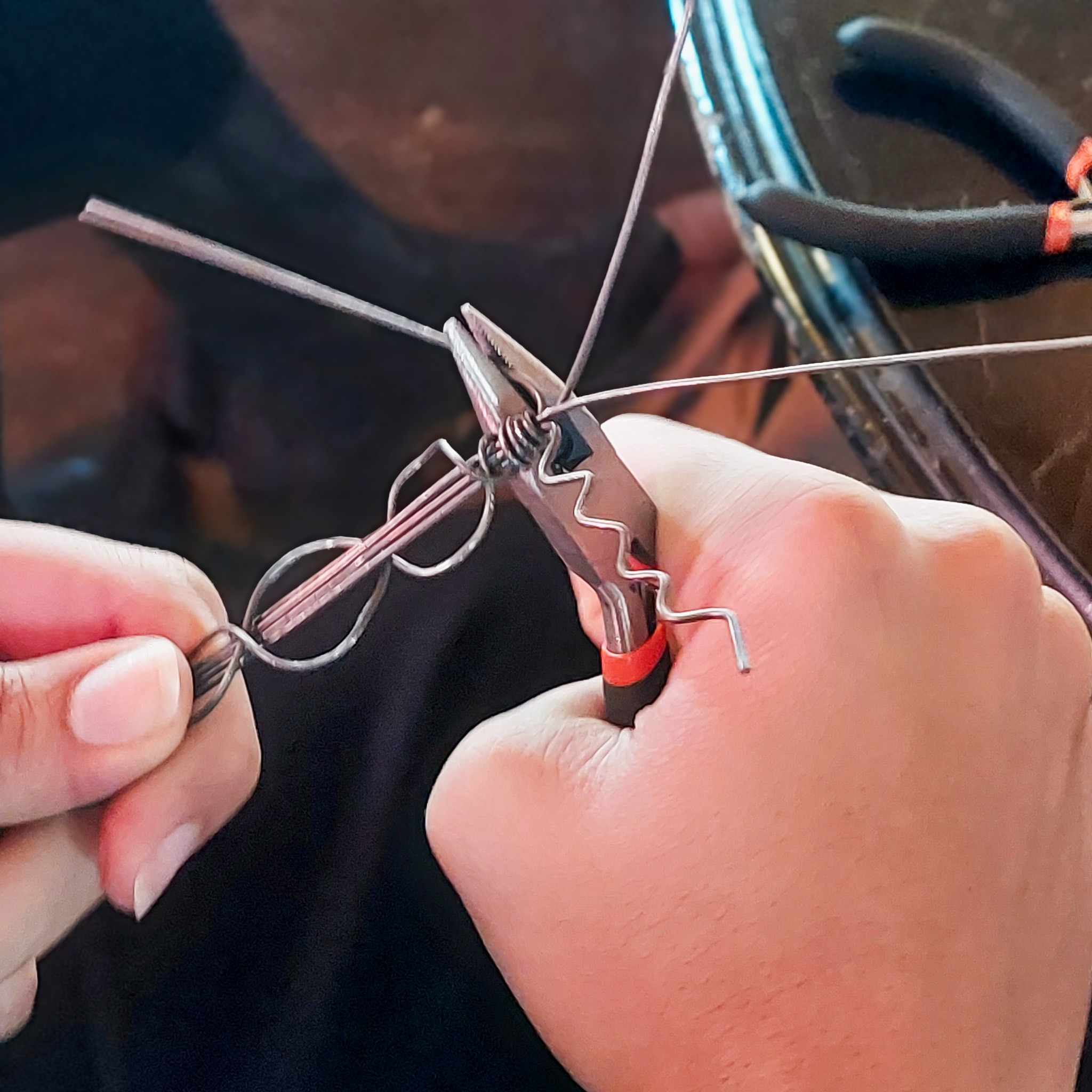
This article explores the significance of traditional Romani crafts, specifically wirework, as a vital component of Romani cultural heritage in Norway. It examines how these traditional practices, in which intangible cultural threads are interwoven with material skills, are transmitted and maintained, as well as how they find new meaning in contemporary design. The Guttormsgaard Archive serves as the primary research site—a space where products function as carriers of culture—and hosts a Romani wire workshop led by the musician and craftsman Elias Akselsen. Together, these elements provide a means of observing how the act of crafting lines, both literal and metaphorical, serves to preserve identity and foster an in-depth understanding of heritage. Through a qualitative case study methodology, including a workshop, interviews and participatory observations, combined with concepts of aesthetics and embodied consciousness, the research examines how material and narrative lines contribute to the contemporary role of craft in cultural preservation, education and societal comprehension.
References
Akner-Koler, C. (2007). Form & formlessness: Questioning aesthetic abstractions through art projects, cross-disciplinary studies and product design education [Doctoral thesis, School of Electrical and Computer Engineering, Chalmers tekniska högskola. Göteborg]. https://www.diva-portal.org/smash/get/diva2:1153218/FULLTEXT01.pdf
Baumgarten, A. G. (2008). Fra Aesthetica (1750). In K. Bale & A. Bø-Rygg (Eds.), Estetisk teori: en antologi [Aesthetic Theory: An Anthology] (pp. 11–16). Universitetsforlaget.
CraftHub EU. (2022). Craft in the context of cultural heritage and its continuing relevance in contemporary practice. Co-founded by the Creative Europe Programme of the European Union. Received April 2, 2026, from https://www.crafthub.eu/
European Union (2020). The New European Bauhaus EU. Received April 15, 2026, from https://new-european-bauhaus.europa.eu/index_en
Fabricius, J., Jørgensen, Å. E., Rasmussen, J., & Prestseter, E. (2025). Pist Protta 97. Space Poetry.
Fallan, K. (2019). Design culturing: Making design history matter. In G. Julier, A.V. Munch, M.N. Folkmann, H-C. Jensen & N.P. Skou (Ed.), Design culture: Objects and approaches (pp. 15–27). London: Bloomsbury Visual Arts. https://doi.org/10.5040/9781474289856.0007
Frayling, C. (2017). On craftmanship: Towards a new Bauhaus. Oberon Books.
Gamble, J. (2001). Modelling the Invisible: The pedagogy of craft apprenticeship. Studies in Continuing Education, 23(2), 185–200. https://doi.org/10.1080/01580370120101957
Greenberg, M. J. (2008). Euclidean and non-Euclidean geometries: Development and history (4th ed.). Freeman.
Grimsgaard, W., & Høie, L. (2018). Design og strategi [Design and strategy]. Cappelen Damm Akademisk.
Groth, C. (2017). Making sense through hands. Design and craft practice analysed as embodied cognition. (Doctoral thesis, Aalto University]. https://aaltodoc.aalto.fi/handle/123456789/24839
Guttormsgaard Archive. (n.d.). HVA NÅ. Guttormsgaards prosjekt om kunst (m/kjent og ukjent opphav) [WHAT NOW. Guttormsgaard's project about art (with known and unknown origins)]. Blaker Gml. Meieri 2006–2009. Guttormsgaard Archive.
Guttormsgaard, G. (2006). Guttormsgaard Archive. https://www.guttormsgaardsarkiv.no/
Hannah, G. G. (2002). Elements of design: Rowena Reed Kostellow and the structure of visual relationships. Princeton Architectural Press.
Heimer, A. (2020). Å gripe form for å begripe form. Konkret og abstrakt formforståelse [Grasping form to understand form. Concrete and abstract understanding of form] [Doctoral thesis]. University of South-Eastern Norway University.
Heimer, A. (2022). AestPra – a meta-methodology for art and craft. Nordic Journal of Art and Research, 11(1), 1-25. https://doi.org/10.7577/information.5066
Heimer, A. M., Andrassen, K., Haugen, S. (2017). Values of crafting in design education. In A. Berg, E. Bohemia, & L. Buck (Eds.), Proceedings of the 19th International Conference on Engineering and Product Design Education (E&PDE17), Building Community: Design Education for a Sustainable Future, Oslo, Norway, 7 & 8 September 2017 (pp. 116-121). Design Society.
Ingold, T. (2016). Lines: A brief history (1st ed.). Routledge. https://doi.org/10.4324/9781315625324
Larsen, B. K. (1991). En gang var vi som vinden [Once we were like the wind]. Gyldendal.
Larsen, B. K. (2001). Et annet folk [Another people]. Tiden. https://doi.org/oai:nb.bibsys.no:990104396414702202
Mäkelä, M. & Löytönen, T. (2015). Enhancing material experimentation in design education. In R. Vande Zande, E. Bohemia, & I. Digranes (Eds.), Proceedings of the 3rd International Conference for Design Education Researchers (pp. 168-183). Aalto University.
Malafouris, L. (2013). How things shape the mind. A theory of material engagement. MIT Press. https://doi.org/10.7551/mitpress/9476.001.0001
Malafouris, L., & Koukouti, M.-D. (2022). Where the touching is touched: The role of haptic attentive unity in the dialogue between maker and material. Multimodality & Society, 2(3), 265–287. https://doi.org/10.1177/26349795221109231
Mancia, L. (2025). Embodied epistemology as rigorous historical method. Cambridge University Press. https://doi.org/10.1017/9781009590334
Merleau-Ponty, M. (2012). Phenomenology of perception. Routledge. https://doi.org/10.4324/9780203720714
Møystad, M. Ø. (2006). Latjo drom. En nettutstilling om romanifolkets/taternes kultur og historie [Latjo drom. An online exhibition about the culture and history of the Romani/Tatar people]. Glomdalsmuseet/ Anno Museene i Hedmark. https://latjodrom.glomdalsmuseet.no/
Nimkulrat, N. (2012). Hands-on Intellect: Integrating craft practice into design research. International Journal of Design, 6(3), 1–14. https://www.ijdesign.org/index.php/IJDesign/article/view/1228
Nimkulrat, N., & Groth, C. (2024). Craft and design practice from an embodied perspective (1st ed.). Routledge. https://doi.org/10.4324/9781003328018
Pallasmaa, J. (2009). The thinking hand: existential and embodied wisdom in architecture. John Wiley & Sons.
Rodgers, P. A., & Yee, J. (2018). The Routledge companion to design research. Routledge.
Saito, Y. (2007). Everyday aesthetics. Oxford University Press.
Saito, Y. (2017). Aesthetics of the familiar: Everyday life and world-making. Everyday life and world-making. Oxford University Press. https://doi.org/10.1093/acprof:oso/9780199278350.001.0001
Sennett, R. (2008). The craftsman. Yale University Press.
Sevaldson, B., & Jones, P. (2019). An interdiscipline emerges: Pathways to systemic design. The Journal of Design, Economics, and Innovation, 5(2), 75–84. https://doi.org/10.1016/j.sheji.2019.05.002
Skov, T. K. (2022). Dannelsesmarkører i håndværket: En læsning af Richard Sennets værk Håndværkeren [Formation markers in the craft: A reading of Richard Sennet's work Håndværkeren]. Tidsskrift for professionsstudier, 18(34), 46–55. https://doi.org/10.7146/tfp.v18i35.134054
Stake, R. (1995). Case study research. Springer.
Stickdorn, M., Hormess, M. E., Lawrence, A., & Schneider, J. (2018). This is service design doing: Applying service design and design thinking in the real world: A practitioners' handbook. O'Reilly.
Tin, M. B. (2007). De første formene: folkekunstens abstrakte formspråk [The first forms: the abstract idiom of folk art] (Vol. 124). Novus.
Utdanningsdirektoratet. (2020). Romanifolk/tatere [Romani people/Taters]. Nasjonale Minoriteter. Utdanningsdirektoratet. https://www.udir.no/laring-og-trivsel/nasjonale-minoriteter/romanifolktatere/
Vie, G. P. (2012). De båtreisende – romanifolket som reiste sjøveien [The boat travelers – the Romani people who traveled by sea] (Vol. 8). Norsk kulturråd.
Yin, R. K. (2018). Case study research and applications (Vol. 6). Sage.
Zhao, X., Keat, O. B., Tham, J. (2024). The role of aesthetic awareness in enhancing college students' aesthetic literacy. International Journal of Multidisciplinary Research and Publications, 6(10), 100-103.
Downloads
Published
How to Cite
Issue
Section
License
Copyright (c) 2026 Astrid Maria Heimer, Haizea Perez

This work is licensed under a Creative Commons Attribution 4.0 International License.
Authors who publish with this journal agree to the following terms:
- Authors retain copyright and grant the journal right of first publication with the work simultaneously licensed under a Creative Commons Attribution 4.0 License that allows others to share the work with an acknowledgement of the work's authorship and initial publication in this journal.
- Authors are able to enter into separate, additional contractual arrangements for the non-exclusive distribution of the journal's published version of the work (e.g., post it to an institutional repository or publish it in a book), with an acknowledgement of its initial publication in this journal.
- Authors are permitted and encouraged to post their work online (e.g., in institutional repositories or on their website) prior to and during the submission process, as it can lead to productive exchanges, as well as earlier and greater citation of published work (See The Effect of Open Access).
- The author(s) must manage their economic reproduction rights to any third party.
- The journal makes no financial or other compensation for submissions, unless a separate agreement regarding this matter has been made with the author(s).
- The journal is obliged to archive the manuscript (including metadata) in its originally published digital form for at least a suitable amount of time in which the manuscript can be accessed via a long-term archive for digital material, such as in the Norwegian universities’ institutional archives within the framework of the NORA partnership.
The material will be published OpenAccess with a Creative Commons 4.0 License which allows anyone to read, share and adapt the content, even commercially under the licence terms:
This work needs to be appropriately attributed/credited, a link must be provided to the CC-BY 4.0 licence, and changes made need to be indicated in a reasonable manner, but not in any way that suggests that the licensor endorses you or your use.
Cited by