Sustainable Design in Action
A Case Study on Fused Recycled Glass in the Redruth Buttermarket Restoration
DOI:
https://doi.org/10.7577/formakademisk.6370Emneord (Nøkkelord):
Case study, fused recycled glass, innovation, architectural application, life cycle assessment.Sammendrag
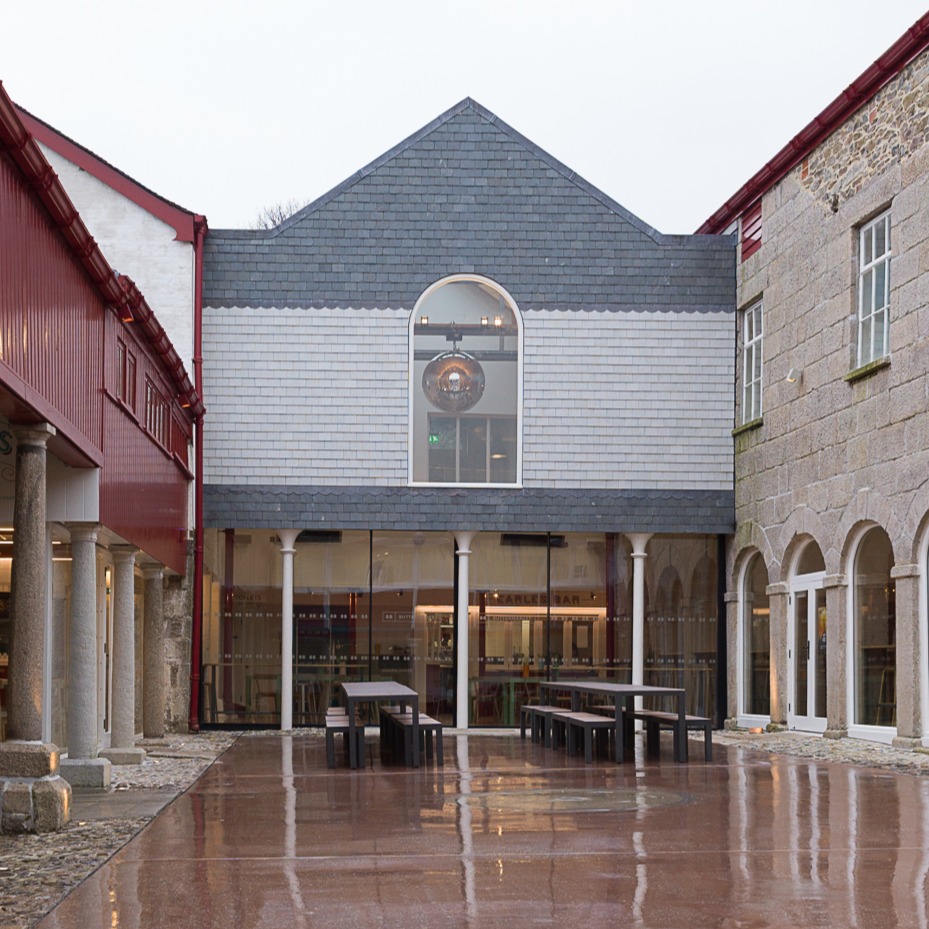
This paper presents a case study that illustrates how discarded glass bottles were transformed into a functional architectural feature. The project aimed to develop a novel product that converts waste glass into a durable material suitable for outdoor cladding in buildings. Prior to the contract, extensive investigation and development were undertaken to ensure that the fused recycled glass met safety and structural requirements. The design—inspired by hanging slates commonly found in architecture across the United Kingdom—incorporates sustainable fused recycled glass, which is innovatively used externally for the first time. Throughout the process, careful assessments were undertaken to evaluate the material’s environmental impact. The project establishes a new benchmark for circular economy principles, thus demonstrating how reclaimed materials can drive architectural innovation while reinforcing environmental responsibility.
Referanser
Bristogianni, T., & Oikonomopoulou, F. (2023). Glass up-casting: A review on the current challenges in glass recycling and a novel approach for recycling “as-is” glass waste into volumetric glass components. Glass Structural Engineering, 7(4), 255–302. https://doi.org/10.1007/s40940-022-00206-9
Bristogianni, T., Oikonomopoulou, F., Justino de Lima, C. L., Veer, F. A., & Nijsse, R. (2018). Structural cast glass components manufactured from waste glass: Diverting everyday discarded glass from the landfill to the building industry. HERON, 63(1/2), 57–102.
Bristogianni, T., Oikonomopoulou, F., Yu, R., Veer, F. A., & Nijsse, R. (2020). Investigating the flexural strength of recycled cast glass. Glass Structural Engineering, 5, 445–487. https://doi.org/10.1001/s40940-020-00138-2
British Standards Institution. (1990). BS 1902-5.3: Methods of testing refractory materials – Part 5.3: Determination of linear change on heating (thermal expansion). BSI.
British Standards Institution. (1997). BS EN ISO 10545-15: Ceramic tiles – Part 15: Determination of lead and cadmium given off by glazed surfaces. BSI.
British Standards Institution. (1997). BS EN ISO 10545-10: Ceramic tiles – Part 10: Determination of moisture expansion. BSI.
British Standards Institution. (1997). BS EN ISO 10545-12: Ceramic tiles – Part 12: Determination of frost resistance. BSI.
British Standards Institution. (1998). BS EN ISO 10545-5: Ceramic tiles, Part 5: Determination of impact resistance by measurement of coefficient of restitution. BSI.
British Standards Institution. (2012). BS EN ISO 10545-6: Ceramic tiles, Part 6: Determination of deep abrasion resistance for unglazed tiles. BSI.
British Standards Institution. (2013). BS EN ISO 10545-9: Ceramic tiles – Part 9: Determination of resistance to thermal shock. BSI.
British Standards Institution. (2014). BS EN ISO 10545-8: Ceramic tiles – Part 8: Determination of linear thermal expansion. BSI.
British Standards Institution. (2015). BS EN ISO 10545-14: Ceramic tiles – Part 14: Determination of resistance to stains. BSI.
British Standards Institution. (2016). BS EN ISO 10545-13: Ceramic tiles – Part 13: Determination of chemical resistance. BSI.
British Standards Institution. (2018). BS EN ISO 10545-3: Ceramic tiles – Part 3: Determination of water absorption, apparent porosity, apparent relative density and bulk density. BSI.
British Standards Institution. (2018). BS EN ISO 10545-2: Ceramic tiles – Part 2: Determination of dimensions and surface quality. BSI.
British Standards Institution. (2019). BS EN ISO 10545-4: Ceramic tiles – Part 4: Determination of modulus of rupture and breaking strength. BSI.
Chalk, I. (2025, July & August). The Buttermarket. Architecture Today, 48–60. https://architecturetoday.co.uk/introducing-the-july-august-2025-issue-of-architecture-today/
Cornwall, R. (n.d.). The Buttermarket. Thread. https://www.a-thread.co.uk/2025-buttermarket
European Committee for Standardisation. (2019). EN 15804:2012+A2:2019: Sustainability of construction works – Environmental product declarations – Core rules for the product category of construction products. CEN-CENELEC.
Ecoinvent (2025). Ecoinvent database. Version 3.10 [Data set]. Ecoinvent Association. https://ecoinvent.org/database/
Halley, D., Oseng-Rees, T., Pagano, L. & Ferriz-Papi, J. A. (2017). Procedure for impact testing of fused recycled glass. International Journal of Materials and Metallurgical Engineering, 11(10), 675–680. https://doi.org/10.5281/zenodo.1132427
Harder, J. (2018). Glass recycling – current market trends. Recovery, 5. https://www.recovery-worldwide.com/en/artikel/glass-recycling-current-market-trends-3248774.html
Hartwell, R., Coult, G., & Overend, M. (2023). Mapping the flat glass value-chain: A material flow analysis and energy balance of UK production. Glass Structures & Engineering, 8, 167–192. https://doi.org/10.1007/s40940-022-00195-9
International Organisation for Standardization. (2006). ISO 14025:2006: Environmental labels and declarations – Type III environmental declarations – Principles and procedures. ISO.
International Organization for Standardisation. (2017). ISO 21930:2017: Sustainability in buildings and civil engineering works – Core rules for environmental product declarations of construction products and services. ISO.
One Click LCA. (2025). Life cycle assessment & EPD software. One Click LCA. https://oneclicklca.com/en-gb/
Oseng-Rees, T. E., Clayton, A. J., Haigh, N. R., & Tomes, J. K. (2025). Environmental and impact testing of post-consumer fused recycled glass tiles for architectural applications. Glass Structures & Engineering, 10(3), 15. https://doi.org/10.1007/s40940-025-00300-8
Oseng-Rees, T. E. (2025). The award-winning glass wall at The Buttermarket in Redruth [Video]. YouTube. https://youtu.be/zfbYAi8lixw
Oseng-Rees, T. E., & Donne, K. (2015). Innovation and development of a new recycled glass material. Glass Technology: European Journal of Glass Science and Technology Part A, 56(2), 43–51. https://doi.org/10.13036/17533546.56.2.43
Oseng-Rees, T. E., Donne, K. E., Bender, R., & Brown, R. D. (2014). Developing design criteria for fused recycled glass tiles. Craft Research, 5(1), 55–79. https://doi.org/10.1386/crre.5.1.55_1
Oseng-Rees, T. E., Donne, K. E., & Bender, R. (2009). Physical and aesthetic properties of fused recycled bottle glass. Making Futures Journal. https://makingfutures-journal.org.uk/index.php/mfj/article/view/30
Premathilaka, K., Liyanapathirana, D., Leo, C., & Hu , P. (2024). Application of recycled waste glass to replace traditional quarried aggregates: A comprehensive review. Journal of Building Engineering, 86, 108846. https://doi.org/10.1016/j.jobe.2024.108846
Royal Institution of Chartered Surveyors (2023). Whole life carbon assessment for the built environment (2nd ed.). RICS. https://www.rics.org/content/dam/ricsglobal/documents/standards/Whole_life_carbon_assessment_PS_Sept23.pdf
Swansea University. (n.d.). AgorIP: Bringing bright ideas and innovation to life. Universities Wales. https://uniswales.ac.uk/agorip-bringing-bright-ideas-and-innovation-life
University of Salford. (2023). Future Homes Project. Energy House Labs. https://energyhouselabs.salford.ac.uk/projects/future-homes-project/
Whettingsteel, S., & Day, K. (2025). A glass industry in denial. Glass International, 48(6), 48–49. https://flickread.com/edition/html/6852bd4c24df3#51
Nedlastinger
Publisert
Hvordan referere
Utgave
Seksjon
Lisens
Opphavsrett 2026 Tyra Oseng-Rees, Juan A. Ferriz-Papi, Ahmad Wadee

Dette verket er lisensiert under Creative Commons Attribution 4.0 International License.
- Forfatteren(e) beholder sin opphavs- og kopieringsrett til eget manuskript, men gir tidsskriftet varig rett til 1) å fremføre manuskriptet for offentligheten i den opprinnelig publiserte digitale form, og 2) å registreres og siteres som første publisering av manuskriptet.
- Forfatteren må selv forvalte sine økonomiske kopieringsrettigheter overfor eventuell tredjepart.
- Tidsskriftet gir ingen økonomisk eller annen kompensasjon for innsendte bidrag, medmindre det er gjort særskilt avtale om dette med forfatteren(e).
- Tidsskriftet plikter å arkivere manuskriptet (inklusive metadata) i den opprinnelig publiserte digitale form, i minst ett dertil egnet åpent tilgjengelig langtidsarkiv for digitalt materiell, som for eksempel i de norske universitetenes institusjonsarkiv innen rammen av NORA-samarbeidet.
Verket vil bli publisert OpenAccess med en Creative Commons 4.0-lisens som tillater alle å lese, dele og tilpasse innholdet, også kommersielt, under lisensvilkårene:
Dette verket må tilskrives/ krediteres på riktig måte, en lenke må gis til CC-BY 4.0-lisensen, og endringer som er gjort må angis på en rimelig måte, men ikke på noen måte som antyder at lisensgiveren støtter deg eller din bruk.
Cited by