Judging architecture
The struggle to find winning design proposals
DOI:
https://doi.org/10.7577/formakademisk.6118Keywords:
Design-developer competition, design proposals, judging, winning design, finding the best solutionAbstract
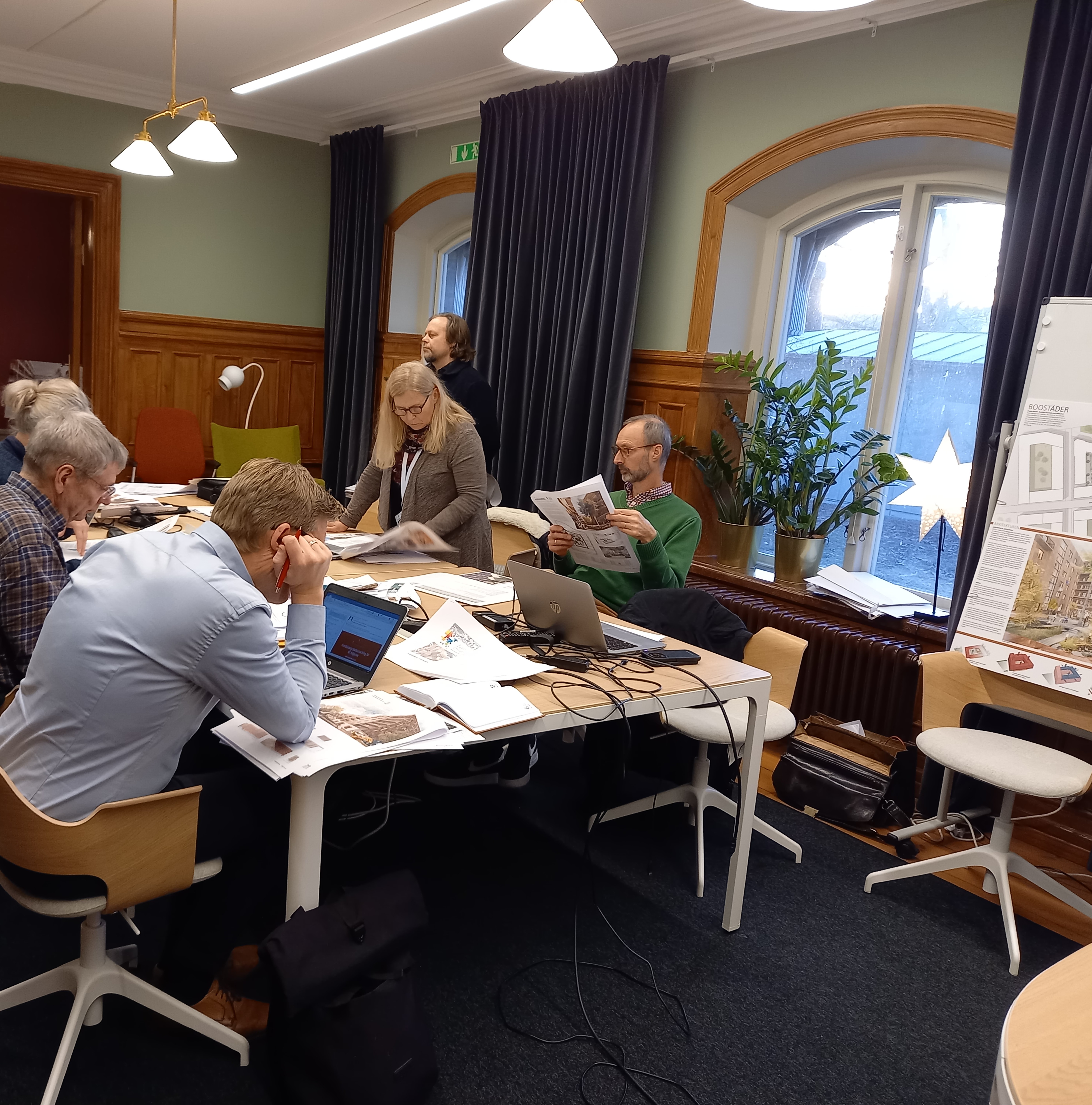
This article critically reflects on how qualified jurors succeeded in identifying winning design proposals during two design developer competitions. Following the close reading and coding of transcribed field notes from jury room deliberations, a judging theory is suggested. The proposed judging model may be of general interest for jury work in architecture and urban design competitions. The underlying concept for this judging theory is that professionals who make qualified assessments must complete critical ethical steps, which are influenced by (a) context and policy, (b) design proposals for competition sites, (c) judging process and competition criteria, and (d) selecting winners and producing the related jury reports. This theory describes and explains how professionals may act in fulfilling their assignment to find a winner.
References
Al-Qaysi, N. (2018). The judgement process in architectural design competitions as a deliberative communicative practice [Doctoral dissertation]. University of Brighton.
Anderson, J. E., Bloxham Zettersten, G., & Rönn, M. (2016). Architectural competitions as institution and process. The Royal Institute of Technology and Kulturlandskapet.
Attoe, W. (1978). Architecture and critical imagination. John Wiley & Sons.
Bazerman, M. H., & Moore, D. A. (2008). Judgment in managerial decision making. Wiley.
Braide, A. (2019). Dwelling in time: Studies on life course spatial adaptability. Chalmers University of Technology.
Braide, A. (2023). Anpassbara bostäder [Adaptable housing]. Studentlitteratur AB.
Carlsson, V. and Koch, C. (2014). What’s so special about action research? A targeted critical review of experiential and prescriptive literature. Proceedings of European Academy of Management Conference (EURAM), 34.
Chupin, J.-P. (2011). Judgement by design: Towards a model for studying and improving the competition process in architecture and urban design. Scandinavian Journal of Management, 27(1), 173–184. https://doi.org/10.1016/j.scaman.2010.12.004
Cross, N. (2025). Designerly ways of knowing. Springer. https://doi.org/10.1007/978-1-4471-7541-4_1
Cucuzzella, C. (2011). Design thinking and the precautionary principle: Development of a theoretical model complementing preventive judgment for design for sustainability enriched through a study of architectural competitions adopting LEED [Doctoral dissertation, Université de Montreal]. Papyrus. https://umontreal.scholaris.ca/items/4303f6f2-bf11-4c44-8b49-e9794b166379
Cucuzzella, C. (2016). Tensions between expert evaluation and qualitative judgment in Canadian architectural competitions. In J. E. Andersson, G. Bloxham Zettersten, & M. Rönn (Eds.), Architectural competitions as institution and process (pp. 116–137), The Royal Institute of Technology and Kulturlandskapet.
Cucuzzella, C. (2020). Competition juries as intercultural spaces: Between evaluation, experience, and judgement. Footprint, 14(1), 39–62. https://doi.org/10.7480/footprint.14.1.3834
Dewey, J. (1939). Theory of valuation. The University of Chicago Press.
Drake, J. (1979). The primary generator in the design process. Design Studies, 1(1), 36–44. https://doi.org/10.1016/0142-694X(79)90027-9
Flyvbjerg, B. (2006). Five misunderstandings about case-study research. Sosiologisk tidsskrift, 12(2), 117–142. https://doi.org/10.18261/ISSN1504-2928-2004-02-02
Geertz, C. (2008). Thick description: Toward an interpretive theory of culture. In T. Oakes, & P. L. Price (Eds.), The cultural geography reader (pp. 41–51). Routledge.
Goubran, S. (2021). Our buildings have credentials … now what? A design-based analysis framework for reconciling green buildings with the sustainable development goals [Doctoral dissertation, Concordia University]. Spectrum Research Repository. https://spectrum.library.concordia.ca/id/eprint/988073/
Groat, L. N., & Wang, D. (2002). Architectural research methods. Wiley.
Houck, L. H. (2016). How juries assess universal design in Norwegian architectural school competitions. In H. Petrie, J. S. Darzentas, T. Walsh, D. M. Swallow, L. F. S. Guzman, & C. D. Power (Eds.), Universal design 2016: Learning from the past, designing for the future (pp. 229–239). IOS Press. https://doi.org/10.3233/978-1-61499-684-2-229
Jacobsen, F. H., & Kamstrup, P. (2017). Jury board at work: Evaluation of architecture and process. In I. Strebel, & J. Silberberger (Eds.), Architecture competition (pp. 103–116). Routledge. https://doi.org/10.4324/9781315567594-7
Kazemian, R., Rönn, M., & Svensson, C. (2007). Arkitekturtävlingar i Finland. Erfarenheter från Finland [Architecture competitions in Finland. Experiences from Finland]. Axel Books.
Kreiner, K. (2010). Paradoxes of architectural competitions: The competition between efficiency, justice and creativity. In Proceedings of the 26th Annual ARCOM Conference (pp. 6–8).
Kreiner, K. (2012). Organizational decision mechanisms in an architectural competition. In A. Lomi & J. R. Harrison (Eds.), The garbage can model of organizational choice: Looking forward at forty. Emerald Group Publishing Limited. https://doi.org/10.1108/S0733-558X(2012)0000036018
Kreiner, K. (2013). Constructing the client in architectural competitions: An ethnographic study of architects' practices and the strategies they reveal. In J. E. Andersson, G. Bloxham Zettersten, & M. Rönn (Eds.), Architectural competitions – Histories and practice (pp. 217–245). Rio Kulturkooperativ & KTH.
Kreiner, K. (2020). Pick the winner, so you can then choose the reasons: Epistemic dissonance in architecture competitions. In D. Stark (Ed.), The performance complex: Competition and competitions in social life (pp. 31–54). Oxford University Press. https://doi.org/10.1093/oso/9780198861669.003.0002
Kreiner, K., & Jacobsen, P. H. 2012. Dialog og konkurrence: Eksperimenter med nye arkitektkonkurrenceformer [Dialogue and competition: Experimenting with new forms of architectural competition]. Nyt fra Samfundsvidenskaberne.
Kreiner, K., Jacobsen, P. H., & Jensen, D. T. (2011). Dialogues and the problem of knowing: Reinventing the architectural competition. Scandinavian Journal of Management, 27(1), 160–166. https://doi.org/10.1016/j.scaman.2010.12.003
Lampel, J., Jha P. P., & Bhalla A. (2012). Test-driving the future: How design competitions are changing innovation. Academy of Management Perspectives, 26(2), 71–85. https://doi.org/10.5465/amp.2010.0068
Lans, W, & Volker, L. (2008). Exploring the assessment of a jury panel in architectural design education and practice. In ICERI 2008 International Conference of Education, Research and Innovation.
Laryea, S., & Watermeyer, R. (2021). Structuring architectural competitions as a competitive procurement process. Engineering, Construction and Architectural Management, 28(4), 886–907. https://doi.org/10.1108/ECAM-06-2019-0282
Lehtonen, H. (1991). Om utgångspunkterna vid visualisering av arkitekturprojekt. Tidskrift för arkitekturforskning, 4(1), 97–108. https://arkitekturforskning.net/na/article/view/920
Lundequist, J. (1992). Projekteringsmetodikens teoretiska bakgrund [Theoretical background of the design methodology]. KTH.
Lundequist, J. (2002). Kritik som kunskapsform [Criticism as a form of knowledge]. In Arkitekturkritik, Arkitekturmuseets årsbok 2002. Arkitekturmuseet.
Lymer, G. (2010). The work of critique in architectural education. Acta Universitatis Gothoburgensis.
Malmqvist, T., Borgström, S., Brismark, J., & Erlandsson, M. (2021). Referensvärden för klimatpåverkan vid uppförande av byggnader [Reference values for climate impact when constructing buildings]. KTH Skolan för Arkitektur och Samhällsbyggnad. Trita-Abe-Rpt.
Menon, C., & Vanderburg, D. (2014). Who – or what – “wins” an architectural competition? A model and a case study. FormAkademisk, 7(1), 1–19. https://doi.org/10.7577/formakademisk.822
Meyer, C. G. (2016). Investigating a design validation process: How jurors handle criteria in a design competition. Journal of Design Research, 14(3), 203–218. https://doi.org/10.1504/JDR.2016.079736
Murphy, K., Ivarsson, J., & Lymer, G. (2012). Embodied reasoning in architectural critique. Design Studies, 33(6), 530–556. https://doi.org/10.1016/j.destud.2012.06.005
Norrköping Municipality. (2018) Arkitekturstaden Norrköping [Architecture city Norrköping]. Norrköpings kommun.
Oh, Y., Ishizaki, S., Gross, M. D., & Do, E. Y.-L. (2013). A theoretical framework of design critiquing in architecture studios. Design Studies, 34(3), 302–325. https://doi.org/10.1016/j.destud.2012.08.004
Östman, L. (2012). A case study: The jury process in an idea competition for a small urban centre. Nordic Journal of Architectural Research, 24(1), 119–148.
Östman, L. (2016). Sustainability requirement in architectural competitions. In J. E. Andersson, G. Bloxham Zettersten, & M. Rönn (Eds.), Architectural competitions as institution and process. The Royal Institute of Technology and Kulturlandskapet.
Rittel, H. W. J., & Webber. M. M. (1973). Dilemmas in a general theory of planning. Policy Sciences, 4, 155–169. https://doi.org/10.1007/BF01405730
Rönn, M. (1995). Designomdömen och industrihusprojekt [Design reviews and industrial house projects]. VEST, 8(19), 61-78. https://www.diva-portal.org/smash/get/diva2:776576/FULLTEXT01.pdf
Rönn, M. (2013). Experience of prequalification in Swedish competitions for new housing for the elderly. In J. E. Andersson, G. Bloxham Zettersten, & M. Rönn (Eds.), Architectural competitions – Histories and practice (pp. 106–132). Rio Kulturkooperativ & KTH.
Rönn, M. (2019). Design developer competition in Stockholm: A case study on innovation, architecture, and affordable housing. Enquiry: A Journal for Architectural Research, 16(1), 15–28. https://doi.org/10.17831/enq:arcc.v16i1.579
Rönn, M., & Koch, C. (2022). Markanvisningstävlingen som verktyg i strategisk utveckling: Del 2. Arrangörens erfarenheter (Rapport ACE/Institutionen för arkitektur och samhällsbyggnadsteknik, 2022:6). Chalmers tekniska högskola. https://research.chalmers.se/publication/533899
Rönn, M., & Koch, C. (2023). Markanvisningstävlingen som verktyg i strategisk utveckling: Del 3. Resultat, erfarenheter och slutsatser (Rapport ACE 2023:4). Chalmers Tekniska Högskola. https://research.chalmers.se/publication/537546/file/537546_Fulltext.pdf
Sällström, P. (1980). Mjukdata i planeringsprocessen. En diskussion kring möjligheter och svårigheter med färgplanering som exempel [Soft data in the planning process. A discussion of opportunities and difficulties using color planning as an example](Rapport R74:1980). Byggforskningsrådet. https://gupea.ub.gu.se/bitstreams/02a80858-0ebb-4562-a99c-d0c859601b0d/download
Samhällsbyggnadskontoret. (2020). Planbeskrivning tillhörande detaljplan för fastigheten Svanen 6 med närområde (del av Inre hamnen) inom Saltängen i Norrköping [Plan description belonging to the detailed plan for the property Svanen 6 with the surrounding area (part of the Inner Harbour) within Saltängen in Norrköping.]. Norrköpings kommun.
Silberberger., J. (2011). A qualitative investigation into decision-making within jury boards of architectural competitions [Doctoral dissertation]. University of Freiburg.
Stadsbyggnadskontoret. (2011). Planbeskrivning tillhörande detaljplan för Sankt Johannes 2:1 med närområde (Södra Vrinnevi) inom Vrinnevi och Kårtorp i Norrköping [Plan description belonging to the detailed plan for Sankt Johannes 2:1 with the surrounding area (South Vrinnevi) within Vrinnevi and Kårtorp in Norrköping.]. Norrköpings kommun.
Stadsbyggnadskontoret. (2015). Riktlinjer för kommunala markanvisningar i Norrköpings kommun [Guidelines for municipal land allocation in Norrköping municipality]. (2015). Norrköpings kommun.
Stadsplanenämnden. (2018). Handlingsplan för marktilldelning vid bostadsbyggande [Action plan for land allocation for housing construction]. Norrköpings kommun.
Stake, R. E. (2000). Qualitative case studies. In N. K. Denzin, & Y. S. Lincoln (Eds.), The SAGE handbook of qualitative research. Sage.
Svensson, C. (2008). Arkitekttävlingar. Om konsten att hitta en vinnare [Architectural competitions. On the art of finding a winner, Licentiate thesis, TRITA-ARK Akademisk avhandling]. 2008:3. KTH Arkitektur och samhällsbyggnad.
Svensson, C. (2009). Speaking of architecture. A study of the jury’s assessment in an invited competition. Nordic Journal of Architectural Research, 21(2–3), 94–107.
Svensson. C. (2012). Architectural persuasion: On quality assessment in an architectural competition. Nordic Journal of Architectural Research, 24(1), 97–118.
Svensson, C. (2013). Inside the jury room. Strategies of quality assessment in Swedish architectural competitions. In J. E. Andersson, G. Bloxham Zettersten, & M. Rönn (Eds.), Architectural competitions – Histories and practice. Rio Kulturkooperativ & KTH.
Swedish Architects. (n.d.). En skrift om juryarbete och bedömning [A Publication on Jury Work and Assessment]. Sveriges Arkitekter.
Swedish Architects. (2021). Att anordna en arkitekttävling [Arranging an Architecture Competition]. Sveriges Arkitekter. https://s3-eu-north-1.amazonaws.com/arkitektse/wpmf/uploads/2021/05/Tavlingsbroschyr-2021.pdf
Swedish Architects. (2024). Etiskt program och etiska regler [Ethics program and ethical rules]. Sveriges Arkitekter. https://www.arkitekt.se/om-oss/styrelse/styrdokument/etiskt-program-och-etiska-regler/
The America Institute of Architects. (1998). The handbook of architectural design competition.
Tostrup, E. (1999). Architecture and rhetoric. Text and design in architectural competitions, Oslo 1939–1996. Andreas Papadakis Publisher.
Van de Ven, A. H. (2007). Engaged scholarship: A guide for organizational and social research. Oxford University Press. https://doi.org/10.1093/oso/9780199226290.001.0001
Wærn, R. (2010). The outcome of the Stockholm City Library competition: A study on entries from internationally renowned architects. In M. Rönn, R. Kazemian, & J. E. Andersson (Eds.), The architectural competition: Research inquiries and experience (pp 603–631). AXL Books.
Downloads
Published
How to Cite
Issue
Section
License
Copyright (c) 2026 Magnus Rönn, Christian Koch, Anna Braide

This work is licensed under a Creative Commons Attribution 4.0 International License.
Authors who publish with this journal agree to the following terms:
- Authors retain copyright and grant the journal right of first publication with the work simultaneously licensed under a Creative Commons Attribution 4.0 License that allows others to share the work with an acknowledgement of the work's authorship and initial publication in this journal.
- Authors are able to enter into separate, additional contractual arrangements for the non-exclusive distribution of the journal's published version of the work (e.g., post it to an institutional repository or publish it in a book), with an acknowledgement of its initial publication in this journal.
- Authors are permitted and encouraged to post their work online (e.g., in institutional repositories or on their website) prior to and during the submission process, as it can lead to productive exchanges, as well as earlier and greater citation of published work (See The Effect of Open Access).
- The author(s) must manage their economic reproduction rights to any third party.
- The journal makes no financial or other compensation for submissions, unless a separate agreement regarding this matter has been made with the author(s).
- The journal is obliged to archive the manuscript (including metadata) in its originally published digital form for at least a suitable amount of time in which the manuscript can be accessed via a long-term archive for digital material, such as in the Norwegian universities’ institutional archives within the framework of the NORA partnership.
The material will be published OpenAccess with a Creative Commons 4.0 License which allows anyone to read, share and adapt the content, even commercially under the licence terms:
This work needs to be appropriately attributed/credited, a link must be provided to the CC-BY 4.0 licence, and changes made need to be indicated in a reasonable manner, but not in any way that suggests that the licensor endorses you or your use.
Cited by