Mapping Ludic Architecture
A Bibliometric Analysis of an Emerging Research Field
DOI:
https://doi.org/10.7577/formakademisk.6479Keywords:
ludic architecture, bibliometric analysis, spatial agency, post-humanist ontology, participatory designAbstract
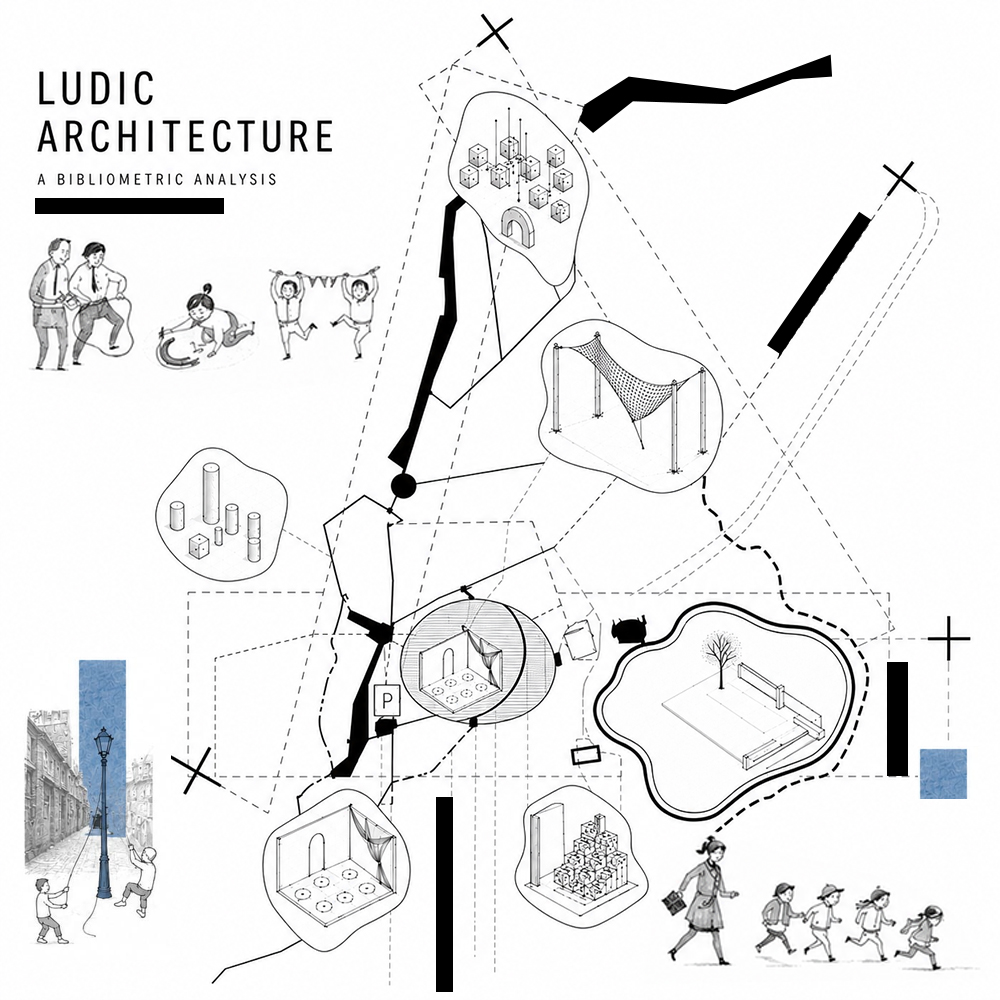
This study maps the academic literature produced between 2000 and 2025 in the field of ludic architecture through bibliometric methods, revealing the transformation of play from a marginal tool into an ontological actor within architectural discourse. A total of 268 publications retrieved from the Web of Science database were analyzed using VOSviewer, through which temporal trends, geographical distributions, disciplinary relations, co-authorship networks, and conceptual clusters were identified. The findings demonstrate that ludic architecture has evolved into an increasingly institutionalized, multilayered, and interdisciplinary research domain shaped by digital technologies, participatory practices, and post-anthropocentric ontologies. By clarifying how ludic agency has become an epistemic framework in architectural knowledge production, pedagogical approaches, and spatial practices, the study offers the first comprehensive bibliometric mapping of the field.
References
Aarseth, E. (1997). Cybertext: Perspectives on ergodic literature. Johns Hopkins University Press. https://doi.org/10.56021/9780801855788
Ahlquist, S., & Menges, A. (Eds.). (2011). Computational design thinking. John Wiley & Sons.
Aria, M., & Cuccurullo, C. (2017). bibliometrix: An R-tool for comprehensive science mapping analysis. Journal of Informetrics, 11(4), 959–975. https://doi.org/10.1016/j.joi.2017.08.007
Awan, N., Schneider, T., & Till, J. (2011). Spatial agency: Other ways of doing architecture. Routledge. https://doi.org/10.4324/9781315881249
Bennett, J. (2010). Vibrant matter: A political ecology of things. Duke University Press. https://doi.org/10.1215/9780822391623
Caillois, R. (2001). Man, play and games (M. Barash, Trans.). University of Illinois Press. (Original work published 1958)
Carvalho, M., Fleury, A., & Lopes, A. P. (2013). An overview of the literature on technology roadmapping (TRM): Contributions and trends. Technological Forecasting and Social Change, 80(7), 1418–1437. https://doi.org/10.1016/j.techfore.2012.11.008
De Carlo, G. (2005). Architecture's public. In P. Blundell Jones, D. Petrescu, & J. Till (Eds.), Architecture and participation (pp. 3–22). Spon Press.
Doğan, F., & Nersessian, N. J. (2010). Generic abstraction in design creativity: The case of Staatsgalerie by James Stirling. Design Studies, 31(3), 207–236. https://doi.org/10.1016/j.destud.2009.12.004
Donthu, N., Kumar, S., Mukherjee, D., Pandey, N., & Lim, W. M. (2021). How to conduct a bibliometric analysis: An overview and guidelines. Journal of Business Research, 133, 285–296. https://doi.org/10.1016/j.jbusres.2021.04.070
Ellegaard, O., & Wallin, J. A. (2015). The bibliometric analysis of scholarly production: How great is the impact? Scientometrics, 105(3), 1809–1831. https://doi.org/10.1007/s11192-015-1645-z
Frasca, G. (2003). Simulation versus narrative: Introduction to ludology. In M. J. P. Wolf & B. Perron (Eds.), The video game theory reader (pp. 221–235). Routledge. https://doi.org/10.4324/9780203700457-11
Frichot, H. (2019). Dirty theory: Troubling architecture. Spurbuch Verlag.
Gekker, A. (2021). Against game studies. Media and Communication, 9(1), 73–83. https://doi.org/10.17645/mac.v9i1.3315
Granovetter, M. (1983). The strength of weak ties: A network theory revisited. Sociological Theory, 1, 201–233. https://doi.org/10.2307/202051
Sanoff, H. (2000). Community participation methods in design and planning. Wiley.
Huizinga, J. (1955). Homo ludens: A study of the play-element in culture. Beacon Press.
Ingold, T. (2013). Making: Anthropology, archaeology, art and architecture. Routledge. https://doi.org/10.4324/9780203559055
Itten, J. (1975). Design and form: The basic course at the Bauhaus and later. Van Nostrand Reinhold.
Latour, B. (2005). Reassembling the social: An introduction to actor-network-theory. Oxford University Press. https://doi.org/10.1093/oso/9780199256044.001.0001
Luck, R. (2018). Participatory design in architectural practice: Changing practices in future making in uncertain times. Design Studies, 59, 139–157. https://doi.org/10.1016/j.destud.2018.10.003
Miessen, M. (2010). The nightmare of participation. Sternberg Press.
Moher, D., Liberati, A., Tetzlaff, J., & Altman, D. G. (2009). Preferred reporting items for systematic reviews and meta-analyses: The PRISMA statement. PLoS Medicine, 6(7), Article e1000097. https://doi.org/10.1371/journal.pmed.1000097
Mouffe, C. (2013). Agonistics: Thinking the world politically. Verso.
Oxman, R. (2006). Theory and design in the first digital age. Design Studies, 27(3), 229–265. https://doi.org/10.1016/j.destud.2005.11.002
Sadler, S. (2005). Archigram: Architecture without architecture. MIT Press.
Salama, A. M. (2015). Spatial design education: New directions for pedagogy in architecture and beyond. Routledge. https://doi.org/10.4324/9781315610276
Schechner, R. (2013). Performance studies: An introduction (3rd ed.). Routledge. https://doi.org/10.4324/9780203715345
Schumacher, P. (2011). The autopoiesis of architecture: A new framework for architecture (Vol. 1). John Wiley & Sons.
Sicart, M. (2014). Play matters. MIT Press. https://doi.org/10.7551/mitpress/10042.001.0001
Stevens, Q. (2007). The ludic city: Exploring the potential of public spaces. Routledge. https://doi.org/10.4324/9780203961803
Tschumi, B. (1996). Architecture and disjunction. MIT Press.
Van Eck, N. J., & Waltman, L. (2010). Software survey: VOSviewer, a computer program for bibliometric mapping. Scientometrics, 84(2), 523–538. https://doi.org/10.1007/s11192-009-0146-3
Van Eck, N. J., & Waltman, L. (2014). Visualizing bibliometric networks. In Y. Ding, R. Rousseau, & D. Wolfram (Eds.), Measuring scholarly impact: Methods and practice (pp. 285–320). Springer. https://doi.org/10.1007/978-3-319-10377-8_13
Zupic, I., & Čater, T. (2015). Bibliometric methods in management and organization. Organizational Research Methods, 18(3), 429–472. https://doi.org/10.1177/1094428114562629
Downloads
Published
How to Cite
Issue
Section
License
Copyright (c) 2026 Sabiha Sevgi , Aydın Arman

This work is licensed under a Creative Commons Attribution 4.0 International License.
Authors who publish with this journal agree to the following terms:
- Authors retain copyright and grant the journal right of first publication with the work simultaneously licensed under a Creative Commons Attribution 4.0 License that allows others to share the work with an acknowledgement of the work's authorship and initial publication in this journal.
- Authors are able to enter into separate, additional contractual arrangements for the non-exclusive distribution of the journal's published version of the work (e.g., post it to an institutional repository or publish it in a book), with an acknowledgement of its initial publication in this journal.
- Authors are permitted and encouraged to post their work online (e.g., in institutional repositories or on their website) prior to and during the submission process, as it can lead to productive exchanges, as well as earlier and greater citation of published work (See The Effect of Open Access).
- The author(s) must manage their economic reproduction rights to any third party.
- The journal makes no financial or other compensation for submissions, unless a separate agreement regarding this matter has been made with the author(s).
- The journal is obliged to archive the manuscript (including metadata) in its originally published digital form for at least a suitable amount of time in which the manuscript can be accessed via a long-term archive for digital material, such as in the Norwegian universities’ institutional archives within the framework of the NORA partnership.
The material will be published OpenAccess with a Creative Commons 4.0 License which allows anyone to read, share and adapt the content, even commercially under the licence terms:
This work needs to be appropriately attributed/credited, a link must be provided to the CC-BY 4.0 licence, and changes made need to be indicated in a reasonable manner, but not in any way that suggests that the licensor endorses you or your use.
Cited by