Urban Memory and Experiential Learning in Architectural Education
DOI:
https://doi.org/10.7577/formakademisk.6629Keywords:
Architectural education, experiential learning, informal learning environments, travellers’ narratives, urban memoryAbstract
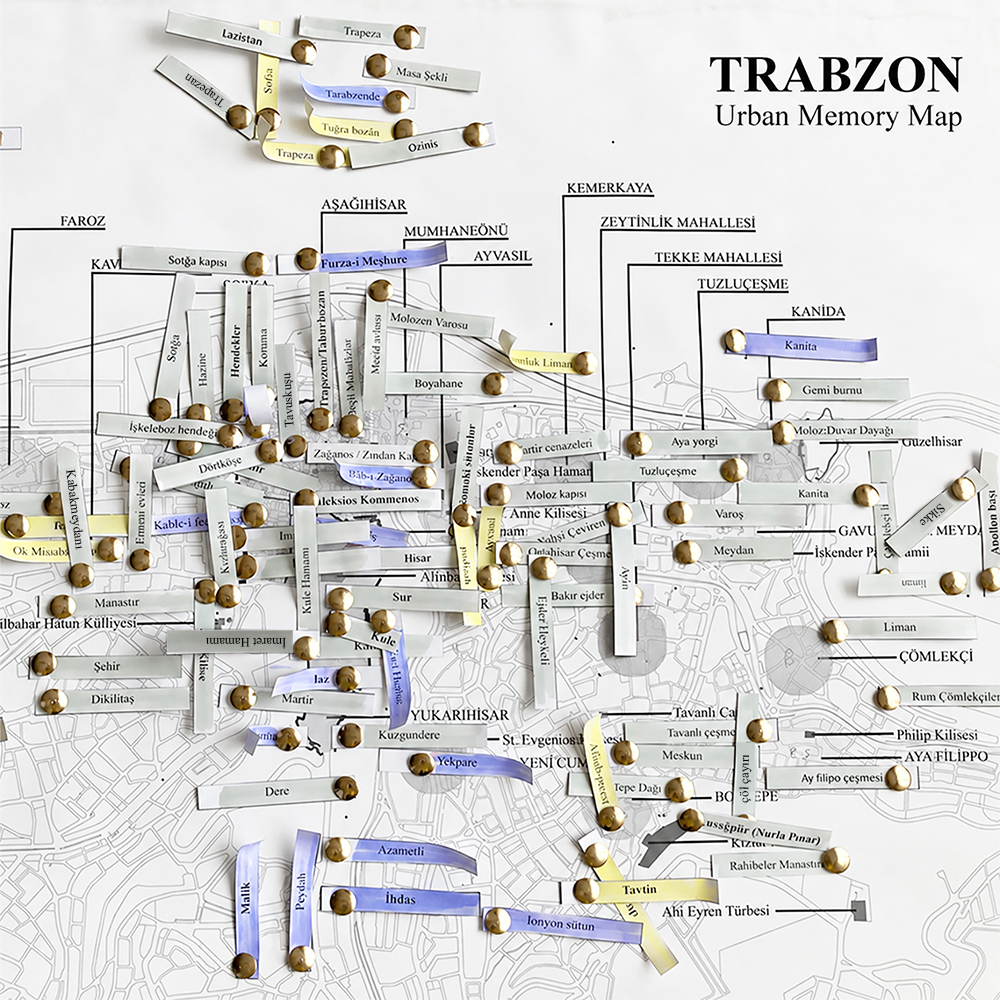
This paper proposes a workshop-based framework that applies experiential learning to the interpretation of urban memory through the travel narratives of three visitors to the Turkish city of Trabzon. Grounded in Kolb’s (1984) experiential learning cycle, this study examines a workshop in which architectural students transformed textual narratives into experiential and representational learning processes. The empirical dataset consists of concept maps, urban memory maps, route proposals, fanzines, posters and reflective notes produced throughout the workshop. These materials are analysed using thematic analysis to examine the relationships between narratives, spatial interpretation and representational practices. The analysis identifies three interconnected themes: (1) walking as experiential learning, (2) mapping urban memory, and (3) concept extraction from narratives. The workshop outputs indicate that travel narratives function not merely as historical documents but as pedagogical resources that foster conceptual thinking, urban memory reconstruction and creative representation. By integrating textual interpretation, spatial exploration and design production, the proposed workshop model offers a transferable pedagogical framework for memory-oriented architectural education.
References
Ak, M. (1990). Aşık Mehmed ve Menazırü’l-avalim [Aşık Mehmed and perspectives of the worlds][Master Thesis]. Istanbul University.
Âşık Mehmed. (2007). Menâzırü’l-Avâlim [Perspectives of the worlds] (M. Ak, Ed.). Türk Tarih Kurumu.
Assmann, J. (1995). Collective memory and cultural identity. New German Critique, (65), 125–133. https://doi.org/10.2307/488538
Assmann, J. (2011). Cultural memory and early civilization: Writing, remembrance, and political imagination. Cambridge University Press. https://doi.org/10.1017/CBO9780511996306
Aydın, B. (2012). XVI. Yüzyıl Osmanlı seyahatnâmeleri hakkında bir değerlendirme [An overview of the Ottoman travelogues of the sixteenth century]. Osmanlı Araştırmaları/The Journal of Ottoman Studies, (XL), 435–451.
Aydınlı, S. (2015). Tasarım eğitiminde yapılandırıcı paradigma: ‘Öğrenmeyi öğrenme’ [The constructivist paradigm in design education: ‘Learning to learn’]. Tasarım+Kuram, 11(20). https://doi.org/10.23835/tasarimkuram.239579
Aykaç Leidholm, P. (2022). Bellek, kolektif bellek ve koruma [Memory, collective memory and conservation]. Mimarlık, (423), 49–52.
Bergson, H. (1919). Matter and memory (N. M. Paul & W. S. Palmer, Trans.). George Allen & Unwin. (Original work published 1896)
Bıjışkyan, P. M. (1998). Pontus Tarihi / Tarihin horona durduğu yer Karadeniz [History of Pontus / The Black Sea region, where history dances the horon] (H. D. Andreasyan, Trans.). Çivi Yazıları.
Ciravoğlu, A. (2003). Mimari tasarım eğitiminde formel ve enformel çalışmalar üzerine [On formal and informal studies in architectural design education]. Yapı Dergisi, (257).
Çıraklı, M. Z. (2022). Image or silhouette? Writing urban places: The midsize city, concepts & parameters. https://padlet.com/writingurbanplaces/x6wyt5i6sphxt38y
Cuff, D. (1991). Architecture: The story of practice. MIT Press.
Dewey, J. (1938). Experience and education. Macmillan.
Durmus Ozturk, S. (2020). Rethinking the black box in architecture design studio. SAGE Open, 10(2). https://doi.org/10.1177/2158244020927408
Durmuş Öztürk, S., & Çıraklı, M. Z. (2023). Anlatı uzamı olarak kent ve mekân deneyimi: yaklaşımlar, kavramlar, teknikler [Experiencing the city as a narrative space: Perspectives, concepts, and techniques]. Book of Abstracts and Proceedings of 9th International Nalans Conference–Narratives across Boundaries, Trabzon, Turkey, (pp. 295–304).
Fisher, T. (2004). What memory? Whose memory? In E. Bastéa (Ed.), Memory and architecture (pp. 283–291). University of New Mexico Press.
Halbwachs, M. (2017). Kolektif Hafıza [On collective memory] (B. Barış, Trans.). Heretik Yayıncılık.
Jung, C. G. (2008). The collected works of C. G. Jung. In H. Read, M. Fordham, & G. Adler (Eds.), Spirit in Man, Art, and Literature (R. F. C. Hull, Trans.). Princeton University Press.
Kolb, D. A. (1984). Experiential learning: Experience as the source of learning and development. Prentice-Hall.
Lefebvre, H. (1991). The production of space (D. Nicholson-Smith, Trans.). Blackwell.
Nora, P. (1989). Between memory and history: Les lieux de mémoire. Representations, 26, 7–25. https://doi.org/10.2307/2928520
Öksüz, M. E. (2024). Katlama (folding) kavramının mimarlık eğitimine katkıları [Contributions of the folding concept to architectural education] [Master’s thesis, Karadeniz Technical University].
Öktem Erkartal, P., & Durmuş, S. (2017). Mimarlık eğitiminde deneysel ve özgürleştirici bir tasarım deneyimi olarak çalıştaylar [Workshops as an experimental and liberating design experience in architectural education]. In Ş. Ö. Gür (Ed.). Mimari Tasarım Eğitimine Çağdaş Önermeler (pp. 175–184). Yapı Endüstri Merkezi Yayınları.
Pallasmaa, J. (2007). Tenin Gözleri: Mimarlık ve Duyular [The eyes of the skin: Architecture and the senses] (A. U. Kılıç, Trans.). Yem Yayınları.
Rossi, A. (1982). The architecture of the city (P. Eisenman, Trans.). MIT Press. (Original work published 1966)
Ruskin, J. (1880). The seven lamps of architecture (8th ed.). George Allen.
Salama, A. M. (2015). Spatial design education: New directions for pedagogy in architecture and beyond. Ashgate Publishing. https://doi.org/10.4324/9781315610276
Schön, D. A. (1983). The reflective practitioner: How professionals think in action. Basic Books.
Sennett, R. (2008). The craftsman. Yale University Press.
Şevket, Ş. (2001). Trabzon tarihi / İlk Türkçe şehir tarihi [History of Trabzon / The first Turkish city history] ( İ. Hacıfettahoğlu, Ed.), Trabzon Belediyesi Kültür Yayınları.
Tomlinson, C. A. (2001). How to differentiate instruction in mixed-ability classrooms (2nd ed.). ASCD.
Uluoğlu, B. (1990). Mimari tasarım eğitimi: Tasarım bilgisi bağlamında stüdyo eleştirileri [Architectural design education: Design knowledge communicated in studio critiques] [Doctoral dissertation, Istanbul Technical University].
Usta, V. (1999). Anabasis’ten Atatürk’e seyahatnamelerde Trabzon [Trabzon in travelogues from Anabasis to Atatürk]. Serander Yayınları, Trabzon.
Üstün Demirkaya, F. (2017). Spatial reflections of social change: The change of urban pattern in the Ottoman Era. Athens Journal of History, 3(3), 205–224. https://doi.org/10.30958/ajhis.3-3-2
Üstün Demirkaya, F., & Durmuş Öztürk, S. (2026). Visual and textual urban narratives through mapping: A case study in architectural design studio. Humanities and Social Science Communication, 13, 1–19. https://doi.org/10.1057/s41599-026-07184-1
Üstün Demirkaya, F., & Kırcı, O. (2020). Travellers who tell about their hometown: Trabzon in the texts of travellers from Trabzon. Selcuk University Journal of Faculty of Letters, 43, 435–466. https://doi.org/10.21497/sefad.756108
Üstün Demirkaya, F., & Tuluk, Ö. İ. (2018). Komnenos Hanedanlığı’ndan Osmanlı’ya Trabzon mahalleleri: Kentsel dinamikler bağlamında bir fiziksel gelişim okuması [Trabzon neighborhoods from the Komnenos Dynasty to the Ottoman period: A reading of physical development in the context of urban dynamics]. Kentsel Morfoloji Sempozyumu, 1.
Wenger, E. (1998). Communities of practice: learning, meaning, and identity. Cambridge University Press. https://doi.org/10.1017/CBO9780511803932
Yazıcı, M., & Durmuş Öztürk, S. (2017). Collocation reading in architectural texts: Words and codes. Theory and History of Architecture Conference/ARCHTHEO’17 Proceedings, Istanbul, Turkey, (pp. 20–31).
Yılmaz, Ö. (2013). Seyyahların kaleminden bir kentin kimliği: 19. Yüzyıl Trabzon’u örneği [The identity of a city through the eyes of travelers: The case of nineteenth-century Trabzon]. In M. A. Beyhan (Ed.). Geçmişten günümüze seyahatler ve seyahatnameler (pp. 111–140). Kitabevi Yayınları.
Yürekli, İ., & Yürekli, H. (2004). Mimari tasarım eğitiminde enformellik [Informality in architectural design education]. Itüdergisi/a, 3(1), 53–62.
Zimmerman, B. J. (2002). Becoming a self-regulated learner: An overview. Theory Into Practice, 41(2), 64–70. https://doi.org/10.1207/s15430421tip4102_2
Downloads
Published
How to Cite
Issue
Section
License
Copyright (c) 2026 Serap Durmus Ozturk, Fulya Ustun Demirkaya, Oguz Kirci, Melis Yazici

This work is licensed under a Creative Commons Attribution 4.0 International License.
Authors who publish with this journal agree to the following terms:
- Authors retain copyright and grant the journal right of first publication with the work simultaneously licensed under a Creative Commons Attribution 4.0 License that allows others to share the work with an acknowledgement of the work's authorship and initial publication in this journal.
- Authors are able to enter into separate, additional contractual arrangements for the non-exclusive distribution of the journal's published version of the work (e.g., post it to an institutional repository or publish it in a book), with an acknowledgement of its initial publication in this journal.
- Authors are permitted and encouraged to post their work online (e.g., in institutional repositories or on their website) prior to and during the submission process, as it can lead to productive exchanges, as well as earlier and greater citation of published work (See The Effect of Open Access).
- The author(s) must manage their economic reproduction rights to any third party.
- The journal makes no financial or other compensation for submissions, unless a separate agreement regarding this matter has been made with the author(s).
- The journal is obliged to archive the manuscript (including metadata) in its originally published digital form for at least a suitable amount of time in which the manuscript can be accessed via a long-term archive for digital material, such as in the Norwegian universities’ institutional archives within the framework of the NORA partnership.
The material will be published OpenAccess with a Creative Commons 4.0 License which allows anyone to read, share and adapt the content, even commercially under the licence terms:
This work needs to be appropriately attributed/credited, a link must be provided to the CC-BY 4.0 licence, and changes made need to be indicated in a reasonable manner, but not in any way that suggests that the licensor endorses you or your use.
Cited by