Reframing Anthropometry and Ergonomics Beyond the Normative Body
An Active Learning Study in Interior Architecture Education
DOI:
https://doi.org/10.7577/formakademisk.6430Emneord (Nøkkelord):
interior architecture, design education, Human Factors and ErgonomicsSammendrag
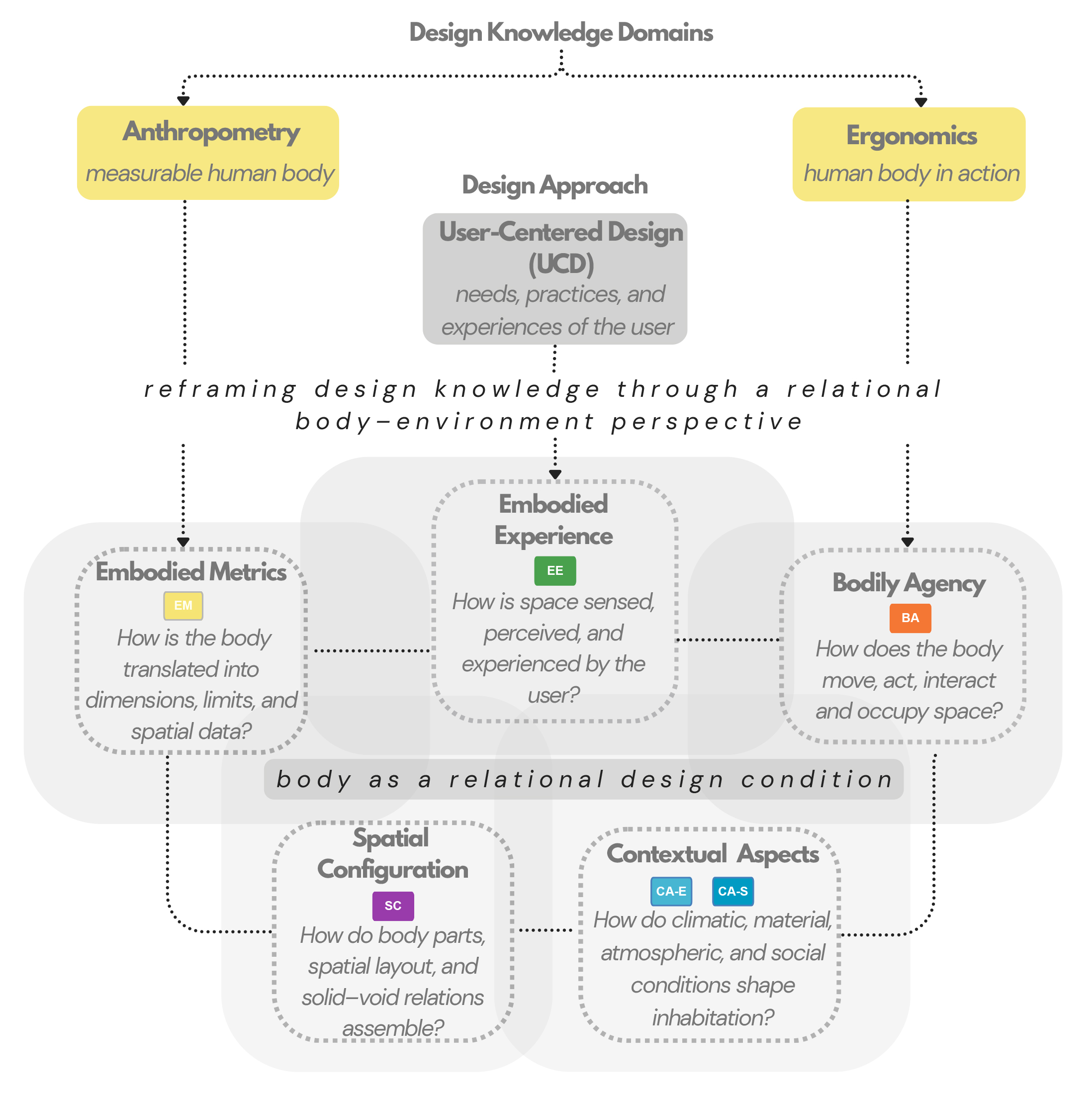
Within interior architecture education, anthropometry and ergonomics constitute foundational domains of knowledge for understanding the relationship between users and designed environments. Their pedagogical application often positions the user as a body to be measured, proportioned, and accommodated within space. This study recasts that initial framing by asking how these domains can be taught beyond the normative body and how they may support a relational understanding of user, action, object, and space. The study was conducted as part of an undergraduate course, Ergonomics in Interior Architecture, at Özyeğin University during the Fall 2024–2025 semester; through an active learning exercise structured around role-playing, a case study, and a poster session. The study was conducted in the Ergonomics in Interior Architecture course at Özyeğin University during the Fall 2024–2025 semester through an active learning exercise structured around role-playing, a case study, and a poster session. Students created fictional users with non-normative bodies, mapped their daily routines, and developed spatial and furniture proposals responsive to their abilities, limitations, and needs. The research material comprised the project posters and written reflections of 10 students who completed all stages of the exercise. The data were analyzed using qualitative content analysis. The findings indicate that the students moved beyond the procedural application of anthropometric and ergonomic standards, interpreting bodily difference as a generator of design reasoning. The study suggests that by centering a non-normative user in a design problem, anthropometry and ergonomics can move beyond their conventional role as instruments of fit and become pedagogical means through which students learn to understand interior space as a relational field.
Referanser
Attaianese, E. (2017). Ergonomics of built environment: How environmental design can improve human performance and well-being in a framework of sustainability. Ergonomics International Journal, 1(1), 1-8. https://doi.org/10.23880/EOIJ-16000S
Attaianese, E., & Duca, G. (2012). Human factors and ergonomic principles in building design for life and work activities: An applied methodology. Theoretical Issues in Ergonomics Science, 13(2), 187–202. https://doi.org/10.1080/1463922X.2010.504286
Biggs, J. (1999). What the student does: Teaching for enhanced learning. Higher Education Research & Development, 18(1), 57–75. https://doi.org/10.1080/0729436990180105
Biswas, S. (2022). Teaching ergonomics in the online studio. Journal of Design Studio, 4(2), 237–247. https://doi.org/10.46474/jds.1183490
Biswas, S., Kundu, G., & Imam, C. A. (2021). Learning human factors/ergonomics (HFE) in architectural education: A study of studio approach in Bangladesh. Creative Space, 9(1), 29–41. https://doi.org/10.15415/cs.2021.91003
Bonwell, C. C., & Eison, J. A. (1991). Active learning: Creating excitement in the classroom. 1991 ASHE-ERIC higher education reports. ERIC.
Costa, A. P. L., Campos, F., & Villarouco, V. (2012). Overview of ergonomics built environment. Work, 41(Supplement 1), 4142–4148. https://doi.org/10.3233/WOR-2012-0710-4142
Creswell, J. W. (2007). Qualitative inquiry and research design: Choosing among five approaches. Sage.
Deshpande, A. (2023). Beyond user-centered design: Moving forward with responsible practice in and outside the classroom. In Proceedings of the 15th International Conference of the European Academy of Design (pp. 545–559). Blucher Design Proceedings. https://doi.org/10.5151/ead2023-3SON_Paper_11Aastha-Deshpande
Dewey, J. (1938). Education and experience. Simon and Schuster.
Dianat, I., Molenbroek, J., & Castellucci, H. (2018). A review of the methodology and applications of anthropometry in ergonomics and product design. Ergonomics, 61, 1696–1720. https://doi.org/10.1080/00140139.2018.1502817
Dreyfuss, H. (1959). Designing for people. Design, 61(2), 80–88. https://doi.org/10.1080/00119253.1959.10744005
Eilouti, B. (2023). A framework for integrating ergonomics into architectural design. Ergonomics in Design: The Quarterly of Human Factors Applications, 31(1), 4–12. https://doi.org/10.1177/1064804620983672
Enomoto, K., Warner, R., & Nygaard, C. (Eds.). (2022). Active learning in higher education: Student engagement and deeper learning outcomes. Libri Publishing.
Flynn, W. J., & Vredevoogd, J. (2010). The future of learning: 12 views on emerging trends in higher education. Planning for Higher Education, 38(2), 5.
Hernández-de-Menéndez, M., Vallejo Guevara, A., Tudón Martínez, J. C., Hernández Alcántara, D., & Morales-Menendez, R. (2019). Active learning in engineering education. A review of fundamentals, best practices and experiences. International Journal on Interactive Design and Manufacturing, 13(3), 909–922. https://doi.org/10.1007/s12008-019-00557-8
Human Factors and Ergonomics Society. (n.d.). About HFES. https://www.hfes.org/
International Ergonomics Association. (2000). Definition of ergonomics (human factors). https://iea.cc/
Lupton, E., Carpentier, T., & Lambert, T. (2014). Beautiful users: Designing for people. Chronicle Books.
McDonagh-Philp, D., & Lebbon, C. (2000). The emotional domain in product design. The Design Journal, 3(1), 31–43. https://doi.org/10.2752/146069200789393562
Neufert, E. (1970). Architects’ data. Crosby Lockwood Staples.
Norman, D. A. (1988). The design of everyday things. Doubleday.
Olguntürk, N., & Demirkan, H. (2009). Ergonomics and universal design in interior architecture education. METU Journal of the Faculty of Architecture, 26(2), 123–138. https://doi.org/10.4305/METU.JFA.2009.2.7
Panero, J., & Zelnik, M. (1979). Human dimension and interior space: A source book of design reference standards. Watson-Guptill.
Pheasant, S. (1991). Ergonomics, work and health. Red Globe Press. https://doi.org/10.1007/978-1-349-21671-0
Pheasant, S., & Haslegrave, C. M. (2018). Bodyspace: Anthropometry, ergonomics and the design of work. CRC Press. https://doi.org/10.1201/9781315375212
Prince, M. (2004). Does active learning work? A review of the research. Journal of Engineering Education. 93(3), 223-231.
Safin, S., Pintus, P., & Elsen, C. (2020). Ergonomics in design and design in ergonomics: Issues and experience in education. Work, 66(4), 917–931. https://doi.org/10.3233/WOR-203237
Scott-Webber, L. (2012). Institutions, educators, and designers: Wake up!: Current teaching and learning places along with teaching strategies are obsolete-teaching styles and learning spaces must change for 21st-century needs. Planning for Higher Education, 41(1), 265.
Sgambi, L., Kubiak, L., Basso, N., & Garavaglia, E. (2019). Active learning for the promotion of students’ creativity and critical thinking: An experience in structural courses for architecture. Archnet-IJAR: International Journal of Architectural Research, 13(2), 386–407. https://doi.org/10.1108/ARCH-11-2018-0018
Silberman, M. (1996). Active learning: 101 strategies to teach any subject. Prentice Hall.
Sulaiman, M., Kosman, K., & Jaafar, N. (2016). An assessment of students’ understanding on anthropometry and ergonomic in shelter design execution. Journal of Engineering Science and Technology, 11, 40–52.
Nedlastinger
Publisert
Hvordan referere
Utgave
Seksjon
Lisens
Opphavsrett 2026 Selin Üst, Hande Karabulut

Dette verket er lisensiert under Creative Commons Attribution 4.0 International License.
- Forfatteren(e) beholder sin opphavs- og kopieringsrett til eget manuskript, men gir tidsskriftet varig rett til 1) å fremføre manuskriptet for offentligheten i den opprinnelig publiserte digitale form, og 2) å registreres og siteres som første publisering av manuskriptet.
- Forfatteren må selv forvalte sine økonomiske kopieringsrettigheter overfor eventuell tredjepart.
- Tidsskriftet gir ingen økonomisk eller annen kompensasjon for innsendte bidrag, medmindre det er gjort særskilt avtale om dette med forfatteren(e).
- Tidsskriftet plikter å arkivere manuskriptet (inklusive metadata) i den opprinnelig publiserte digitale form, i minst ett dertil egnet åpent tilgjengelig langtidsarkiv for digitalt materiell, som for eksempel i de norske universitetenes institusjonsarkiv innen rammen av NORA-samarbeidet.
Verket vil bli publisert OpenAccess med en Creative Commons 4.0-lisens som tillater alle å lese, dele og tilpasse innholdet, også kommersielt, under lisensvilkårene:
Dette verket må tilskrives/ krediteres på riktig måte, en lenke må gis til CC-BY 4.0-lisensen, og endringer som er gjort må angis på en rimelig måte, men ikke på noen måte som antyder at lisensgiveren støtter deg eller din bruk.
Cited by