A Southern European Portrait of Learning Outcomes
Perspectives of Educators and Young Learners
DOI:
https://doi.org/10.7577/njcie.6559Keywords:
Social construction of learning, Interactions between educators and learners, Educational aspirations and place, Comparative analysis of career guidanceAbstract
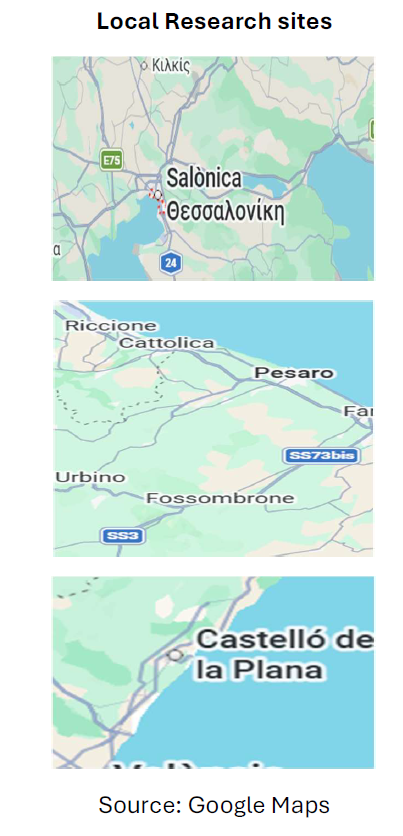
This article draws on interviews with educators, employment services officers, and young people conducted in three localities of Southern Europe in 2024. It contributes to the comparative literature on education, training, and youth transition regimes through an analysis of interactions between these actors in three local contexts. The fieldwork was conducted in Castelló (Spain), Pesaro- Urbino (Italy), and the rural areas and tourist resorts in the district of Thessaloniki (Greece). Across the three local contexts, educators and employment service officers expressed concerns about declining local economic opportunities and identified shortcomings in career guidance and training provision. At the same time, young people reported strong attachments to their localities while expressing pessimism about their prospects for developing long-term life plans in areas where opportunities are perceived to be more limited than in major urban centres. By comparing experiences across three Southern European contexts, the article highlights both common challenges and contextual differences in education and training policies targeting disadvantaged youth. The findings contribute to debates in comparative education on youth transitions, spatial inequalities, and the implementation of the European Pillar of Social Rights.
Downloads
References
Alexander, R. (2019). Social justice and geographical location in career guidance. In R. Hooley, T. Sultana, & R. Thomsen (Eds.), Career guidance for social justice: Contesting neoliberalism (pp. 77–92). Routledge. https://doi.org/10.4324/9781315110516-5
Anderson, L. W., Krathwohl, D. R., Airasian, P. W., Cruikshank, K. A., Mayer, R. E., Pintrich, P. R., Raths, J., & Wittrock, M. C. (2001). A taxonomy for learning, teaching, and assessing: A revision of Bloom's taxonomy of educational objectives. Longman.
Antonsich, M. (2010). Searching for belonging: An analytical framework. Geography Compass, 4(6), 644–659. https://doi.org/10.1111/j.1749-8198.2009.00317.x
Bæck, U.-D. K. (2019). Spatial manoeuvring in education: Educational experiences and local opportunity structures among rural youth in Norway. Nordic Journal of Comparative and International Education, 3(3), 61–74. https://doi.org/10.7577/njcie.3274
Biesta, G. (2006). What's the point of lifelong learning if lifelong learning has no point? On the democratic deficit of policies for lifelong learning. European Educational Research Journal, 5(3-4), 169–180. https://doi.org/10.2304/EERJ.2006.5.3.169
Benasso, S., Buillet, D., Neves, T., & Parreira do Amaral, M. (2022). Introduction: Exploring landscapes of lifelong learning policies across Europe. In S. Benasso, D. Buillet, T. Neves, & M. Parreira do Amaral (Eds.), Landscapes of lifelong learning policies across Europe (pp. 1–16). Palgrave Macmillan. https://doi.org/10.1007/978-3-030-96454-2_1
Bonvin, J.-M., Otto, H.-U., Wohlfarth, A., & Ziegler, H. (2018). Introduction.Ambivalences of the Rising Welfare Service State – Hopes and Hazard of Modern Welfare Architectures. Social Work & Society, 16(2). https://ejournals.bib.uni-wuppertal.de/sws/article/view/1203/2237
Cuervo, H., & Wyn, J. (2017). A longitudinal analysis of belonging: Temporal, performative and relational practices by young people in rural Australia. Young, 25(3), 219–234. https://doi.org/10.1177/1103308816669463
Cuzzocrea, V. (2018). ‘Rooted mobilities’ in young people's narratives of the future: A peripheral case. Current Sociology, 66(7), 1106–1123. https://doi.org/10.1177/0011392118776357
European Commission. (2017). European Pillar of Social Rights. European Parliament, Council of the European Union, European Commission. https://ec.europa.eu/commission/publications/european-pillar-social-rights-booklet_en
European Commission. (2020). Communication from the Commission to the European Parliament, the Council, the European Economic and Social Committee and the Committee of the Regions on achieving the European Education Area by 2025 (COM(2020) 625 final). European Union. https://eur-lex.europa.eu/legal-content/EN/TXT/?uri=CELEX:52020DC0625
European Commission. (2021). European skills agenda for sustainable competitiveness, social fairness and resilience. European Commission. https://employment-social-affairs.ec.europa.eu/policies-and-activities/skills-and-qualifications/european-skills-agenda_en
Eurostat. (2026a). Human resources in science and technology (HRST) by NUTS 2 region (tgs00038). European Commission. https://ec.europa.eu/eurostat/databrowser/view/tgs00038/default/table
Eurostat. (2026b). Persons aged 25–64 with tertiary educational attainment level by sex and NUTS 2 region (tgs00109). European Commission. https://ec.europa.eu/eurostat/databrowser/view/tgs00109/default/table
Eurostat. (2026c). Employment rate (persons aged 15–64) by NUTS 2 region (tgs00007). European Commission. https://ec.europa.eu/eurostat/databrowser/view/tgs00007/default/table
Farrugia, D. (2020). Class, place and mobility beyond the global city: Stigmatisation and the cosmopolitanisation of the local. Journal of Youth Studies, 23(2), 237–251. https://doi.org/10.1080/13676261.2019.1596236
Kelstrup, J. D. (2024). Understanding the role of practical knowledge in evidence-based welfare reform: A three-stage model. Humanities and Social Sciences Communications, 11, Article 1438. https://doi.org/10.1057/s41599-024-03937-y
Kettunen, M. (2023). Negotiating multiple spatialities: Geographies of youth educational subjectivity. Young, 31(3), 215–232. https://doi.org/10.1177/11033088231151354
Møller, A. M., Pedersen, K. Z., & Pors, A. S. (2022). The bureaucratic ethos in street-level work: Revitalizing Weber’s ethics of office. Perspectives on Public Management and Governance, 5(2), 151–163. https://doi.org/10.1093/ppmgov/gvac001
Roberts, K. (2022). Integrating young people into the workforce: England’s twenty-first century solutions. Societies, 12(2). https://doi.org/10.3390/soc12020038
Ryökkynen, S., Raudasoja, A., Heino, S., Maetoloa, K., & Pynnönen, P. (2022). Administration staff’s descriptions of inclusion in Finnish vocational education and training. Nordic Journal of Comparative and International Education, 6(3–4), 1–13. https://doi.org/10.7577/njcie.4818
Skeggs, B., & Loveday, V. (2012). Struggles for value: Value practices, injustice, judgment, affect and the idea of class. British Journal of Sociology, 63(3), 472–490. https://doi.org/10.1111/j.1468-4446.2012.01420.x
Sultana, R. G. (2012). Learning career management skills in Europe: A critical review. Journal of Education and Work, 25(2), 225–248. https://doi.org/10.1080/13639080.2010.547846
Tessarin, M. S., Boschma, R., Li, D., & Petralia, S. (2026). Regional development traps in Europe: A study of occupational trajectories of regions. Cambridge Journal of Regions, Economy and Society, 19(1), 49 –67. https://doi.org/10.1093/cjres/rsaf040
Valiente, O., Capsada-Munsech, Q., & de Otero, J. P. (2020). Educationalisation of youth unemployment through lifelong learning policies in Europe. European Educational Research Journal, 19(6), 525–543. https://doi.org/10.1177/1474904120908751
Walther, A. (2017). Support across life course regimes: A comparative model of social work as construction of social problems, needs, and rights. Journal of Social Work, 17(3), 277–301. https://doi.org/10.1177/1468017316640195
Published
How to Cite
Issue
Section
License
Copyright (c) 2026 Xavier Rambla, Federico Rossi, Konstantinos Pagkratis

This work is licensed under a Creative Commons Attribution 4.0 International License.
Declaration on copyright
- The author/s will keep their copyright and right of reproduction of their own manuscript, with the work simultaneously licensed under a Creative Commons Attribution License, but give the journal a permanent right to 1) present the manuscript to the public in the original form in which it was digitally published and 2) to be registered and cited as the first publication of the manuscript.
- The author itself must manage its financial reproduction rights in relation to any third-parties.
- The journal does not provide any financial or other remuneration for contributions submitted.
- Readers of the journal may print the manuscripts presented under the same conditions that apply to reproduction of a physical copy. This means that mass reproduction of physical copies or production of copies for commercial purposes is not permitted without the agreement of the author/s.


