Student Councils in the Nordic region
From policy promises to meaningful participatory practices
DOI:
https://doi.org/10.7577/njcie.6646Nøgleord:
Student councils, Meaningful participation, Nordic model, Citizenship, Youth voicesResumé
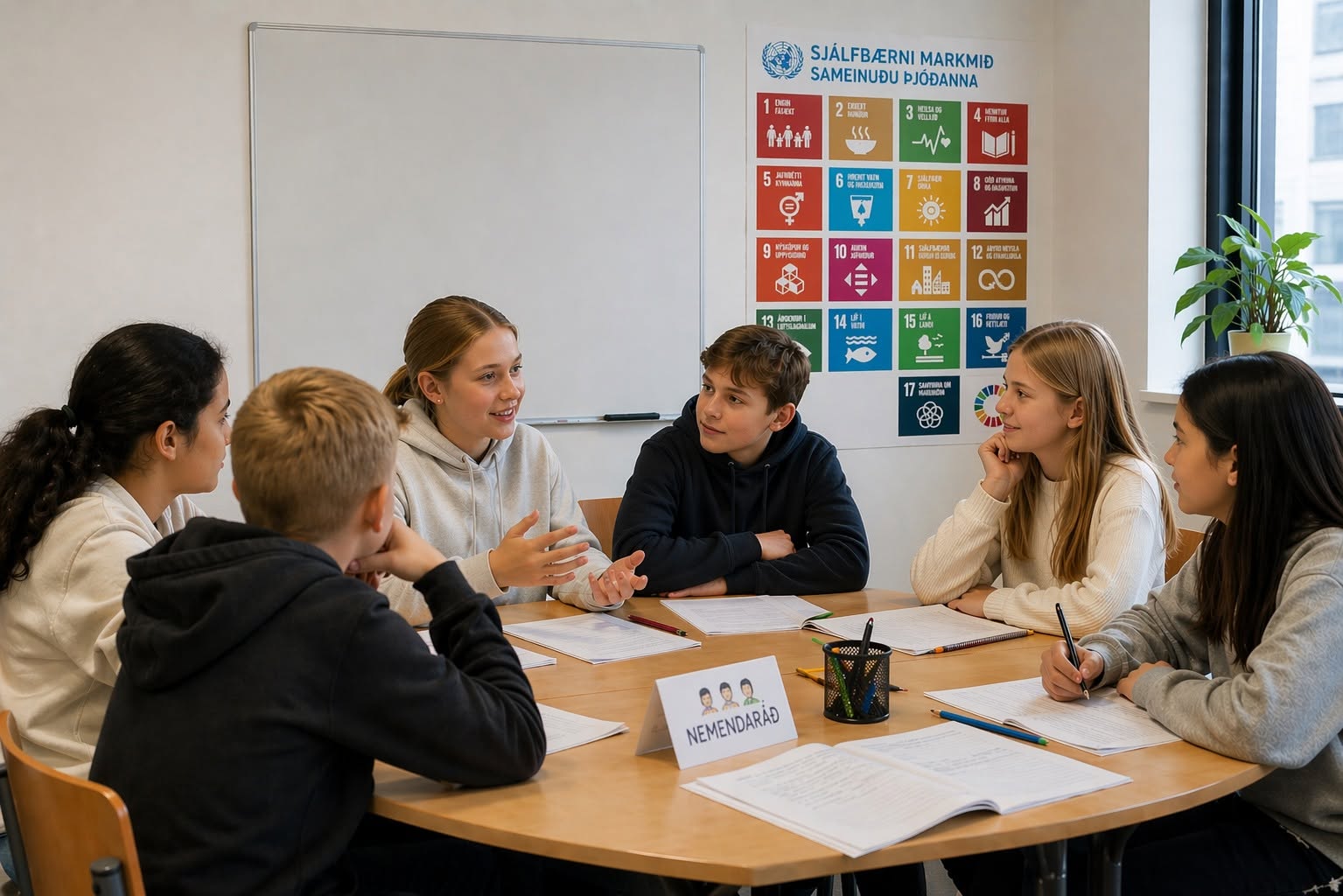
Elevråd promoveres bredt i Norden som den primære uddannelsesplatform for demokratisk uddannelse og børns ret til at blive hørt. Alligevel undersøger få sammenlignende studier, hvordan disse råd drives med hensyn til udvælgelsesprocesser, fokus og elevindflydelse. Med udgangspunkt i en mixed-methods-undersøgelse på tværs af fem nordiske lande blev data om elevråd analyseret gennem Lundys deltagelsesmodel sammen med teoretiske koncepter vedrørende visse modsætninger i demokratisk uddannelse. Resultaterne tyder på, at selvom de fleste systemer kræver elevråd i grundskolen og lægger vægt på demokratiske udvælgelsesprocesser, forbliver implementeringen ujævn. Deltagelsesmulighederne er ofte begrænset til ældre og mere socialt fordelagtige elever; udvælgelsesprocedurerne er ofte uigennemsigtige; og rådenes dagsordener har en tendens til at fokusere på sociale begivenheder og mindre skoleforbedringer med begrænset opfølgning på elevernes forslag. Undersøgelsen identificerede dog også lovende praksisser, herunder hybride adgangsmodeller, strukturerede feedback-loops og vigtige forbindelser til kommunale ungdomsråd, der tilbyder en vej til mere meningsfuld og inkluderende demokratisk deltagelse. Vi argumenterer for, at elevråd risikerer at forblive symbolske, medmindre skolerne integrerer inkluderende adgang, transparente processer, gensidig kommunikation og en bredere og globalt relevant dagsorden. Disse konklusioner er samlet i en designprincipmodel for at styrke meningsfuld deltagelse af børn og unge i nordiske skoler.
Downloads
Referencer
Aðalbjarnardóttir, S., & Harðardóttir, E. (2018). Students’ attitudes towards immigrants’ rights: The role of democratic classroom discussions. In H. Ragnarsdóttir & S. C. Lefever (Eds.), Icelandic studies on diversity and social justice in Education (pp. 130–155). Cambridge Scholars Publishing.
Aðalnámskrá grunnskóli. (2011/2013). Aðalnámskrá grunnskóla: Almennur hluti 2011: Greinasvið 2011/2013 [The Icelandic National Curriculum Guide for Compulsory Schools: General section and subject areas]. https://www.adalnamskra.is/grunnskoli
Alderson, P. (2000). School students' views on school councils and daily life at school. Children & Society, 14(2), 121–134. https://doi.org/10.1111/j.1099-0860.2000.tb00160.x
Alderson, P., & Morrow, V. (2011). The ethics of research with children and young people: A practical handbook. SAGE. https://doi.org/10.4135/9781446268377
Alerby, E., & Bergmark, U. (2019). Democratic values and student participation in Swedish education: Essentials for a sustainable and equal society. In M. C. Beaton, D. B. Hirshberg, G. R. Maxwell, & J. Spratt (Eds.), Including the North: A comparative study of the policies on inclusion and equity in the Circumpolar North (pp. 145–160). University of Lapland. https://urn.fi/URN:ISBN:978-952-337-136-1
Almgren, E. (2006). Att fostra demokrater: Om skolan i demokratin och demokratin i skolan [Fostering democratic citizens]. [Doctoral dissertation, Uppsala University]. Uppsala University Publications. http://uu.diva-portal.org/smash/record.jsf?pid=diva2:168399
Andersson, E. (2018). The school as a public space for democratic experiences: Formal student participation and its political characteristics. Education, Citizenship and Social Justice, 14(2), 149–164. https://doi.org/10.1177/1746197918776657
Biesta, G. (2020). Risking ourselves in education: Qualification, socialization, and subjectification revisited. Educational Theory, 70(1), 89–104. https://doi.org/10.1111/edth.12411
Biesta, G. (2022). World-centred education: A view for the present. Taylor & Francis. https://doi.org/10.4324/9781003098331
Biesta, G., & Lawy, R. (2006). From teaching citizenship to learning democracy: Overcoming individualism in research, policy and practice. Cambridge Journal of Education, 36(1), 63–79. https://doi.org/10.1080/03057640500490981
Biseth, H. (2009). Democracy and education in a multicultural Scandinavia: What mandate is designated to educators? Intercultural Education, 20(3), 243–254. https://doi.org/10.1080/14675980903138590
Braun, V., & Clarke, V. (2013). Successful qualitative research: A practical guide for beginners. SAGE.
Børne- og Undervisningsministeriet. (2014). Bekendtgørelse om elevråd i folkeskolen (BEK nr. 695/2014) [Executive order on student councils in compulsory education]. Retsinformation. https://www.retsinformation.dk/eli/lta/2014/695
Børne- og Undervisningsministeriet. (2024). Bekendtgørelse om formål, kompetencemål og opmærksomhedspunkter for folkeskolens fag og emner (Fælles Mål) (BEK nr. 1715/2024) [Common objectives for compulsory education]. Retsinformation. https://www.retsinformation.dk/eli/lta/2024/1715
Council of Europe. (2018). Reference framework of competences for democratic culture (Volume 1-3). Context, concepts and model. Council of Europe Publishing. https://www.coe.int/en/web/reference-framework-of-competences-for-democratic-culture/rfcdc - Volume1
Creswell, J. W., & Plano Clark, V. L. (2018). Designing and Conducting Mixed Methods Research (3rd ed.). SAGE.
Damiani, V., Losito, B., & Schulz, W. (Eds.). (2025). IEA International Civic and Citizenship Education Study 2022 European Report. Springer. https://doi.org/10.1007/978-3-031-68631-3
Dewey, J. (1916). Democracy and education: An introduction to the philosophy of education. Macmillan.
Edelstein, W. (2010). Lýðræði verður að læra [Democracy must be learned]. Netla – Online Journal on Pedagogy and Education.
Elkjær, M. A., & Iversen, T. (2020). The Political Representation of Economic Interests: Subversion of Democracy or Middle-Class Supremacy? World Politics, 72(2), 254-290. https://doi.org/10.1017/S0043887119000224
Elvstrand, H. (2009). Delaktighet i skolans vardagsarbete [Participation in everyday school work]. (Doctoral dissertation, Linköping University). Linköping University Electronic Press. https://www.diva-portal.org/smash/get/diva2:229768/FULLTEXT01.pdf?fbclid=IwAR3pnE37KKScH9Fy7xHr8LgOWi9fREaPkJZw9T-dmcVWe9RSi6UODatJUSw
Eriksson, L., & Bostedt, G. (2011). Elevinflytande i spänningsfältet mellan skolans kunskapsuppdrag och demokratiska uppdrag: En studie av fyra skolor [Student influence in the tension between the school’s knowledge mission and democratic mission: A study of four schools] (Utbildningsvetenskapliga studier 2011:1). Mittuniversitetet. https://miun.diva-portal.org/smash/get/diva2:442283/FULLTEXT01.pdf
Fattore, T., Mason, J., & Watson, E. (2016). Children’s understandings of well-being: Towards a child standpoint. Springer. https://doi.org/10.1007/978-94-024-0829-4
Finnsdóttir, A. J., Harðardóttir, E., & Auðardóttir, A. M. (2026). Útilokuð eða útvalin: Val og aðgengi að nemendaráðum í íslenskum grunnskólum [Excluded or selected: Selection processes and accessibility of student councils in Icelandic compulsory schools]. Netla, Online Journal on Education and Pedagogy. https://doi.org/10.24270/netla.2026/4
Freeman, M. (Ed.). (1996). Children’s rights: A comparative perspective. Dartmouth Publishing.
Gilljam, M., Esaiasson, P., & Lindholm, T. (2010). The voice of the pupils: An experimental comparison of decisions made by elected pupil councils, pupils in referenda, and teaching staff. Educational Assessment, Evaluation and Accountability, 22(1), 73–88. https://doi.org/10.1007/s11092-009-9084-0
Griebler, R., & Nowak, P. (2012). Student councils: A tool for health promoting schools? Characteristics and effects. Health Education, 112(2), 105–132. https://doi.org/10.1108/09654281211203402
Griffin, C. P. (2022). Can you hear my voice? Using Lundy’s model of participation to elicit student voice in student support plans. Irish Learning Support Association Newsletter, Autumn 2022, 7–10.
Guðjohnsen, R. Þ. (2025). Moral and citizenship education in Iceland: A historical and contemporary perspective. In K. Tirri (Ed.), Nordic perspectives on moral and citizenship education (pp. 97–114). Brill. https://doi.org/10.1163/9789004745902_006
Guðjohnsen, R. Þ., & Harðardóttir, E. (2025). Student councils and democratic participation in the Nordic region. Nordic Welfare Centre. https://doi.org/10.52746/VEXG8822
Guðjohnsen, R. Þ., Jordan, K. E., Jónsson, Ó. P., Aðalbjarnardóttir, S., & Garðarsdóttir, U. E. (2024). Good citizenship and sustainable living: Views, experiences, and opportunities among young people in Iceland. In N. Snow (Ed.), Routledge Handbook: Self, virtue and the public life project (pp. 59–78). Routledge. https://doi.org/10.4324/9781003367857-5
Guillemin, E. (2024). Biesta’s world-centred education: subjectification revisited? Journal of Philosophy of Education, 59(2), 274-289. https://doi.org/10.1093/jopedu/qhae057
Gunnulfsen, A. E., Ärlestig, H., & Storgaard, M. (2023). Making sense of Nordic school leadership: Four perspectives on similarities and variations. In A. E. Gunnulfsen, H. Ärlestig, & M. Storgaard (Eds.), Education and democracy in the Nordic countries: Making sense of school leadership, policy, and practice (pp. 173–182). Springer. https://doi.org/10.1007/978-3-031-33195-4_11
Harada, A. (2021). How to involve a diverse group of young people in local government decision making: A case study of Danish youth councils. Compare: A Journal of Comparative and International Education, 53(3), 436–452. https://doi.org/10.1080/03057925.2021.1976615
Jónsson, Ó. P., Guðmundsson, B., Øyehaug, A. B., Didham, R. J., Wolff, L. A., Bengtsson, S., Andreasen Lysgaard, J., Gunnarsdóttir, B. S., Árnadóttir, S. M., Rømoen, J., Sund, M., Cockerell, E., Plummer, P., & Brückner, M. (2021). Mapping education for sustainability in the Nordic countries. Nordic Council of Ministers. https://doi.org/10.6027/temanord2021-511
Jónsson, Ó. P., & Rodriguez, A. G. (2021). Educating democracy: Competences for a democratic culture. Education, Citizenship and Social Justice, 16(1), 62–77. https://doi.org/10.1177/1746197919886873
Kahne, J., Hodgin, E., & Eidman-Aadahl, E. (2016). Redesigning civic education for the digital age: Participatory politics and the pursuit of democratic engagement. Theory & Research in Social Education, 44(1), 1–35. https://doi.org/10.1080/00933104.2015.1132646
Kempner, I., & Janmaat, J. G. (2022). School councils across Europe: Democratic forums or exclusive clubs? Brill. https://doi.org/10.1163/9789004541375
Khan, F. (2006). Who participates in school councils and how? Prospects, 36(1), 97–119. https://doi.org/10.1007/s11125-006-7584-y
Lieberkind, J. (2020). Democracy and togetherness: Between students’ educational and political status—A study of primary and lower secondary education in Denmark. Multicultural Education Review, 12(1), 17–30. https://doi.org/10.1080/2005615X.2020.1720134
Lundy, L. (2007). ‘Voice’ is not enough: Conceptualising Article 12 of the United Nations Convention on the Rights of the Child. British Educational Research Journal, 33(6), 927–942. https://doi.org/10.1080/01411920701657033
Lundy, L. (2018). In defence of tokenism? Implementing children’s right to participate in collective decision-making. Childhood, 25(3), 340–354. https://doi.org/10.1177/0907568218777292
Lög um grunnskóla. (2008). Lög um grunnskóla, nr. 91/2008 [Compulsory School Act]. Alþingi/Government of Iceland. https://www.althingi.is/thingstorf/thingmalalistar-eftir-thingum/ferill/?ltg=135&mnr=285
Løgtingslóg um fólkaskúlan. (1997). Løgtingslóg no. 125 frá 20. juni 1997 um fólkaskúlan [Compulsory Education Act]. Lógasavnið, Government of the Faroe Islands. https://logir.fo/Logtingslog/125-fra-20-06-1997-um-folkaskulan-sum-seinast-broytt-vid-logtingslog-nr-34-fra-28
Mager, U., & Nowak, P. (2012). Effects of student participation in decision making at school: A systematic review and synthesis of empirical research. Educational Research Review, 7(1), 38–61. https://doi.org/10.1016/j.edurev.2011.11.001
Mentamálaráðið. (2025). Kunngerð no. 119 frá 2. juli 2025 um næmingaráð og landsráð fyri næmingaráð fólkaskúlans [Executive order on student councils in compulsory education]. Lógsavnið/Government of the Faroe Islands. https://logir.fo/Kunngerd/119-fra-02-07-2025-um-naemingarad-og-landsrad-fyri-naemingarad-folkaskulans
Männistö, P. (2020). The state of democracy education in Finnish primary school education [Doctoral dissertation, University of Jyväskylä]. JYX – University of Jyväskylä Digital Repository. https://jyx.jyu.fi/jyx/Record/jyx_123456789_72316
Nordic Council of Ministers. (2019). Vision 2030 for the Nordic region. Nordic Council of Ministers. https://www.norden.org/en/declaration/our-vision-2030
Opetushallitus. (2014). Perusopetuksen opetussuunnitelman perusteet 2014 [National core curriculum for compulsory education 2014]. Opetushallitus/Utbildningsstyrelsen. https://www.oph.fi/sites/default/files/documents/perusopetuksen_opetussuunnitelman_perusteet_2014.pdf
Patton, M. Q. (1999). Enhancing the quality and credibility of qualitative analysis. Health Services Research, 34(5 Pt 2), 1189–1208. https://pmc.ncbi.nlm.nih.gov/articles/PMC1089059/
Perusopetuslaki. (1998). Perusopetuslaki 628/1998 [Compulsory Education Act]. Suomen säädöskokoelma https://www.finlex.fi/fi/lainsaadanto/saadoskokoelma/1998/628?utm_source=chatgpt.com
Rönnlund, M. (2011). Demokrati och deltagande: Elevinflytande i grundskolans årskurs 7–9 ur ett könsperspektiv [Democracy and participation: Pupils’ influence in lower secondary schools from a gender perspective] [Doctoral dissertation, Umeå University]. Umeå University Electronic Publications. https://umu.diva-portal.org/smash/get/diva2:443227/FULLTEXT04.pdf
Rönnlund, M. (2014). Justice in and through education? Students’ participation in decision-making. Journal of Social Science Education, 13(2), 104–113. https://doi.org/10.4119/jsse-695
Sant, E. (2019). Democratic education: A theoretical review (2006–2017). Review of Educational Research, 89(5), 655–696. https://doi.org/10.3102/0034654319862493
Scarparolo, G., & MacKinnon, S. (2024). Student voice as part of differentiated instruction: Students’ perspectives. Educational Review, 76(4), 774–791. https://doi.org/10.1080/00131911.2022.2047617
Schulz, W., Ainley, J., Fraillon, J., Losito, B., Agrusti, G., Damiani, V., & Friedman, T. (2023). Education for citizenship in times of global challenge: IEA International Civic and Citizenship Education Study 2022 international report. International Association for the Evaluation of Educational Achievement (IEA). https://www.iea.nl/sites/default/files/2023-11/ICCS2022-International-Report.pdf
Sinclair, R. (2004). Participation in practice: Making it meaningful, effective, and sustainable. Children & Society, 18(2), 106–118. https://doi.org/10.1002/chi.817
Skollagen. (2010). Skollag (2010:800) [Education Act, Sweden]. Sveriges Riksdag. https://www.riksdagen.se/sv/dokument-och-lagar/dokument/svensk-forfattningssamling/skollag-2010800_sfs-2010-800
Skolverket. (2022). Läroplan för grundskolan samt för förskoleklassen och fritidshemmet (Lgr22) [The Swedish National Curriculum for Compulsory Schools]. Skolverket. https://www.skolverket.se/undervisning/grundskolan/laroplan-lgr22-for-grundskolan-samt-for-forskoleklassen-och-fritidshemmet/curriculums/LGR22?schoolType=GR&tosHeading=Kursplaner&hasSubjects=tru
Sousa, I., & Ferreira, E. (2024). Students’ participation in democratic school management: A systematic literature review. Journal of Social Science Education, 23(1), 1–20. https://doi.org/10.11576/jsse-6333
Stoddard, J. (2014). The need for media education in democratic education. Democracy & Education, 22(1). https://democracyeducationjournal.org/home/vol22/iss1/4/
Thomson, I. (2025). Redogörelse för Nordiska ministerrådets arbete med barn och unga 2024–2025 (PolitikNord 2025:726). Nordic Council of Ministers. https://doi.org/10.6027/politiknord2025-726
Tiusanen, M. (2025). Oppilaskuntatoiminnan tavoitteista toteutukseen: Oppilaiden näkemyksiä vaikuttamisesta [Doctoral dissertation, University of Turku]. Turun yliopiston julkaisuja – Annales Universitatis Turkuensis, Series B (Vol. 709). https://urn.fi/URN:ISBN:978-952-02-0031-2
Torney-Purta, J., & Barber, C. (2005). Democratic school engagement and civic participation among European adolescents: Analysis of data from the IEA Civic Education Study. Journal of Social Science Education, 4(3). https://doi.org/10.4119/jsse-324
Tujula, M. (2023). Aktiiviseksi koulussa ja yhteiskunnassa: Kouludemokratian toteuttaminen peruskoulussa [Doctoral dissertation, University of Helsinki]. Helsinki Studies in Education (No. 165). http://hdl.handle.net/10138/357034
Tujula, M., Rautopuro, J., Löfström, J., & Niilo-Rämä, M. (2021). Koulun yhteisöllinen ilmapiiri ja oppilaiden yhteiskunnallisen vaikuttamisen orientaatio: yhteyksiä etsimässä. Nuorisotutkimus, 39(3), 36-57. https://journal.fi/nuorisotutkimus/issue/view/8458
United Nations. (1989). Convention on the Rights of the Child. https://www.ohchr.org/en/instruments-mechanisms/instruments/convention-rights-child
Verba, S., Schlozman, K. L., & Brady, H. E. (1995). Voice and equality: Civic voluntarism in American politics. Harvard University Press. https://doi.org/10.2307/j.ctv1pnc1k7
Downloads
Publiceret
Citation/Eksport
Nummer
Sektion
Licens
Copyright (c) 2026 Eva Harðardóttir, Ragný Þóra Guðjohnsen, Pernelle Rose Hansen, Najat Ouakrim-Soivio, Marleena Mustola, Mikko Hiljanen, Josephine Lau, Frida Birita Poulsen , Johanna Jormfeldt

Dette værk er under følgende licens Creative Commons Navngivelse (by).
Declaration on copyright
- The author/s will keep their copyright and right of reproduction of their own manuscript, with the work simultaneously licensed under a Creative Commons Attribution License, but give the journal a permanent right to 1) present the manuscript to the public in the original form in which it was digitally published and 2) to be registered and cited as the first publication of the manuscript.
- The author itself must manage its financial reproduction rights in relation to any third-parties.
- The journal does not provide any financial or other remuneration for contributions submitted.
- Readers of the journal may print the manuscripts presented under the same conditions that apply to reproduction of a physical copy. This means that mass reproduction of physical copies or production of copies for commercial purposes is not permitted without the agreement of the author/s.


